
Why Joplin Food and Beverage Factories Are Re-evaluating Primary Clarification in 2026
For Joplin food and beverage factories evaluating primary clarification in 2026, the short answer is straightforward: choose dissolved air flotation (DAF) when fats, oils, and grease (FOG) dominate the stream, because DAF removes up to 95% of oils versus roughly 70% for a gravity clarifier on the same influent. Choose a gravity clarifier — preferably a high-rate lamella unit — when the stream is heavy on settleable solids and the CAPEX budget is tight. Joplin plants that run a true mixed load (FOG plus suspended solids plus grit) increasingly deploy a hybrid train: a DAF system as the primary oil and colloidal solids removal step, followed by a lamella clarifier as a polish step before the receiving POTW or Missouri DNR discharge point.
Joplin's food and beverage manufacturing base is broader than most national selection guides acknowledge. The four-corner region around Joplin, Carthage, and Webb City carries a meaningful mix of meat and poultry processors, dairy and ice cream operations, pet food kibble lines, snack and bakery plants, and a growing craft brewing segment that doubled taproom counts between 2022 and 2025 (per Missouri Department of Agriculture 2025 ag census summaries). Each sub-segment produces a characteristic wastewater profile: meat and poultry streams run high FOG and emulsified blood; dairy streams run high BOD with milk fat and cleaning chemistry residues; pet food lines carry both rendered fats and starch carry-over; snack and bakery lines concentrate free oils and shortenings; breweries and bottling lines carry spent grain, trub, and diatomaceous earth but comparatively little free oil.
What changed in 2026 is the receiving-side pressure. The Joplin Water Treatment Plant (JWTP) is operating closer to its NPDES permit envelope after the 2023 headworks upgrade, and industrial pretreatment surcharges in the City of Joplin sewer-use ordinance were recalibrated in 2025 to penalize high-FOG and high-TSS discharges more aggressively. Combined with Missouri Department of Natural Resources (DNR) enforcement of 40 CFR 133 categorical standards on significant industrial users, the practical effect is that the pretreatment system inside the factory — not the JWTP — is now the compliance bottleneck. That shifts the buyer's decision from "what is cheapest to install" toward "what removes the most FOG and TSS per square foot of repurposed production floor."
How DAF and Clarifiers Actually Treat Food and Beverage Wastewater
DAF treats wastewater by floating contaminants, not by settling them. A saturated recycle stream — typically 20-40% of clarified effluent pressurized with air in an external saturator vessel — releases 30-50 micron microbubbles at the inlet of a shallow flotation cell (per Clearwater/SigmaDAF technical literature, 2026). Those microbubbles attach to FOG droplets, colloidal solids, and flocculated particles, lowering their effective density and lifting them to the surface in 3-5 minutes, where a paddle or scoop skimmer removes the float layer. Heavier settleable solids drop to a bottom cone and are augered out separately. The DAF Corp FC Maximizer round-tank design, for example, processes 10 to 11,000 GPM in tanks 6-70 ft in diameter and is rated for 92-98% TSS removal at 2,000 ppm feed loading (per DAF Corp engineering data, 2026).
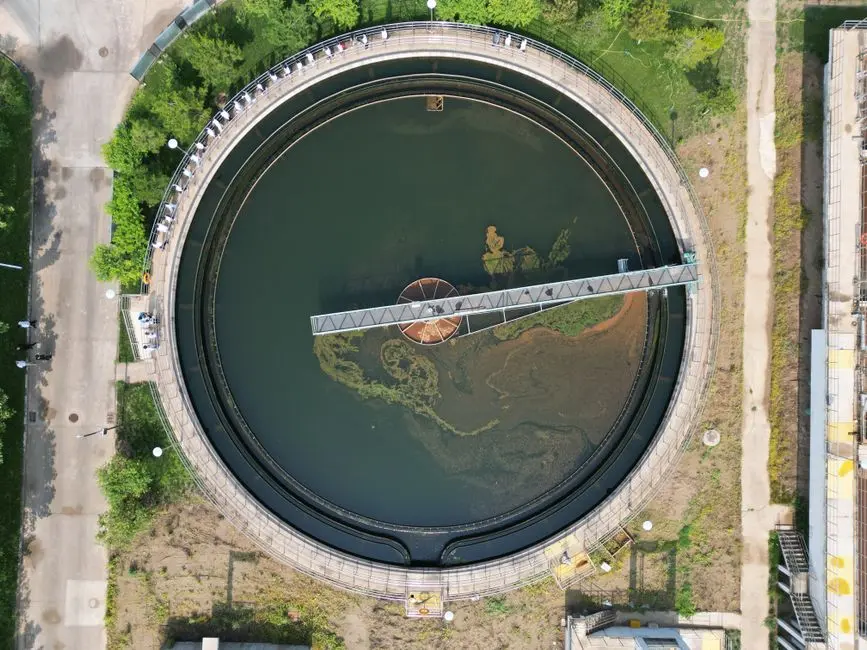
A gravity clarifier does the opposite: it gives the wastewater 2-4 hours of quiescent residence in a deeper tank so that settleable solids drop by gravity to a sludge cone or hopper, while clarified water overflows a peripheral weir. Surface loading on a conventional clarifier is low — typically 1-2 m/h — because the separation physics depends on Stokes-law settling velocities. A lamella (inclined-plate) clarifier compresses that residence footprint by stacking parallel plates at 55-60° inside a compact shell, pushing effective surface loading to 20-40 m/h (HydropureWater engineering data, 2026) and reducing chemical demand by roughly 30% compared to a conventional clarifier at equivalent settling duty.
The mechanical differences drive the operating differences. A DAF cell needs an air compressor or blower, a recycle pump, a saturator vessel, and a chemical conditioning train ahead of the cell — typically a coagulant (alum, PAC, or ferric chloride) followed by a flocculant polymer. A gravity clarifier needs a sludge rake mechanism and, in the lamella variant, no moving skimmer at all. The DAF footprint is roughly one-third that of a comparably rated conventional clarifier, which is the deciding factor in a retrofitted Joplin plant where floor space has to be carved out of an active production hall. The clarifier wins on operator simplicity and on tolerating grit, sand, and high-density particles that would otherwise accumulate in a DAF cell's bottom cone.
DAF vs Clarifier: Head-to-Head Comparison for 2026 Factory Sizing
The 2026 head-to-head data, drawn from the Ecologix DAF-vs-clarifier selection guide, DAF Corp field ratings, and SigmaDAF/Clearwater product literature, lines up as follows. Use the table to brief procurement and operations in the same conversation.
| Parameter | Dissolved Air Flotation (DAF) | Gravity / Lamella Clarifier |
|---|---|---|
| FOG removal efficiency | Up to 95% on food processing streams (Ecologix 2026) | ~70% on the same stream; poor on emulsified oils |
| TSS removal efficiency | 92-98% on 2,000 ppm feed (DAF Corp FC Maximizer rating) | ~90% on heavy settleable solids; 50-70% on colloidal TSS |
| Surface loading rate | 10-20 m/h (high-rate designs) | 1-2 m/h conventional; 20-40 m/h lamella |
| Footprint at 50 m³/h | ~3-5 m² cell area, plus chemical skid | ~25-50 m² conventional; ~5-7 m² lamella |
| CAPEX drivers | Saturator, recycle pump, chemical dosing skid, 304/316SS tank | Tank, rake mechanism, lamella pack; no compressor |
| OPEX drivers | Compressor kWh, polymer, skim disposal | Rake kWh, sludge pumping; minimal chemistry |
| Microbubble size | 20-40 µm (DAF Corp Micro Bubbler); 30-50 µm (SigmaDAF) | N/A |
| Operator skill | Moderate; needs jar testing and polymer tuning | Low; simple rake and sludge cycle |
| Start-up time | 1-2 hours to saturator steady state | Hours to fill; no warm-up |
| Best-fit stream | FOG-dominant, emulsified oils, colloidal TSS, food/bev/dairy | Grit, sand, grain sediment, low-FOG wash water, mining |
| Hybrid role | Primary FOG and colloidal removal | Polish step or grit removal pre-stage |
The microbubble-size line is the 2026 differentiator. DAF Corp's Micro Bubbler generator holds a consistent 20-40 µm bubble size, 24/7, 365 days a year, with no coarse air carryover (per DAF Corp product specifications, 2026). Finer bubbles increase the bubble-to-particle collision frequency, which improves FOG capture and lets the plant run lower polymer doses. For a Joplin food plant that has historically battled polymer cost on a legacy DAF, that is a CAPEX-justified retrofit in 2026.
Which Joplin Food and Beverage Sub-Segments Should Choose DAF
The sub-segment map below translates the table into a procurement recommendation. The decision rule is simple: if FOG or emulsified oil is in the top three constituents of your composite sampler data, DAF is the 2026 default. Joplin meat, poultry, dairy, pet food, and snack/bakery plants all sit in that camp, though for slightly different reasons.
| Joplin sub-segment | Dominant wastewater constituents | 2026 primary choice | Typical DAF performance |
|---|---|---|---|
| Meat & poultry processing | FOG, blood, emulsified solids, paunch manure | DAF (round FC-style or rectangular RC-style) | 90-95% FOG, 92-98% TSS |
| Dairy & ice cream | Milk fat, BOD, CIP cleaning residues | DAF with warm-water recycle | 85-95% FOG, 85-92% TSS |
| Pet food (rendered + kibble) | Rendered fats, starch, protein carry-over | DAF + chemical conditioning | 90-95% FOG, 90-95% TSS |
| Snack, bakery, frying | Free oils, shortenings, batter solids | DAF with heated saturator | 90-95% FOG, 85-92% TSS |
| Craft brewing (>50 m³/day) | Spent grain, trub, DE, low FOG | Lamella clarifier (DAF only if oily CIP) | DAF marginal; lamella >90% TSS |
| Bottling / beverage wash | Low FOG, modest TSS, sugar carry-over | Lamella clarifier or DAF if oily | Either; lamella is cheaper |
For a Joplin meat processor or dairy running 4-300 m³/h, the DAF system covers the typical Joplin plant envelope, with chemical conditioning delivered through a paired automatic chemical dosing skid. The dosing skid is not optional: DAF performance collapses without consistent coagulant/polymer feed, and a 2026 retrofit that treats the chemical skid as an afterthought typically leaves 15-25% of the rated FOG removal on the table (HydropureWater field data, 2026). For a deeper engineering dive on system selection, the 2026 industrial DAF system selection guide walks through the specs and zero-risk selection logic in detail.
When a Gravity Clarifier Is Still the Right Primary for Joplin Plants
A clarifier is not a fallback — in three Joplin sub-segments it is still the 2026 right answer, and pushing a DAF into those applications is what gets pretreatment projects blown up on budget and operating cost. The first is beverage and brewing: spent grain, trub, and diatomaceous earth are dense, settle fast, and carry little free oil. A lamella clarifier removes these in a fraction of the DAF footprint-equivalent cost, with no compressor, no saturator, and no polymer demand. DAF would only be justified if the brewery also runs an oily CIP loop or a frying line on the same discharge.
The second is dry-blend snack and grain-handling operations where the wastewater is mostly wash water with low FOG and modest TSS. A high-efficiency lamella clarifier at 20-40 m/h surface loading hits pretreatment TSS limits with 30% lower chemical demand than a conventional clarifier and tolerates the periodic grit load that a DAF cell would just accumulate. The third is small craft breweries under roughly 50 m³/day, where a packaged lamella skid hits discharge limits at a CAPEX that a small brewery can finance inside a single fiscal year.
For Joplin plants that sit on the boundary — for example, a brewing operation that also runs a fried-snack line — the honest engineering answer is to split the streams. Route the oily fryer wastewater to a small DAF, route the grain-bearing brew house wastewater to a lamella clarifier, and combine the polished effluents before the final pH equalization step. That hybrid split is cheaper than a single oversized DAF and more robust than forcing a clarifier to do a job it was not designed for. For a regional cross-check on similar mid-size food plants, the companion Joplin-region DAF vs clarifier buyer's guide covers comparable hybrid logic in a different municipal discharge envelope.
2026 Cost, Footprint, and Payback Framework for Joplin Buyers
The 2026 CAPEX conversation for a Joplin food plant starts with two bracketed figures and four swing variables. The bracketed figures, drawn from recent industrial wastewater equipment quotes and HydropureWater 2026 list pricing, are: a packaged DAF skid at roughly USD 18,000-45,000 per m³/h of design flow for compact units (up to ~30 m³/h), and a custom DAF cell at roughly USD 12,000-30,000 per m³/h for mid-scale plants (30-150 m³/h) once the saturator and recycle system are integrated. A lamella clarifier package sits at roughly USD 4,000-10,000 per m³/h, with a conventional circular clarifier at USD 3,000-7,000 per m³/h. The four swing variables that move a project from the bottom to the top of the range are:
| CAPEX swing variable | Effect on DAF price | Effect on clarifier price |
|---|---|---|
| Material of construction (304SS vs 316SS) | +15-25% for 316SS or polypropylene | +10-20% for 316SS lamella packs |
| Integrated chemical conditioning skid | +USD 8,000-25,000 per stream | Not required for most lamella installs |
| Automation level (PLC + VFD vs relay logic) | +USD 5,000-20,000 | +USD 2,000-8,000 |
| Indoor vs outdoor / covered installation | +10-15% for heated/insulated saturator | Minor; covers for odor control only |
OPEX is where the FOG-driven decision actually swings. DAF energy is dominated by the saturator compressor and recycle pump — typically 0.3-0.6 kWh per m³ treated. Clarifier energy is the sludge rake mechanism only, at 0.05-0.15 kWh per m³. DAF chemical OPEX runs USD 0.02-0.08 per liter of wastewater treated at typical polymer doses; clarifier chemistry is negligible on a grit and grain stream. The payback case for DAF on a FOG-dominated stream is straightforward: a Joplin meat processor avoiding a USD 0.12-0.30 per kg sewer surcharge on FOG, plus avoided haul-off of skimmed grease, plus avoided POTW violation fines (City of Joplin 2025 surcharges), can pay back the DAF CAPEX delta over a clarifier in 18-36 months. The payback case for a clarifier on a low-FOG, sediment-heavy stream is shorter — typically 8-18 months — because the first-cost delta is the whole story.
Footprint is the under-appreciated line item in a Joplin retrofit. A DAF at 10-20 m/h surface loading occupies roughly one-third the floor area of a comparably rated conventional clarifier at 1-2 m/h. A lamella clarifier narrows that gap to roughly 1.5-2x the DAF footprint, while still costing less. In a Joplin plant where production floor is being repurposed from a discontinued line, that floor-area delta frequently decides the project before the CAPEX spreadsheet does.
Decision Tree: DAF, Clarifier, or Hybrid for Your Joplin Plant in 2026
Run these four steps on your most recent 7-day composite sampler data, plus a 30-minute jar test. The output is a defensible equipment recommendation you can take to procurement without re-reading the article.
| Step | Action | Decision rule | Result |
|---|---|---|---|
| 1. Classify the stream | Pull the last 7 days of composite FOG, TSS, and BOD data | FOG > 200 mg/L or oil sheen visible → FOG-dominant; TSS > 1,500 mg/L with low FOG → TSS-dominant; both elevated → mixed | One of three labels: FOG, TSS, or mixed |
| 2. Match to system | Apply the label to the technology matrix | FOG-dominant → DAF; TSS-dominant → clarifier or lamella; mixed → DAF primary + clarifier polish | Preliminary system choice |
| 3. Check flow and footprint | Confirm design flow m³/h and available floor area m² | <20 m³/h → packaged skid DAF or lamella; 20-100 m³/h → custom DAF cell or single lamella; >100 m³/h → parallel trains or large circular DAF | Equipment class |
| 4. Confirm compliance envelope | Cross-check projected effluent against JWTP pretreatment limits and Missouri DNR surface discharge rules | If projected FOG < 100 mg/L and TSS < 250 mg/L → packaged skid; otherwise → engineered custom system with jar-test validation | Final spec: packaged or custom |
For a Joplin meat or dairy plant, step 1 will almost always return "FOG-dominant" and step 2 will lock in DAF. For a craft brewery, step 1 returns "TSS-dominant" and step 2 locks in a lamella clarifier. For a pet food plant running both rendering and kibble extrusion, step 1 returns "mixed" and the hybrid train is the right call: a DAF system as the primary FOG and colloidal removal, followed by a high-efficiency lamella clarifier as the polish step. The hybrid train is the under-specified answer in most 2026 selection guides, but it is the configuration that actually hits the new JWTP surcharge schedule on a real Joplin mixed stream.
Frequently Asked Questions
What FOG removal efficiency should a Joplin food plant expect from a DAF in 2026?
A properly sized and chemically conditioned DAF system achieves 90-95% FOG removal on a typical Joplin meat, poultry, or dairy stream, versus roughly 70% for a comparably sized gravity clarifier on the same influent (per the 2026 Ecologix DAF-vs-clarifier selection guide). The remaining 5-10% is typically polished in a downstream DAF or biological step, not in the primary clarifier.
Is a hybrid DAF + clarifier train ever justified for a Joplin food plant?
Yes, on a mixed FOG-plus-TSS stream — most commonly a pet food plant running rendering and kibble extrusion on the same discharge. The DAF primary removes 90-95% of FOG and colloidal solids; the downstream lamella clarifier polishes residual settleable solids and grit before the JWTP discharge point, with the combination typically cutting polymer consumption by 20-30% versus a single oversized DAF (HydropureWater field data, 2026).
How much does a packaged DAF system cost for a small Joplin food plant in 2026?
A packaged DAF skid for a compact Joplin food plant in the 5-30 m³/h range sits at roughly USD 18,000-45,000 per m³/h of design flow, with the four swing variables being material of construction (304SS vs 316SS), integrated chemical conditioning, automation level, and indoor vs outdoor installation. A lamella clarifier package in the same flow range is roughly USD 4,000-10,000 per m³/h (HydropureWater 2026 list pricing).
Can a DAF or clarifier be retrofit into an existing Joplin plant without major structural work?
Yes, if the existing building has 4-5 m of clear height and a floor area of roughly 5-7 m² per m³/h of design flow, a packaged DAF skid typically drops into place on a prepared concrete pad with the saturator, recycle pump, and chemical skid on a single frame. Rectangular DAF cells are also retrofit-friendly for narrow sites or existing concrete basins (per ClearStream DAF engineering data, 2026). Lamella clarifiers retrofit even more easily because there is no saturator or compressor.
What are the key 2026 compliance drivers for Joplin food and beverage pretreatment?
The two dominant drivers are the City of Joplin 2025 sewer-use ordinance surcharges on FOG and TSS, and Missouri DNR enforcement of EPA 40 CFR 133 categorical pretreatment standards on significant industrial users. Combined with capacity strain at the JWTP after the 2023 headworks upgrade, these push the compliance bottleneck upstream into the factory pretreatment system, which is why a 2026 primary clarifier selection is no longer a "cheapest tank" decision.