Why the 2026 Auckland Envelope Is Different from a Taipei or Phoenix Design
In October 2024 the Cheyenne Board of Public Utilities revoked a Meta-backed data centre's wastewater permit, fined its developer USD 10,000, and banned fill-and-flush discharge to the public sewer after Cupriavidus gilardii — a copper-loving bacterium — survived treatment and was traced to commissioning water from a closed-loop system (E&E News, 2024). Loudoun Water, the utility that handles more than 200 data centres in northern Virginia, now independently verifies every fill-and-flush sample before it accepts discharge, because there is no federal permit category that cleanly covers construction-phase water from closed loops (E&E News, 2024). A 2026 Auckland designer who copies a Taipei or Phoenix water model is engineering for a regulatory world that does not exist in Aotearoa.
The Auckland Council Network Discharge and Trade Waste Bylaw 2024 requires pre-discharge characterisation of any trade waste entering the Watercare sewer catchment, and the bylaw covers commissioning and fill-and-flush streams — not just steady-state blowdown. The receiving plant, Mangere Island Road WWTP, serves a population equivalent of about 997,242 (UtilityRadar) and discharges near the coast under the NPS-FM 2020, which is now a mandatory consideration in any new consent. On the supply side, Warkworth source augmentation is constrained, and any hyperscale intake above ordinary municipal scale triggers multi-agency review under the NZ Coastal Policy Statement 2010 and the NPS-FM 2020. The procurement pattern has already shifted locally: containerised, skid-mounted, remotely monitored trains are now standard ANZ delivery (Hydroflux Epco NZ), so a 2026 stick-built ETP is a 12-month delay no hyperscale buyer will accept. The hyperscale investor layer compounds the risk: TNFD-aligned disclosure is now asked for in RFPs even where local rules are silent, and "we discharged to drain" is no longer an answer a finance committee will sign.
Two Streams, Two Trains: Fab UPW Blowdown vs Data-Hall Cooling Blowdown
Fab UPW blowdown and data-hall cooling blowdown do not share a process train because the contaminant fingerprints are not even close. A semiconductor fab draws about 14 billion litres of UPW per year and needs 1.4–1.6 L of municipal intake per litre of UPW upstream (TNFD, 2025); a single hyperscale hall in Tāmaki or Māngere can rival the municipal demand of a small NZ town at 25 million–2 billion litres per year. The decision rule is simple: if the load is organic plus fluorinated plus metallised, route to the fab train; if the load is inorganic plus silica plus oxidant, route to the cooling-blowdown train. There is no shared biological stage, and any attempt to commingle them will fail the Auckland Council trade-waste characterisation step before it fails a chemistry test.
| Parameter | Fab UPW blowdown (raw) | Data-hall cooling blowdown (raw) |
|---|---|---|
| COD | 200–1,500 mg/L | Not a control parameter; <50 mg/L expected |
| Fluoride (F⁻) | 50–800 mg/L | Negligible |
| Copper (Cu) | 0.5–10 mg/L | <0.1 mg/L from corrosion inhibitor carryover |
| Ammonia-N | 20–200 mg/L | Negligible |
| TMAH | 5–50 mg/L | Not present |
| TSS | 50–300 mg/L | 20–80 mg/L from basin dust and corrosion product |
| TDS | 200–1,000 mg/L | 500–2,500 mg/L |
| Silica (SiO₂) | Not a control parameter; <20 mg/L target on RO feed | 10–80 mg/L; cooling-tower feed target <50 mg/L |
| Conductivity | 500–2,000 µS/cm | 1,000–4,000 µS/cm |
| Residual oxidiser | None typically | 0.1–1.0 mg/L as ClO₂ or Cl₂ |
| Hardness (CaCO₃) | Not a control parameter | 200–800 mg/L |
| pH | 7–11 (etch baths push alkaline) | 7.5–9.0 |
| Temperature | 25–40 °C | 12–25 °C ambient cooling-tower return |
Source: HydropureWater commissioning logs, 2024–2025. Volume ranges per TNFD case study, 2025.
2026 Process Train for Auckland Fab UPW Blowdown
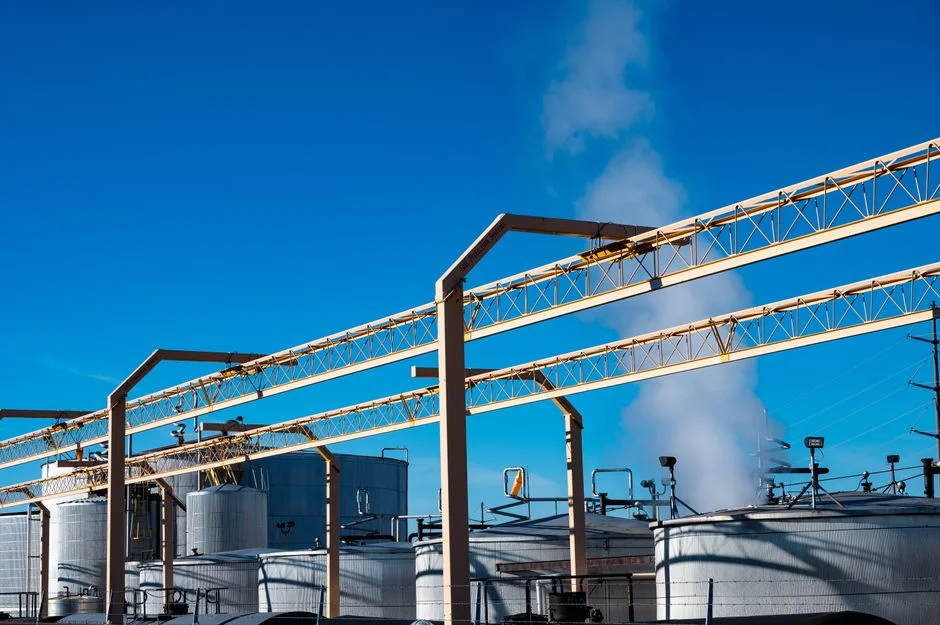
The defensible 2026 Auckland fab train runs in six modules — equalisation, DAF pre-treatment unit, MBR with 0.1 µm PVDF submerged modules, industrial two-pass RO unit, selective ion exchange, and ZLD polish on a falling-film evaporator plus crystalliser when concentrate volume or chromium/TMAH removal demands it. Carbon-steel equalisation has failed inside 18 months in 2024–2025 field service; FRP or SS316L tanks are mandatory for fluoride resistance, and pH is held at 9–10 to drive F⁻ and Cu co-precipitation as their hydroxides. The DAF strips 70–90% of TSS, colloidal metals, and free oil before the biology stage at 15–25 m³/h per 100 m³/d of design flow. MBR drops COD from 1,000–2,000 mg/L to under 100 mg/L at 0.5–0.8 m³/m²·h, with a 2–5 mg/L ClO₂ backwash — generated on-site by an on-site ClO₂ generator — for biofouling control, a routine drawn from HydropureWater commissioning logs at fab-support facilities during 2024–2025.
| Module | Function | 2026 design target / sizing |
|---|---|---|
| Equalisation | Flow and pH dampening; F⁻/Cu co-precipitation | 8–12 h retention, pH 9–10, FRP or SS316L |
| DAF | TSS, colloidal metals, oil removal | 70–90% TSS cut; <20 mg/L effluent TSS; 15–25 m³/h per 100 m³/d |
| MBR (0.1 µm PVDF) | COD and ammonia reduction; solids barrier | COD <100 mg/L; turbidity <1 NTU; flux 0.5–0.8 m³/m²·h |
| Two-pass RO | TDS and silica strip; permeate reuse | 1st pass 70–75% recovery; 2nd pass 85–90%; permeate TDS <50 mg/L |
| Selective IX | Fluoride and copper polish | Activated alumina: F⁻ <1 mg/L; chelating resin: Cu <0.1 mg/L |
| ZLD polish (evap + crystalliser) | Concentrate volume reduction; Cr/TMAH >95% | Triggered above 30 m³/d concentrate or strict Cr/TMAH envelope |
Activated alumina columns take fluoride from 5–20 mg/L residual to under 1 mg/L; chelating resin drops copper below 0.1 mg/L. TMAH is controlled through MBR COD reduction plus concentrate ZLD when the 95% removal threshold applies. ZLD is added only when concentrate exceeds 30 m³/d or when total chromium and TMAH must clear 95% — for a 200 m³/d Auckland fab that adder runs NZD 8–13 million on the cost methodology in the CAPEX section below.
2026 Process Train for Auckland Data-Hall Cooling Blowdown
Data-hall cooling blowdown does not need biological treatment; the load is inorganic and oxidant-bearing, not organic. The 2026 Auckland train is therefore tighter, lower-CAPEX, and built around closed-loop cooling-tower make-up reuse. A multi-media filter ahead of the RO removes suspended solids and protects the high-pressure pump from particulate fouling, and a 5–10 µm cartridge polisher guards against breakthrough. Softening follows — either a weak-acid cation exchanger or a lime-soda unit — to drop hardness below 50 mg/L as CaCO₃ and silica below 20 mg/L as SiO₂ before the RO feed. In Auckland's ambient 12–25 °C cooling-tower return, silica is the limiting species on cycle concentration; if it is not softened out, silica scales the chiller condenser at 5–8 cycles. A PLC-controlled antiscalant and pH dosing skid dispenses 2–5 mg/L of a phosphonate blend so the RO can run at 70–75% recovery, with permeate (TDS <50 mg/L) blended back into cooling-tower make-up.
| Module | Function | 2026 design target / sizing |
|---|---|---|
| Multi-media filter + 5–10 µm cartridge | Particulate removal; RO high-pressure pump protection | <5 µm effluent; differential pressure <0.5 bar across cartridge |
| Softener (WAC or lime-soda) | Hardness and silica reduction | Hardness <50 mg/L as CaCO₃; silica <20 mg/L as SiO₂ |
| Antiscalant / pH dosing | Scale inhibition on RO membranes | 2–5 mg/L phosphonate blend; pH 7.0–7.5 on RO feed |
| Single-pass RO | TDS strip; permeate to cooling-tower make-up | 70–75% recovery; permeate TDS <50 mg/L |
| Concentrate recycle | Cooling-tower blowdown replacement | 25–30% of feed; 70–85% total reuse |
| Auto-blowdown | Conductivity-triggered basin discharge | Trip at 4,000 µS/cm on RO reject line |
Concentrate — 25–30% of feed — is recycled to the cooling-tower basin as blowdown replacement, giving 70–85% reuse of total blowdown volume. A DAF unit is sometimes added upstream when the cooling water carries corrosion-inhibitor or microbiological floc from an open basin. Auto-blowdown is triggered by a conductivity probe on the RO reject line at 4,000 µS/cm. Final discharge targets for any residual bleed are TDS <2,100 mg/L, residual chlorine ≤1 mg/L, and pH 6–9 — consistent with the Auckland Council trade-waste envelope.
Auckland 2026 CAPEX/OPEX Bands and Finance-Committee Payback
On-site CAPEX for a 2026 fab or data-hall ETP in Auckland, at an indicative 0.65 NZD/USD, inclusive of civil works, equipment, installation, instrumentation, and commissioning, scales as follows across the design points a procurement team will be quoted. The cost ratios are derived from the HydropureWater field-data set used for the parallel Dhaka 2026 design and rebased to NZD. OPEX for a 200 m³/d data-hall train breaks down as energy, chemicals, sludge, labour, and membrane reserve, landing in the same 2.5–4 year simple payback window the Dhaka 2026 design reports — when run against the Auckland Watercare industrial trade-waste tariff, which sits at a meaningful multiplier over the BDT 60–120/m³ Dhaka municipal water figure used in S1.
| Design flow | Typical application | On-site CAPEX band (NZD, 2026) |
|---|---|---|
| 50 m³/d | Edge data hall, small fab pilot line | NZD 0.10–0.23 cr (NZD 1.0–2.3 million) |
| 200 m³/d | Mid-size fab support, single hyperscale hall | NZD 0.40–0.78 cr (NZD 4.0–7.8 million) |
| 500 m³/d | Full fab, multi-hall hyperscale campus | NZD 1.2–1.8 cr (NZD 12–18 million) |
| 1,000 m³/d | Multi-line fab, hyperscale cluster | NZD 2.0–3.0 cr (NZD 20–30 million) |
The ZLD adder for a fab at 200 m³/d is equivalent to the BDT 8–15 crore in S1, scaled to NZD — only triggered when concentrate exceeds 30 m³/d or when Cr/TMAH 95% removal applies. Sludge handling uses a plate and frame filter press for sludge to reach 25–35% dry solids, which keeps cake transport within the NES for Assessing and Managing Contaminants in Solid Waste and minimises leachate return to the head of the plant. For hyperscale finance committees, the defensible answer is: a 60% water-recovery rate on a 200 m³/d plant running 365 days/year saves about 44,000 m³/year of Auckland Watercare industrial water, which is the line item that drives the 2.5–4 year simple payback.
Frequently Asked Questions
What process train should a 2026 Auckland fab use for UPW blowdown?
Equalisation at pH 9–10 in FRP or SS316L tanks, DAF, MBR with 0.1 µm PVDF modules, two-pass RO at 70–75% then 85–90% recovery, selective IX on activated alumina and chelating resin, and ZLD polish on a falling-film evaporator and crystalliser when concentrate exceeds 30 m³/d or total chromium and TMAH must clear 95% (HydropureWater field data, 2024–2025).
Can a hyperscale data hall in Tāmaki or Māngere discharge cooling blowdown to the Watercare sewer in 2026?
Only after characterisation under the Auckland Council Network Discharge and Trade Waste Bylaw 2024, and only with on-site RO plus 70–85% concentrate recycle to the cooling-tower basin; a single hyperscale hall drawing up to 2 billion litres per year rivals the demand of a small NZ town and triggers multi-agency review under the NPS-FM 2020 (TNFD, 2025).
What does the Cheyenne 2024 permit revocation mean for a 2026 Auckland fill-and-flush audit?
Fill-and-flush water from closed-loop commissioning is no longer accepted on a generic trade-waste permit; the Cheyenne Board of Public Utilities banned it after Cupriavidus gilardii survived treatment (E&E News, 2024), and Loudoun Water now requires independent verification on every discharge, so a 2026 Auckland design should plan characterisation, third-party sampling, and haul-off or on-site treatment as a line item, not an afterthought.
How long is the payback on a 200 m³/d Auckland data-hall reuse train?
A 200 m³/d train of multi-media filter, softener, and RO lands at NZD 0.40–0.78 cr CAPEX and pays back in 2.5–4 years against the Auckland Watercare industrial trade-waste tariff, on the same methodology the parallel Addis Ababa semiconductor and data-hall 2026 compliance guide and the Gaborone semiconductor and data-hall 2026 engineering guide use for off-grid sites (HydropureWater field data, 2025).