Why residential wastewater treatment in Vietnam is a 17% problem
Vietnam's wastewater sector has built 17 centralized municipal WWTPs and invested roughly $150 million per year since 1998, yet only 17% of urban wastewater and 4% of septage is actually treated to a compliant standard (ARCOWA-PEMSEA, 2018, updating the World Bank 2013 Vietnam Urban Wastewater Review). The gap between headline sewerage coverage and real effluent compliance is the binding engineering constraint for any new residential project. While 60% of households discharge to a public sewer and 90% use septic tanks, only 10% of the sewered flow and 4% of the septage are treated to QCVN 14:2008/BTNMT before reaching a watercourse. In 2005, the World Bank valued the economic loss from poor sanitation at $780 million per year, or 1.3% of national GDP, which is the financial case for compound-scale packaged plants rather than another trunk main. For a developer or EPC consultant in 2026, the practical implication is clear: the binding discharge targets are QCVN 14:2008/BTNMT at the discharge point, enforced under the 2020 Law on Environmental Protection and Decree 31/2020/ND-CP, not the central municipal interceptor. That shifts the design responsibility from the city utility onto the project boundary.
Combined sewerage, septic tanks, and why they cannot meet QCVN alone
The combined sewerage system (CSS) is the dominant collection method in Vietnamese cities, mixing household wastewater with stormwater and street drainage in the same flat-bottomed, open-jointed rectangular channels (ARCOWA-PEMSEA, 2018, citing Nguyen Viet Anh et al., 2005). On-site septic tanks feeding the CSS remove only 30–40% of influent BOD5, so the flow arriving at any downstream WWTP is well below design organic strength. In Ho Chi Minh City the operating capacity of the centralized plant fleet is 211,000 m³/day against an estimated production of 908,000 m³/day, meaning the system is structurally under-sized even before infiltration dilutes the load (ARCOWA-PEMSEA, Table 3.1). For uncontrolled discharges without treatment, the Rach Tram–Phu Quoc monitoring study recorded TSS, BOD5, NH4+, and total phosphorus 3–8 times above the Vietnam standard in the receiving estuary (Thu Minh et al., 2023). The engineering consequence is direct: a developer cannot rely on the trunk main or an existing septic tank to demonstrate compliance at the discharge point, because the on-plot or compound-scale polishing plant is what MONRE inspectors measure. A package plant sized to the compound's own envelope is the only defensible answer under Decree 31/2020/ND-CP enforcement.
Residential influent envelope: what your plant must actually treat
Domestic wastewater generated in Vietnamese residential catchments falls within a well-bounded parameter envelope that any packaged plant must be designed against, rather than guessed at. The typical ranges used in Vietnamese design practice are summarized below.
| Parameter | Typical range | Design assumption |
|---|---|---|
| BOD5 | 150–300 mg/L | Use 250 mg/L for an apartment block; 200 mg/L for landed housing |
| COD | 250–500 mg/L | BOD5:COD ratio 0.5–0.6 expected |
| TSS | 150–400 mg/L | Higher in catchments with short, flat CSS laterals |
| NH4+ (as N) | 20–40 mg/L | Fresh domestic waste, warm tropical sewers |
| Total phosphorus (as P) | 4–8 mg/L | Driven by detergent and food waste |
| Per-capita flow | 100–150 L/person·day | 120 L/person·day is a safe central value |
| Per-capita BOD5 load | 50–70 g/person·day | Match a 60 g/person·day design load |
| Hydraulic peaking factor | 1.10–1.20 of mean | Morning and evening peaks in residential catchments |
For compounds discharging more than 500 m³/day the project crosses the EIA threshold under the 2020 Law on Environmental Protection, which means the design envelope above must be supported by 24-hour composite sampling during the EIA baseline period. Below 500 m³/day, the same envelope can be defended on typical Vietnamese residential values, but should still be re-checked with a one-week composite before commissioning.
QCVN 14:2008/BTNMT effluent targets your plant must hit
QCVN 14:2008/BTNMT sets the discharge ceiling at the point of release, not at the boundary of the municipal network. Column A applies to discharges into surface waters used as drinking-water sources or for recreation; Column B applies to standard inland surface-water discharges. The numerical envelope a residential plant must clear is summarized in the table below.
| Parameter | Column A (most stringent) | Column B | Notes |
|---|---|---|---|
| BOD5 | ≤ 30 mg/L | ≤ 50 mg/L | Same regardless of column for residential plants |
| COD | ≤ 50 mg/L | ≤ 100 mg/L | Cr(Cr₂O₇²⁻) reference method |
| TSS | ≤ 50 mg/L | ≤ 100 mg/L | — |
| NH4+ (as N) | ≤ 5 mg/L | ≤ 10 mg/L | Column A required for receiving water < 5 mg/L background |
| Total phosphorus (as P) | ≤ 4–6 mg/L | ≤ 6–8 mg/L | Site-specific limit set in EIA |
| Fecal coliforms | ≤ 1,000 CFU/100 mL | ≤ 5,000 CFU/100 mL | Achievable only with disinfection step |
Decree 31/2020/ND-CP and the 2020 Law on Environmental Protection set the enforcement framework, with MONRE inspecting discharge points, not influent. Discharging to an inland river, a coastal estuary, or an urban drainage channel each invokes a different applicable column and a different dilution allowance, so the receiving-water class must be confirmed during site selection. The 3–8× exceedance data from Rach Tram–Phu Quoc (Thu Minh et al., 2023) is the empirical reminder of what uncontrolled residential flows look like in a real Vietnamese watercourse.
Choosing a process train: MBR, SBR, or A/O for Vietnamese compounds
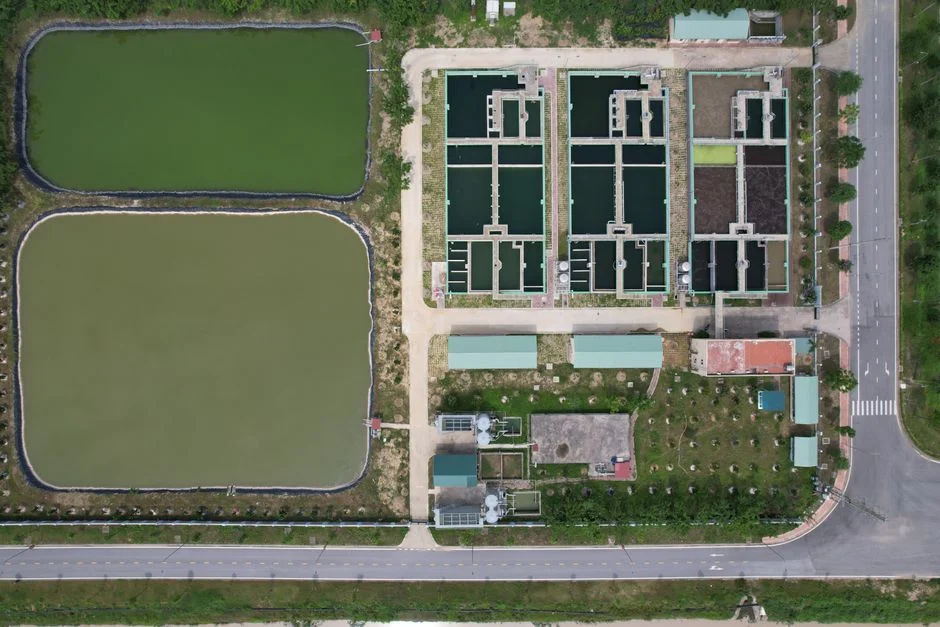
Three biological process trains dominate residential packaged-plant procurement in Vietnam. A packaged MBR residential wastewater plant with submerged PVDF membranes (0.1–0.4 µm nominal pore size) typically achieves BOD5 below 5 mg/L and TSS below 5 mg/L, and uses roughly 60% of the footprint of a comparable conventional activated-sludge (CAS) basin. That footprint advantage matters on tight peri-urban plots in Hanoi and HCMC, but membrane replacement every 7–10 years and a higher aeration energy draw are the trade-offs. SBR technology is the workhorse of the centralized HCMC and Hanoi fleets (ARCOWA-PEMSEA, Table 3.1), and a packaged SBR delivers a defensible BOD5 ≤ 30 mg/L and NH4+ ≤ 10 mg/L against Column B with simple timer-based operation. A/O + sedimentation remains the lowest CAPEX option for compounds under 200 m³/day, but an additional polishing stage is required to guarantee NH4+ ≤ 5 mg/L for a Column A site. Underground packaged STPs such as the WSZ series keep the visual profile low and free up surface area for parking or landscaping on a housing compound, and are well suited to compounds between 50 and 500 m³/day.
| Process train | Footprint (m² per m³/day) | Effluent envelope | O&M skill | CAPEX envelope | Best fit |
|---|---|---|---|---|---|
| MBR (submerged PVDF) | 0.4–0.6 | BOD5 < 5, TSS < 5, NH4+ < 1 mg/L | Moderate (membrane CIP) | High (USD 1,200–1,800 per m³/day installed) | Tight plots, Column A, reuse intent |
| SBR | 0.7–1.0 | BOD5 ≤ 25, TSS ≤ 30, NH4+ ≤ 8 mg/L | Low (timer + decanter) | Medium (USD 800–1,200 per m³/day installed) | Compounds 100–500 m³/day, Column B |
| A/O + clarifier | 0.9–1.4 | BOD5 ≤ 30, TSS ≤ 50, NH4+ ≤ 10 mg/L | Low | Low (USD 500–900 per m³/day installed) | Compounds < 200 m³/day, budget-driven |
For compounds with a discharge permit requiring Column A or with a water-reuse downstream load, MBR is the defensible default. For compounds where the developer plans to flush the resource envelope with growth, an underground packaged STP for housing compounds is the practical answer that satisfies the municipal aesthetic and the QCVN envelope. If you need a deeper look at the engineering and cost side of an MBR fleet, the MBR engineering, costs and ROI guide walks through the same CAPEX/OPEX logic for a comparable residential brief.
Sizing a packaged plant for a Vietnamese residential project
Start the sizing exercise at 120 L/person·day average dry-weather flow with a 2.0–2.5 peaking factor, and verify with 24-hour composite sampling for compounds over 500 m³/day. The MBR footprint typically lands at 0.4–0.6 m² per m³/day of installed capacity, while a WSZ underground unit lands at 0.8–1.2 m² per m³/day because the basin walls and cover slab are part of the civil package. Allow sludge storage for 6–12 months on-site, with dewatering via a small sludge dewatering press for residential WWTPs before transport to a licensed facility. For coastal Mekong sites with high TDS influent, add a screening and grit-removal step before biological treatment to protect the membranes from abrasive wear. Plan for an emergency storage volume equal to 8–12 hours of peak flow in case of power outage or maintenance shutdown. An underground packaged STP for housing compounds is the usual form factor for compounds between 50 and 500 m³/day because it frees surface space and shortens the civil work. For a worked example on a residential and camp brief, the containerized MBR sizing for residential projects walk-through translates this envelope into a specific design.
From influent to reuse: where water reuse fits in a residential scheme
Most residential compounds in Vietnam are sized for compliance, not reuse, but adding a tertiary disinfection step is a small incremental cost that opens real estate value. On-site chlorine dioxide disinfection or UV brings fecal coliforms below 1,000 CFU/100 mL and unlocks landscape irrigation and toilet flushing reuse. Reverse-osmosis polishing is justified only for potable reuse in high-end developments where the developer markets a closed-loop water cycle; standard reuse typically stops at MBR + UV/ClO₂. The 2005 Hanoi case study on decentralized wastewater management (Nguyen Viet Anh et al.) remains the original Vietnamese reference for on-site reuse at the compound scale. For developers eyeing a high-end compound, the parallel residential wastewater treatment in Bahrain 2026 blueprint shows what a reuse-driven scheme looks like under an equally strict Gulf envelope. Before signing a packaged plant order, the package STP troubleshooting guide is worth a read to anticipate the seven failure modes that account for most service calls.
Frequently Asked Questions
What is the minimum effluent standard for residential wastewater discharge in Vietnam?
The binding target is QCVN 14:2008/BTNMT, applied under the 2020 Law on Environmental Protection and Decree 31/2020/ND-CP. For most inland residential discharges the envelope is BOD5 ≤ 30 mg/L, COD ≤ 50 mg/L, TSS ≤ 50 mg/L, NH4+ ≤ 5 mg/L (Column A) or ≤ 10 mg/L (Column B), and fecal coliforms below 1,000–5,000 CFU/100 mL.
Do all new residential compounds in Vietnam need an EIA?
Compounds with a design flow above 500 m³/day, or that fall inside a protected catchment, require a full Environmental Impact Assessment under the 2020 Law on Environmental Protection. Smaller compounds below 500 m³/day still need a wastewater discharge permit and an environmental protection plan, but the EIA requirement is replaced by a simpler registration.
What size package plant is needed for a 300-unit apartment block?
At 3.5 residents per unit and 120 L/person·day, a 300-unit block produces roughly 126 m³/day average dry-weather flow. With a 2.0 peaking factor the design flow is about 250 m³/day, which puts the project in the MBR or SBR range; a packaged MBR on 0.5 m² per m³/day would occupy roughly 125 m² of plant footprint.
Is septic-tank-only treatment enough for a residential project?
No. A septic tank removes only 30–40% of BOD5 and cannot meet QCVN 14:2008/BTNMT on its own. The effluent will not satisfy NH4+ ≤ 5 mg/L or fecal coliform targets, and a developer signing off on a septic-tank-only scheme carries the compliance risk directly under Decree 31/2020/ND-CP enforcement.
How is septage from existing septic tanks handled in Vietnam?
Septage must be desludged at 3–5 year intervals and transported to a licensed treatment facility. With only 4% of national septage actually treated (ARCOWA-PEMSEA, 2018), the responsible move for a residential compound is to desludge on schedule and to provide an on-site dewatering unit, such as a plate press, to bring the cake solids above 20% before transport.
What O&M staffing does a packaged residential STP require?
An MBR or SBR package plant in the 100–500 m³/day range typically needs one trained operator on site for 2–4 hours per day, plus a part-time supervisor for routine sampling, plus a service contract for membrane CIP or decanter maintenance. The skill requirement is moderate, but it is not zero, and the operator must be trained against the plant's specific QCVN monitoring schedule.