Start with the project brief, not the catalog page
Containerized MBR STPs for Addis Ababa residential and camp projects must be sized from a locked project brief before any equipment list is opened. The two most common briefs crossing an engineer's desk in 2026 are a 500-person worker camp on the Bole Lemi II periphery, with effluent targeted at landscape irrigation, and a 250-unit condominium at 4.5 persons per unit (1,125 residents) discharging to the municipal sewer at Akaki-Kaliti. Both require three inputs locked up front: population (P), per-capita flow (q in L/c/d), and peaking factor (PF). Without those locked, every downstream cassette count and blower kilowatt is unreviewable.
Ethiopia EPA's Ambient Water Quality Guideline (revised 2023, still in force 2026) sets industrial and municipal discharge to surface water at BOD₅ ≤50 mg/L, COD ≤200 mg/L, TSS ≤50 mg/L, FOG ≤10 mg/L, total N ≤30 mg/L, total P ≤5 mg/L, pH 6–9, and temperature ≤40 °C. Where effluent is reused for irrigation or cooling, the same guideline tightens to BOD₅ ≤30 mg/L, TSS ≤10 mg/L, and FOG ≤5 mg/L. A correctly sized MBR delivers BOD₅ ≤5 mg/L and TSS ≤1 mg/L — comfortably inside both bands.
Total project duration from purchase order to commissioned effluent is 14–18 weeks: 8–12 weeks ex-works, 18–25 days sea freight, 3–5 days Djibouti→Addis trucking, and 2 weeks on-site commissioning. A concrete civil WWTP runs 12–17 months, which is why containerized is the default choice for any camp with a hard occupancy deadline (per the 2026 Ethiopia containerized WWTP engineering guide).
Step 1 — Convert population to design flow
Per-capita flow in Addis Ababa is not a US 50 gpd figure. The defensible basis is 100–120 L/c/d for urban Addis residential (consistent with Ethiopian Ministry of Water & Energy defaults for unsewered urban zones) and 60–80 L/c/d for humanitarian or worker camps (UNHCR/WHO emergency standards). Add 10–15% for infiltration and inflow where the collection network is partially combined sewer or stormwater-crossed — common in Bole and Akaki sub-cities.
Apply a peaking factor of 2.5–3.0 for residential (Harmon/WPCF peaking curve truncated at small populations) and 3.0–4.0 for camps where morning and evening wash blocks dominate the diurnal curve. Size the membrane train on average daily flow; size the hydraulic train, equalization, and pump volutes on peak flow.
Worked calculation for the 1,125-resident condominium: 1,125 × 110 L/c/d × 1.10 I&I × 2.5 PF = ~341 m³/d average flow, ~852 m³/d peak instantaneous. For the 500-person camp: 500 × 70 L/c/d × 3.0 PF = ~105 m³/d peak, ~50 m³/d average daily — design the cassette on 60 m³/d for margin, but the EQ tank must swallow 105 m³/d peaks.
Step 2 — Convert flow to BOD₅ load and aeration volume
Per-capita BOD₅ loading in Ethiopia sits at ~50 g/c/d for residential and 30–40 g/c/d for camps (lower food-waste fraction in camp messes). For the 1,125-resident example, total load is 1,125 × 50 g × 10⁻³ = 56.25 kg BOD₅/d. For the 500-person camp, the load is 500 × 35 g = 17.5 kg BOD₅/d.
Design the aeration tank for a submerged MBR at MLSS 8,000–10,000 mg/L with F/M 0.08–0.15 kg BOD₅/kg MLSS·d and SRT 20–30 days. The 6–8 hour hydraulic retention time band on average daily flow is the standard for MBR at this MLSS range: V = Q × HRT = 100 m³/d × 8 h ÷ 24 = 33.3 m³. Round to 35–40 m³ to absorb the pre-anoxic zone typically integrated in containerized MBRs for denitrification.
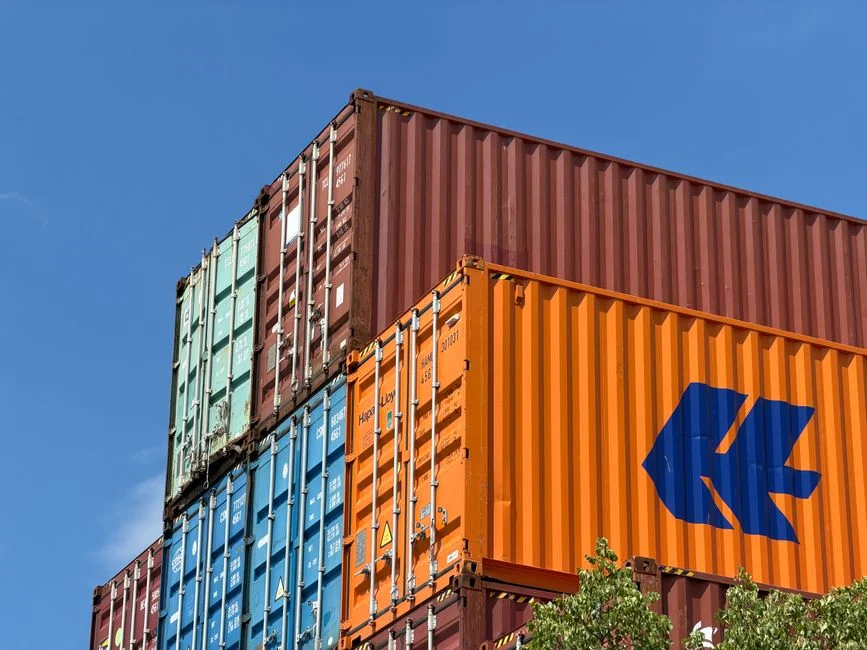
For 100 m³/d in a single 40-ft ISO container (≈67 m³ internal volume, per HydropureWater field data 2026), the MBR cassette, pre-anoxic zone, and permeate tank fit in one box. Flows above 150 m³/d typically require two 40-ft containers, or one 40-ft plus an external equalization tank. The 1,125-resident condominium at 341 m³/d average needs a 2 × 40-ft configuration with a dedicated EQ skid sized to 850 m³/d peak shaving.
Step 3 — Select membrane cassette count and configuration
The DF series flat-sheet PVDF MBR cassette at 0.1 µm pore size is available in 80, 120, 160, 200, and 225 m² footprints, rated at 32–135 m³/d per cassette per the DF product data sheet. For municipal-strength sewage at 8,000–10,000 mg/L MLSS, design flux is 15–20 LMH.
Required membrane area: A = Q (m³/d) ÷ (flux LMH × 24). At 100 m³/d and 18 LMH design flux, A = 100 ÷ (18 × 24) = 231 m² of effective area — achieved with two 120 m² DF cassettes operating at 17 LMH. One duty, one redundancy is the standard configuration at this scale; redundancy is non-negotiable for camp deployments where membrane cleaning is often deferred.
For the 500-person camp, design on 60 m³/d average: A = 60 ÷ (18 × 24) = 139 m² — one 160 m² DF cassette with 15% area margin. The containerized MBR system integrating a single DF cassette plus pre-anoxic zone, permeate tank, CIP skid, and blower fits in a single 20-ft ISO at this flow band.
Flat-sheet over hollow-fiber is the right choice for camp and residential work for three reasons: air-scour cleaning is straightforward with no internal fiber bundles, the modules tolerate the occasional TSS spike from camp kitchen greywater (relevant where FOG pre-treatment is undersized), and individual elements can be replaced on a single cassette without depressurizing the train. Pure Aqua's containerized MBR (cited elsewhere in 2026 sourcing) uses HF membranes, but flat-sheet wins on operability in East African field conditions (per HydropureWater 2026 Ethiopia deployments).
Step 4 — Apply the Addis Ababa altitude correction to aeration
Addis Ababa sits at 2,355 m above sea level. Per ISO 2533, air density at this altitude is ~0.74 kg/m³ versus 1.225 kg/m³ at sea level — a 39.6% drop. A standard blower sized for sea-level mass flow transfers approximately 22% less O₂ to the mixed liquor at altitude, which is the single most commonly missed sizing error in vendor bids that quote sea-level performance without correction.
Two accepted fixes: oversize the blower motor 25–30% to recover the lost mass-flow transfer at the same SCFM, or extend the HRT and accept a larger aeration tank. The altitude correction must be applied in the RFQ — reject any bid that quotes SOTE at 20 °C sea level without stating the field-corrected SOTE per ASCE 18-21 and the design αF factor.
Off-grid camps in Ethiopia have a third option: solar-assisted blower operation is bankable at the country's 5.5–6.5 kWh/m²/day solar yield. The 2025 Springer SOWAT paper documents a solar-PV + concentrated-solar hybrid containerized plant running continuously for one year on produced water. The same architecture — 30–50 kWp PV array with 100–150 kWh BESS — supports a 100 m³/d MBR running fully off-grid for a remote worker camp.
Containerized MBR sizing table — 10 to 200 m³/day
The table below consolidates the sizing chain into a single procurement-ready view for the residential and camp demand band. FOB CAPEX 2026 figures are drawn from HydropureWater field data 2026; the landed Addis column applies the 35–50% multiplier for Djibouti port handling, the 910 km road haul, 10–25% customs duty, 15% VAT, and 3% withholding tax.
| Design flow (m³/d) | Population equivalent @ 100 L/c/d | DF-series cassette configuration | Altitude-corrected blower kW | Container configuration | FOB CAPEX 2026 (USD) | Landed Addis estimate (USD) |
|---|---|---|---|---|---|---|
| 10 | 100 | 1 × 80 m² DF | 1.5 | 1 × 20-ft | 55,000 | 74,000–82,000 |
| 25 | 250 | 1 × 80 m² DF | 2.2 | 1 × 20-ft | 78,000 | 105,000–117,000 |
| 50 | 500 | 1 × 160 m² DF | 3.7 | 1 × 40-ft | 135,000 | 182,000–202,000 |
| 100 | 1,000 | 2 × 120 m² DF | 7.5 | 1 × 40-ft | 225,000 | 304,000–337,000 |
| 150 | 1,500 | 2 × 160 m² DF | 11.0 | 2 × 40-ft | 295,000 | 398,000–442,000 |
| 200 | 2,000 | 3 × 160 m² DF | 15.0 | 2 × 40-ft | 380,000 | 513,000–570,000 |
MBR CAPEX curves are steeper in the 10–50 m³/d band because cassette minimums do not scale linearly below ~25 m³/d. For flows under 20 m³/d, MBBR is often the lower-CAPEX option — but MBR remains the right pick whenever reuse compliance (BOD₅ ≤30, TSS ≤10 mg/L) is the driver.
Pre- and post-treatment packaged with the container
Specifying the MBR cassette alone is the second most expensive procurement error after the altitude derate. The headworks, FOG pre-treatment, and disinfection chain determine whether the plant actually meets the Ethiopia EPA reuse limits at the discharge point.
Upstream, a GX-series rotary bar screen at 1.5–3 mm aperture protects the membrane from rags and plastics in camp greywater. Where kitchen or mess hall wastewater drives FOG above 50 mg/L, a DAF pre-treatment skid (4–300 m³/h range) cuts FOG to under 30 mg/L before the aeration tank — non-negotiable for brewery or food-service camp tenants. A factory-fitted CIP/clean-in-place skid on the MBR cassette frame handles periodic recovery cleaning without cassette disassembly.
Downstream, a ClO₂ disinfection unit at 50–20,000 g/h capacity, sized to 2–5 mg/L residual on the reuse flow, is the standard final step. ClO₂ is preferred over chlorine because it does not form trihalomethanes at the high organic loads typical of camp sewage. Sludge handling closes the loop: a small lamella thickener for waste-activated sludge, then a plate-and-frame filter press dewatering to >22% dry solids before off-site disposal.
Compliance, O&M and the RFQ checklist
Effluent verification runs on 24-hour flow-weighted composite samples, analyzed at a lab accredited by the Ethiopian National Accreditation Office, with self-monitoring reports filed twice yearly to the regional EPA — Addis Ababa City Administration Environment, Forest & Climate Change Authority for in-city projects, Oromia or Amhara for outlying sites. Remote monitoring via Modbus/TCP or 4G gateway with daily parameter push is mandatory when the operator is based in Addis and the asset is at an outlying camp.
OPEX bands to verify in the bid: electricity 0.25–0.45 kWh/m³ at the USD 0.06/kWh Ethiopian industrial tariff; MBR membrane replacement amortized at USD 0.02–0.05/m³; ClO₂ and CIP chemicals proportional to reuse flow. The HydropureWater containerized WWTP manufacturer overview lists the 2026 turnkey OPEX envelopes for each flow band.
The RFQ must-ask list: altitude-corrected blower sizing per ASCE 18-21 with field SOTE stated; 24-month membrane warranty; factory acceptance test video recorded before shipment; on-site commissioning supervision included in the supply scope; 1-year spare parts kit; and a documented Modbus register map for the SCADA gateway. A bid missing any one of these is non-comparable and should be returned for clarification.
Frequently Asked Questions
What is the 2026 turnkey CAPEX for a 100 m³/day containerized MBR in Addis Ababa?
FOB China is USD 225,000; landed Addis runs USD 304,000–337,000 after Djibouti trucking (910 km), 10–25% customs duty, 15% VAT, and 3% WHT (HydropureWater field data, 2026).
Does a containerized MBR meet Ethiopia EPA reuse limits for irrigation?
Yes — MBR effluent at BOD₅ ≤5 mg/L and TSS ≤1 mg/L sits inside the Ethiopia EPA reuse band of BOD₅ ≤30 mg/L and TSS ≤10 mg/L (per the 2023 Ambient Water Quality Guideline, still in force 2026).
How does the 2,355 m Addis altitude affect blower sizing?
Air density drops to 0.74 kg/m³, cutting oxygen transfer ~22%. Oversize the blower motor 25–30% or extend HRT to compensate, and require field-corrected SOTE per ASCE 18-21 in the bid (per ISO 2533).
How long from PO to commissioned effluent for a containerized MBR in Addis?
14–18 weeks total: 8–12 weeks ex-works, 18–25 days sea freight to Djibouti, 3–5 days trucking to Addis, 2 weeks on-site commissioning — versus 12–17 months for a concrete civil WWTP, per the 2026 Ethiopia containerized WWTP engineering guide.