Why Potato Starch Wastewater Breaks a Textbook MBBR Design
Generic moving bed biofilm reactor sizing guidance is built on municipal and laundry data, and it fails the moment you point it at a potato starch plant. The canonical potato starch effluent profile runs COD 6,000–10,000 mg/L, BOD 3,500–5,500 mg/L, TSS in the 1,500–4,000 mg/L range from fiber and cell-wall carryover, temperature 30–45 °C off the process, and pH 3.5–5.0 because lactic acid fermentation starts in the starch slurry within hours of grinding. That is a high-strength, warm, acidic stream with a generous soluble fraction — and the published MBBR benchmark studies sit two orders of magnitude lower. The Smitha & Aishwarya (2017) IJSR review of MBBR for river-water purification reports feed COD of 120–150 mg/L at HRT 5–15 hr (Calderón, 2012, Spain). The Tanjungpura (Kusuma et al.) laundry study that anchors the standard 20% Kaldnes K1 fill worked on surfactant-laden greywater, not starch slurry. A Moving Bed Biofilm Reactor (MBBR) — a continuously operated, fully mixed biological reactor filled with free-floating plastic carrier media on which biofilm grows, fluidized by aeration or mechanical mixing — is a robust technology, but its comfortable operating envelope tops out around 3–4 kg COD/m³·day. A stand-alone aerobic MBBR on raw potato starch water sits at the upper edge or above that envelope, which is why most full-scale 2026 plants use MBBR as a polishing step behind a UASB or IC reactor rather than as the primary stage.
Step 1 — Characterize the Incoming Stream and Define the Discharge Target
Before you open a tank-sizing spreadsheet, lock down the inputs. Request or measure the following from the plant: average and peak hourly flow (m³/h), 24-hour composite COD, BOD₅, TSS, total nitrogen, total phosphorus, pH, and temperature. For potato starch wash and protein-recovery water, the BOD/COD ratio typically lands between 0.5 and 0.7, which confirms high biodegradability and direct biological treatability; if the ratio falls below 0.3, suspect inhibitors or a non-starch contaminant load and consider pre-oxidation or a different train. Temperature and pH drive downstream correction factors — biofilm kinetics roughly double per 10 °C rise up to about 35 °C, then decline — so log them at the MBBR inlet, not just the plant headworks.
Frame the discharge target next, because the target sets the required removal. Chinese and EU-equivalent indirect-discharge permits for food-industry effluent to a municipal sewer typically require COD ≤ 500 mg/L and BOD ≤ 300 mg/L; direct discharge to surface water often requires COD ≤ 100 mg/L and BOD ≤ 20–30 mg/L (per GB 8978-1996 Class I/II thresholds and EU Directive 91/271/EEC equivalent practice). Convert flow and concentration to load with Load (kg/day) = Flow (m³/day) × Concentration (mg/L) × 10⁻³. Worked example for a mid-sized line: 200 m³/day at 8,000 mg/L COD gives 1,600 kg COD/day; at 4,500 mg/L BOD that is 900 kg BOD/day. Those two numbers — not concentrations — drive every downstream tank, media, and blower calculation.
Step 2 — Pick a Volumetric Loading Rate and Calculate Reactor Volume
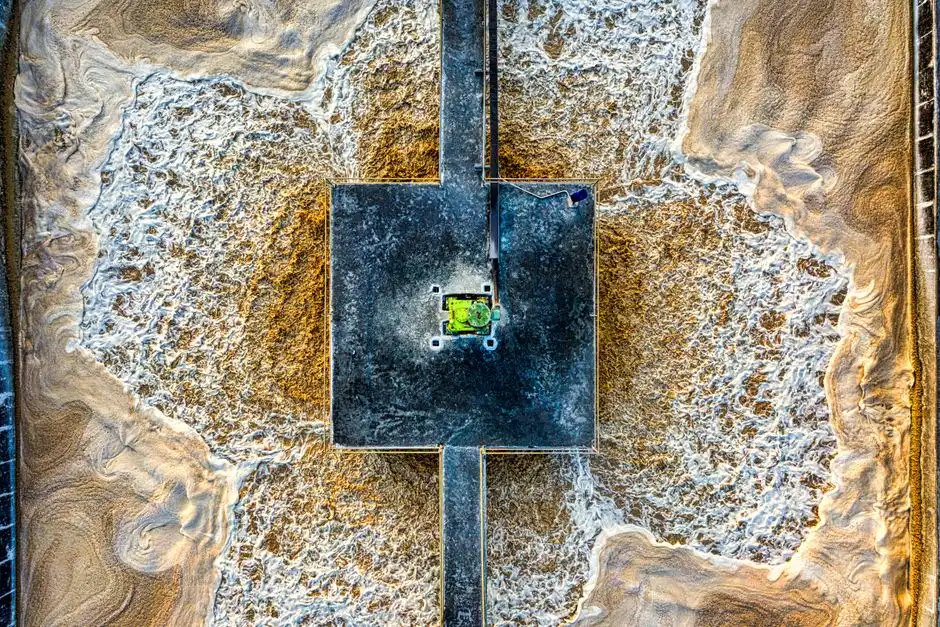
The volumetric loading rate (VLR) is the central sizing decision for any moving bed biofilm reactor in food-industry service. For a stand-alone aerobic MBBR on raw potato starch water, design for 1.5–3.0 kg COD/m³·day; for a polishing MBBR downstream of a UASB or IC reactor that has already removed 70–85% of the COD, drop to 0.5–1.5 kg COD/m³·day. The VLR-based formula is straightforward: Reactor volume (m³) = Daily COD load (kg/day) ÷ VLR (kg COD/m³·day). Using the worked example from Step 1 — 1,600 kg COD/day at a mid-range VLR of 2.0 — the total reactor working volume is 800 m³.
Cross-check that number against hydraulic residence time with HRT (hr) = Volume (m³) ÷ Flow (m³/hr). At 200 m³/day (≈ 8.3 m³/hr) into 800 m³, HRT works out to roughly 96 hours. That is far above the 5–15 hr HRT range reported in the S2 river-water review, and the gap is the point: potato starch effluent is fundamentally a different stream, and the engineer-facing sizing workflow must reflect it. For practical design, treat 48–96 hr as the stand-alone aerobic MBBR envelope (typically with a sludge recycle loop to keep mixed-liquor biology active in the carrier bed), and 8–24 hr as the polishing-MBBR envelope where the upstream anaerobic reactor has already cut the load. The 800 m³ figure derived above is total working volume; the carrier-occupied portion is calculated in Step 3.
Step 3 — Carrier Media Selection and Fill Fraction
Carrier choice and fill ratio translate tank geometry into actual biological surface area. The Tanjungpura study established that 20% Kaldnes K1 fill delivers effective COD, BOD, phosphate, and surfactant reduction in biofilm MBBR operation — a published anchor for the lower end of food-industry practice. Generalizing to high-strength food-industry service, HDPE carriers with protected specific surface area of 500–1,200 m²/m³ are standard, with fill fractions of 20–40% of reactor volume. Use 20–30% fill when the stream is foaming, when influent TSS is high, or when the MBBR is the primary aerobic stage; use 30–40% fill for polishing duty on a low-SSD stream.
Effective liquid volume is what drives HRT and aeration, not the gross tank volume. Effective liquid volume = Tank volume × (1 − fill fraction). At 30% fill in the 800 m³ tank, the effective working liquid is 560 m³ — the volume that actually contacts biomass. As a check on biological capacity, design for 1.5–3.0 m² of protected carrier surface per kg COD/day applied on starch water, which sits slightly above the 1.0–2.0 m²/kg typical for municipal MBBR and reflects the heavier organic load. A worked check: 1,600 kg COD/day at 2.5 m²/kg requires 4,000 m² of protected carrier area, which at 800 m²/m³ specific surface area and 30% fill of 800 m³ means roughly 192 m³ of media — well within the 240 m³ (30% of 800 m³) available.
MBBR Design Parameter Table for Potato Starch Wastewater
Use the table below as the 2026 design-year reference for a Basis of Design or P&ID annotation. All ranges are engineering estimates and must be confirmed by bench- or pilot-scale testing on the actual plant water before final procurement.
| Parameter | Stand-Alone MBBR | Post-Anaerobic Polishing MBBR |
|---|---|---|
| Influent COD | 6,000–10,000 mg/L | 800–2,000 mg/L (after UASB/IC) |
| Influent BOD | 3,500–5,500 mg/L | 400–1,000 mg/L |
| BOD/COD ratio | 0.5–0.7 | 0.4–0.6 |
| Target VLR | 1.5–3.0 kg COD/m³·day | 0.5–1.5 kg COD/m³·day |
| HRT | 48–96 hr | 8–24 hr |
| Carrier fill | 20–30% | 30–40% |
| Carrier specific surface area | 500–1,200 m²/m³ | 500–1,200 m²/m³ |
| Aeration rate | 2–4 Nm³ air/m²·h | 2–4 Nm³ air/m²·h |
| Dissolved oxygen target | 2–4 mg/L | 2–4 mg/L |
| MBBR operating temperature | 20–35 °C (after cooling/pre-equil) | 20–35 °C |
The 5–15 hr HRT range in the S2 IJSR review applies to dilute river-water purification and is not transferable to potato starch effluent. The 20% K1 figure in the S1 Tanjungpura study is a published lower-bound anchor for the carrier fill column.
Step 4 — Aeration, Mixing, and Screen Protection
Two distinct duties drive MBBR aeration design: fluidizing the carrier bed and delivering oxygen to the biofilm. For the fluidization duty, design for 2–4 Nm³ of air per m² of tank cross-section per hour; the same blower air also satisfies the bulk of the oxygen demand on a high-strength stream. Size the blower on oxygen demand rather than mixing alone where the load is heavy — assume 1.1–1.5 kg O₂ per kg COD removed after accounting for biomass yield, with the upper end of that range applying to streams that still carry significant soluble BOD after the reactor. Maintain dissolved oxygen at 2–4 mg/L in the MBBR; below 1.5 mg/L risks sulfide odors and poor nitrification, while above 5 mg/L wastes blower power against diminishing returns.
Verify mixing with CFD or with a simple empirical check that the entire carrier bed moves in a toroidal pattern; dead zones cause carrier aggregation, loss of effective surface area, and biofilm sloughing within weeks. Upstream of the MBBR, potato starch water carries fiber, peel, and grit that will jam carrier-retaining screens and pile on top of the media if not removed. Specify a rotary bar screen with ≤3 mm aperture before the MBBR and a grit removal step on the wash-water line. Skipping this headwork is the single most common cause of carrier clogging and unplanned MBBR shutdowns in starch plants.
MBBR vs UASB vs SBR for Potato Starch Water
Decide first whether MBBR belongs as the primary aerobic stage or downstream of anaerobic pretreatment. The 2026 industry pattern for potato starch plants is clear: a UASB or IC reactor as the primary stage, followed by an MBBR or SBR as polishing to hit 100–500 mg/L discharge COD, with the biogas offsetting hot-water and steam loads. Stand-alone MBBR is viable only for small plants under 500 m³/day where anaerobic CAPEX is hard to justify, or for retrofit of an existing aeration basin that already has blower capacity.
| Criterion | UASB / IC Anaerobic | MBBR Aerobic | SBR Aerobic |
|---|---|---|---|
| COD removal achieved | 70–85% | 60–85% (lower on raw starch water) | 85–95% |
| Footprint | Small | Compact | Large (batch basins) |
| CAPEX | High (gas system, IC reactors) | Moderate | Moderate |
| OPEX | Low (no aeration) | Moderate–high (blower power) | Moderate–high |
| Biogas credit | Yes (CH₄ for hot water/steam) | No | No |
| Sensitivity to load swings | Low (once granulated) | High (carrier biofilm adapts slowly) | Moderate |
For direct discharge to surface water, the defensible train in 2026 is UASB → MBBR → clarifier or DAF polishing unit → disinfection, not MBBR alone. For a comparison of MBBR against membrane bioreactors on a different industrial stream, see our MBR vs MBBR decision context.
Step 5 — Sludge, Effluent Polishing, and Reuse
MBBR produces 0.1–0.3 kg TSS per kg COD removed, roughly an order of magnitude less excess sludge than conventional activated sludge, because biofilm grows slowly and most assimilated carbon leaves as CO₂. That low sludge yield is a real CAPEX and OPEX advantage for a starch plant already managing wash-water solids. A plate-and-frame filter press handles the small waste-sludge volumes efficiently and dewaters thin streams to >20% dry solids cake.
For effluent polishing toward reuse — boiler feed, CIP rinse make-up, or process cleaning water — send the MBBR effluent through an industrial RO system. MBBR's stable, low-SSD effluent is exactly what protects RO membranes from organic fouling. If the only target is compliant discharge, finish with a chlorine dioxide generator: ClO₂ tolerates the elevated organic residual that bleaches conventional chlorine and provides reliable microbial control across variable upstream conditions. For a potato processing line whose wash water varies with the hourly throughput, that tolerance is the deciding factor.
Frequently Asked Questions
What is a moving bed biofilm reactor (MBBR)?
An MBBR is a continuously operated, fully mixed biological reactor filled with free-floating HDPE carrier media (typically Kaldnes K1 or equivalent at 500–1,200 m²/m³ specific surface area) on which biofilm grows. The carriers are kept in motion by coarse-bubble aeration or mechanical mixers at 2–4 Nm³/m²·h, and the reactor is normally designed for a hydraulic residence time of 8–96 hr depending on stream strength and whether the MBBR is primary or polishing.
Is MBBR enough on its own for potato starch wastewater?
For most 2026 potato starch plants, no. Raw potato starch effluent at COD 6,000–10,000 mg/L and BOD 3,500–5,500 mg/L pushes a stand-alone MBBR to its 1.5–3.0 kg COD/m³·day ceiling, with high CAPEX, large tank volume (48–96 hr HRT), and no biogas credit. The defensible 2026 design is UASB/IC primary (70–85% COD removal, biogas for hot water) followed by a polishing MBBR at 0.5–1.5 kg COD/m³·day and 8–24 hr HRT.
What hydraulic residence time should an MBBR have for starch effluent?
Use 48–96 hr HRT for a stand-alone aerobic MBBR on raw starch water and 8–24 hr HRT for a polishing MBBR downstream of a UASB or IC reactor. The 5–15 hr HRT range reported for dilute river-water MBBR (Calderón, 2012, per the IJSR review) does not apply to starch effluent, which is roughly 50–80 times stronger in COD and demands a much longer contact time at the same target effluent quality.