
Why Print Paste Washwater Breaks Generic Textile MBR Designs
Print-paste wash is a different feed than the desize, bleach, or dye-bath streams that most textile MBR guidance is built around. It carries 3,000–8,000 mg/L COD from a blend of starch, guar gum, PVA binders, urea, and unfixed reactive dye residues — well above the 800–2,500 mg/L typical of desize effluent and the 1,500–3,500 mg/L band seen in combined print/dye wastewater. The stream also swings pH from 4 to 11 and temperature from 30 °C to 60 °C within a single shift, because screens are stripped with hot alkaline soap and then rinsed cold between color changes. Surfactants and printing thickeners form a colloidal COD fraction that passes through primary settling essentially intact, so dissolved air flotation (DAF) without a downstream bioreactor leaves a heavily colored, high-COD stream that no membrane polish can rescue.
This chemistry is why generic textile MBR case studies mislead print-house engineers. Most published MBR performance data (flux 15–20 LMH, MLSS 8,000–10,000 mg/L) is drawn from cotton knit or yarn-dyeing plants where the binder and thickener load is much lower. A 2024 Springer review of MBR for textile reuse is explicit: nanofiltration is only viable after an MBR polish, because the colloidal fraction in print effluent fouls NF membranes within hours if fed raw (Springer 2024, doi 10.1007/978-3-031-62054-6_15). The biological step is non-negotiable for this stream; it breaks down starch, PVA, and most reactive dye chromophores into something downstream polishing can actually handle.
Submerged Flat-Sheet MBR: The Default 2026 Configuration
The 2026 default for print-paste wash in the 50–1,000 m³/day range is a submerged 0.1 μm PVDF flat-sheet MBR with an integrated aeration box. DF series PVDF flat-sheet MBR modules ship as cassettes of 80–225 m², each producing 32–135 m³/day at design flux, and stack into a standard integrated MBR membrane bioreactor system with the blower, permeate pump, and backflush manifold pre-piped. The flat sheet geometry puts coarse-bubble air-scour directly under every panel, which keeps the membrane surface in motion at 10–20× lower specific aeration demand than a sidestream cross-flow loop running the same feed.
Operating envelope, drawn from DF-series field deployments in textile print houses:
- Sustainable flux: 10–25 LMH; 30 LMH tolerable for ≤2 hours during batch discharge peaks
- MLSS: 8,000–12,000 mg/L; SRT 30–45 days to clear the slow-degrading starch and PVA fraction
- Effluent: turbidity <1 NTU, COD <50 mg/L, color <50 Pt-Co units from MBR alone
- Footprint: roughly 60% smaller than a conventional activated-sludge tank plus secondary clarifier at equivalent loading (HydropureWater product catalog, 2026)
| Parameter | Specification | Operating range |
|---|---|---|
| Membrane material | PVDF, reinforced | 0.1 μm nominal pore |
| Module geometry | Flat-sheet cassette | 80–225 m² per cassette |
| Design flux | 10–25 LMH | Peak 30 LMH ≤2 h |
| MLSS | 8,000–12,000 mg/L | SRT 30–45 d |
| Aeration demand (SAD) | 0.2–0.4 Nm³/m³ permeate | Integrated coarse-bubble scour |
| Effluent turbidity | <1 NTU | Continuous |
| Effluent COD | <50 mg/L | After MBR alone |
| Color (Pt-Co) | <50 units | Reactive dyes, post-MBR |
| Footprint vs CAS + clarifier | ~40% of conventional | Equal load basis |
The long SRT is the parameter that makes this work on print-paste feed. Starch hydrolysate and PVA need 20+ days of sludge age for complete oxidation, and most of the reactive-dye decolorization happens co-metabolically in that same window. Drop the SRT to 10–15 days and color removal falls off a cliff even though COD looks acceptable.
Sidestream Tubular MBR: When the Influent Demands It
Sidestream tubular MBR is required when the influent overwhelms what air-scour can keep suspended. This configuration pushes the feed through 8-inch PVDF or PES tubes at 2–4 m/s cross-flow velocity, which keeps high-solids and pigment-heavy streams moving across the membrane surface instead of blinding it. Sidestream is the correct choice when influent COD exceeds 15,000 mg/L, TSS exceeds 2,000 mg/L, or the print paste contains carbon black, titanium dioxide, or metallic pigments that settle into a cake on flat sheets within an hour.
The trade-off is energy. Sidestream tubular MBR draws 5–10× the specific energy of a submerged unit at the same permeate flow, because the cross-flow pump must move the entire recirculation loop continuously. That penalty is only justifiable above ~500 m³/day and only with a heat-recovery loop on the recirculation stream; otherwise, the feed heats past 40 °C and inhibits the biomass. The offsetting advantage is tolerance: a sidestream train can absorb a 2× batch shock from a dumped screen-strip tank without flux collapse, which is a realistic failure mode in print houses running reactive dyes.
Submerged vs Sidestream: Head-to-Head for Print Paste
Submerged flat-sheet MBR is the superior choice below 1,000 m³/day with normal print-paste chemistry, except regarding influent shock tolerance. Above that flow, or with carbon-black/metallic pigment in the feed, sidestream earns its energy penalty. The table below uses the DF series flat-sheet MBR module as the submerged reference and a generic 8-inch tubular as the sidestream benchmark.
| Parameter | Submerged flat-sheet (DF series) | Sidestream tubular (8-inch) |
|---|---|---|
| Sustainable flux | 10–25 LMH | 30–60 LMH |
| MLSS tolerance | 8,000–12,000 mg/L | 12,000–25,000 mg/L |
| Influent COD ceiling | ~10,000 mg/L | 30,000+ mg/L |
| Footprint index (m² per m³/day) | 0.05–0.08 | 0.12–0.18 |
| Specific energy (kWh/m³ permeate) | 0.4–0.8 | 2.5–6.0 |
| CAPEX index (per m³/day) | 1.0× | 2.2–2.8× |
| Membrane replacement cost per m² | 1.0× | ~3.0× |
| Replacement interval (print-paste service) | 3–5 years | 5–7 years |
| Shock-load tolerance (2× batch spike) | Poor | Good |
| Operator skill required | Moderate | Moderate-high |
The CAPEX gap narrows once you account for replacement frequency. Sidestream tubes cost roughly 3× per square meter but last 5–7 years in dirty print-paste service versus 3–5 years for flat sheets, so lifetime membrane cost is closer to 1.7–1.9×. For a procurement justification, frame submerged as the lower-CAPEX, lower-op-ex baseline and sidestream as a 25–40% CAPEX premium bought for influent tolerance and longer membrane life.
Reuse vs Discharge: What MBR Permeate Has to Deliver
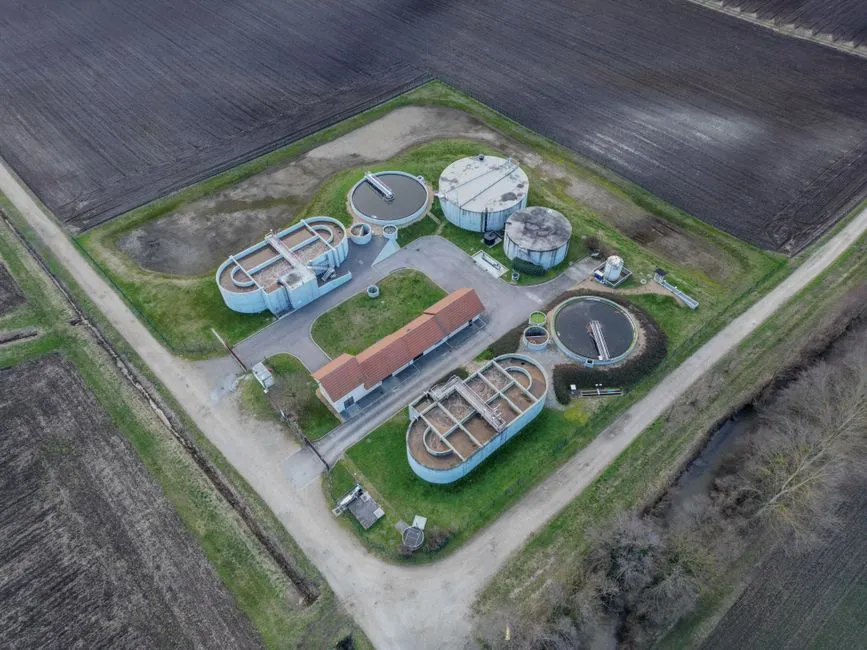
Discharge is the easier target for treated print-paste effluent. MBR permeate from either configuration typically meets the EU Urban Waste Water Treatment Directive 91/271/EEC COD and BOD limits for textile effluent without further polishing, and most provincial discharge standards in textile-producing regions sit inside that envelope. Color is the variable that can still fail discharge consent — a submerged MBR removes 70–90% of reactive dye color, but the residual 10–30% is often enough to push Pt-Co above a 50–100 unit consent limit, requiring a downstream NF or RO polish.
Reuse tightens every parameter. To feed a reverse osmosis stage for closed-loop printing water, MBR permeate must hold turbidity <1 NTU and SDI <3 consistently, which a well-run submerged MBR delivers but a marginal sidestream train may not. For direct screen wash reuse without RO, the spec relaxes to <5 NTU turbidity and no visible color, which is achievable on MBR alone for most reactive-dye houses. The 2024 Springer hybrid MBR-NF pilot is the reference configuration for reuse projects, reporting stable flux and water recovery above 85% across multiple reactive-dye feed chemistries (Springer 2024, doi 10.1007/978-3-031-62054-6_15).
Pretreatment That Makes or Breaks MBR Performance
Pretreatment failures are the primary cause of MBR performance collapse. The minimum train for print-paste wash ahead of either MBR configuration includes:
- Bar screen — a GX series rotary bar screen at 2–3 mm aperture to strip lint, fiber, and fabric scraps before they mat on the membrane surface
- DAF — a DAF system rated 4–300 m³/h to remove emulsified surfactant, size, and loose pigment; without it, colloidal COD loads the MBR with non-biodegradable material
- Equalization basin — minimum 8-hour HRT sized to one full print batch, to flatten pH (4–11) and temperature (30–60 °C) swings
- pH correction — automatic dosing to 6.5–7.5 via an automatic chemical dosing system ahead of the bioreactor
Skipping equalization is the single most common cause of MBR flux collapse in print houses. A pH swing from 11 to 4 across two batches will kill nitrifiers and shock the biomass; the membrane then fouls with dead-cell SMP and the operator blames the cassette.
Frequently Asked Questions
What flux should I spec for a submerged MBR on print-paste washwater?
Design at 15–20 LMH sustainable flux with 25 LMH peak rating, using 0.1 μm PVDF flat-sheet modules at 8,000–12,000 mg/L MLSS and 30–45 day SRT (per HydropureWater DF series operating envelope, 2026).
Can MBR alone remove reactive dye color for reuse?
Submerged MBR removes 70–90