Why Mercerizing Rinse Needs a ZLD Configuration
Mercerizing rinse is one of the most punishing streams in a knit-woven finishing mill: pH 12–14, free NaOH typically 1–5% w/w, COD 1,500–5,000 mg/L, temperature 60–90°C, and a load of suspended fibers, size residues, and short-chain organics pulled off the cotton. Combined flow from a 20–50 ton/day fabric line commonly lands between 200 and 600 m³/day at the effluent collection sump. Conventional biological treatment fails on this stream — the pH alone knocks out any nitrification/activated-sludge train, and the refractory COD fraction (PVA, CMC, wetting agents) passes through aerobic and anaerobic stages with 20–30% removal at best. The CPCB (2007) guidance on advance methods for textile-industry effluents already routes strong alkaline streams away from biological units and toward physico-chemical trains, and the 2025 Springer chapter on MLD/ZLD strategies for wastewater management confirms that textile and dye-house sectors are now the second-largest ZLD adopters after power. A mercerizing ZLD configuration has only two valid end states: in-process reuse — recovering NaOH concentrate back to the mercerizing bath and RO permeate back to rinse — or true ZLD discharge, where the only output is a dry sodium-sulfate or sodium-carbonate salt cake plus condenser-quality water. Both end states share the same unit operations, but the sizing and the priority of the caustic-recovery front-end change sharply between them.
The Canonical ZLD Process Train for Mercerizing Rinse
The flowsheet below is the mercerizing-specific sequence; it is the hybrid membrane-thermal configuration validated by Panagopoulos (2020c, Process Saf Environ Prot 146:656-669) and re-confirmed in the MDPI 2025 review on hybrid membrane-thermal ZLD.
- Step 1 — Caustic Recovery Unit (CRU). Diffusion-dialysis or membrane caustic recovery lifts the NaOH concentration from the 1–5% rinse back to 8–12% concentrate suitable for re-feed to the mercerizing bath. Typical NaOH recovery yield is 70–85% per pass, and the unit operates at 40–60°C to limit cellulose degradation carry-over.
- Step 2 — Primary clarification. A DAF for fiber and suspended-solids removal strips the lint, size, and metal hydroxides that escaped the CRU; a lamella clarifier is acceptable as an alternative at surface loadings of 20–40 m³/m²·h when solids are already coagulated. A parallel high-efficiency sedimentation tank handles the denser slurry bleed.
- Step 3 — Softening. Lime-soda or weak-acid ion exchange drops calcium, magnesium, and silica to Ca²⁺ + Mg²⁺ < 1 mg/L and SiO₂ < 5 mg/L — the thresholds below which an RO and an MEE/MVR can run 6,000+ hours between acid cleans.
- Step 4 — UF → RO pre-concentration. UF (50–100 kDa) protects downstream membranes; an industrial RO system for pre-concentration then tightens the feed from ~1% TDS to 6–8% TDS, cutting the volume reaching the thermal stage by 75–85%. A multi-media filter upstream of RO removes residual turbidity that would otherwise foul the high-pressure pumps.
- Step 5 — Thermal evaporation (MEE or MVR). Concentrates the RO brine from 6–8% to 20–25% TDS at near-atmospheric pressure.
- Step 6 — Forced-circulation crystallizer. Evaporates the final water of crystallization and produces a dry Na₂SO₄ or Na₂CO₃ cake at 95–98% purity for disposal or sale.
| Stage | Unit operation | Key inlet spec | Key outlet spec | Operating window |
|---|---|---|---|---|
| 1 | Caustic recovery (diffusion dialysis) | 1–5% NaOH, 60°C | 8–12% NaOH concentrate | 40–60°C, 70–85% NaOH yield |
| 2 | DAF / lamella clarifier | TSS 200–800 mg/L | TSS < 30 mg/L | Surface load 20–40 m/h (lamella) |
| 3 | Lime-soda softening | Ca²⁺+Mg²⁺ 200–600 mg/L | Ca²⁺+Mg²⁺ < 1 mg/L; SiO₂ < 5 mg/L | pH 10.0–10.4 |
| 4 | UF → RO pre-concentration | TDS 0.5–1.0% | Permeate TDS < 500 mg/L; brine TDS 6–8% | RO recovery 75–85% |
| 5 | MEE or MVR evaporator | TDS 6–8% | TDS 20–25% | < 90°C (vacuum) to limit NaOH carry-over |
| 6 | Forced-circulation crystallizer | TDS 20–25% | Dry cake 95–98% Na₂SO₄/Na₂CO₃ | 110–125°C body, 5–15% slurry density |
Reuse vs Discharge Endpoints: How the Configuration Shifts
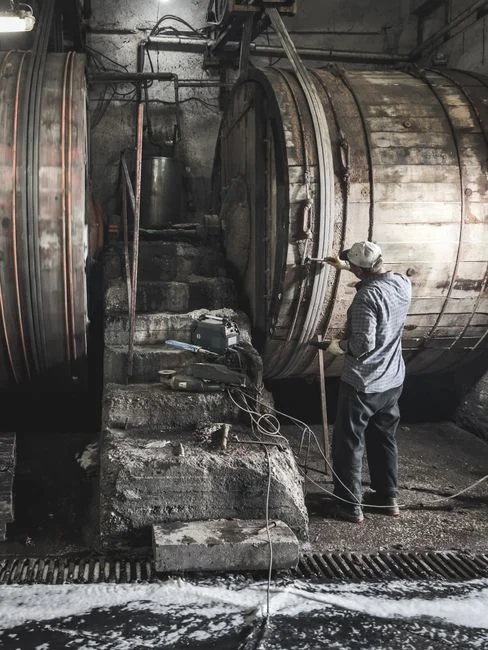
The two end states are not the same plant. A reuse scheme treats the mercerizing-rinse stream as a feedstock — the goal is to put both the water and the caustic back into the process. A discharge scheme treats it as a waste — the goal is to leave nothing liquid behind. The unit operations are identical; the sizing and the relative weight of the front-end caustic-recovery step are not.
In a reuse endpoint, RO permeate must hit ≤500 µS/cm and evaporative distillate must hit TDS ≤10 mg/L to feed rinse and wash stages without foaming or shade drift. The CRU earns its slot: the recovered NaOH (8–12% concentrate) is directly reusable in the mercerizing bath, and the credit at local caustic price (USD 350–500/ton in 2026 spot markets) materially offsets evaporation energy. In a true ZLD discharge endpoint, the CRU is still valuable as a pre-concentrator — it cuts the volume reaching the thermal stage by 30–50% — but the recovered NaOH often has to be neutralized and routed to the crystallizer as Na₂SO₄/Na₂CO₃, because the mercerizing bath has no demand for it. Evaporative distillate still typically goes to a polishing step before disposal or reuse, per the MLD/ZLD strategies chapter (Springer 2025).
| Design parameter | Reuse endpoint | Discharge endpoint (true ZLD) |
|---|---|---|
| RO permeate target | ≤500 µS/cm, reused in rinse/wash | May be discharged if < local TDS limit, or polished |
| Evaporative distillate | ≤10 mg/L TDS, reused | Polished (TDS < 50 mg/L) before disposal |
| NaOH concentrate | Returned to mercerizing bath (8–12%) | Neutralized to Na₂SO₄, sent to crystallizer |
| CRU priority | High — economic anchor of the project | Medium — used as volume reducer, not as credit source |
| Final solid form | Optional — only if NaOH excess exists | Required — dry cake is the only solid output |
| Chemical dosing intensity | Lower — kept clean for reuse | Higher — PLC-controlled chemical dosing for pH and softening can be aggressive |
MEE vs MVR for Mercerizing Brine: A 2026 Decision Matrix
The thermal-stage choice is the single largest CAPEX line in the bill of materials and the one with the longest payback sensitivity. The decision is driven by five variables, and on caustic textile brine, the 2026 default has shifted toward MVR.
MEE (multi-effect evaporator) uses external steam and reuses vapor across 3–6 effects. CAPEX is lower — typically 60–70% of an equivalent MVR at the same evaporation duty — and it is competitive below 15 m³/h concentrate capacity where a plant already has saturated steam at 4–6 barg available. The drawback is OPEX exposure to steam cost; on caustic brine, MEE also runs hotter on the first effect, which lifts NaOH carry-over and forces a polishing stage on the distillate.
MVR (mechanical vapor recompression) uses an electrically driven blower to compress the vapor from one effect and re-feed it as the heating medium for the same effect. CAPEX is higher, but at concentrate capacities above 15 m³/h and electricity tariffs below USD 0.07/kWh, the OPEX crossover typically lands at 2–4 years (Panagopoulos 2020c). MVR is the 2026 preference for caustic textile brine because it operates at lower body temperature (60–75°C under vacuum), which minimizes NaOH volatility and carry-over, and it is more thermally efficient at the viscous, high-TDS feeds that mercerizing streams become after RO pre-concentration. A solar MED/TVC hybrid remains a credible low-carbon option where land area above 1.5–2.0 acres per 100 m³/day and solar yield above 1,800 kWh/kWp·yr are available.
| Decision variable | Favors MEE | Favors MVR |
|---|---|---|
| Concentrate capacity | < 15 m³/h | ≥ 15 m³/h |
| Steam availability | Steam at 4–6 barg, < USD 8/ton | No saturated steam, or steam > USD 12/ton |
| Electricity tariff | Tariff > USD 0.10/kWh | Tariff < USD 0.07/kWh |
| Footprint constraint | Multi-effect tower is taller than MVR skid | Single compact skid, lower headroom |
| NaOH carry-over tolerance | Lower operating T is acceptable if distillate is polished | Lower body T directly reduces carry-over; preferred for caustic |
| Solar/land availability | Solar MED/TVC hybrid competes when both are present | Not applicable |
2026 Cost and Footprint Benchmarks for Mercerizing ZLD

The defensible methodology for the numbers below is the techno-economic envelope established in Panagopoulos 2021 MLD assessment (Process Saf Environ Prot 146:656-669) and the 2021 ZLD brackish/seawater study (Energy Convers Manag 113957), applied here to a 300 m³/day mercerizing-rinse plant with 70% RO recovery and a 4-effect MEE plus forced-circulation crystallizer.
| Cost block | Share of CAPEX | 2026 OPEX driver | Typical range (USD/m³ treated) |
|---|---|---|---|
| Thermal stage (MEE or MVR + crystallizer) | 45–55% | Steam (MEE) or electricity (MVR); crystallizer steam | 0.45–0.75 OPEX |
| RO pre-concentration train | 15–20% | Membrane replacement (every 3–5 yr), high-pressure pump power | 0.10–0.18 OPEX |
| Pretreatment + civil (DAF, lamella, softening, dosing) | 25–35% | Lime, soda ash, NaOH for regeneration, polymer | 0.15–0.25 OPEX |
| Caustic recovery credit (reuse scheme only) | Offsets OPEX | Net of CRU CAPEX amortization + acid for anion exchange | −0.20 to −0.35 OPEX credit |
For the 300 m³/day reference plant, 2026 CAPEX for a discharge endpoint typically lands at USD 4.5–6.5 million, and for a reuse endpoint (with CRU front-end) at USD 5.5–8.0 million. OPEX lands at USD 0.75–1.10/m³ for a discharge scheme and USD 0.50–0.85/m³ for a reuse scheme once the NaOH credit is netted. Steam and electricity together still account for 55–65% of OPEX — that is why the MEE-vs-MVR choice is the single biggest lever in long-run cost.
Selection Checklist Before You Specify a Mercerizing ZLD
- Map peak and average flow separately. The thermal stage must be sized to peak wet-season flow with at least one effect or one compressor in standby; sizing to average flow guarantees 6–8 hours of bypass storage every week.
- Confirm NaOH recovery value at your local caustic price. At 2026 spot prices above USD 350/ton, the CRU pays back in under 3 years; below USD 250/ton, it is a pre-concentrator only.
- Verify the energy side first. A 4–6 barg saturated-steam line at < USD 8/ton points to MEE; an electricity tariff below USD 0.07/kWh points to MVR. Lock this before vendor talks, not during them.
- Confirm the final solid form. If the bath chemistry is acid-neutralized downstream, you produce Na₂SO₄; if it is caustic-neutralized, Na₂CO₃. The crystallizer and bagging/disposal route are different in each case.
- Cross-check the hybrid membrane-thermal ZLD review (MDPI Membranes 2025, 15(2):64) against your line diagram before issuing the enquiry — that paper is the current best-practice reference and will surface any unit you have missed.
Frequently Asked Questions
What unit operations make up a mercerizing ZLD train? Caustic recovery (diffusion dialysis or membrane) → DAF/lamella clarification → lime-soda softening → UF → RO pre-concentration → MEE or MVR thermal evaporation → forced-circulation crystallizer. RO permeate and evaporative distillate are returned to the rinse and wash stages in a reuse scheme.
Can RO alone treat mercerizing rinse? No. RO handles 75–85% of the volume at 6–8% TDS, but the concentrate still has to go to a thermal stage for evaporation and crystallization. RO alone produces a brine stream that is harder to dispose of than the original rinse.
MEE or MVR for mercerizing brine? MVR is the 2026 default for caustic textile brine above 15 m³/h concentrate capacity when electricity is below USD 0.07/kWh, because it operates at lower body temperature and limits NaOH carry-over. MEE remains competitive below 15 m³/h or where 4–6 barg steam is already on site.
Can the NaOH be reused? Yes. Diffusion-dialysis or membrane caustic recovery units return 70–85% of the inlet NaOH as an 8–12% concentrate that re-feeds the mercerizing bath directly. The credit at 2026 caustic prices materially offsets the thermal-stage OPEX.
What is the reuse-quality target for RO permeate and distillate? RO permeate ≤500 µS/cm (or TDS ≤300 mg/L) and evaporative distillate TDS ≤10 mg/L, both returned to rinse and wash stages. For a stricter reuse loop into the mercerizing bath itself, the distillate is polished further through a mixed-bed polisher. For a deeper read on the broader market context, see the 2026 ZLD adoption forecast; for plant-side visibility, see the engineering guide on remote monitoring of a textile ZLD plant.