
Why Tablet Coating Wash Water Is a DAF Problem, Not a Biological One
A two-stage dissolved air flotation (DAF) skid with pre-coagulation and post-polymer flocculation is the standard 2026 configuration for tablet coating wash water. Operate the saturator at 5–7 bar to generate 20–60 µm micro-bubbles, target 15–25 minute hydraulic retention, and dose a cationic coagulant followed by an anionic polyacrylamide. This combination routinely removes 80–95% of suspended solids, color bodies, and entrained coating polymers, enabling either closed-loop rinse reuse or compliant sewer discharge when paired with pH correction and a polishing filter.
Coating pan wash-down and spray-gun rinse dumps carry a distinct pollutant fingerprint that downstream biology handles poorly. The load is dominated by hydroxypropyl methylcellulose (HPMC), polyethylene glycol (PEG), polyvinylpyrrolidone (PVP), talc, titanium dioxide, iron oxide and lake colorants, plus residual sugar alcohols such as mannitol and sorbitol. Batch-to-batch API carryover adds 10–200 mg/L of dissolved active, but the operational headache — color spikes on the discharge monitor, pan re-clean failures, foaming in the equalisation tank — comes from the colloidal and suspended fraction, not the dissolved organics. Coagulation and flotation attack exactly that fraction.
DAF belongs at the front of the train to ensure consistent effluent quality. In the 2026 multistage integrated framework published in Resources, Conservation & Recycling Advances, DAF sits as a base-level separation unit that protects higher-value downstream stages (MBR, RO, adsorbent polish) from fouling and shock loading; without it, membrane lifespans shrink and reuse water carries visible color into CIP loops (per sciencedirect.com S2214714426008809). The economic case mirrors what the pulp-and-paper sector demonstrated decades ago: up to 70 m³ of process water per tonne of finished product, and water reuse, not just compliance, is now the design driver (per bioresources.cnsu.edu). Pharma plants running 8–12 coating batches a day sit in the same volumetric regime, which is why specifying flotation correctly pays for itself inside one campaign.
Reference DAF Configuration: Saturator, Bubble Size, Retention
Saturators should be specified at 5–7 bar with a recycle ratio of 20–40% of forward flow and a white-water contact tank sized for at least 3 minutes residence. That pressure window is what generates the 20–60 µm micro-bubble band that attaches reliably to destabilised HPMC, PEG, and pigment flocs — the same micro-bubble principle validated for industrial oil-water separation, where bubble size and saturator pressure are the dominant performance levers (per Durban University of Technology, doi 10.51415/10321/3182). For a typical coating-pan wash stream of 5–15 m³/h, a 10 m³ saturator with a 2.2 kW recycle pump covers the envelope without saturator short-circuiting.
Hydraulic retention in the flotation cell should land between 15 and 25 minutes. Shorter than 15 minutes and the high-solids pan-wash dumps push float over the weir before the sludge bed compacts; longer than 25 minutes and the cell sizes out of budget for the same removal. Surface loading rate is the second lever: target 5–15 m/h for coating effluents, and step to a lamella or inclined-plate insert when a batch program includes high-surfactant or oily formulations (for example, ethylcellulose or aqueous dispersion coatings), because the rising bubble velocity has to overcome the entrained air that would otherwise re-suspend the float.
The table below captures the parameter envelope a process engineer can put on a P&ID today.
| Parameter | Design value | Operating tolerance | Driver |
|---|---|---|---|
| Saturator pressure | 6 bar (range 5–7) | ±0.3 bar | Micro-bubble size 20–60 µm |
| Recycle ratio | 30% of Qforward | 20–40% | Adequate bubble density without hydraulic upset |
| White-water retention | 3 min | ≥2 min | Saturator contact time |
| Flotation cell HRT | 20 min | 15–25 min | Float bed compaction and clarity |
| Surface loading rate | 8 m/h | 5–15 m/h | Colloidal load; surfactant batches need lamella |
| Skimmer speed | 0.5–1.0 m/min | — | Float removal without re-entrainment |
A correctly sized dissolved air flotation system in this envelope typically delivers 90–95% TSS removal and 85–92% color reduction on coating wash (HydropureWater field data, 2026), which is the number the QA team will ask for first.
Pre- vs Post-Coagulation: Which Chemistry Wins for Coating Effluent
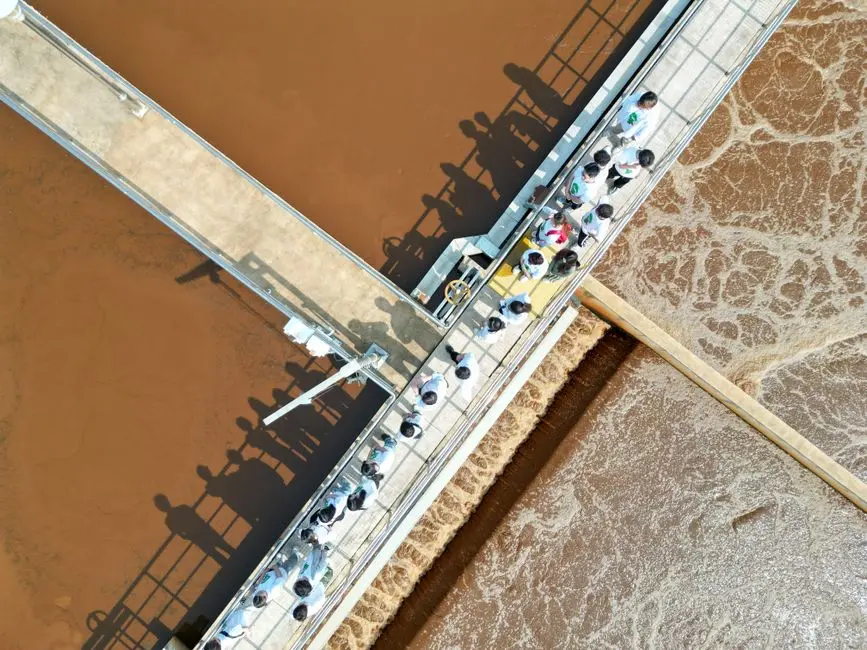
Pre-coagulation is the most effective method for tablet coating wash, and the placement of the polymer dose is a critical engineering detail. In a pre-coagulation layout, the cationic coagulant — typically polyaluminium chloride (PACl) at 30–80 mg/L as Al2O3, or aluminium sulphate (alum) at 50–150 mg/L — is injected upstream of the flocculation tube, where it neutralises the negative surface charge on HPMC, PEG, and pigment colloids. The anionic or non-ionic polyacrylamide flocculant is then dosed in the 0.5–3 mg/L range immediately before the saturator, so the macro-floc forms inside the white-water stream where micro-bubbles nucleate onto the freshest, largest flocs.
Post-coagulation (both coagulant and polymer dosed inside the cell or in a downstream reaction tank) delivers weaker results on coating effluent. The reason is kinetics: by the time the floc has passed through the reaction zone and into the flotation chamber, the polymer chains have already started to shear, and the bubble-to-floc attachment window is narrower. Plants that retrofit from post- to pre-coagulation typically see 5–15 percentage points of additional TSS and color removal without changing the saturator setpoint (HydropureWater field data, 2026).
Dose windows are feed-specific, so the dosing values above should be confirmed by jar testing against the actual coating recipe. Run a six-beaker jar test with the production-side effluent, sweep PACl from 20–120 mg/L, and pick the coagulant dose that delivers the lowest supernatant turbidity at the lowest settled-sludge volume. Then sweep the polymer from 0.3–5 mg/L and pick the dose that produces the fastest 30-second settling. Drive the selected pair through an automatic chemical dosing skid with flow-paced control so the dose tracks the pan-wash diurnal pattern.
| Variable | Pre-coagulation | Post-coagulation |
|---|---|---|
| Coagulant dose point | Upstream flocculation tube | Inside cell or downstream reactor |
| Polymer dose point | Just before saturator | Inside cell |
| Typical TSS removal | 90–95% | 75–88% |
| Color removal | 85–92% | 70–82% |
| Polymer consumption | Lower (0.5–3 mg/L) | Higher (3–8 mg/L) |
| Best fit | HPMC/PEG/pigment-rich coating wash | Low-colloid, high-suspended streams |
Reuse vs Discharge: How the Configuration Changes
DAF skid downstream configurations vary based on whether the target is water reuse or sewer discharge. For a reuse target, DAF effluent needs to clear turbidity under 10 NTU, TOC under 50 mg/L, and color reduction above 90% — sufficient to feed CIP pre-rinse loops and pan-rinse make-up water, but not sufficient for final product-contact water without an RO or UF polish. In the multistage integrated framework, this is the moment a first-level upgrade to an integrated MBR system enters the train; the MBR strips residual dissolved API and organics that DAF leaves behind, and the RO stage that follows hits the conductivity and TOC limits the QA team will demand for any water touching the pan or spray gun (per sciencedirect.com S2214714426008809).
For a discharge target, DAF alone is often sufficient when coating-line segregation is in place — meaning the coating pan wash stream does not get blended with high-strength API mother-liquor waste. The polishing stage collapses to a multi-media polishing filter (sand–anthracite–garnet) for TSS guard, and pH correction handles the residual aluminium and colour. Local sewer limits vary, but indirect-discharge envelopes typically sit at BOD under 300–500 mg/L and TSS under 250–400 mg/L; the configuration above lands comfortably under both with a 5–10× safety margin on a typical coating wash (HydropureWater field data, 2026).
| Decision criterion | Reuse path | Discharge path |
|---|---|---|
| Target water quality | Turbidity <10 NTU, TOC <50 mg/L, color >90% removal | Meet local sewer BOD/TSS limits (typically 300/250–500/400 mg/L) |
| Downstream of DAF | MBR → RO/UF polish | Multi-media filter → pH correction |
| Capital intensity | Higher (membranes, CIP of membranes) | Lower (media filter vessels) |
| Operating driver | Water scarcity, CIP cost reduction | Discharge compliance only |
| QA/regulatory posture | USP/EMA wash-water quality validation | Local POTW discharge permit |
Sludge Handling, Skid Sizing, and What to Ask a Vendor
DAF float from coating wash typically contains 2–5% dry solids with a fibrous, pigmented character that does not dewater well on a belt press. Specify a plate and frame filter press for low-volume, high-solids coating skimmings; it pushes the cake to 25–35% DS, which is the window incinerator co-processing or hazardous-waste pickup expects. A rotary drum thickener is acceptable on continuous three-shift operations where the float is more dilute (<2% DS) and the throughput justifies the footprint, but for batch coating lines the plate press is almost always the right call.
When sizing the skid, add 20–30% hydraulic margin on top of the calculated average flow — coating wash is batchy, and the peak from a pan dump is roughly 3–5× the steady-state rate for 10–20 minutes. For a vendor review, the procurement-side checklist that holds up to QA scrutiny includes: (1) stated recycle ratio and how it tracks forward-flow swings, (2) polymer compatibility data with HPMC and PEG matrices, (3) skimmer drive type and torque rating for high-solids float, (4) ATEX classification for any coating solvent vapour carryover, and (5) full validation documentation — IQ/OQ templates, material certificates, and surface-finish records — for the dissolved air flotation system being offered.
Frequently Asked Questions
What saturator pressure produces the right bubble size for tablet coating wash?