Why Edible Oil Soapstock Water Defeats a Standard DAF
Soapstock is the saponified fatty-acid layer skimmed from the centrifugal separator during caustic refining of soybean, palm, sunflower, or rapeseed oil. It carries 800–3,000 mg/L of saponified oil and grease (SOG) and 5,000–25,000 mg/L of COD, making it one of the most heavily loaded sidestreams in a vegetable-oil refinery (per Durban University of Technology, 2021). What makes it uniquely difficult for dissolved air flotation is that the oil is not free — it is chemically bound as sodium-carboxylate micelles that behave as anionic surfactants.
Those micelles leave the refinery at pH 10–12 and 60–90 °C, conditions that maximize emulsion stability. A generic DAF spec — neutral pH, room-temperature feed, polymer-only conditioning — typically achieves less than 40% FOG removal because the bubbles cannot attach to charged, sub-100 µm micelles. The stream defeats off-the-shelf designs in three ways: the carryover of 0.3–1.5% free caustic buffers any coagulant dose, the high temperature lowers air-saturation efficiency in the saturator, and the viscous floated blanket overloads a standard scraper. The fix is a four-step train — acid split, pH-matched coagulation, micro-bubble DAF, and an optional reuse polish — laid out in the sections that follow.
Soapstock Water Characteristics That Drive DAF Design
Before selecting a DAF, the engineer needs the influent envelope. Soapstock washwater from soybean, palm, sunflower, and rapeseed refining clusters into a predictable range across the major edible-oil categories, and the numbers below are the envelope used for equipment sizing in food-and-oil BAT reference documents and the pollutant categories catalogued in the Durban University of Technology study.
| Parameter | Typical range (soapstock washwater) | Design implication |
|---|---|---|
| SOG (saponified oil & grease) | 800–3,000 mg/L | Drives coagulant demand; dictates float-blanket scraper rating |
| COD | 5,000–25,000 mg/L | Sets biological or RO polish load downstream |
| TSS | 500–2,000 mg/L | Pre-DAF screening/equalisation typically required |
| pH | 10–12 (caustic) | Must be lowered to 3–5 (acid split) before DAF |
| Temperature | 60–90 °C leaving refinery | Cool to 40–55 °C for best air saturation and micelle destabilisation |
| Free caustic (NaOH) | 0.3–1.5% | Sets H₂SO₄ or HCl dose for the acid-split step |
Two physical changes that happen on cooling are useful: below 55 °C, higher-melting saturated soaps (C16:0, C18:0) begin to precipitate out of the micelle, which actually improves bubble attachment in the DAF contact zone if the temperature ramp is controlled. The second is that the same cooling that helps the DAF also cuts the saturator's air-supply demand, because cooler water holds more dissolved air at a given pressure. Free caustic carryover is the silent killer in many retrofit installations: it buffers the pH downward, so the engineer must over-dose acid or waste the downstream coagulant.
Scale matters for CAPEX framing: oil-based and saponified industrial streams together represent more than 85% of global emulsified-oil wastewater volume (Springer, 2025), which is why DAF has become the default primary separator for this class of effluent rather than a niche option.
The Conditioning → DAF → Polish Process Train
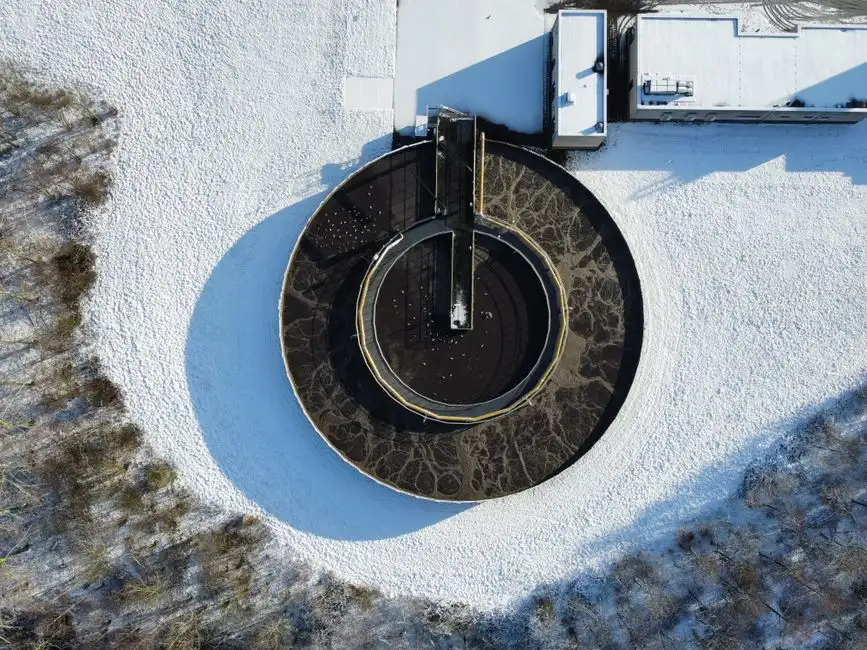
A working soapstock train has four unit operations, and the order is not optional. Each step conditions the stream for the next; re-arranging them is one of the more common reasons DAF units underperform on commissioning.
- Acid split / pH conditioning. Dose sulfuric (typically 93–98% H₂SO₄ diluted) or hydrochloric acid to pH 3–5. Sodium-soap micelles protonate to free fatty acids (FFA), which separate as a floating layer that can be skimmed upstream of the DAF or captured inside the cell. This single step is responsible for the largest single jump in FOG removal on caustic-refining effluent.
- Coagulation and flocculation. Dose polyaluminum chloride (PAC) at 50–200 mg/L, optionally paired with CaCl₂ (calcium chloride) at 20–80 mg/L and an anionic polymer at 1–5 mg/L. The Ca²⁺/Mg²⁺ pairing destabilises the residual sodium-soap micelles by ion exchange; the polymer bridges the destabilised floc. pH in the floc tank is held at 6.5–7.5 — the optimum for PAC performance (Springer, 2025). Dosing is best handled by a PLC-controlled acid and coagulant dosing skid tied to a pH probe in the flash mix.
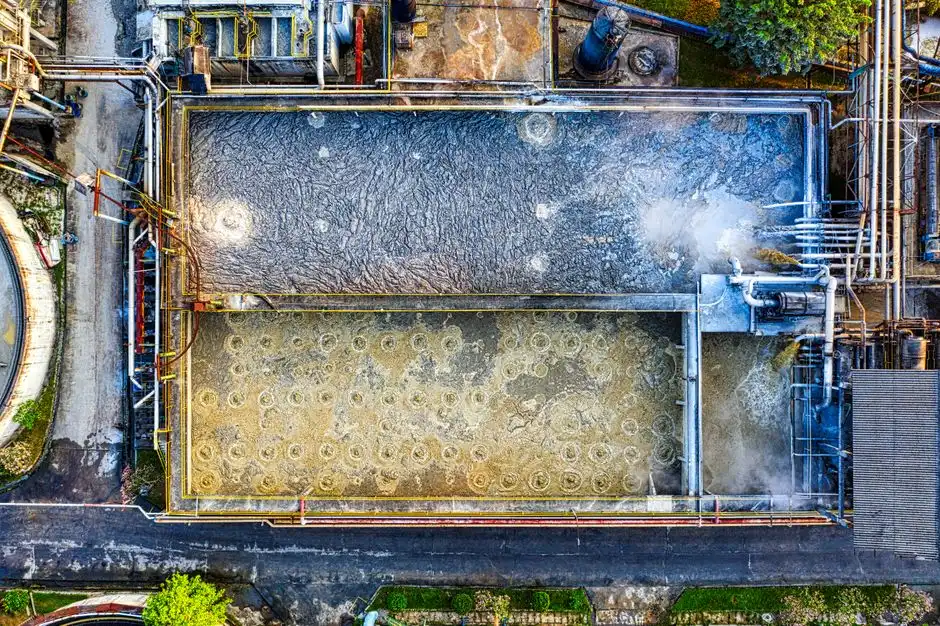
- Micro-bubble DAF. The conditioned feed enters the contact zone where 20–50% recycle water, saturated with air at 4–6 bar, releases 10–80 µm bubbles that attach to the destabilised floc and float it. The skimmer drives the FOG blanket into a sludge hopper; clarified underflow exits the cell.
- Polish step (optional). If the goal is reuse, route DAF effluent through an MBR polish train for reuse-grade effluent (oil and grease <10 mg/L) or, for boiler-feed quality, an additional RO polish for boiler-feed reuse. If the goal is direct discharge and the DAF outlet is already inside consent, the polish step is omitted.
Saturator recycle returns to the contact zone through a dedicated pump and air-mixing loop; the saturator itself runs at 4–6 bar with a recycle-to-influent ratio of 20–50% depending on the float loading. Sludge from the hopper is routed to a soap-recovery tank or a separate dewatering unit, depending on whether the FFA layer is sold as a by-product or sent to waste.
DAF Configuration Parameters for Soapstock Service
The parameter block below is the lift-ready set an engineer can drop into a P&ID or equipment enquiry for a DAF for FOG and SOG removal sized for caustic-refining effluent. Numbers are drawn from the bubble-size window in the CRC Press algae-DAF pilot work and the micro-bubble contact zone described in the WIT Press livestock-DAF study, and reconciled against edible-oil jar-test protocols (Springer, 2025).
| Parameter | Design value | Operating window | Note |
|---|---|---|---|
| Bubble diameter | 30–50 µm | 10–80 µm | 30–50 µm gives best collision efficiency with soap micelles |
| Recycle ratio | 30% | 20–50% | Higher ratios raise collision frequency but load the saturator pump |
| Hydraulic loading (contact zone) | 10–15 m/h | 5–25 m/h | 10–15 m/h is the edible-oil design point |
| Total flotation retention time | 20 min | 15–30 min | Longer for high-SOG feeds above 2,000 mg/L |
| Saturator pressure | 5 bar | 4–6 bar | Drives dissolved-air mass transfer |
| Air-to-water ratio | 50 g air/m³ water | 30–80 g/m³ | Set by recycle ratio and saturator back-pressure |
| Floc-tank pH | 7.0 | 6.5–7.5 | Optimum for PAC; outside this band, dose rises sharply |
| PAC dose | 100 mg/L | 50–200 mg/L | Higher doses risk restabilisation above 250 mg/L |
| Cationic polymer dose | 2 mg/L | 1–5 mg/L | Optional; tune by jar test |
| Skimmer speed | 1.0 m/min | 0.5–1.5 m/min | Specify heavy-duty scraper for viscous soap blanket |
| Feed temperature at DAF inlet | 45 °C | 40–55 °C | Below 40 °C, viscosity rises; above 55 °C, air saturation falls |
Operating this envelope on a well-conditioned feed routinely delivers 85–95% FOG and SOG removal (HydropureWater field data, 2026). The two parameters with the least margin are bubble diameter and feed temperature — drifting outside 30–50 µm or 40–55 °C collapses removal toward 60% even when the rest of the train is correct.
Reuse vs Discharge: Choosing the Right End-of-Pipe Target
The decision pivot for the CAPEX committee is whether the DAF alone is enough or whether the project must fund a polish train. The thresholds below frame the choice against the two regulatory anchors that govern edible-oil effluent — EU IED 2010/75/EU with its BAT-AEL for food-and-oil processing, and US EPA 40 CFR Part 405 for the oil-and-grease subcategory.
| Target | Oil & grease (mg/L) | TSS (mg/L) | COD (mg/L) | Treatment train required | Relative CAPEX |
|---|---|---|---|---|---|
| Cooling-tower make-up | <10 | <50 | <150 | Acid split + DAF + MBR | 1.0× (baseline) |
| Scrubber make-up | <15 | <80 | <200 | Acid split + DAF + sand filter | 0.7× |
| Boiler feed (low-pressure) | <1 | <10 | <30 | Acid split + DAF + MBR + RO | 2.5× |
| EU IED BAT-AEL discharge (food, drink, milk) | <10 daily / <15 monthly | <35 (BAT-AEL band) | <250 after biological | Acid split + DAF (± biological) | 0.8–1.0× |
| US EPA 40 CFR Part 405 discharge (typical subcategory) | ~30 daily max | Site-specific | Site-specific | Acid split + DAF (often sufficient) | 0.7–0.9× |
For a CAPEX-committee defence, the simple framing is: DAF alone covers direct discharge in most EU and US jurisdictions once the acid-split step is included; reuse adds an MBR or RO polish and lifts CAPEX 1.8–2.5×. The compliance arithmetic above is anchored to EU IED 2010/75/EU BAT-AEL bands for the food-and-drink sector and the oil-and-grease limits published in EPA 40 CFR Part 405; specific subcategory limits vary, so the engineer should always cross-check the local NPDES or BAT-AEL notice before finalising the design. For a related precedent on oily-water trains in metals finishing, the EU IED monitoring for surface treatment compliance guide walks through the same regulatory framing.
Common Configuration Mistakes on Soapstock Streams
Three failures show up repeatedly on commissioning reports for generic DAF units retrofitted onto caustic-refining effluent, and each one collapses the performance of an otherwise correctly sized unit.
Mistake 1 — Skipping the acid split. Dosing PAC directly onto feed at pH 10–12 wastes 60–80% of the coagulant as it is consumed buffering the free caustic, and the cloudy substandard effluent that results typically scores 30–45% FOG removal. The acid-split step is the single highest-leverage change a plant can make.
Mistake 2 — Oversizing the bubble. A standard DAF saturator running at 3 bar with worn nozzles can produce a 200+ µm bubble population. Those bubbles rise through the contact zone in under a second and burst at the surface before attaching to the viscous, semi-solid FOG layer. Removal drops to 50–60% even with correct chemistry. Hold the saturator at 4–6 bar and verify bubble size with a column test on commissioning.
Mistake 3 — Undersizing the skimmer. The float blanket on a soapstock DAF is a heavy, viscous, semi-solid layer that can stall a light-duty scraper within hours. Specify a heavy-duty skimmer with a torque-rated drive and a wiper geometry matched to the expected blanket thickness (often 50–150 mm).
Across all three, the upstream discipline is the same: run a jar test (pH curve × coagulant dose) before committing to the full-scale DAF. Jar-test optimisation is the standard protocol for confirming pH-matched coagulant pairing on emulsified-oil streams (Springer, 2025), and it is the cheapest insurance on the project.
Frequently Asked Questions
What DAF bubble size works best for soapstock water? 30–50 µm is the optimal range, inside a 10–80 µm operating window. Smaller bubbles attach more efficiently to destabilised soap micelles and produce the cleanest floated blanket.
What coagulant should I dose for sodium-soap emulsions? Polyaluminum chloride (PAC) at 50–200 mg/L, optionally paired with CaCl₂ at 20–80 mg/L, with the floc-tank pH held at 6.5–7.5. This pairing breaks the sodium-soap micelles by ion exchange and bridges the resulting floc.
Can DAF alone meet discharge limits for edible-oil effluent? Yes, in most jurisdictions. With the acid-split step included, a correctly configured micro-bubble DAF typically achieves 85–95% FOG removal and meets the EU IED BAT-AEL and US EPA 40 CFR Part 405 oil-and-grease limits for direct discharge.
What temperature should the DAF feed be? 40–55 °C at the DAF inlet. Below 40 °C the float blanket becomes too viscous; above 55 °C the saturator's dissolved-air capacity falls and removal efficiency drops. A plate heat exchanger on the soapstock line is the standard way to hit the window. For a related deep-dive on oily-water DAF in a different industry, see the DAF configuration for stamping press oily water guide or the DAF configuration for die-cast aluminum wash water piece.