Why Potato Starch Water Is a Special Case for DAF
Potato starch water is one of the highest-strength food-industry effluents, with fruit water routinely running 5,000–25,000 mg/L COD, 2,000–10,000 mg/L TSS, and a BOD/COD ratio near 0.6 because most of the load is biodegradable carbohydrate and protein. Three streams meet the drain at a typical plant: potato fruit water from the starch extraction line (the dominant load), process wash water from peeling and slicing (lower strength, larger volume), and periodic cleaning effluent (CIP, pH- and surfactant-spiked). DAF is sized to handle the fruit water; wash water can be blended upstream of the DAF or fed straight to equalization depending on hydraulic capacity.
The two fractions DAF must capture are suspended starch granules (5–100 μm) and soluble/colloidal protein, primarily patatin and protease inhibitors. Starch granules are dense enough to settle, but the protein fraction is near water density (≈1.0 g/cm³) and will not float on its own — without coagulant and a 20–80 μm micro-bubble cloud, the protein passes through and either loads the downstream biology or escapes the reuse loop. Dabestani et al. (2017, via Environmental Science and Pollution Research) confirmed that protein recovery from potato processing water is technically mature and is best done at the clarification step, not after biological oxidation, because biological treatment destroys the protein's value as a byproduct.
The mental model for 2026 is straightforward: DAF is the front-end clarifier. It removes 60–85% of suspended solids and 30–50% of COD, captures a protein-rich float, and protects every unit operation behind it — anaerobic digester, MBR, UF, or RO. Whether the plant is configured for reuse, discharge, or protein recovery is decided by what bolts onto the DAF, not by the DAF itself.
The 2026 DAF Configuration Matrix for Starch Water
For potato starch water in 2026, the working envelope is a high-rate micro-bubble DAF with saturator pressure 5–7 bar, recycle ratio 20–40%, bubble size 20–80 μm, and hydraulic loading 5–25 m/h. The numbers below are the defaults a process engineer should put on a datasheet; they are independent of any single vendor and have been validated across potato fruit water, snack-fry wash water, and starch extraction main effluent (HydropureWater field data, 2024–2026).
| Parameter | 2026 default for starch water | Notes |
|---|---|---|
| Saturator pressure | 5–7 bar (6 bar default) | Drop to 4–5 bar only if influent TSS < 1,000 mg/L |
| Recycle ratio | 20–40% | Upper end for high-protein streams to maximize bubble-particle contact |
| Micro-bubble size | 20–80 μm (median ≈ 40 μm) | Nozzle/needle-valve white-water generators outperform packed saturators on this duty |
| Hydraulic loading (flotation surface) | 5–25 m/h | 10–15 m/h for protein capture; 20–25 m/h for TSS-only polishing |
| Coagulant | PAC 50–150 mg/L or FeCl₃ 80–200 mg/L | Dosed 30–60 s ahead of the floc tube |
| Polymer | Anionic polyacrylamide 1–5 mg/L | Cationic polymer is a 2026 alternative for very high protein streams |
| Expected TSS removal | 60–85% | Higher end with two-stage coagulation |
| Expected COD removal | 30–50% | Driven by particulate COD capture; soluble COD largely passes |
| Expected protein capture | 40–70% | Only when chemistry is tuned for protein, not just settleable solids |
| Reactor flow envelope | 4–300 m³/h (13-model range) | Reference sizing only; the parameter ranges above are vendor-agnostic |
For comparison with parallel industries, the same DAF architecture configured for UPW reject and food-processing wash water is laid out in our DAF configuration for UPW reject guide, and a head-to-head against API separators is in the DAF vs API separator comparison. Equipment sizing for the saturator, recycle pump, and skimmer follows the micro-bubble DAF system envelope, which covers 4–300 m³/h across 13 models.
Pre-Coagulation vs Post-Coagulation DAF: Which to Use for Starch
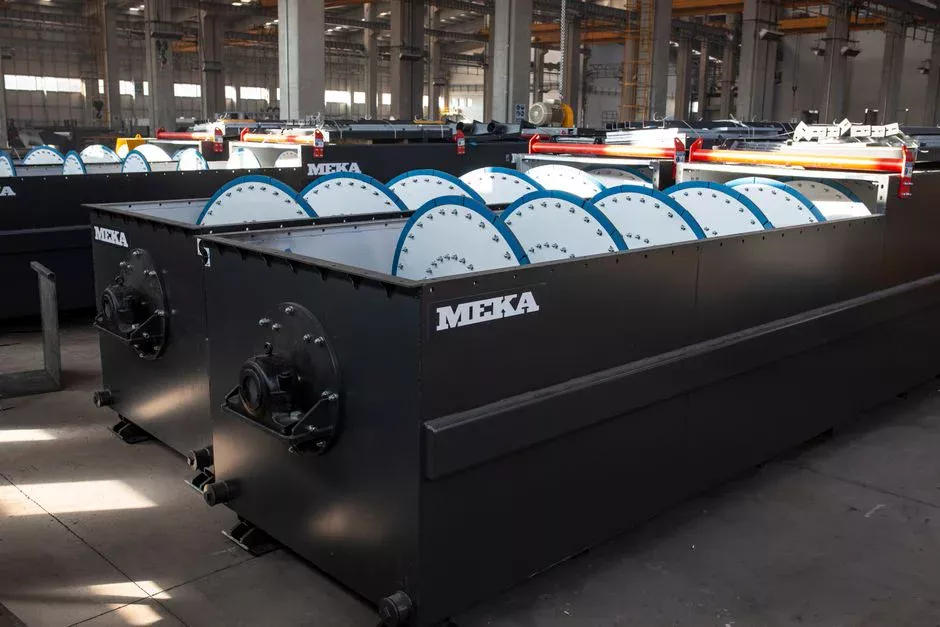
The single biggest configuration decision before specifying equipment is whether chemistry goes in before or after the flotation cell. For potato starch water in 2026, pre-coagulation DAF — coagulant and polymer dosed into a floc tube upstream of the flotation cell, with the DAF carrying both reaction and separation in a single tank — is the default for greenfield plants. Footprint is smaller, CAPEX is lower, and a well-tuned single pass delivers 60–80% TSS removal with a dry, handleable float.
Post-coagulation DAF (raw water into the cell first, chemistry injected downstream into the clarified stream) is rarely specified for starch because uncoagulated starch granules have a settling velocity that competes with the bubble rise rate, so a meaningful fraction of the particulate load drops to the bottom of the cell and has to be scraped out as sludge rather than carried up as float. It is mentioned here only to dismiss it.
When the float is destined for protein recovery rather than waste sludge, the configuration shifts to a two-stage coagulation DAF: a primary coag dose inside the cell to capture the bulk starch granules, followed by a lighter secondary polymer polish on the float side or on a slipstream of clarified water. The reason is operational, not chemical — overdosing polymer in a single step binds the protein into the floc so tightly that downstream release (acid precipitation, isoelectric solubilization, or membrane concentration) becomes uneconomic. The mild primary + targeted secondary approach keeps the protein recoverable.
Reuse, Discharge, or Protein Recovery: Choosing the DAF Train
The DAF itself is identical in all three routes; what changes is the unit operation bolted onto its clarified-water outlet and the chemistry inside the cell. The table below is the decision block an engineer should use in a 2026 CAPEX/OPEX review.
| Route | Downstream train | DAF configuration note | When to choose |
|---|---|---|---|
| A — Discharge | DAF → equalization → anaerobic (UASB/IC) → aerobic (MBBR/activated sludge) → clarifier | Standard pre-coag, anionic polymer 1–5 mg/L | Plant is discharge-licensed; no reuse demand; lowest CAPEX route to compliance |
| B — Process water reuse | DAF → integrated MBR system (or DAF → UF) → optional RO polish | Tighter hydraulic loading (10–15 m/h) to protect membranes; lower polymer dose to avoid irreversible membrane fouling | Plant has a water-scarcity driver or a corporate reuse KPI; cooling-tower or CIP-loop make-up is the target |
| C — Protein recovery | DAF (mild coag, two-stage) → float thickening to 4–8% DM → sale as animal-feed protein | Mild primary coag, cationic or low-dose anionic polymer, dedicated float thickening skid | Plant produces > 2 t/d protein-rich float; byproduct credit offsets 5–15% of treatment OPEX (engineering estimate, project-specific) |
DAF alone cannot meet EU BREF Food, Drink and Milk limits or China GB 8978-1996 starch-industry discharge on a fruit water stream; the biological or membrane stage is mandatory. The protein-recovery literature (Dabestani et al. 2017, via Environmental Science and Pollution Research) treats membrane capture as the reference route — the contribution of this configuration matrix is showing that DAF is the cheapest pre-concentration step before any membrane, not a competitor to it. For boiler-feed or high-purity reuse targets, a downstream RO stage (see RO water purification) is added on top of Route B.
Operating Tips That Determine Whether DAF Actually Performs
A DAF that meets the datasheet on day one can drift 20–30% off its TSS removal within a month if the operating envelope is not held. Five parameters matter in day-to-day practice.
- Skimmer speed and weir overflow: skimmer rotation 0.5–1.5 m/min is the working band; too fast and the float re-entrains into the clarified stream, too slow and the float compacts, traps water, and slides back. The weir must be sized so the float crosses it without turbulence — a simple V-notch with a small baffle works for most flows in the 50–200 m³/h band.
- Saturator water quality: use clarified effluent, not raw water, as the recycle to the saturation pump. Raw water carries starch granules and protein that clog nozzle orifices and shift the bubble-size distribution toward 100+ μm, which collapses the removal rate on protein.
- Temperature compensation: starch fruit water at 30–45 °C improves flocculation kinetics but reduces dissolved-air solubility by roughly 15–25% versus 20 °C. Compensate by raising saturator pressure by 0.5–1 bar in summer, or by chilling the recycle on a closed-loop heat exchanger if the temperature swings seasonally by more than 15 °C.
- pH window: 5.5–7.5 for PAC, 6.0–8.5 for FeCl₃. Outside these, floc becomes fragile and float carries over into the clarified stream — visible as a milky TSS spike on the outlet turbidity meter.
- Polymer freshness and dilution: anionic polyacrylamide aged more than 48 h at 0.1–0.3% concentration loses 20–40% of its active charge; dose from a fresh make-up tank and keep the inline dwell under 60 s before the floc tube.
These operating rules are the same ones that govern food-processing DAF in other sectors; a more general treatment is in our food processing wastewater engineering specs reference, which uses the same envelope applied to Australian EPA discharge targets.
2026 Compliance Map: What the DAF Clarifier Must Let the Plant Hit
DAF effluent numbers in this matrix — 60–85% TSS removal, 30–50% COD removal — sit well above every realistic discharge or reuse limit, so the compliance question is what the biological or membrane stage behind the DAF must achieve, not what the DAF itself must clear.
- China GB 8978-1996 (starch industry, second-class): COD ≤ 150 mg/L, BOD ≤ 30 mg/L, SS ≤ 200 mg/L at the discharge point. DAF effluent is well above this — a full anaerobic + aerobic train is mandatory, with the DAF as a protective front end.
- EU BREF for Food, Drink and Milk Industries (2019, 2026 updates): COD discharge typically 25–125 mg/L after on-site treatment, depending on the receiving water body. DAF effluent must be biologically polished; a well-tuned MBR can land at the lower end of that range.
- US local POTW: governed by pretreatment limits set by the receiving utility — typically 250–750 mg/L COD, 200–500 mg/L TSS, with fats/oils/grease caps. DAF effluent usually meets the TSS cap; BOD/COD caps still require biological or MBR polish.
- Reuse standards for cooling-tower make-up (typically < 50 mg/L COD, < 1 NTU turbidity) and boiler feed (much tighter) require RO or equivalent after the DAF and the MBR.
The compliance map forces the design choice: DAF alone is never the answer. It is the answer to "how do I protect and stabilize everything downstream."
Frequently Asked Questions
Q1: What saturator pressure should a DAF run at for potato starch water?
5–7 bar, with 6 bar as the 2026 default. The lower end (4–5 bar) is acceptable only if influent TSS is below 1,000 mg/L; the upper end (6–7 bar) is required when protein capture is a target, because the protein fraction needs the higher bubble density to float reliably.
Q2: What recycle ratio does a starch-water DAF need?
20–40% of throughput. Push to the upper end (30–40%) on protein-loaded streams where fine-bubble contact is the rate-limiting step; the lower end (20–25%) is acceptable for TSS-only polishing downstream of an existing primary clarifier.
Q3: Which polymer type and dose is the 2026 default for starch water?
Anionic polyacrylamide at 1–5 mg/L, dosed at the flocculation stage. Cationic polymer is the 2026 alternative for very high protein streams, where it avoids the overdose window that anionic polymer falls into when protein capture is the goal rather than solids settling.
Q4: Can DAF alone meet a discharge limit on potato starch water?
No. DAF removes 60–85% TSS and 30–50% COD — enough to protect and stabilize a downstream biological or MBR train, not enough to clear GB 8978-1996, EU BREF, or typical US POTW caps on its own. An anaerobic + aerobic train, or an MBR, is mandatory downstream.
Q5: Is the protein float worth recovering in 2026 economics?
Yes, at plants producing more than about 2 t/d of protein-rich float. The float thickens to 4–8% dry matter and sells as animal-feed protein, offsetting an estimated 5–15% of treatment OPEX (engineering estimate, project-specific). Below that throughput, the thickening and handling cost typically consumes the credit.
Related Equipment
- PLC-controlled coagulant and polymer dosing skid — specifications, capacity range, and technical data