Why Tea Processing Wastewater Is Unusual for a Decanter Centrifuge
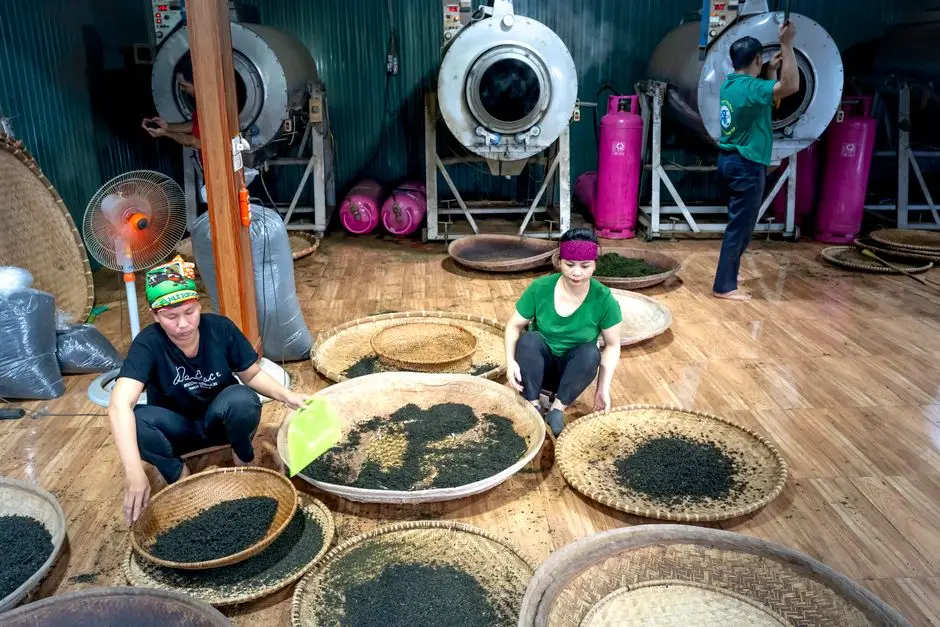
Tea effluent is not a generic food-industry stream, and pricing it as one is the most common budget error. Black and green tea withering, rolling, fermentation, and washing steps release a sludge load that is simultaneously organic, fibrous, and chemically aggressive: COD 1,800–6,500 mg/L, TSS 800–3,500 mg/L, pH 4.5–6.8, and polyphenol load 200–900 mg/L (HydropureWater field data, 2025–2026). The dissolved and colloidal polyphenols — catechins, theaflavins, thearubigins — make the solids sticky and tend to blind standard filter media within hours. A substantial fraction of the leaf-fine fraction sits below 75 µm, which means settling is slow and the bowl has to do the work that gravity cannot.
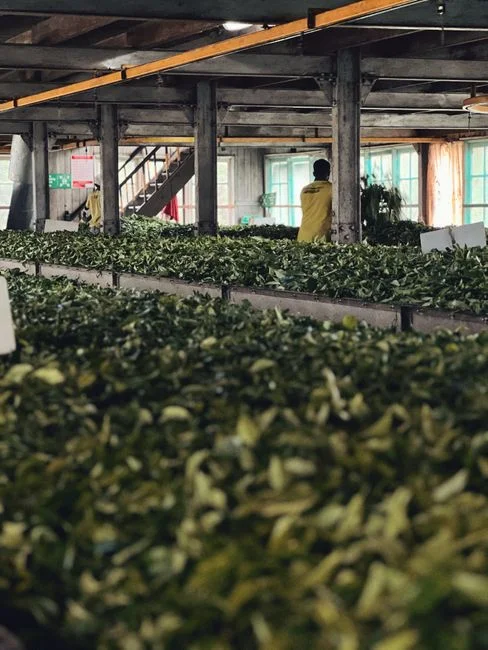
Three engineering consequences follow. First, the bowl needs ≥3,000 × g of relative centrifugal force, higher than the 1,800–2,500 × g typical of dairy or brewery duty, just to achieve a usable clarifying rate. Second, the scroll differential has to be steep — ≥25 rpm relative to bowl speed — to move the sticky cake forward without re-flooding the clarifying zone. Third, sizing to mean dry-season flow is wrong: peak monsoon flow at Sri Lankan, Assamese, and Kenyan estates runs 2.2–2.8× the dry-season average (industry hydrology data, 2024 monsoon season), and any unit that cannot pass that peak will trip on TSS, not on hydraulic capacity. In practice, a DAF pre-treatment for tea wastewater almost always sits upstream to drop bulk TSS to 200–500 mg/L and protect the bowl from runaway solids loading.
How a Decanter Centrifuge Dewaters Tea Sludge
A decanter centrifuge is a horizontal solid-bowl machine with an internal scroll rotating a few rpm faster (or slower, in some designs) than the bowl. Feed enters through a central tube, solids settle against the bowl wall under high G, and the scroll conveys them toward the conical end where they discharge as cake. The clarifying liquid — the centrate — overflows at the opposite end through adjustable weir plates.
For tea plants, 2-phase (liquid + cake) is the standard configuration. 3-phase (oil/water/solids) is only relevant if an upstream oil-bearing pre-stream exists — uncommon in black or green tea, more common in instant-tea lines where condensate carries essential oils. The core sizing relationship is Q ≈ vg × A, where hydraulic capacity Q scales with particle settling velocity vg and the bowl's clarifying area A. Because tea fines settle slowly, increasing A by going to a larger bowl diameter raises throughput faster than simply turning a small bowl faster — a key reason the 320–360 mm bowl is the workhorse for mid-size factories.
The "nominal flow" on a data sheet is also misleading. A unit rated for 100 GPM of thin wastewater will realistically process only about 20 GPM of thick, high-TSS tea sludge (per the standard industry rule of thumb, 2024). Working the numbers back from a 25¢/kWh / 5 GPM / 300 gal/h example cited in the general decanter literature, the equivalent power draw for tea duty lands at 4–9 kWh/m³ — the figure we use for OPEX in the next sections.
2026 CAPEX: What a Decanter Centrifuge for Tea Wastewater Actually Costs
The general industry range is $50,000 for a small new machine to over $1,000,000 for a large industrial unit, with remanufactured units at 40–60% of new price (decanter market data, 2024). That spread is too wide to budget against. Narrowed to tea duty and 2026 pricing, the realistic bands by bowl diameter and design flow look like this:
| Bowl diameter | Typical tea-plant design flow | 2026 new price (USD, FOB) | Remanufactured (40–60% of new) |
|---|---|---|---|
| 220–280 mm | 2–6 m³/h | $35,000–$65,000 | $14,000–$39,000 |
| 320–360 mm | 8–18 m³/h | $70,000–$120,000 | $28,000–$72,000 |
| 400–500 mm | 20–45 m³/h | $140,000–$280,000 | $56,000–$168,000 |
These are bare-unit numbers. Real 2026 budgets almost always carry adders: an ABB or Siemens VFD adds $4,000–$9,000, 316L stainless scroll and conveyor parts add $8,000–$18,000 (non-negotiable for polyphenol-rich tea effluent), explosion-proof panels for solvent-flush areas add $6,000–$14,000, and a full PLC with remote telemetry adds $5,000–$11,000. Add a polymer dosing skid for the centrifuge and the upstream DAF pre-treatment for tea wastewater and the installed system lands at 1.35–1.6× the bare FOB price. A $100,000 bowl becomes a $135,000–$160,000 installed line. Remanufactured units are tempting but carry a known risk for "no-name" overseas makes, where the buyer depends on a single source for spares and lead times stretch into months (decanter market data, 2024).
2026 OPEX: Power, Polymer, Wear Parts and Labour
Operating cost runs $0.04–$0.22 per cubic metre treated for a tea-duty decanter, and four lines drive the number. Power is the most visible: 4–9 kWh/m³ at the 2026 industrial tariffs of $0.08–$0.14/kWh in India, Sri Lanka, Kenya, and southern China translates to $0.32–$1.26/m³. Polymer — cationic polyacrylamide (CPAM), 2–6 kg per tonne of dry solids at typical tea TSS — is the dominant OPEX line, normally 35–55% of the total, at $0.018–$0.038/m³ depending on dose and regional CPAM price.
Wear parts (scroll flights, conveyor tip inserts, feed-port liners) are replaced on a 8,000–14,000 hour cycle. Budget $1,800–$4,200/year for a mid-size 320 mm unit running 6,000 hours annually. Lubricant, seal-flush water, and operator time bundle to $0.012–$0.028/m³.
| OPEX line | Unit rate (2026) | Per m³ treated | Share of OPEX |
|---|---|---|---|
| Power | $0.08–$0.14/kWh | $0.32–$1.26 | Variable |
| Polymer (CPAM) | 2–6 kg/tDS | $0.018–$0.038 | 35–55% |
| Wear parts (annualised) | $1,800–$4,200/yr | $0.015–$0.035 | 10–18% |
| Lubricant + water + labour | Bundled | $0.012–$0.028 | 8–15% |
| Total OPEX band | — | $0.04–$0.22/m³ | 100% |
Worked example: a 10 m³/h tea plant on a 320 mm bowl, running 6,000 hours/year, lands at roughly $0.11/m³ → $6,600/year in OPEX before polymer, and $11,000–$18,000/year with polymer. For a like-for-like benchmark, our filter press operating cost benchmark shows a plate and frame press typically runs 25–40% higher on polymer but lower on power — a useful cross-check if you are comparing the two technologies. The plate and frame filter press alternative is worth evaluating on lines below 6 m³/h.
Sizing and Selection Framework for Tea Plants
Five steps separate a defensible 2026 budget from a guess. First, lock the design flow to the peak wet-season rate, not the annual mean, and apply a 1.4–1.6× safety factor on top. This single decision shifts the price band by $30,000–$80,000 — skipping it is the most expensive mistake in the room. Second, match bowl diameter to design flow using the table below. For most 8–14 m³/h mid-size tea factories, the 320 mm bowl is the sweet spot between CAPEX and cake-dryness performance.
| Design flow (m³/h) | Recommended bowl diameter | Typical main-drive power | Expected cake DS |
|---|---|---|---|
| 2–6 | 220–280 mm | 7.5–15 kW | 20–25% |
| 8–14 | 320 mm | 22–30 kW | 22–28% |
| 15–18 | 360 mm | 30–45 kW | 23–28% |
| 20–45 | 400–500 mm | 45–90 kW | 24–30% |
Third, specify 316L stainless on the scroll, conveyor, and all wetted solids-contact parts; standard duplex or carbon-steel scrolls pit within 12–18 months on polyphenol-bearing effluent. Fourth, choose 2-phase (default) or 3-phase (only if an oil-bearing pre-stream is present upstream). Fifth, confirm that the polymer dosing skid for the centrifuge is skid-mounted, PLC-interlocked with the backdrive, and tied to the upstream DAF pre-treatment for tea wastewater — without that interlock, throughput drops 15–25% during peak shift.
Payback and ROI: Discharge Compliance vs Water Reuse
The equipment decision is really a financial decision between two outcomes. In the compliance-only scenario, where the centrifuge delivers centrate that meets local discharge norms (typically COD ≤250 mg/L and TSS ≤100 mg/L for Indian CPCB and Sri Lankan CEA standards, 2024 thresholds), payback runs 3.5–6 years for a mid-size plant at 2026 energy and polymer prices. The saving comes mostly from avoided sludge-haul cost ($18–$40/t wet cake, region-dependent) and reduced effluent surcharge.
In the reuse-driven scenario, the centrate is polished through an RO system for boiler or CIP water — often paired with an MBR polishing stage upstream of the RO to drop SDI. Reuse value offsets $0.40–$0.85/m³ of freshwater, and payback shortens to 1.8–2.8 years. The working formula is:
Annual savings = (Freshwater cost × reused volume) + (Sludge-haul saving at $18–$40/t wet cake) − Annual OPEX
Worth noting for the procurement file: the global decanter centrifuge market was valued at $2.1B in 2025 and is projected to reach $3.1B by 2034 at 4.8% CAGR (decanter market research, 2025-06). That trajectory means spares availability, VFD integration, and regional service coverage in tea-producing regions will all improve through 2026, which favours a 2026 purchase over a 2027–2028 deferral.
Frequently Asked Questions
What is the 2026 price of a decanter centrifuge for a 10 m³/h tea wastewater line? A 320 mm bowl sized for 8–18 m³/h runs $70,000–$120,000 new (FOB), or $95,000–$165,000 installed with skid, cabling, civil works, and a polymer dosing skid.
How much polymer does a tea wastewater decanter need? 2–6 kg of cationic polyacrylamide per tonne of dry solids, depending on influent TSS and target centrate clarity. Polymer is typically 35–55% of total OPEX.
Can a small $50,000 decanter handle a tea plant? Only for ≤4 m³/h with low seasonal swing. At 8–14 m³/h with monsoon peaks, a 220–280 mm unit shows 25–40% throughput shortfall and centrate clarity above 800 mg/L TSS.
What cake dryness can I expect from tea sludge? 22–28% DS with proper polymer conditioning and a ≥25 rpm scroll differential. Below 18% DS indicates insufficient differential or under-conditioned feed.
How long is the payback? 1.8–2.8 years in a reuse-driven configuration (centrate to RO), 3.5–6 years in a discharge-compliance-only configuration. For broader food-industry context, our food-industry wastewater equipment guide covers adjacent effluent profiles.
Related Equipment
- plate and frame filter press alternative — specifications, capacity range, and technical data