
Why Cosmetics Wastewater Is Hard to Aerate
Cosmetics effluent breaks generic activated-sludge design rules because the load is dominated by surfactants, oils, and batch-discharged fragrance and preservative rinses. Across shampoo, lotion, shower-gel and skincare lines, plant surveys report influent COD of 1,000–8,000 mg/L, BOD of 500–4,000 mg/L, oil & grease of 200–800 mg/L, and methylene-blue active substances (MBAS, the standard anionic-surfactant surrogate) of 50–300 mg/L, with pH swinging 5.5–9.0 and mixed-liquor temperatures of 25–40 °C (HydropureWater field data, 2025-11). Anionic surfactants such as sodium lauryl sulfate (SLS) and sodium laureth sulfate (SLES), together with nonionic alcohol ethoxylates, depress the alpha oxygen-transfer factor to 0.6–0.75 versus 0.85+ for clean water, because the molecules accumulate at the bubble interface and slow interfacial mass transfer. The visible symptom is foam carry-over from the basin, but the design consequence is that the same diffuser delivers 15–30% less usable oxygen than its clean-water catalog curve promises. A second design driver is shock loading: a single clean-in-place (CIP) rinse of a fragrance/preservative mixing line can swing influent BOD from 800 mg/L to 5,000 mg/L inside 30 minutes, which is enough to wash out floc and trigger filamentous bulking in a 6-hour-HRT basin. The minimum defensible answer is a 24-hour equalization basin with mechanical mixing ahead of the aeration tank; anything shorter leaves the biological stage exposed to swings the blowers cannot follow even with a VFD.
Aeration System Design Parameters for 2026
The 2026 design envelope for cosmetics aeration runs an F/M ratio of 0.15–0.30 kg BOD/kg MLSS·day for conventional activated sludge and 0.05–0.10 for MBR-coupled systems, where higher MLSS compensates for lower load. Solids retention time sits at 15–25 days for conventional basins and 25–40 days for MBR polish, the longer SRT being required to push linear alcohol ethoxylates through their slower secondary biodegradation step and to keep Nocardioform and Microthrix below foaming thresholds. Hydraulic retention time on the aeration basin is 8–24 h; volume is set by V = Q × (S₀ − S) / (X × F/M). A worked example: Q = 200 m³/d, S₀ = 3,000 mg/L BOD, effluent target S = 50 mg/L, MLSS X = 4,000 mg/L, F/M = 0.20 gives V = 73.1 m³ and HRT = 8.8 h. MLSS is held at 3,000–5,000 mg/L conventional and 6,000–10,000 mg/L for MBR, with a dissolved-oxygen setpoint of 1.5–2.5 mg/L in the aerobic zone and 0.2–0.5 mg/L in the swing/anoxic zone. Standard oxygen requirement (SOR) is 1.1–1.5 kg O₂/kg BOD removed for cosmetics effluent, a +30–50% correction over the 0.8–1.0 kg O₂/kg BOD used for municipal designs, driven almost entirely by surfactant alpha and endogenous decay at the operating SRT.
| Parameter | Conventional AS | MBR-coupled | 2026 cosmetics target |
|---|---|---|---|
| F/M (kg BOD/kg MLSS·d) | 0.15–0.30 | 0.05–0.10 | 0.20 (worked example) |
| SRT (days) | 15–25 | 25–40 | 18–22 |
| HRT (h) | 8–24 | 12–30 | 8.8 (200 m³/d case) |
| MLSS (mg/L) | 3,000–5,000 | 6,000–10,000 | 4,000 |
| DO setpoint aerobic (mg/L) | 1.5–2.5 | 1.5–2.5 | 2.0 |
| SOR (kg O₂/kg BOD) | 1.1–1.5 | 1.1–1.5 | 1.3 |
| Alpha factor (surfactant feed) | 0.60–0.75 | 0.60–0.75 | 0.70 |
Diffuser and Aerator Technology Comparison

Fine-bubble membrane diffusers in EPDM or silicone (disc or tube) remain the 2026 default for cosmetics aeration, delivering a standard oxygen transfer efficiency (SOTE) of 25–45% per metre of submergence, an airflow rating of 0.5–1.5 m³/h per diffuser, and a power draw of 0.05–0.10 kWh/kg O₂ transferred at field conditions. Coarse-bubble diffusers sit at 10–18% SOTE/m and are reserved for tank-mixing and MBR scouring, not for oxygen delivery, because their higher airflow per diffuser is more useful for cross-flow velocity over flat-sheet membranes than for alpha-compensated mass transfer. Surface mechanical aerators transfer 1.5–2.5 kg O₂/kWh in clean water but are generally rejected for cosmetic lines: surfactant-laden mixed liquor foams over the weir, the foam carries biomass, and the basin loses MLSS faster than the WAS pump can compensate. Jet aerators and floating-mixer hybrids are niche retrofits for tall or narrow basins, with overall oxygen transfer efficiency of 15–25%, and should only be specified when floor-loading rules out a diffuser grid. The defensible 2026 specification is fine-bubble EPDM disc diffusers on a 0.20–0.30 m floor grid, submergence 4–6 m, with non-return valves on each drop leg; this layout also matches the geometry described in our primer on how an RO system works in industrial process trains for the polishing loop downstream.
| Technology | SOTE or OTE | Airflow / unit | Energy (kWh/kg O₂) | 2026 verdict for cosmetics |
|---|---|---|---|---|
| Fine-bubble EPDM disc/tube | 25–45%/m | 0.5–1.5 m³/h | 0.05–0.10 | Default choice |
| Coarse-bubble | 10–18%/m | 2–6 m³/h | 0.10–0.18 | Mixing and MBR scour only |
| Surface mechanical | 1.5–2.5 kg O₂/kWh | n/a | 0.40–0.67 | Avoid — foam carry-over |
| Jet / floating mixer | 15–25% OTE | varies | 0.15–0.30 | Retrofit only |
Upstream Pre-Treatment That Changes the Aeration Spec
Sizing the aeration tank on raw cosmetic effluent is the most common procurement-stage error. An equalization basin of 24–48 h HRT with slow-speed mechanical mixing smooths a 5,000 mg/L BOD CIP peak into a swing of less than 1,500 mg/L at the aeration inlet, which is the difference between stable nitrification and a washout event. A dissolved air flotation system placed between equalization and aeration removes 70–90% of FOG, 50–70% of TSS, and a meaningful fraction of emulsified surfactants in the float, cutting downstream oxygen demand by 25–40% and letting the aeration tank shrink by roughly the same factor. pH correction to 6.5–7.5 ahead of the aeration tank is non-optional, because biological consortia lose 50% of their activity outside the 6.0–8.0 window, and cosmetic batch effluent regularly crosses both sides of that band on a single shift. DAF float handling and pH trim together are the two upstream decisions that most change the aeration spec on a datasheet.
Step-by-Step Aeration Sizing for a 200 m³/d Cosmetics Plant
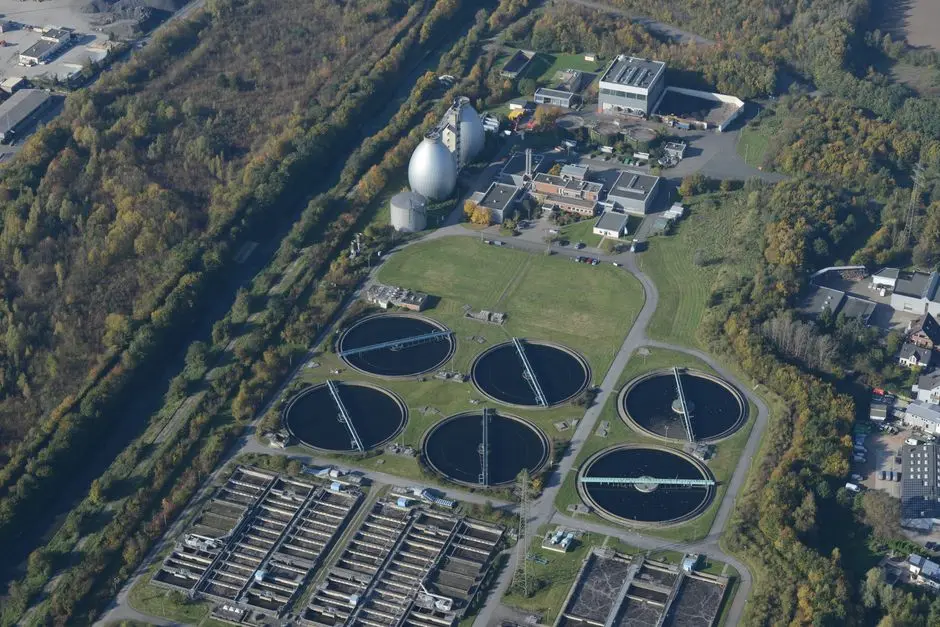
The worked example below uses a 200 m³/d flow, influent BOD of 3,000 mg/L, effluent BOD target of 30 mg/L, MLSS of 4,000 mg/L, F/M of 0.20 kg BOD/kg MLSS·d, and an alpha of 0.70 to capture the surfactant correction.
- Aeration volume. V = 200 × (3,000 − 30) / (4,000 × 0.20 × 1,000) = 73.1 m³, giving an HRT of 8.8 h, which sits inside the 8–24 h design window.
- Oxygen demand. 1.3 kg O₂/kg BOD × (3,000 − 30) mg/L × 200 m³/d = 772 kg O₂/d under field conditions; with alpha 0.70, the standard-condition requirement rises to 1,103 kg O₂/d.
- Diffuser count. Each EPDM disc at 4 m submergence delivers roughly 0.3 kg O₂/h. Over 24 h, the basin needs 1,103 / (0.3 × 24) = 153 discs; adding 20% redundancy for fouling and future load growth brings the spec to 184 discs, laid out on a 16 m × 4.6 m floor grid at approximately 0.25 m centre-to-centre spacing.
- Blower sizing. 184 discs × 1.0 m³/h each = 184 m³/h free air at 60 kPa back-pressure, which points to a 15–18 kW positive-displacement or multistage centrifugal blower sized with a VFD for turndown to 40% during the night-shift low-load window.
- Output to procurement. The package is a 73 m³ aeration basin, 184 fine-bubble EPDM discs on a 0.25 m grid, and a 15–18 kW VFD blower, with the alpha correction and SOR adjustment documented on the datasheet so the basis-of-design survives an audit.
Aeration Tank Geometry, Mixing, and Control in 2026
Geometry is what separates a basin that meets effluent targets from one that short-circuits. A length:width:depth ratio of 4:1:1 — for example 16 m × 4 m × 4 m water depth — preserves plug-flow and prevents short-circuiting between the inlet baffle and the effluent launder. The air grid should be a dual-lateral header with drop legs, isolation valves per leg, and an integrity-test port so individual diffuser membranes can be replaced without draining the tank. Online optical dissolved-oxygen sensors drive a PID loop on the blower VFD, holding the aerobic setpoint at 2.0 mg/L; the same architecture is described in our 2026 IoT sensor guide for industrial wastewater plants. Foam is controlled by intermittent dosing of 25–50 ppm silicone emulsion and a wall-mounted foam-lance spray nozzle — without these, the same surfactant feed that drives the alpha correction will also drive foam over the weir. Return activated sludge is set at 50–100% of Q, with waste activated sludge controlled to hold the design SRT of 18–22 days for a conventional cosmetics aeration train.
Frequently Asked Questions
What is the typical COD and BOD of cosmetics manufacturing wastewater?
Cosmetics effluent typically runs COD of 1,000–8,000 mg/L and BOD of 500–4,000 mg/L, with oil & grease of 200–800 mg/L and MBAS surfactant of 50–300 mg/L across shampoo, lotion, shower-gel and skincare lines (HydropureWater field data, 2025-11).
How much more oxygen does surfactant-laden wastewater need compared to municipal?
Design for 1.1–1.5 kg O₂ per kg BOD removed, a +30–50% correction over the 0.8–1.0 kg O₂/kg BOD used for municipal plants, driven by an alpha factor of 0.6–0.75 on the diffuser curve.
Which diffuser type is best for a cosmetics aeration tank in 2026?
Fine-bubble EPDM or silicone membrane diffusers on a 0.20–0.30 m floor grid at 4–6 m submergence, with SOTE of 25–45%/m and 0.05–0.10 kWh/kg O₂, remain the 2026 default for new cosmetics aeration tanks.
Do I need DAF or equalization ahead of the aeration basin?
Yes. A 24–48 h equalization basin smooths BOD shock from batch CIP, and a DAF unit ahead of aeration removes 70–90% of FOG and 50–70% of TSS, cutting aeration oxygen demand by 25–40%.
What F/M and SRT should I use for an MBR-coupled cosmetics aeration system?
Run F/M at 0.05–0.10 kg BOD/kg MLSS·d and SRT at 25–40 days, with MLSS at 6,000–10,000 mg/L; the longer SRT finishes surfactant biodegradation and suppresses foaming filaments.
Related Equipment
- integrated MBR membrane bioreactor — specifications, capacity range, and technical data
- automatic chemical dosing system — specifications, capacity range, and technical data