Why Ion Exchange Belongs in an Electroplating Wastewater Train
Ion exchange for electroplating wastewater is a recovery and polishing unit, not a stand-alone treatment. It closes two problems metal-finishing plants cannot separate: regulatory discharge limits and raw-material cost. GB 21900-2008 sets Cr(VI) at 0.5 mg/L and total Cr at 1.5 mg/L. The U.S. EPA 40 CFR 413/433 framework imposes comparable metal ceilings for electroplating point sources. A single drag-out rinse tank typically carries 5–500 mg/L Cu²⁺ and 10–300 mg/L Ni²⁺. At LME-tracked prices those dissolved grams leave the building as unpriced inventory.
An ion exchange system polishes rinsewater after Cr(VI) reduction and alkaline precipitation. It recovers Cu²⁺, Ni²⁺, Zn²⁺, and Cd²⁺ that would otherwise lock into filter cake. Beds typically run at 8–15 BV/h and 1.0–1.5 m depth, targeting Cu/Ni below 0.5 mg/L. Acid regeneration yields a 5–10× brine for electrowinning.
Mechanistically, the resin starts loaded with benign counter-ions (H⁺, Na⁺). During service, divalent target metals displace those ions and accumulate on the bead. Acid or salt regeneration strips them as concentrated brine. The Open Access Library study on a three-compartment electrodialysis cell using Purolite A100 and C150 acrylic ion-exchange membranes confirmed copper extraction above 70% across the operating window examined. That result remains a clean proof point for Cu recovery from authentic rinsewater matrices. In a 2026 hybrid train, IX almost never runs on raw rinsewater. It polishes the supernatant after Cr(VI) reduction and alkaline precipitation.
Resin Chemistry: Four Families and the Metals They Target
Resin selection is the single most consequential decision in IX system design. Four commercial families map cleanly onto the metals an electroplating plant actually discharges. The strong-acid cation (SAC) resin uses sulfonic acid groups, typified by Purolite C100 and Amberlite IR120. It is the workhorse for bulk divalent removal (Cu²⁺, Ni²⁺, Zn²⁺) with a total capacity of 1.8–2.2 eq/L. It has limited selectivity in high-Ca/Mg matrices. In the Na form it will load calcium before the target metal. The weak-acid cation (WAC) resin uses carboxylic acid groups, e.g., Purolite C104. It regenerates efficiently with H₂SO₄ at near-neutral pH. WAC is the right pick for rinsewater with high alkalinity, where SAC would consume excessive regenerant.
The chelating resin is the precision tool. Iminodiacetic acid (Purolite S930, Lewatit TP207) or aminomethylphosphonic acid (Lewatit TP260) groups hold trace heavy metals even with up to 2 g/L of alkaline-earth chlorides and sulfates. The Russian Journal of Applied Chemistry work on S-930 showed it outperformed KU-2 universal cation exchanger for nonferrous-metal recovery in exactly this high-TDS regime. The strong-base anion (SBA) resin — quaternary ammonium, e.g., Purolite A400, Amberlite IRA 900 — is the only family that loads Cr(VI) as HCrO₄⁻/CrO₄²⁻ after oxidation. It regenerates with NaCl or NaOH. A newer 2026 procurement option is the magnetic ion-exchange resin covered in the Springer chapter by Bolto and Pawlowski. The iron-oxide core improves kinetics and can cut vessel size by 30–50% versus gel resins at the same throughput. Plants that already operate an Industrial Water Softener System (KJ-WT Series) often reuse the same regenerant handling and vessel piping practices on the cation IX skid.
| Resin Family | Functional Group | Example Products | Target Metals | Capacity (eq/L) | Regenerant |
|---|---|---|---|---|---|
| Strong-acid cation (SAC) | Sulfonic acid | Purolite C100, Amberlite IR120 | Cu²⁺, Ni²⁺, Zn²⁺, Cd²⁺ (bulk) | 1.8–2.2 | HCl or H₂SO₄ |
| Weak-acid cation (WAC) | Carboxylic acid | Purolite C104 | Cu²⁺, Ni²⁺, Zn²⁺ at high alkalinity | 3.0–4.0 | H₂SO₄ (near-neutral) |
| Chelating (IDA / AMP) | Iminodiacetic / aminomethylphosphonic | Purolite S930, Lewatit TP207, TP260 | Trace Cu, Ni, Zn, Cd in high TDS | 1.0–1.4 | H₂SO₄ or HCl |
| Strong-base anion (SBA) | Quaternary ammonium | Purolite A400, Amberlite IRA 900 | Cr(VI) as HCrO₄⁻/CrO₄²⁻ | 1.0–1.4 | NaCl or NaOH |
| Magnetic ion exchange | SAC + Fe₃O₄ core | MIEX (various) | DOC, trace metals | 0.8–1.2 | NaCl |
Which ion exchange resin removes copper best?
Chelating resins with iminodiacetic or aminomethylphosphonic groups remove copper best when rinsewater carries high Ca/Mg or TDS above about 2 g/L. For bulk Cu²⁺ on cleaner matrices, SAC resins at 1.8–2.2 eq/L remain the lower-cost workhorse. Most plants we size for copper rinse lines run chelating beds when effluent must stay below 0.5 mg/L Cu after precipitation. SAC beds suit higher Cu loads above roughly 200 mg/L when calcium competition is low. Match the functional group to the matrix before you lock vessel diameter.
Process Design: Ion Exchange for Electroplating in a 2026 Train
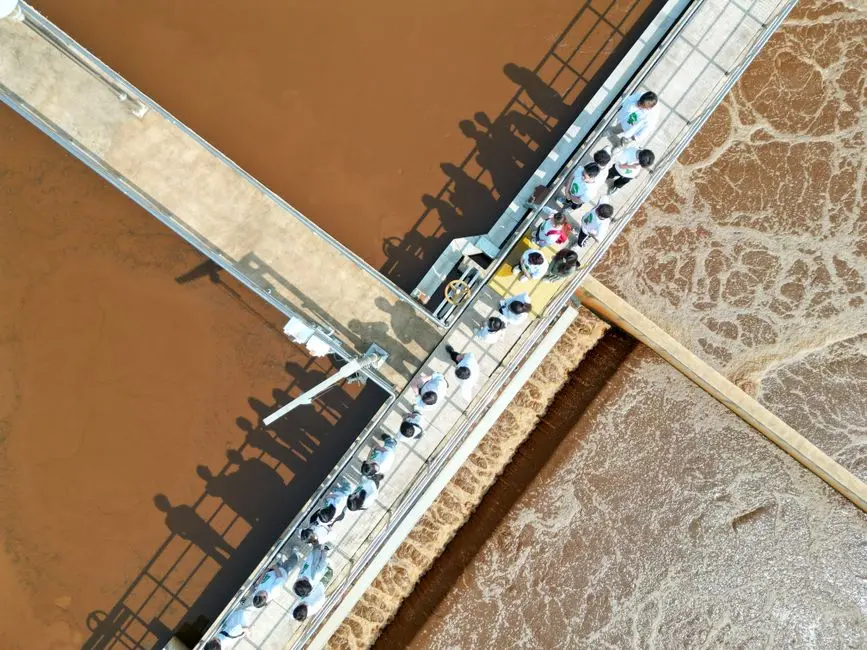
The 2026 process flow for a Cr(VI)/Cu/Ni rinsewater line is a five-step train. IX belongs in the back half — never on raw, never on overflow. Step 1 is Cr(VI) reduction with NaHSO₃ or FeSO₄ at pH 2.0–3.0, with a 30-minute residence. This is the same acidic regime in which the Fenton–alternating-current electrocoagulation work reported 94.21% COD removal, confirming the matrix is workable. Step 2 is alkaline precipitation with NaOH or Ca(OH)₂ at pH 8.5–9.5. That step drops Cr(OH)₃, Cu(OH)₂, and Ni(OH)₂ out of solution. The resulting sludge is dewatered on a plate-and-frame filter press for the upstream precipitation sludge. Step 3 is multi-media pre-filtration ahead of the ion exchange bed, targeting <5 NTU to keep suspended solids off the resin. Step 4 is the IX polishing train itself: a two-stage cation + anion sequence at 8–15 BV/h with 1.0–1.5 m bed depth. Size it for an 8–24 hour service run on typical rinsewater. Step 5 is regeneration. 5–10% H₂SO₄ on the cation bed yields a 5–10× concentrated Cu/Ni brine for electrowinning. The anion bed regenerates with NaCl or NaOH to release Cr(VI) for re-reduction and precipitation upstream. Automatic chemical dosing for regenerant and pH control keeps regeneration reproducible. Manual dosing on a regeneration skid is the single most common cause of capacity loss in the field.
| Step | Unit Operation | Key Reagent / Condition | Target Outcome |
|---|---|---|---|
| 1 | Cr(VI) reduction | NaHSO₃ or FeSO₄, pH 2.0–3.0, 30 min | Cr(VI) → Cr(III) |
| 2 | Alkaline precipitation | NaOH or Ca(OH)₂, pH 8.5–9.5 | Cr(OH)₃, Cu(OH)₂, Ni(OH)₂ sludge |
| 3 | MMF pre-filtration | Sand/anthracite/garnet | <5 NTU to IX bed |
| 4 | IX polishing | 8–15 BV/h, 1.0–1.5 m bed depth | Cu/Ni <0.5 mg/L, Cr(VI) <0.1 mg/L |
| 5 | Regeneration + recovery | 5–10% H₂SO₄ (cation), NaCl/NaOH (anion) | 5–10× brine → electrowinning |
Operating Parameters and Breakthrough Monitoring
Day-to-day control of an IX skid comes down to three numbers: hydraulic loading, service run length, and the breakthrough trigger. Design hydraulic loading is 8–15 BV/h for SAC and WAC beds. Chelating resins often run 10–20 BV/h because functional-group kinetics are faster. Service run length on a chelating bed treating typical rinsewater is 24–72 hours between regenerations. On an SAC bed loaded above 200 mg/L Cu, the run compresses to 8–12 hours. Operators then see a measurable conductivity profile shift as the bed exhausts. Breakthrough detection should be sensor-driven rather than timer-driven. online copper monitoring for IX breakthrough detection at the bed outlet triggers regeneration when effluent reaches 10–20% of inlet concentration. That window maximizes resin utilization without violating the discharge permit. Resin expected life is 3–5 years with proper regeneration chemistry. A capacity loss greater than 15% in the first 12 months almost always traces to oil/grease from upstream leaks or iron hydroxide scale. Fix oil with better pre-filtration or a coalescer. Clear iron scale with an occasional 5% HCl soak on the cation bed. A 2026 procurement specification should require the resin supplier to publish a fouling-cleaning protocol as a deliverable. That document is worth more than the warranty.
What are ion exchange operating costs in 2026?
Ion exchange operating costs in 2026 are dominated by regenerant mass, brine handling, and periodic resin replacement, not by power. CAPEX for a skid-mounted two-bed IX system sized for 10 m³/h of rinsewater — vessels, resin, instrumentation, and regeneration skid, installed — runs $180,000–$320,000 in 2026 (HydropureWater field data, 2026). Resin replacement is a separate line. Chelating resin costs $8–$15 per liter. SAC costs $4–$8 per liter. A 1,000 L bed is therefore a $4,000–$15,000 event every 3–5 years. OPEX is dominated by regenerant chemicals. Expect 0.5–1.5 kg H₂SO₄ per cubic meter treated on the cation bed and 0.3–0.8 kg NaOH on the anion bed. Waste brine is typically 0.05–0.15 m³ per cubic meter treated and must be neutralized or sent to recovery. The offsetting credit is real but conditional. At LME Cu around $9,000/t in 2026, a 70% recovery from a 100 mg/L Cu stream yields roughly $0.6/m³ of credit. That credit is meaningful at 50 m³/h and marginal at 5 m³/h. The break-even rule of thumb that survives a procurement review is simple. Ion exchange wins when recovered metal value exceeds $1,500/m³ of treated brine, or when discharge limits for total metals are below 1 mg/L and precipitation alone cannot reliably meet them. For broader context, the 2026 industrial resource recovery ROI comparison places IX in the mid-capex / high-selectivity band. It is not the cheapest option. It is the one that recovers metals as a saleable product rather than a hazardous sludge. Softener regenerant logistics on an Industrial Water Softener System (KJ-WT Series) often foreshadow the acid and brine handling cost a plating shop will see on the IX skid.
| Cost Line | Unit | 2026 Value | Notes |
|---|---|---|---|
| Skid-mounted IX system (10 m³/h) | CAPEX | $180,000–$320,000 | Vessels, resin, instrumentation, regen skid |
| Chelating resin (Purolite S930) | $/L | $8–$15 | 3–5 year replacement |
| SAC resin (Purolite C100) | $/L | $4–$8 | 3–5 year replacement |
| H₂SO₄ regenerant | kg/m³ treated | 0.5–1.5 | Cation bed |
| NaOH regenerant | kg/m³ treated | 0.3–0.8 | Anion bed |
| Waste brine | m³/m³ treated | 0.05–0.15 | Sent to electrowinning or treatment |
| Cu recovery credit (@ $9,000/t) | $/m³ treated | ~$0.6 | 100 mg/L influent, 70% recovery |
Choosing Between IX, Precipitation, Electrowinning, and Membrane Systems
Ion exchange is a precision tool, not a default. Deploy it only after you weigh influent concentration, target effluent, suspended solids, and metal value together. Precipitation alone has the lowest CAPEX. It fits high-concentration streams above 1,000 mg/L mixed metals when sludge disposal is cheap and metal recovery is not valued. It struggles to push total metals below 1 mg/L reliably. That is exactly where IX begins to earn its premium. Ion exchange for electroplating rinse lines fits low-concentration (5–500 mg/L) rinsewater, strict discharge limits, and metal-recovery value. Its weakness is streams with high oil/grease or suspended solids, which foul the bed. Electrowinning is not a primary rinsewater treatment. It is the downstream recovery unit for the 5–10× concentrated brine from IX regenerant. It fits feeds above 10,000 mg/L that IX should not see. Reverse osmosis fits water-reuse duties where permeate TDS matters. It is usually paired with IX for concentrate management — see the RO for water reuse when IX concentrate is recycled integration pattern. The full plant context is laid out in the full electroplating effluent treatment plant design guide. The decision shortcut for a procurement memo is clear. Choose IX when influent metal is below 500 mg/L, target effluent is below 1 mg/L, and metal market value justifies regenerant plus electrowinning OPEX.
| Technology | Best Influent Range | Target Effluent | CAPEX Tier | Metal Recovery | Primary Weakness |
|---|---|---|---|---|---|
| Precipitation | >1,000 mg/L mixed | 1–5 mg/L | Low | None (sludge) | Sludge disposal cost |
| Ion exchange | 5–500 mg/L rinsewater | <0.5 mg/L | Medium | Yes (brine) | Oil/grease fouling |
| Electrowinning | >10,000 mg/L brine | 10–50 mg/L | Medium-high | Yes (cathode) | Not for dilute streams |
| Reverse osmosis | 500–5,000 mg/L | <50 mg/L (permeate) | High | Concentrate only | Membrane scaling |
Selection Checklist, Who This Is For, and Next Step
Use this short checklist before you freeze the process design. Confirm influent metals sit in the 5–500 mg/L rinsewater band, not above 1,000 mg/L mixed sludge streams. Confirm target effluent is below 1 mg/L total metals, or Cr(VI) below 0.5 mg/L under GB 21900-2008. Require multi-media filtration to <5 NTU ahead of the bed. Size hydraulic loading at 8–15 BV/h for SAC/WAC or 10–20 BV/h for chelating resin. Budget regenerant at 0.5–1.5 kg H₂SO₄/m³ and 0.3–0.8 kg NaOH/m³ treated. Plan electrowinning or re-precipitation for the 0.05–0.15 m³ brine per m³ treated. Demand a written fouling-cleaning protocol with the resin bid.
Who this is for: plating shops and EPC teams that must meet sub-1 mg/L metal limits and want Cu/Ni credit from rinsewater. Who should look elsewhere: plants with oil-laden streams, or feeds above about 1,000 mg/L metals where precipitation or direct electrowinning is cheaper. Next step: send rinsewater analyses and discharge limits through our ion exchange system inquiry form so vessel volume and resin family can be sized against your actual Cu/Ni/Cr profile.
Frequently Asked Questions
What copper removal can ion exchange achieve on electroplating rinsewater?
A properly designed chelating-resin IX system (e.g., Purolite S930) achieves 95–99% copper recovery on 5–500 mg/L influent Cu rinsewater. Effluent stays below 0.5 mg/L Cu (HydropureWater field data, 2026). SAC beds reach similar effluent when calcium competition is low and regeneration starts at 10–20% breakthrough. Keep oil and solids off the bed or recovery collapses inside the first year.
Which resin is best for Cr(VI) removal?
A strong-base anion resin (Purolite A400 or Lewatit M500) loads Cr(VI) as HCrO₄⁻/CrO₄²⁻ at 1.0–1.4 eq/L capacity and regenerates with NaCl or NaOH. Run the anion bed on oxidized Cr(VI) streams. Cr(III) after NaHSO₃ or FeSO₄ reduction belongs on the cation and precipitation side of the train. Most plants we size keep SBA as the Cr(VI) polishing step, not as a raw-rinse first stage.
How often must ion exchange resin be regenerated?
Service run length is 24–72 hours for chelating beds on typical rinsewater and 8–12 hours for SAC beds on high-Cu streams above about 200 mg/L. Online metal sensors should trigger regeneration at 10–20% breakthrough rather than on a fixed timer. That window maximizes resin utilization without violating the discharge permit when hydraulic loading stays in the design BV/h band.
Can ion exchange recover metals profitably?
Yes — when LME-tracked metals (Cu, Ni, Zn, Sn) in the treated brine exceed roughly $1,500/m³ of treated flow, regenerant and electrowinning OPEX is offset by cathode sales. Below that threshold, precipitation-plus-sludge-handling is usually cheaper. At LME Cu around $9,000/t in 2026, 70% recovery from 100 mg/L Cu yields about $0.6/m³ credit, which matters more at 50 m³/h than at 5 m³/h.
How long does ion exchange resin last in plating service?
Resin life is 3–5 years with proper pre-filtration and regeneration chemistry. A capacity loss greater than 15% inside the first 12 months almost always indicates fouling from oil/grease or iron hydroxide scale. Fix oil with better pre-filtration or a coalescer, and clear iron scale with an occasional 5% HCl soak on the cation bed before you replace the inventory.