Why Bogota's Industrial Effluent Problem Demands Specialized Manufacturers in 2026
A wastewater treatment plant manufacturer in Bogota in 2026 must deliver systems compliant with Colombia's Resolucion 0631 de 2015 (BOD5 limits of 50-150 mg/L depending on sector) and account for the city's 2,640 m altitude, which reduces standard oxygen transfer efficiency by roughly 20-25%. The strongest suppliers offer modular packaged STP (1-80 m3/h), MBR membrane bioreactors delivering <1 micrometer filtration, and DAF pre-treatment (4-300 m3/h) with documented after-sales support in Cundinamarca and Spanish-language documentation.
Bogota sits on a high plain where air mass is roughly 30% thinner than at sea level. Nameplate aerator transfer efficiencies quoted by Pune or Guangzhou factories assume 20-25 C water and 1.0 atm pressure; at 2,640 m elevation the standard oxygen transfer rate (SOTR) drops about 20-25%, which means a blower sized for 200 kg O2/h at sea level only delivers around 150-160 kg O2/h on the savanna (per standard alpha-F correction methods). Pair that with average ambient temperatures of 12-14 C in the Bogota savanna — well below the 20 C benchmark most biological-kinetic curves are built around — and the nitrification rate constant drops by a factor of roughly 1.6-1.9 inside the typical 5-20 C activity band. An aeration tank that works in Shandong or Maharashtra will underperform in Cundinamarca unless the manufacturer re-runs the mass balance for altitude and temperature.
Regulatory pressure has tightened. Resolucion 0631 de 2015 (MADS) replaced the older Decreto 1594/1984 framework and is now enforced through CAR Cundinamarca ambient authority inspections, with non-compliance fines starting around 500 SMLMV and escalating for repeated findings. The major industrial loads around the savanna — tanneries in San Benito and Villapinzon, cut-flower greenhouses in Chia and Cajica, dairy processors, breweries (Bogota Beer Company and Bavaria-tier volumes), and pharmaceutical formulators — each carry distinct pollutant fingerprints: tanneries push chromium and sulfides, flowers contribute nitrate and pesticide residues, dairy adds high FOG and BOD, breweries swing pH and sulfate. A generic catalog quotation that does not name your sector is a compliance risk before the first liter is treated.
What a Qualified Wastewater Treatment Plant Manufacturer in Bogota Must Deliver
Any serious evaluation of a wastewater treatment plant manufacturer in Bogota should rest on four pillars, each scored against objective evidence rather than sales deck claims. A supplier that fails two of these four is almost always the wrong shortlist candidate.
Pillar 1 — Regulatory documentation. Spanish-language operating manuals, Res. 0631/2015 performance guarantee letters, and active support during CAR Cundinamarca permiso ambiental filing. Ask for a sample performance bond or liquidated-damages clause tied to effluent BOD5 and TSS at design flow.
Pillar 2 — Process engineering depth. A documented influent characterization report (pH, BOD5, COD, TSS, FOG, total nitrogen, total phosphorus, temperature, peak factor), mass-balance diagrams, P&ID, and a hydraulic profile sized to the specific flow regime. Manufacturers that quote from a generic catalog without requesting site influent data should be excluded.
Pillar 3 — Equipment origin and quality. ASME or ISO 9001 fabrication for pressure vessels, CE or UL listing for electrical panels, PVDF or PES membrane certification for MBR modules with documented nominal pore size (typically 0.1 micrometer for hollow-fiber, 0.08-0.2 micrometer for flat-sheet). On packaged units, the blower brand, pump seal type, and PLC platform should be named, not described in generic terms.
Pillar 4 — Local service. Response time commitment (ideally under 72 hours for a Cundinamarca or Antioquia site), spare parts inventory in Cundinamarca or Medellin, and bilingual Spanish/English commissioning engineers. The two-question red flag: can the supplier document at least two Colombian reference projects with verifiable Res. 0631/2015 sampling data from the last 36 months, and can they name a service engineer within driving distance of the plant?
Core Treatment Technologies: Matching Plant Configuration to Bogota Industrial Loads
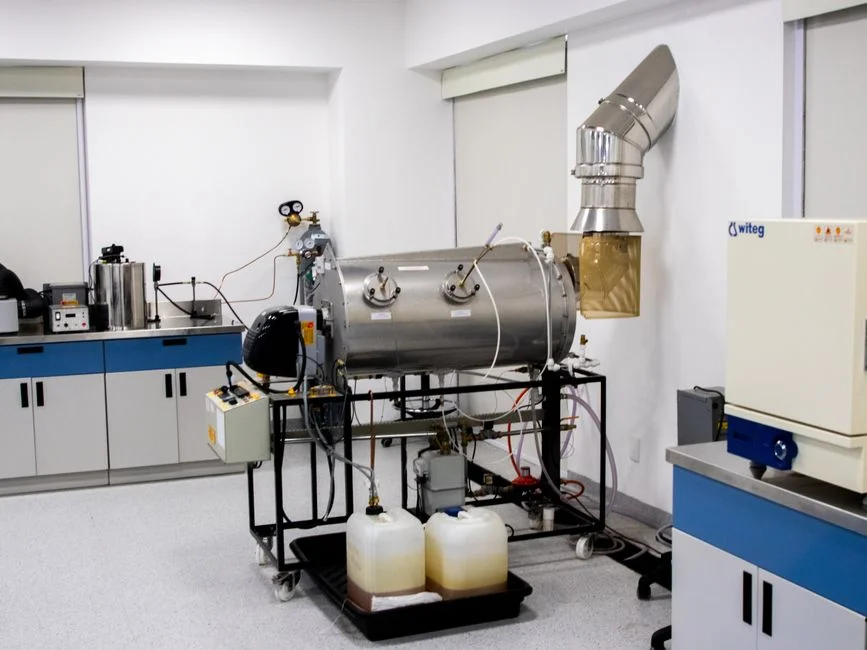
Three architectures dominate the decentralized WWTP outlook for 2026 in the Bogota savanna. The right choice depends on flow, load variability, and whether the buyer needs reuse-quality effluent for irrigation, cooling, or boiler feed.
Packaged buried STP — a WSZ packaged STP for small Bogota facilities in the 1-80 m3/h range — uses A/O biological contact oxidation in a fully buried tank with landscaping above. It suits hotels, hospitals, residential developments, and small factories under 500 m3/day, and it preserves the savanna's limited flat buildable land. The MBR membrane bioreactor — a MBR membrane bioreactor for industrial reuse at 10-2,000 m3/day with submerged PVDF flat-sheet or hollow-fiber modules at 0.1 micrometer pore size — delivers near-reuse effluent and tolerates the 12-14 C Bogota temperatures that would stall conventional nitrification, because the high mixed-liquor suspended solids (8,000-12,000 mg/L) keep nitrifier retention high even at low temperatures. DAF pre-treatment for high-FOG and suspended solids (4-300 m3/h, 13 standard micro-bubble models) feeding activated sludge handles the blood, FOG, and TSS from tanneries and dairy processors. For the flower-growing belt around Chia, add sand filtration plus UV or chlorine dioxide (50 g/h to 20,000 g/h generator capacity) for irrigation-reuse polishing.
Sludge dewatering is the second half of any Bogota industrial planta de tratamiento de aguas residuales. A plate and frame filter press for sludge line in the 1-500 m2 filtration area range, or a lamella clarifier at 20-40 m/h surface loading, reaches the 60-70% moisture cake required for sanitary landfill disposal at the Don Juanito or El Mondoño sites. Lamella designs cut polymer consumption by roughly 30% versus conventional gravity thickeners — a meaningful OPEX line in a market where polyacrylamide runs about COP 18,000-25,000/kg.
| Parameter | Packaged STP (WSZ, buried) | MBR Membrane Bioreactor | DAF + Activated Sludge |
|---|---|---|---|
| Flow range | 1-80 m3/h (24-1,920 m3/day) | 10-2,000 m3/day | 4-300 m3/h (96-7,200 m3/day) |
| Typical BOD5 removal | 90-95% | 98-99% | 95-97% |
| Effluent TSS target | ≤30 mg/L | ≤1 mg/L (turbidity <1 NTU) | ≤20 mg/L post-DAF |
| Sludge yield | 0.15-0.25 kg DS/kg BOD removed | 0.10-0.18 kg DS/kg BOD removed | 0.20-0.30 kg DS/kg BOD removed |
| Footprint (per 100 m3/day) | ~25 m2 (buried) | ~40 m2 | ~70 m2 |
| Best fit in Bogota | Hotels, small factories, residential | Pharma, electronics, reuse demand | Tanneries, dairy, slaughterhouses |
| Altitude derating required | +20-25% blower kW | +20-25% blower kW, MLSS tuning | +20-25% air for DAF saturation |
2026 CAPEX and OPEX Benchmarks for Wastewater Treatment Plants in Colombia
Quotes in the Bogota market cluster tightly once you correct for the same scope. The numbers below reflect a turnkey supply — design, fabrication, FAT, shipping, installation, commissioning, and first-year spares — for a greenfield plant on the Cundinamarca savanna (HydropureWater field data, 2026).
A packaged STP at 50 m3/day runs USD 28,000-55,000 CAPEX, with OPEX of 0.18-0.32 USD/m3 driven mainly by aeration energy and sludge hauling. An MBR plant at 200 m3/day — see the MBR OPEX breakdown for 2026 — runs USD 180,000-340,000 CAPEX and 0.35-0.55 USD/m3 OPEX, with membrane replacement every 5-7 years typically equating to 12-18% of CAPEX annualized. A combined DAF + activated sludge plant at 1,000 m3/day runs USD 650,000-1.2M CAPEX and 0.22-0.40 USD/m3 OPEX. Logistics matters: containerized skid units shipped via Buenaventura add 8-14% to the factory FOB price; inland trucking to Bogota is another 3-5%, and customs clearance plus nacionalizacion typically runs 4-6 weeks. Imported membrane modules are subject to COP peso volatility — request peso-denominated spare parts quotes or annual price-index clauses tied to the TRM or a manufacturing PPI.
| Plant size & configuration | CAPEX range (USD, turnkey) | OPEX range (USD/m3 treated) | Dominant OPEX driver |
|---|---|---|---|
| Packaged STP, 50 m3/day | 28,000-55,000 | 0.18-0.32 | Blower energy, sludge haul |
| MBR, 200 m3/day | 180,000-340,000 | 0.35-0.55 | Membrane replacement, energy |
| DAF + activated sludge, 1,000 m3/day | 650,000-1,200,000 | 0.22-0.40 | Polymer, sludge haul, energy |
| Logistics premium (Bogota-bound) | +8-14% (ocean) + 3-5% (inland) | — | Customs + trucking |
Supplier Selection Checklist: 10 Questions to Ask Any WWTP Manufacturer
Print this list. Take it to every RFQ meeting in Chia, Funza, or Zipaquirá. A qualified wastewater treatment plant manufacturer in Bogota will answer each question with documentation, not adjectives.
- Can you share two Colombian reference projects with verifiable Res. 0631/2015 sampling data from the last 36 months?
- What is your guaranteed BOD5, COD, and TSS effluent at design flow and at 120% design flow?
- Has the MBR membrane been independently tested for 0.1 micrometer nominal pore size, and what is the documented cleanability after chemical CIP (typically 2,000-5,000 mg/L NaOCl)?
- What is the lead time from purchase order to container loading at port of origin, and what is the estimated Bogota customs clearance window via Buenaventura or Cartagena?
- Do you provide Spanish-language PLC HMI, operator training, and a 12-month performance warranty with on-site response commitments under 72 hours?
- What is the SOTR-corrected blower kW at 2,640 m altitude for the proposed aeration tank, and what ambient temperature did you size for?
- Which polyurethane, PVDF, or PES grade is used in the MBR modules, and what is the documented mean time between replacements in similar Andean installs?
- Can you provide a peso-denominated spare parts price list valid for 24 months, with an annual indexation clause?
- What is the maximum simultaneous peak factor (Qpeak/Qavg) the proposed hydraulic profile can absorb without washout?
- Who signs the CAR Cundinamarca permiso ambiental performance guarantee, and is the guarantee backed by an insurance underwriter or a bank letter of credit?
Frequently Asked Questions
What percentage of CAPEX typically covers engineering, installation, and commissioning for a Bogota WWTP? Turnkey engineering, fabrication, shipping, installation, commissioning, and first-year spares usually account for 40-50% of the total CAPEX in a Colombian WWTP project, with the balance covering civil works, electromechanical erection by local subcontractors, and contingency. The split shifts toward equipment for MBR plants and toward civil works for buried packaged STP.
How long does delivery and installation take for a packaged STP vs. an MBR plant? Packaged units typically ship 14-22 weeks after purchase order, and MBR plants over 500 m3/day run 26-40 weeks. Add 6-10 weeks for Colombian customs, nacionalizacion, and inland trucking to the Cundinamarca site, then another 4-8 weeks for on-site assembly, hydrostatic testing, and biological seeding before the plant reaches design effluent quality.
Which Colombian regulations govern industrial effluent discharge in 2026? Resolucion 0631 de 2015 (MADS) sets the sector-specific discharge limits in Annex I — BOD5, COD, TSS, FOG, total nitrogen, total phosphorus, and pH by industrial activity. The environmental permit (permiso ambiental) is issued by CAR Cundinamarca for facilities in the savanna, not directly by MADS; for Antioquia, the corresponding authority is Corantioquia or Corpourabá depending on the municipality.
Can treated wastewater be reused for industrial processes in the Bogota savanna? Yes, MBR followed by reverse-osmosis polishing delivers reuse-quality water suitable for cooling-tower make-up, boiler feed (after softening), and irrigation at the flower greenhouses around Chia and Cajica. The reclaimed-water market in commercial real estate and colocation data centers is the fastest-growing segment in Cundinamarca in 2026, with resale economics of 0.8-1.4 USD/m3 versus 1.6-2.2 USD/m3 for potable supply.
What redundancy is required for power outages or blower failure in the Andean climate? At minimum, 6-8 hours of continuous blower redundancy through a second blower plus UPS, and a permanent on-site generator connection sized for the full aeration load plus DAF polymer dosing and UV disinfection. Res. 0631/2015 requires that the treatment chain remains operable during power interruptions; a plant that dumps untreated effluent during a 4-hour outage is in violation regardless of lab results on a normal day.