Why Meat Processing Wastewater Demands a Dedicated Recycling System
Meat and poultry processing consumes 1,500–10,000 L of water per animal unit — a figure that holds across beef, pork, and poultry operations whether the source is a small custom-exempt plant or a 500 m³/day industrial facility. Because sanitation, carcass washing, and rendering cannot be turned off without shutting the line, water use is non-discretionary. The only viable lever for reducing draw from municipal supplies — and for controlling rising discharge surcharges — is on-site recycling.
The influent is heavily operation-specific. A slaughter floor discharges blood and paunch manure at concentrations that can spike 3:1 between the bleed shift and overnight clean-in-place (CIP). Cut-and-wrap rooms add protein fines and emulsified fat; rendering cookers add dissolved and emulsified FOG that resists simple settling. A plant that mixes all three streams cannot be designed from a generic food-and-beverage template — the recycle train must be matched to the unit-operation mix.
Closed-loop recycling converts a wastewater liability into a process asset. Treated effluent can be routed back to washdown, boiler feed, or irrigation under frameworks such as China's GB/T 19923-2005 reused-water standard, the EU Water Reuse Regulation 2020/741, and U.S. state-level industrial reuse permits. The design pressure now extends beyond discharge compliance: regulators and corporate ESG mandates increasingly require quantified water-reuse percentages, pushing meat processors toward dedicated recycle trains rather than end-of-pipe discharge treatment.
Meat Processing Wastewater Characteristics: The Numbers Behind the Design
Meat processing influent is defined by four headline pollutants — total suspended solids (TSS), fats/oils/grease (FOG), biochemical oxygen demand (BOD), and total phosphorus (TP) — and the concentrations are an order of magnitude higher than municipal sewage. Typical raw wastewater from a mixed slaughter and deboning operation carries COD of 800–6,000 mg/L, BOD of 400–3,000 mg/L, TSS of 200–1,500 mg/L, and FOG of 100–800 mg/L. Total nitrogen runs 50–250 mg/L, and pH spans 6.0–8.5 depending on the proportion of paunch and pickling streams.
Load swings dominate the design. The peak:trough ratio between the bleeding shift and the overnight CIP is typically 3:1, with shorter spikes during stun-and-bleed and evisceration. This is the engineering reason equalization tanks and flow balancing must precede any biological stage — without hydraulic damping, the bio-reactor receives slugs of blood and paunch that wash out biomass and destroy nitrification.
Temperature and chemistry add further constraints. Influent at the headworks often arrives at 30–45 °C, which accelerates biological kinetics but reduces oxygen solubility and forces aeration upgrades. Curing and pickling lines contribute chlorides that can reach 2,000–5,000 mg/L and inhibit nitrifiers above 3,000 mg/L. CIP detergents and quaternary ammonium sanitizers carry over into equalization, where residual concentrations above 50 mg/L can stall MBR activity. The recycle train must be sized for these real-world excursions, not steady-state lab values.
| Parameter | Typical Range (mg/L unless noted) | Design Implication |
|---|---|---|
| COD | 800–6,000 | Defines biological stage volume and aeration |
| BOD | 400–3,000 | Sets DAF polymer dose and MBR F/M ratio |
| TSS | 200–1,500 | Drives screen aperture and DAF surface loading |
| FOG | 100–800 | Primary DAF target; protects downstream membranes |
| Total Nitrogen | 50–250 | Determines MBR HRT and nitrification capacity |
| pH | 6.0–8.5 | Equalization with pH correction required pre-bio |
| Temperature | 30–45 °C | Reduces O₂ solubility; raises biological rate |
| Chloride | 500–5,000 | Inhibits nitrification above ~3,000 mg/L |
The Recycle Train: How Each Stage Cuts the Load
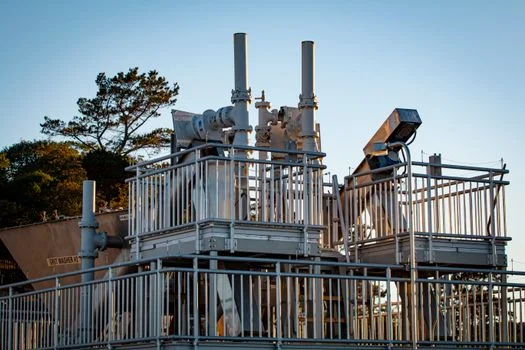
A properly designed meat processing wastewater recycling system runs as a four-stage train, with each stage dropping the load by a defined percentage before the next receives the flow. Cumulative removal determines whether the effluent meets discharge limits, reuse standards, or both.
Stage 1 — Pretreatment. A rotary mechanical bar screen with 3–6 mm apertures captures rags, hooves, paunch solids, and bone fragments. A grit chamber follows for sand and bone-chip removal. This stage strips 10–25% of incoming TSS and protects downstream DAF pumps, polymer injectors, and membrane modules from mechanical damage.
Stage 2 — DAF (Dissolved Air Flotation). The DAF system injects micro-bubbles (typically 20–80 μm) that carry coagulated FOG, blood solids, and colloidal protein to the surface as float. Coagulant (PAC or ferric chloride) and a cationic polymer are dosed upstream through an automatic chemical dosing system. DAF typically removes roughly 80% of the organic load and the bulk of the FOG, producing an effluent with TSS below 150 mg/L and FOG below 30 mg/L. The floated skimmings — blood solids and emulsified fat — are recovered for rendering or sent to a plate and frame filter press for solids capture.
Stage 3 — Biological + MBR. An equalization tank dampens flow and load swings, then an integrated MBR membrane bioreactor (or MBBR) carries out carbon oxidation and nitrification. Submerged PVDF ultrafiltration membranes at 0.1–0.4 μm retain the activated sludge, producing a solids-free effluent. Typical design targets: BOD below 20 mg/L, COD below 100 mg/L, NH₃-N below 5 mg/L. Published AnMBR data on meat-processing wastewater shows COD removal falling from 100% at an organic loading rate (OLR) of 0.71 g/(L·d) to 73% at 2.2 g/(L·d) — a reminder that MBR sizing must hold OLR below roughly 1.5 g/(L·d) to maintain high removal rates at peak load.
Stage 4 — Polishing & Reuse. For plants targeting reuse, an industrial RO polishing system drops TDS, residual color, and trace organics to reuse-grade targets — COD below 50 mg/L, turbidity below 1 NTU, conductivity below 200 µS/cm for boiler feed. A final disinfection step using a chlorine dioxide disinfection generator handles pathogens for washdown and irrigation reuse. A lamella clarifier can be added upstream of RO to drop residual floc and protect membrane life.
| Stage | Unit Operation | Target Effluent Parameter | Typical Removal vs. Raw Influent |
|---|---|---|---|
| 1 — Pretreatment | Bar screen + grit chamber | TSS reduction | 10–25% |
| 2 — DAF | Dissolved air flotation + coag/polymer | TSS <150 mg/L, FOG <30 mg/L | ~80% organic load |
| 3 — Bio + MBR | Equalization + MBR (PVDF 0.1–0.4 µm) | BOD <20 mg/L, COD <100 mg/L, NH₃-N <5 mg/L | 95–98% BOD; 95%+ COD |
| 4 — Polishing & Reuse | UF/RO + ClO₂ disinfection | COD <50 mg/L, turbidity <1 NTU, conductivity <200 µS/cm | Reuse-grade; >99% pathogen reduction |
Compliance and Reuse Standards: Mapping the Design to the Regulator
Discharge limits and reuse standards are written against different parameters, and the controlling threshold depends on the jurisdiction, the receiving environment, and whether the water leaves the site or returns to the process. The table below maps the four most binding frameworks a meat processor will encounter.
On the discharge side, U.S. facilities are governed by EPA 40 CFR Part 432 effluent limitation guidelines for meat and poultry products, with new-source performance standards of BOD below 20 mg/L, TSS below 40 mg/L, FOG below 10 mg/L, and TP below 1.0 mg/L. Chinese facilities follow GB 13457-92 (the integrated wastewater discharge standard for meat packing and poultry processing) with class-2 limits of BOD₅ below 30 mg/L, COD below 120 mg/L, SS below 30 mg/L, and FOG below 20 mg/L. In the EU, the Industrial Emissions Directive 2010/75/EU and the BREF on Food, Drink and Milk Industries set BAT-AEL ranges of COD 25–100 mg/L, BOD 3–25 mg/L, and TSS 5–30 mg/L.
On the reuse side, the EU Water Reuse Regulation 2020/741 defines minimum requirements for agricultural irrigation (E. coli ≤10 CFU/100 mL, BOD₅ ≤10 mg/L, TSS ≤10 mg/L, turbidity ≤5 NTU for Class A). China's GB/T 19923-2005 reused-water grades for industrial use allow up to 1,000 mg/L COD for cooling water but require turbidity below 5 NTU. The U.S. EPA 2012 Guidelines for Water Reuse and WHO 2006 Guidelines set the pathogen and turbidity envelope for non-potable reuse. For a plant planning to recycle, the binding constraint is usually the reuse standard, not the discharge limit.
| Parameter | US EPA 40 CFR 432 (new source) | China GB 13457-92 (Class 2) | EU IED 2010/75 + BREF (BAT-AEL) | EU 2020/741 Reuse (Class A) |
|---|---|---|---|---|
| BOD₅ | 20 mg/L | 30 mg/L | 3–25 mg/L | 10 mg/L |
| COD | — | 120 mg/L | 25–100 mg/L | — |
| TSS | 40 mg/L | 30 mg/L | 5–30 mg/L | 10 mg/L |
| FOG | 10 mg/L | 20 mg/L | — | — |
| TP | 1.0 mg/L | — | 0.3–2 mg/L | — |
| NH₃-N | — | 25 mg/L | 0.5–10 mg/L | — |
| E. coli | — | — | — | ≤10 CFU/100 mL |
| Turbidity | — | — | — | ≤5 NTU |
Cost Benchmarks: CAPEX, OPEX, and Payback for a 50–500 m³/day System

Translating the technical case into dollars is the conversation that moves the project from engineering to budget approval. The figures below are installed-cost benchmarks (packaged skid, civil works, installation, and commissioning) drawn from industry ranges; they are not quotes and vary with influent load, site conditions, and reuse targets.
Capital cost scales roughly with the 0.7 power of flow — meaning a 4× increase in daily capacity yields only a 2.5× increase in CAPEX because containerized skids, PLC panels, and RO racks benefit from scale. A 50 m³/day packaged system (DAF + MBBR + clarification, discharge only) typically falls in the $180,000–$320,000 range. A 100 m³/day system with MBR polishing runs $320,000–$580,000. A 250 m³/day train with MBR plus RO reuse polishing sits at $650,000–$1.1 million, and a 500 m³/day facility integrating anaerobic pretreatment, MBR, and full RO reuse reaches $1.1 million–$1.8 million installed.
Operating cost runs $0.35–$0.90 per cubic meter treated. Power dominates at 40–55% of OPEX, followed by coagulants, polymers, and CIP chemicals at 15–25%, membrane replacement and consumables at 10–20%, and labor plus scheduled maintenance at 10–20%. For a 200 m³/day plant achieving 70% water recycle at a freshwater unit cost of $1.20/m³, the freshwater line item alone saves roughly $61,000 per year. Add avoided discharge surcharges (typically $0.30–$1.50/m³ in municipal pretreatment programs) and by-product credits from DAF float and biogas, and simple payback lands in the 18–36 month band for most regions, with a positive 5-year NPV in nearly every case where local water and discharge tariffs exceed $0.80/m³ combined.
| Capacity (m³/day) | Train Configuration | CAPEX Installed (USD) | OPEX ($/m³) | Typical Payback (months) |
|---|---|---|---|---|
| 50 | DAF + MBBR + clarifier (discharge) | $180,000–$320,000 | 0.35–0.55 | 20–32 |
| 100 | DAF + MBBR + MBR (discharge / partial reuse) | $320,000–$580,000 | 0.45–0.70 | 22–34 |
| 250 | DAF + MBR + RO + ClO₂ (reuse) | $650,000–$1,100,000 | 0.55–0.85 | 20–36 |
| 500 | Anaerobic + MBR + RO + ClO₂ (full reuse) | $1,100,000–$1,800,000 | 0.60–0.90 | 24–40 |
Choosing the Right Configuration: A Buyer's Selection Matrix
The right train depends on three site variables: daily flow, the discharge-or-reuse target, and the variability of the incoming load. The matrix below maps those variables to a recommended configuration and flags the design risks that should be priced into the equipment selection.
Small flows (≤100 m³/day) with discharge-only obligations typically justify a DAF + MBBR + clarifier train, where capital efficiency and operator simplicity outweigh the marginal gain from MBR. Mid-tier plants (100–250 m³/day) aiming for partial reuse (washdown, irrigation) move to DAF + MBR + UV/ClO₂, which delivers the low-turbidity effluent a reuse permit typically requires. Large or high-load facilities (250–500 m³/day) targeting 70%+ recycle, boiler feed, or zero-liquid-discharge add RO polishing and often an anaerobic front-end for biogas yield and OLR damping. The selection matrix below turns those rules into a single table.
Vendor evaluation should weigh stainless steel contact surfaces for FOG resistance (304 or 316L at wetted parts), PLC automation with remote telemetry and trending, factory skid-mounting to reduce field installation hours, membrane module replaceability without pipe refit, and verified references in meat and poultry plants at similar scale. The three most common failure modes — DAF grease blinding, blood shock-loading the bio stage, and RO fouling from residual FOG — are all addressable in the design: hot-water DAF wash and polymer selection prevent blinding; equalization with online TOC/COD monitoring absorbs blood slugs; and a polishing activated carbon or UF pre-filter ahead of RO strips residual oil that would otherwise foul the membranes within weeks.
| Flow Tier | Target Effluent | Recommended Train | Primary Design Risk | Mitigation |
|---|---|---|---|---|
| ≤100 m³/day | Discharge only | Screening + DAF + MBBR + clarifier | Grease blinding of DAF | Hot-water wash, polymer selection |
| 100–250 m³/day | Partial reuse (washdown/irrigation) | Screening + DAF + MBR + ClO₂ | Blood shock load on bio | Equalization tank, online TOC/COD |
| 250–500 m³/day | Full reuse (boiler feed/irrigation) | Screening + DAF + MBR + RO + ClO₂ | RO fouling from residual FOG | UF pre-filter or activated carbon ahead of RO |
| Any | High load, biogas capture | Add anaerobic front-end | OLR overshoot | Hold OLR <1.5 g/(L·d) per AnMBR data |
For engineers working through related design questions, a complementary deep-dive on the MBR system for food processing sewage provides a stage-by-stage breakdown of biological-stage sizing and membrane selection. Plants in Turkey and the eastern Mediterranean can also reference the regional industrial wastewater treatment in Izmir guide for compliance pathways, while facilities planning the disinfection step will find the selection criteria in the ClO₂ disinfection system for industrial use article.
Frequently Asked Questions

What is the typical capacity range for a packaged meat processing wastewater recycling system?
Packaged skid-mounted systems cover 5–500 m³/day as a single train, with parallel trains applied above 500 m³/day. The 50–250 m³/day band is the most common installation size for mid-sized beef, pork, and poultry plants, typically delivering 60–90% water recycle at $0.35–$0.90 per m³ treated.
How much FOG can DAF remove from slaughterhouse wastewater?
A properly sized DAF with coagulant and polymer dosing removes roughly 80% of the organic load and the majority of FOG, blood, and suspended solids, dropping raw FOG of 100–800 mg/L to below 30 mg/L in the DAF effluent and protecting downstream biological and membrane stages.
What MBR effluent quality is required for reuse in meat processing?
For washdown or irrigation reuse, MBR effluent typically targets BOD below 20 mg/L, COD below 100 mg/L, NH₃-N below 5 mg/L, and turbidity below 1 NTU; RO polishing is then added to drop conductivity below 200 µS/cm for boiler feed or to meet the turbidity and E. coli thresholds of EU Regulation 2020/741 Class A for irrigation.
What is the typical payback period for a slaughterhouse wastewater recycling system?
Payback typically falls in the 18–36 month range, driven by freshwater savings (often $0.50–$1.50/m³), avoided discharge surcharges ($0.30–$1.50/m³), and by-product credits from DAF float and biogas; a 200 m³/day plant achieving 70% recycle at $1.20/m³ freshwater cost saves about $61,000 per year on the freshwater line alone.
What are the most common failure modes in meat processing wastewater treatment?
The three dominant failure modes are DAF grease blinding from under-dosed or poorly selected polymer, blood shock-loading that washes out biomass in the bio stage, and RO fouling from residual emulsified FOG; all three are mitigated at the design stage through hot-water DAF wash, hydraulic equalization with online monitoring, and UF or activated-carbon pre-filtration ahead of RO.