Separate the streams and establish the design basis
A Hannover data center must separate cooling-tower blowdown, domestic sewage and other process or laboratory wastewater before selecting equipment. Use a measured data-center water balance: cooling-tower blowdown is approximately 1/(CoC−1) of make-up, or 25% at 4 cycles of concentration and 20% at 6 CoC, according to the HydropureWater data-center blowdown guide. If the confirmed sewer route accepts the stream, pretreatment may be sufficient. If cooling-water reuse is required, pretreatment and industrial reverse osmosis form a relevant option; the supplied benchmark cites 80–90% recovery and 99.5% salt rejection. Hannover-specific sewer criteria, tariffs, water chemistry and permit terms must be verified before sizing or tendering.
Do not combine these streams during preliminary design. Cooling-tower blowdown carries concentrated cooling chemicals and scaling salts; sanitary wastewater has a different contaminant and treatment profile; laboratory or process wastewater may contain pollutants absent from either. The Nuremberg data-center blowdown treatment comparison makes the same procurement distinction: each stream remains a separate line until the authority confirms the route.
The blowdown calculation is a screening relationship, not a design flow. Request average and peak hourly blowdown, operating hours, make-up source, CoC, chemical programme, representative analyses, anticipated IT-load changes and commissioning conditions. Peak-hour flow, ramp-up and future operating scenarios determine equalisation, pretreatment and recovery-train capacity.
| Design input | Required evidence | Owner | Unresolved assumption to close |
|---|---|---|---|
| Stream inventory | Separate metering plan for cooling-tower blowdown, domestic sewage and other wastewater | Facilities and process engineer | Whether any stream may be combined |
| Make-up and blowdown | Average and peak hourly flows, operating hours and CoC | Facilities | Future IT-load and cooling configuration |
| Water chemistry | Representative analyses with sampling points, methods and dates | Laboratory | Scaling, fouling and reuse limits |
| Cooling programme | Biocide, inhibitor, dispersant and dosing records | Facilities | Compatibility with pretreatment and membranes |
| Future conditions | Committed development scenarios and commissioning assumptions | Project and operations teams | Design margin and redundancy |
Confirm the Hanover route before choosing equipment
Hannover’s equipment route must follow written sewer acceptance criteria and applicable indirect-discharge conditions. Obtain the current criteria, tariffs, monitoring duties and approved discharge point directly from the competent authority or utility. Confirm potable make-up and CTBD reuse requirements with the utility and an environmental consultant.
The supplied Frankfurt research identifies conductivity, temperature, pH, chloride, sulfate and persistent substances as German control indicators. These are investigation items for Hannover, not confirmed local limits. The German domestic-sewage treatment guide reinforces the need to identify the applicable standard and permit boundary before specifying a sanitary treatment route.
Keep three questions open until answered in writing:
- May cooling-tower blowdown enter the sewer directly, or must it be treated first?
- Which analytical parameters, flow controls, monitoring records and chemical restrictions apply at the discharge point?
- May treated water return to the cooling system as make-up, and what water-quality or hygiene controls apply?
The supplied research does not establish Hannover limits, tariffs, water chemistry or permit terms. They should not appear as assumed values in a tender; they are verification items assigned to named owners and given a deadline before equipment capacity or acceptance limits are fixed.
Compare sewer, reuse and advanced treatment routes
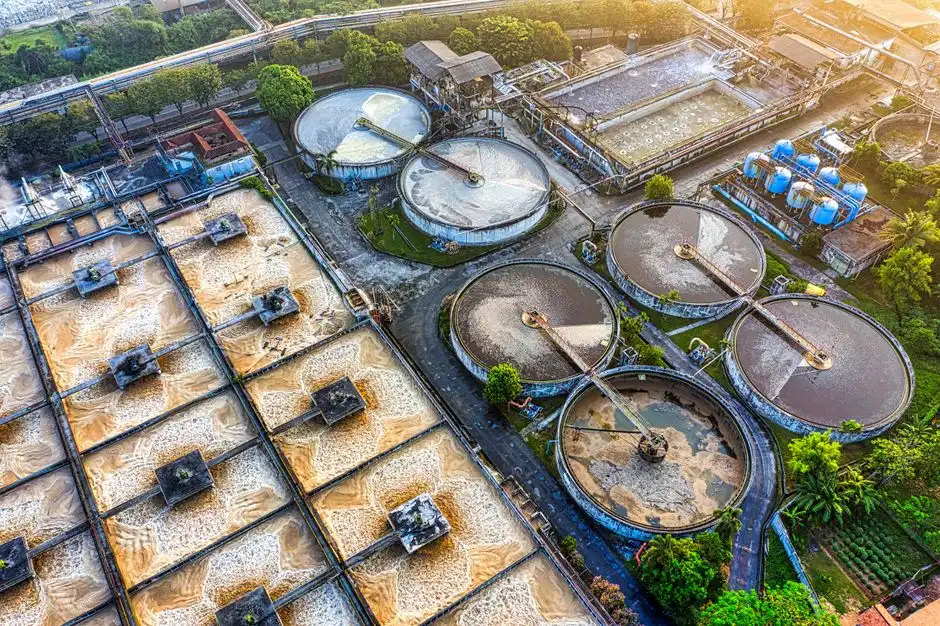
Direct sewer discharge is appropriate only when the confirmed indirect-discharge criteria accept the untreated or pretreated stream. Reuse becomes relevant when discharge constraints or water-management objectives justify recovery. Neither decision can be made without the measured water balance and pollutant profile.
For sewer discharge, pretreatment may include dissolved-air flotation or Lamella clarification where floatable material is present, filtration where particulate removal is required, and controlled chemical dosing selected from the actual chemistry. The relevant equipment question is which pollutants threaten sewer acceptance or downstream treatment.
For cooling-water reuse, a train can combine filtration, optional UF, an industrial RO system for cooling-water reuse, polishing, disinfection and a defined reject route. The supplied benchmark cites 80–90% recovery and 99.5% salt rejection; reuse targets are conductivity below 50 µS/cm and silica at or below 1 mg/L. These are comparison benchmarks, not Hannover guarantees. They must be converted into site-specific permeate and blended make-up specifications after reviewing cooling chemistry, scaling indices and treatment requirements.
Domestic sewage should remain on a defined sanitary route. The supplied MBR reference cites BOD below 25 mg/L and SS below 35 mg/L under EU Urban Waste Water Treatment Directive 91/271/EEC, but the applicable permit and standard must be confirmed before those values become guarantees. An MBR treatment route for segregated domestic sewage should be evaluated separately from CTBD reuse.
Modular evaporator-crystallizer ZLD is a higher-complexity fallback. Saltworks Technologies describes modular evaporator-crystallizers as a route for minimal and true liquid discharge. It becomes defensible where no acceptable discharge route remains and the whole-life case supports the added equipment and residual-management obligations.
| Route | Primary objective | Indicative equipment boundary | Decision condition | Residual to resolve |
|---|---|---|---|---|
| Direct sewer discharge | Comply with applicable sewer criteria | Flow control, monitoring and treatment only if required | Authority confirms acceptance of the actual stream | Sewer discharge and surcharge exposure |
| Pretreatment plus sewer discharge | Remove pollutants that impede acceptance or downstream treatment | DAF or Lamella clarification, filtration and controlled dosing as analysis requires | Pollutant profile justifies pretreatment | Sludge and chemical residues |
| CTBD reuse with UF/RO | Recover cooling make-up | Filtration, optional UF, RO, polishing, disinfection and reject management | Reuse target and cooling chemistry are confirmed | Concentrate destination and mixed-stream compatibility |
| Sanitary treatment | Manage domestic sewage separately | Authority-approved sewer route or segregated MBR | Applicable sanitary standard and permit are confirmed | Sludge and sanitary reuse restrictions |
| ZLD | Minimise liquid discharge | Advanced treatment, concentrate minimisation and crystallisation | No acceptable discharge route and whole-life case is justified | Solids, chemicals, energy and maintenance |
Compare operating economics without hiding energy demand
Compare sewer discharge and reuse on the same boundary: treatment capital cost, power, chemicals, labour, sampling, membrane replacement, changes in make-up-water demand and reject handling. A route that looks inexpensive per recovered cubic metre can lose its advantage once concentrate disposal, scaling control and higher-energy recovery are included.
The 2026 LCA study, Reclaiming Cooling: Wastewater Reuse as a Strategic Resource for Data Center Water Management by Cartagena Vaca and colleagues, found that UF+RO wastewater energy use exceeded five times the freshwater case. Treatment energy accounted for roughly 80% of the global-warming-potential difference, and the wastewater scenario had about twice the GWP of the freshwater case. Improved CoC is associated with lower blowdown and chemical consumption.
That evidence does not establish the economics of a Hannover project. Electricity prices, recovery, chemical use, operating hours, tariff structure and reject handling remain site inputs. Obtain current Hanover water, wastewater and surcharge information and use it in the business case. Do not transfer the Frankfurt tariff band or the LCA’s approximate 0.93 L/m³ indirect-water penalty to Hannover without local assumptions.
Use the industrial RO maintenance protocol to identify lifecycle work that bidders should price, including membrane condition, cleaning, consumable replacement and operator effort. Ask whether treatment enables a higher CoC and whether any change in make-up-water demand has been included in each bidder’s model.
Issue a comparable supplier tender
A comparable tender requires one design basis, one permit boundary and one reject-water destination. Every bidder must state design flow, operating envelope, water-analysis assumptions, recovery, permeate quality, reject route, power demand, footprint, chemical consumption, redundancy, controls scope and commissioning tests.
Attach the measured water balance, representative analyses with sampling points and dates, confirmed permit conditions, current tariffs, future IT-load scenarios and a defined concentrate destination. Require each bidder to identify every unresolved assumption and assign an owner. A proposal based on generic chemistry cannot be compared fairly with one based on site analysis.
Make acceptance testing operational rather than documentary. Include automatic upset response, alarm setpoints, diversion logic, sampling and flow control. Test equipment response to abnormal feed chemistry, loss of utility, tank high level, membrane or disinfection failure, and conditions that would otherwise allow untreated or off-specification water to leave the equipment boundary.
| Schedule item | Bidder response required | Acceptance evidence | Owner |
|---|---|---|---|
| Design flow and operating envelope | Average, peak, operating hours, ramp-up and future-load assumptions | Capacity calculation reconciled with measured water balance | Process engineer |
| Influent assumptions | Full analysis, sampling date, method and sensitivity limits | Site-analysis comparison with generic assumptions exposed | Laboratory and process engineer |
| Recovery and output quality | Net recovery, permeate quality and blended make-up basis | Performance test under defined feed and operating conditions | Supplier and commissioning team |
| Reject and residuals | Flow, composition basis, destination and handling responsibility | Approved route and complete mass balance | Authority, utility and environmental consultant |
| Energy and consumables | Demand, duty point, chemicals, labour and replacement assumptions | Measured demand during agreed test conditions | Supplier and operations team |
| Footprint and redundancy | Arrangement, utility connections, equalisation, standby and turndown | Approved drawings and failure-response demonstration | Design, facilities and supplier |
| Controls and upset response | Setpoints, alarms, interlocks, diversion and sampling sequence | Cause-and-effect and automatic-response test | Controls and commissioning team |
| Open assumptions | List, impact, owner and closure date | Closed before award or expressly accepted as an exception | Procurement and project lead |
Frequently Asked Questions
How much does Hannover data-center blowdown treatment cost, and which costs drive the comparison?
No supplied research establishes a Hannover quotation. Ask bidders for capital cost and a common operating-cost basis covering power, chemicals, labour, sampling, membrane replacement, make-up-water changes and reject handling. Request current Hannover water, wastewater and surcharge information rather than using a Frankfurt tariff or an unverified savings estimate.
What data must a supplier receive before sizing an RO or UF system?
Provide average and peak hourly flows, operating hours, CoC, make-up source, chemical programme, representative analyses, future IT-load scenarios and the intended reuse quality. Include scaling and fouling assessment, equalisation requirements, redundancy and the concentrate destination; the UF pretreatment basis for RO and reuse systems should follow the measured feed condition.
When is sewer discharge more appropriate than cooling-water reuse?
Sewer discharge is more appropriate when the authority confirms that the stream meets applicable sewer acceptance criteria and the whole-life comparison supports discharge without major pretreatment. Reuse is more relevant when confirmed discharge restrictions or water-resilience objectives justify recovery and the permeate can satisfy the cooling-water specification.
How should bidders be evaluated when one quote assumes reuse and another assumes sewer discharge?
Do not rank the quotations directly. Put both onto the same measured water balance, permit route, tariff basis and whole-life boundary. Require each bidder to state the recovery, reject route, power demand, chemicals, footprint, redundancy, controls and commissioning tests assumed. Use the data-center UF/RO versus ZLD comparison as a framework for exposing incompatible assumptions.
When does full zero-liquid-discharge become defensible?
Full ZLD becomes defensible when no acceptable discharge route remains, a modular evaporator-crystallizer train can be operated and maintained reliably, and the complete energy, chemical, labour and solids-handling burden is acceptable.