Define the wastewater streams and treatment objective
A Nuremberg data center should treat cooling-tower blowdown, domestic sewage and other process or laboratory wastewater as separate procurement lines until the permit route is confirmed. The supplied German guide separates these streams and compares direct sewer discharge, pretreatment and reverse-osmosis reuse for blowdown, with membrane bioreactors considered for segregated sanitary wastewater. Its blowdown relationship is 1/(CoC−1) of make-up: 25% at 4 cycles of concentration and 20% at 6, although higher cycles also increase scale risk. The decision starts with a documented water balance, local discharge criteria and the intended recovery target.
Begin with three inventory lines:
- Cooling-tower blowdown: establish whether it will be discharged, pretreated or reclaimed as cooling make-up.
- Domestic sewage: identify the sanitary collection system and whether sewer discharge, packaged treatment or a separate reuse duty applies.
- Other process or laboratory wastewater: characterize before connection because compatibility and permit status cannot be inferred from flow data alone.
Do not merge these flows for preliminary sizing. The comparison of data-center blowdown treatment options provides the broader process context, but the equipment boundary should follow verified Nuremberg requirements.
Request average and peak flow, operating hours, make-up-water source, cycles of concentration, chemical programme, analytical results and a water balance. Include anticipated IT-load changes and commissioning conditions. The Frankfurt reference guide gives a relationship rather than a Nuremberg design load: blowdown is 25% of make-up at 4 CoC and 20% at 6 CoC, while concentration also raises the risk from calcium carbonate, calcium sulfate and silica.
The water and energy balance must extend beyond the treatment skid. The 2026 LCA study, Reclaiming Cooling: Wastewater Reuse as a Strategic Resource for Data Center Water Management by Cartagena Vaca and colleagues, found that UF+RO wastewater energy use exceeded five times the freshwater case. Its scenario also associated improved CoC with lower blowdown and chemical consumption. Compare freshwater, sewer-discharge and reuse cases for water, power, chemicals and reject-water consequences rather than selecting on recovered volume alone.
Compare discharge, pretreatment and reuse routes
Direct sewer discharge requires obtaining the applicable indirect-discharge criteria before proceeding. The Frankfurt guide identifies conductivity, temperature, pH, chloride, sulfate and persistent substances as relevant German controls, but it does not establish Nuremberg limits. The decision matrix below distinguishes verified process evidence from site-specific inputs.
| Route | Use when | Indicative equipment scope | Key open condition |
|---|---|---|---|
| Direct sewer discharge | The authority confirms that the analyzed stream meets all applicable indirect-discharge requirements. | Monitoring, flow control and any required sampling; no treatment skid can be scoped from the route alone. | Obtain Nuremberg sewer criteria, tariffs and permit conditions. |
| Pretreatment followed by discharge | Cooling chemicals, conductivity, suspended solids or other constituents threaten sewer acceptance or downstream process performance. | DAF or Lamella clarification, filtration and controlled chemical dosing, selected from the pollutant profile. | Confirm analytes, chemical inventory, dose limits and receiving-sewer requirements. |
| Reuse as cooling make-up | Water scarcity, discharge constraints or operating economics justify recovery, and the target chemistry can be met. | Filtration, optional UF, industrial RO system for cooling-water recovery, polish, disinfection and reject management. | Set permeate conductivity, silica, scaling indices, recovery and make-up blend limits. |
| Segregated sanitary treatment | Domestic sewage must be treated separately or reused under a defined sanitary route. | MBR system for segregated domestic sewage, or the authority-approved sewer route. | Confirm applicable standard, reuse target and permit boundary. |
| Full zero-liquid-discharge | No acceptable discharge route remains and the project can justify the added process complexity. | Advanced treatment plus concentrate minimization and residuals management. | Establish the concentrate destination and complete life-cycle comparison. |
Pretreatment selection depends on the specific pollutant profile of the wastewater. Choose DAF or Lamella clarification when floatable material is present, filtration where particulate removal is required, and controlled dosing according to the actual chemistry. An DAF unit as a pretreatment option may fit a solids-bearing stream, but influent analysis must define whether coagulation, flocculation, filtration or another unit operation is appropriate.
Industrial RO becomes relevant when treated blowdown is intended for cooling make-up. The supplied benchmark cites 80–90% recovery and 99.5% salt rejection. These figures serve as comparison benchmarks, not guaranteed Nuremberg values. The permeate must also satisfy the cooling chemistry and site’s defined recovery objective.
The 2026 LCA found that the wastewater scenario had about twice the GWP of the freshwater case, with treatment energy accounting for roughly 80% of the difference. Include that energy sensitivity in tender evaluation. Full zero-liquid-discharge should remain a higher-complexity fallback where no acceptable discharge route exists, not the default concept.
Size the blowdown and sanitary treatment equipment
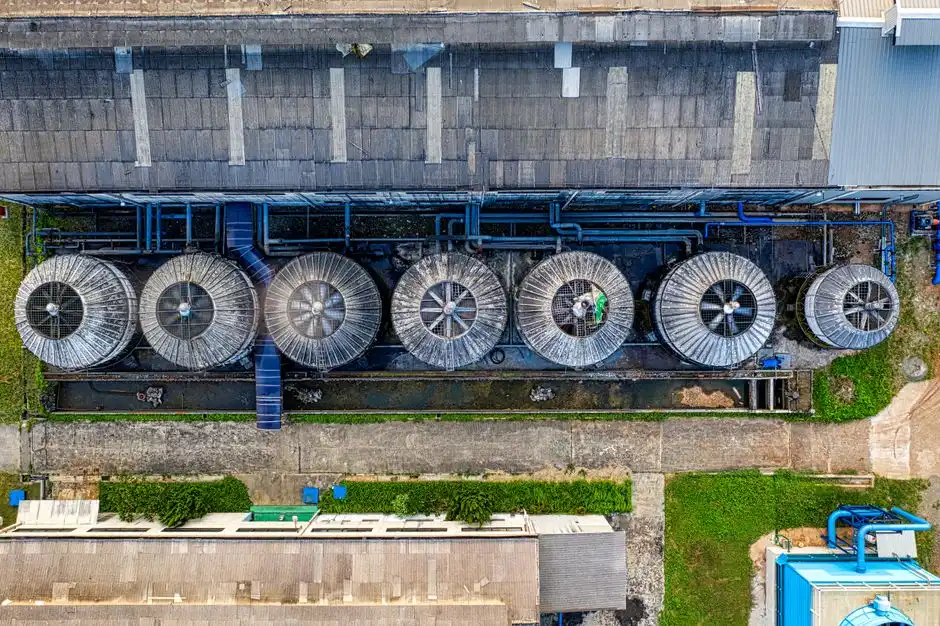
Equipment sizing should begin with a measured water balance rather than IT load alone. The supplied Frankfurt reference case estimates roughly 8,000–10,000 m³/month of blowdown for a 30 MW site at approximately 1.3 L/kWh WUE and 4 CoC. That is a benchmark, not a Nuremberg design load; multiply documented make-up by the selected blowdown fraction and test the result against measured hourly peaks.
The Frankfurt reference also places the industrial RO recovery target at up to 95%, while the supplied product information describes PLC-based automation. Final capacity must follow Nuremberg flow, chemistry, operating hours, redundancy and reuse targets.
| Sizing or selection parameter | Evidence or required input | Procurement consequence |
|---|---|---|
| Blowdown design flow | Average and maximum hourly flow, CoC and operating hours from a commissioned water balance. | Sets pretreatment and RO feed capacity; include future IT-load growth. |
| RO recovery and permeate quality | Benchmark: 80–90% recovery and 99.5% salt rejection; benchmark reuse targets: conductivity below 50 µS/cm and silica at or below 1 mg/L. | Select membranes, pretreatment, pumps and concentrate route against guaranteed output. |
| Sanitary treatment flow | Occupancy, operating schedule and measured peak flow; the supplied guide estimates 10–25 m³/day for its 30 MW Frankfurt reference case. | Determine MBR vessel count and redundancy. |
| Effluent standard | Supplied benchmark: BOD below 25 mg/L and SS below 35 mg/L for the described MBR route under EU Urban Waste Water Treatment Directive 91/271/EEC. | Verify the applicable Nuremberg standard and permit before making it a guarantee. |
| Peak and ramp conditions | Twelve months of operating data or a commissioning water balance, including maximum hourly flow, ramp-up and redundancy requirements. | Check equipment turndown, storage, equalization and standby capacity. |
Request twelve months of operating data where available, or a commissioning water balance if the site is new. State maximum hourly flow, projected ramp-up, future IT-load changes, required redundancy and operating scenarios in the tender. These inputs determine whether one train is credible, whether equalization is required, and how the reject route affects the overall water balance.
Protect recovery performance and control discharge quality
Protection of membranes and biological systems depends on matching pretreatment to the measured contaminant load. The 2026 LCA study used depth filtration, granular activated carbon and chlorination as its primary treatment train before analysing advanced reuse options. That sequence is an evidenced case, not a universal configuration for every Nuremberg stream.
The supplied reuse benchmark specifies permeate conductivity below 50 µS/cm and silica at or below 1 mg/L. Verify these values against the actual cooling-water chemistry and put them into the guaranteed permeate specification rather than treating them as generic RO performance.
The supplied product information describes a chlorine dioxide generator covering 50–20,000 g/h and identifies industrial cooling loops and process wastewater as applications. This range does not establish a Nuremberg dosage requirement. Confirm make-up hygiene, contact performance, chemical storage, residual handling and permit conditions before including disinfection.
Acceptance criteria should cover both equipment performance and automatic response to upset conditions:
- Online conductivity, turbidity and pH at the required control points;
- Differential pressure and permeate-quality monitoring;
- Free or residual chlorine measurement where disinfection is included;
- Automatic diversion when permeate or feed conditions fall outside the agreed envelope;
- Reject-water flow, composition and destination;
- Commissioning tests based on the actual wastewater analysis.
These controls prevent a failed membrane or disinfection condition from becoming an uncontrolled discharge. Their alarm setpoints and diversion logic must reference the confirmed permit and reuse specification.
Build the procurement and compliance checklist
A Nuremberg procurement package should separate confirmed requirements from missing local evidence. The supplied research does not establish Nuremberg sewer limits, tariffs, water chemistry or permit terms, so none should be inserted into a tender as assumed values.
| Open input or package item | Responsible owner | Evidence required before tender |
|---|---|---|
| Nuremberg sewer discharge criteria and indirect-discharge permit conditions | Environmental consultant with the authority or utility | Current applicable criteria, permit limits, monitoring obligations and discharge point. |
| Potable-water requirements and site abstraction constraints | Utilities and environmental consultant | Written confirmation of applicable make-up-water and reuse conditions. |
| Average and peak flows, chemical programme and operating history | Operations team | Twelve months of data where available, or a commissioning water balance. |
| Wastewater analysis and scale assessment | Laboratory and process engineer | Representative results with sampling points, methods and dates. |
| Tariff and discharge-cost information | Utilities and procurement | Current water, wastewater and surcharge structure applicable to the site. |
| Equipment guarantees and reject route | OEM | Design basis, recovery, permeate quality, power, footprint, chemicals, redundancy, controls, commissioning tests and concentrate destination. |
Ask every bidder to state its design flow, recovery, permeate quality, reject-water route, power demand, footprint, chemical consumption, redundancy, controls scope and commissioning tests. Also require the supplied boundary conditions and operating assumptions. A bid based on generic water chemistry is not comparable with one based on the site’s analysis.
The 2026 LCA reports an approximate 0.93 L/m³ indirect water penalty, less than 0.1% of the direct displacement benefit in its scenario. Use the LCA method to compare alternatives, but do not transfer that value to Nuremberg without the relevant electricity, chemical and treatment assumptions. The industrial effluent treatment selection framework can support the same separation of inputs, guarantees and residual routes.
Before award, complete a compliance workshop with operations, facilities, environmental and procurement teams. The agenda should cover the confirmed permit route, measured water balance, reuse objective, bid assumptions and unresolved boundary conditions. Record each unresolved item and its owner rather than converting it into an unsupported performance guarantee.
Frequently Asked Questions
Which inputs are needed to fix the treatment capacity for a Nuremberg data center?
Fix capacity only after obtaining make-up flow, cycles of concentration, average and maximum hourly blowdown, operating hours, make-up-water source, chemical programme, wastewater analysis and expected future IT load. The blowdown relationship of 1/(CoC−1) provides a starting calculation, but the selected route also needs peak-hour, ramp-up and redundancy inputs. A full water balance should reconcile the equipment design with the permit route and reject-water balance.
How should treatment cost be compared when Nuremberg tariffs are not yet known?
Request current water, wastewater and applicable surcharge information from the utility, then compare each route on the same basis: treatment capital cost, power, chemicals, labour, sampling, membrane replacement, make-up-water change and reject-water handling. Direct sewer discharge has a different cost structure from onsite reuse because it avoids some treatment equipment but remains exposed to sewer charges and permit conditions. Do not use a generic tariff or an unverified savings estimate in the business case.
What should a treatment-equipment supplier provide to demonstrate capacity and compliance?
The supplier must provide the design flow and operating envelope, water-analysis assumptions, recovery and permeate