What Can—and Cannot—Be Stated About GM's India Plant
No defensible plant-specific DAF capacity can be selected for General Motors's new assembly plant in India from the supplied public evidence. The evidence does not establish verified wastewater flow, operating hours, peak factor, stream inventory, pollutant concentrations, reuse targets, or applicable consent conditions. A supplier range of 5–500 m³/hr is a catalog scope, not a design duty derived from this plant. The immediate decision is to commission a project-specific sizing basis or issue a clearly labelled preliminary design envelope pending client data.
This distinction matters because production scale, vehicle output, or plant area cannot be converted into hydraulic treatment capacity without wastewater quantities. The sizing chain must connect verified flow and operating conditions to a selected surface-loading rate, then test whether the resulting equipment can treat the relevant wastewater quality. A supplier may offer standard models within a stated throughput range, but the buyer still needs to establish whether any offered configuration satisfies the plant duty.
The verified DAF sizing-basis approach used for another automotive assembly project illustrates the required evidence discipline: the capacity remains conditional until the client provides the flow schedule, operating profile, and wastewater characterization. For the Indian plant, that approach should be applied to the actual site data rather than adapted from another location.
Collect the Wastewater Inputs Needed for DAF Sizing
A DAF sizing request requires the segregation of wastewater by origin because domestic sewage, cooling-water blowdown, process rinse water, oily floor washings, storm water, and manufacturing wastewater cannot be assigned one hydraulic duty without confirming their destinations and treatment routes. Record each stream's average flow, peak-hour flow, peak-day flow, operating hours per day, operating days per week, rainfall dependence, and any planned production expansion or water-reuse reduction. These inputs determine both instantaneous treatment demand and whether equalisation is required before flotation.
Obtain representative wastewater testing at the proposed DAF inlet. The minimum request should cover TSS, oil and grease or FOG, colloids, pH, temperature, and relevant metals or process-quality parameters. Also identify equipment expected to discharge solids larger than 3 mm or gross oil slugs, because Spans Envirotech specifies that DAF inlet quality should exclude both to protect the recycle pump and saturator. Where those materials are present, define the upstream removal duty before sizing the flotation unit.
The discharge point, reuse destination, statutory consent conditions, and pretreatment limits must be identified by the client or EPC team. Without them, the buyer cannot define the DAF outlet target or determine whether DAF is the correct final process before further treatment.
| Client or plant input | Evidence required | Decision affected |
|---|---|---|
| Wastewater inventory | Source, destination, average flow, peak-hour flow, peak-day flow | Which streams enter DAF and which require segregation |
| Operating profile | Hours per day, days per week, rainfall dependence, production expansion | Design flow and equalisation need |
| Water quality | TSS, FOG or oil and grease, colloids, pH, temperature, metals or process parameters | Surface-loading selection, pretreatment and chemical dosing |
| Protected contaminants | Solids above 3 mm and gross oil slug sources | Upstream screening or oil-removal equipment |
| Compliance and reuse | Discharge point, consent conditions, pretreatment limits, reuse destination | Outlet targets and downstream process scope |
Where wastewater routing is still unresolved, use the rotary mechanical bar screen reference only to assess whether its screening duty is relevant; it does not establish the DAF inlet flow or remove dissolved and emulsified FOG.
Calculate Preliminary DAF Capacity from Verified Parameters
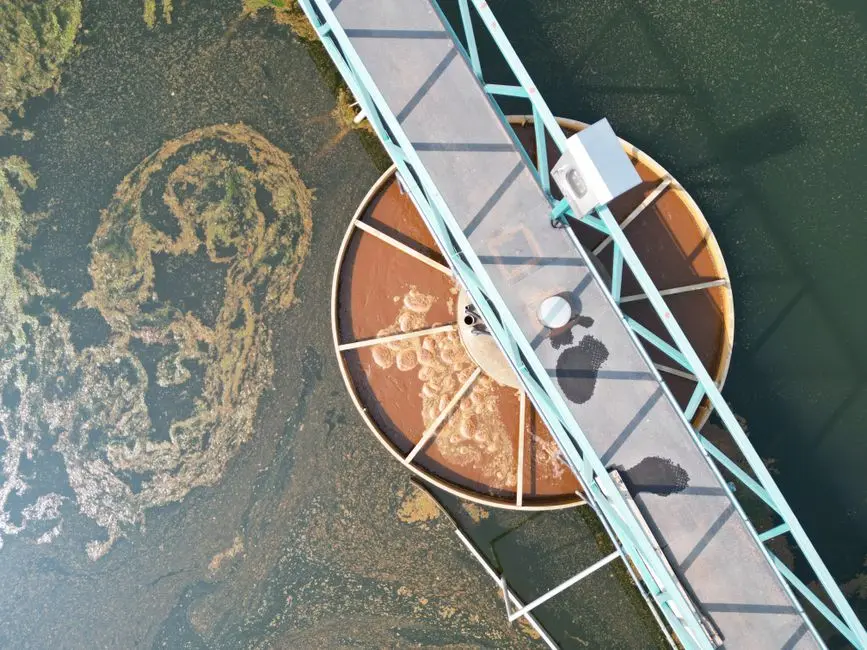
The preliminary DAF hydraulic capacity is based on the agreed design wastewater flow after applying the verified operating profile and peak factor. Keep that treatment rate separate from equalisation or storage volume: a tank may need buffering for intermittent discharges without indicating that its continuous flotation capacity should equal the buffered volume divided by an assumed operating period.
The core dissolved air flotation sizing calculation is:
Required flotation-tank plan area = design wastewater flow in m³/hr ÷ selected surface-loading rate in m/hr.
Spans Envirotech gives an industrial surface-loading range of 3–6 m/hr and notes the final rate should be selected after wastewater characterization. A worked example cannot responsibly be calculated for the GM India plant because its verified design flow and selected loading rate are both absent. The buyer can prepare the equation and worksheet now, but must leave the numerical output open until those inputs are approved.
| Calculation step | Verified input | Preliminary output or decision |
|---|---|---|
| 1. Establish inlet flow | Average and peak flow by wastewater stream | Confirmed streams entering DAF |
| 2. Apply operating profile | Operating hours, peak factor, expansion, equalisation strategy | Design wastewater flow in m³/hr |
| 3. Select hydraulic loading | Wastewater characterization and selected value within 3–6 m/hr | Surface-loading rate in m/hr |
| 4. Calculate tank area | Design flow ÷ selected loading rate | Total flotation-tank plan area in m² |
| 5. Size recycle | Inlet flow and agreed recycle percentage | Recycle flow in m³/hr |
| 6. Define recycle system | Supplier's saturation and release design | Saturator operating pressure stated in the submittal |
| 7. Define flocculation | Actual wastewater and chemical trials | Contact time, mixer arrangement and chemical duty |
Spans Envirotech states that recycle is normally 15–30% of inlet flow, the saturator operates at 4–6 bar, and flocculation contact is typically 3–8 minutes. Those values should frame preliminary design, not replace wastewater-specific chemical selection and vendor confirmation. These parameters must be reconciled with specific site requirements.
Residence-time conventions also need reconciliation. Wikipedia reports 3 minutes for circular DAF and 20–30 minutes for rectangular DAF, according to its 2026 source entry. That difference cannot be substituted for the surface-area calculation. The supplier must state whether its quoted duty is based on hydraulic loading, nominal residence time, or both, and show how its proposed configuration satisfies the selected DAF hydraulic surface loading rate. The detailed DAF system engineering specifications provide the appropriate basis for this reconciliation.
Define Equipment, Pretreatment, and Performance Requirements
Each DAF tender should require the bidder to disclose its design basis rather than accept a throughput range as a performance commitment. The submittal should state design flow, operating hours, selected surface-loading rate, total tank plan area, recycle percentage, saturation pressure, bubble-generation method, and predicted solids-removal performance. It should also identify whether performance is continuous, intermittent, or based on equalised flow.
Upstream protection is part of the equipment scope. The DAF inlet should exclude solids larger than 3 mm and gross oil slugs, consistent with Spans Envirotech's stated inlet requirement. DAF may remove emulsified oil and FOG under a suitable chemical regime, but it should not be treated as the primary screening or bulk oil-slug device.
| Tender requirement | Required supplier response | Buyer's acceptance check |
|---|---|---|
| Hydraulic basis | Design flow, loading rate, plan area, operating profile | Recalculation against the approved flow schedule |
| Recycle and pressure | Recycle percentage, saturator pressure, bubble-generation method | Reconcile with the preliminary sizing basis |
| Flocculation and chemicals | Contact time, mixer arrangement, dosing duty, chemical compatibility | Confirm against representative wastewater |
| Controls and instrumentation | Flow control, recycle control, scraper drive, pressure and level instrumentation | Functional sequence and local requirements |
| Materials and sludge handling | Wetted materials, scraper, hopper, drain, sludge transfer arrangement | Corrosion and downstream dewatering compatibility |
| Utilities and commissioning | Power, water, compressed air, drains, installation, testing and training | Complete responsibility matrix and witnessed test plan |
Performance limits must retain their original scope. Spans Envirotech states 85–95% TSS removal and greater than 90% FOG removal for food and dairy effluent with correct chemical dosing. Those figures must not be transferred automatically to automotive assembly wastewater. The bidder should reconcile its proposed performance with the actual inlet characteristics and agreed outlet targets. Chemical compatibility and automatic chemical dosing system arrangement should be selected against the wastewater data.
Spans Envirotech also states a 10–16-week ARO for fabricated stainless-steel units, with shorter lead times possible for standard MS units depending on tank size. Treat the 10–16-week figure as one supplier's planning input, not a universal procurement lead time. Obtain a project-specific delivery schedule and confirm engineering approval, manufacturing, site readiness, and commissioning dependencies.
Issue a Tender-Ready Capacity and Acceptance Checklist
The tender request should attach the completed wastewater-flow schedule, operating profile, wastewater analysis, pretreatment criteria, discharge or reuse basis, and preliminary DAF duty calculation. Each bidder should then complete the same technical return so that alternatives can be compared on equivalent duties. This converts the sizing exercise from a supplier catalogue exercise into a traceable engineering submittal.
Make final acceptance conditional on witnessed testing with representative wastewater and confirmation of hydraulic stability. The DAF sizing basis for an automotive assembly plant provides a useful document structure, but only the Indian plant's verified data should populate it.
| Submission item | Minimum bidder response | Final acceptance evidence |
|---|---|---|
| Design capacity | Design flow, operating hours, surface-loading rate, tank area | Checked calculation and demonstrated operation |
| Recycle and flocculation | Recycle ratio, saturation pressure, contact time, chemical duty | Instrumented commissioning results |
| Equipment | Materials, scraper, controls, instrumentation, utilities, sludge provisions | Inspection and functional tests |
| Delivery | Manufacturing, shipping, site installation and commissioning schedule | Agreed milestone dates |
| Performance | Proposed outlet limits tied to defined inlet conditions | Witnessed test using representative wastewater |
Require reconciliation of every promised removal performance with the client's actual inlet characteristics and outlet targets. Where the client cannot yet define those limits, the bid should state that performance remains conditional and identify the information needed to convert it into a guarantee. A witnessed test should then verify the agreed duty under stable operating conditions before final acceptance.
Frequently Asked Questions
Why can plant area or vehicle production not determine the required DAF capacity?
Plant area and production volume do not establish wastewater flow, pollutant loading, peak discharge, or treatment objectives. Capacity comes from verified wastewater flow and operating conditions applied to the selected hydraulic basis. Until those inputs are approved, any plant capacity remains preliminary.
What wastewater data should be requested before asking suppliers to size a DAF?
Request flow by source, average and peak flows, operating hours, peak factors, stream destinations, equalisation requirements, TSS, FOG or oil and grease, colloids, pH, temperature, relevant metals, and applicable discharge or reuse limits. Also identify upstream sources of solids larger than 3 mm and gross oil slugs.
How should a standard-model bid be compared with a custom duty calculation?
Ask whether the supplier's model can satisfy the verified design flow and selected surface-loading rate, rather than comparing nominal catalog throughput. The industrial DAF system submittal should include tank area, recycle ratio, pressure, flocculation duty, controls, utilities and project-specific delivery schedule.
What should a buyer do before accepting a quoted DAF price and lead time?
Require the quotation to state exclusions, design flow, selected surface-loading rate, recycle ratio, construction material, chemical system, utilities, installation scope, commissioning, performance conditions and delivery milestones. Spans Envirotech's 10–16-week ARO for fabricated stainless-steel units is a planning input only; obtain a project-specific commitment. The