Separate the Wastewater Streams Before Selecting Equipment
An Ar Raqqah data center should route cooling-tower blowdown and sanitary wastewater through separate treatment trains because their chemistry and reuse requirements differ. Treat blowdown with industrial water pretreatment, brackish-water reverse osmosis, and disinfection before cooling reuse; treat sewage on a biological MBR train. Select discharge, partial reuse, cooling reuse, or high recovery only after establishing the site water balance, source-water chemistry, cooling configuration, and confirmed receiving route. The supplied Aleppo guide is a regional analogue, not evidence of Ar Raqqah conditions, permits, or prices, so local measurements and authority confirmation remain necessary before equipment is ordered.
The Poznan cooling-blowdown treatment options provide a useful decision structure, but they cannot replace an Ar Raqqah water balance. Cooling blowdown contains concentrated minerals, treatment chemicals, corrosion-control compounds and residual biocide. Sanitary wastewater contains organics and pathogens. Construction fill-and-flush water may contain corrosion-inhibitor residues and trace metals. Combining these streams hides their individual treatment gates and can foul the wrong process.
Ask the EPC to issue a seasonal, measured water balance by stream, including make-up, evaporation, blowdown, sanitary flow, and construction water. For cooling streams, request pH, TDS, calcium, magnesium, silica, chloride, sulfate, alkalinity, residual oxidant, temperature and the complete treatment-chemical inventory. The 2026 Aleppo engineering guide identifies TDS, hardness, silica, chloride, sulfate, alkalinity and pH as the influent parameters that gate downstream chemistry decisions, but Ar Raqqah values must be measured.
| Stream | Principal risks | Required treatment boundary | Procurement input |
|---|---|---|---|
| Cooling-tower blowdown | Mineral scaling, corrosion compounds, residual oxidizing biocide | Separate mineral-control and membrane train; separate case where biocide is present | Measured flow and complete chemistry envelope |
| Sanitary sewage | Organics, FOG, colloids and pathogens | Equalization, biological treatment and disinfection | Daily flow, load and intended reuse endpoint |
| Fill-and-flush water | Corrosion-inhibitor residues, trace metals and batch-event chemistry | Characterize and route separately until its discharge or reuse method is approved | Construction chemical inventory and disposal plan |
Choose the Discharge or Reuse Route
Four procurement routes are available, and their selection depends on sewer capacity, tenant obligations, freshwater cost and the permitted destination for concentrate. The discharge option generally requires less treatment equipment, but it retains sewer exposure, discharge fees and continued freshwater purchases. Reuse converts treatment into a controlled internal water supply, so the bid must include downstream water-quality and recovery guarantees rather than only treatment equipment prices.
The 2026 Aleppo guide presents municipal discharge with pretreatment as the lowest-CAPEX path and industrial RO with 50–70% loop closure as the practical default for 10–30 MW colocation sites. It treats high-recovery brine treatment or near-zero liquid discharge as a higher-complexity option justified by tenant requirements or water and disposal economics. These are regional conclusions, not verified Ar Raqqah requirements.
Conventional brackish-water RO typically reaches 75–80% recovery before scaling becomes unmanageable, according to IDE Tech’s 2026 data-center water-reuse article. The same article describes an industrial salt-precipitation case operating at around 95% recovery and producing permeate silica of about 1 mg/L. That case supports the feasibility of higher recovery, but it does not establish site performance without the relevant feed chemistry and concentrate route.
Likewise, the Aleppo guide’s USD 350,000–600,000 CAPEX band and three-to-five-year simple payback are indicative only. It reports that Syrian logistics can shift landed cost by more than 20%. Request an itemized quotation and do not convert the regional capital figure into an Ar Raqqah budget. The data-center wastewater discharge-versus-reuse comparison can inform the tender questions, but local tariffs and receiving conditions must replace any assumed economics.
| Decision route | Best fit when | Main advantages | Principal risks to resolve |
|---|---|---|---|
| Discharge with pretreatment | Confirmed sewer route, available capacity and no reuse mandate | Lowest treatment-capital path in the 2026 Aleppo guide | Discharge fees, freshwater exposure, sewer capacity and pretreatment rejection |
| Industrial-RO reuse | Make-up reduction is required without near-zero liquid discharge | Regional guide identifies 50–70% loop closure as the default for 10–30 MW colocation | Feed chemistry, membrane scaling, concentrate disposal and tenant acceptance |
| Cooling reuse | Treated blowdown can meet the cooling make-up specification | Reduces external make-up and discharge | Permeate quality, disinfection, residual biocide and storage stability |
| High recovery or near-ZLD | Contracts require very low liquid discharge or the verified residual stream has an approved route | Greater recovery; regional case reports around 95% operation | Salt precipitation, pellet handling, residual brine and added operating complexity |
Map the Blowdown Pretreatment and Reuse Train
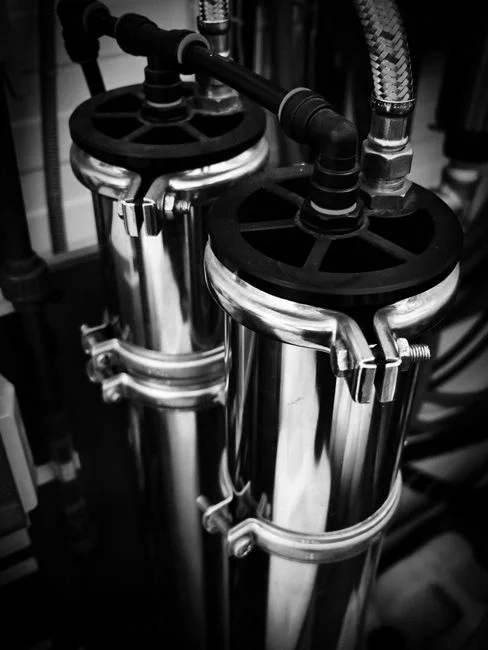
The regional blowdown sequence is screening, multi-media filtration, softening or controlled antiscalant dosing, industrial RO, then UV or on-site chlorine-dioxide polishing before cooling-tower make-up storage. The 2026 Aleppo guide specifies a three-to-five millimetre mechanical screen, multi-media filtration targeting SDI below 3, and industrial RO at 75–80% local recovery. It also identifies permeate below 50 ppm TDS as suitable for direct cooling-tower make-up. These are the basis for an equivalent Ar Raqqah process scope, not verified site performance.
- Screen the blowdown and remove suspended material.
- Apply multi-media filtration, with the supplier responsible for demonstrating the selected SDI target.
- Provide either a twin-tank softener or a controlled antiscalant and acid-dosing skid. The Aleppo guide uses LSI −0.5 to +0.5 and RSI 6.0–7.0 as operating gates.
- Treat with an industrial RO system for cooling-blowdown reuse.
- Apply UV or on-site chlorine-dioxide polishing, then store the product as cooling make-up.
Control scale through chemistry and cycles of concentration rather than unnecessary blowdown. The regional sequence places acid or antiscalant dosing and pH trim ahead of RO. During quotation, ask each bidder to define how LSI, RSI, silica saturation, calcium sulfate and concentrate chemistry will be controlled across changing tower operation.
Treat a chlorinated cooling loop as a separate design case. Residual oxidizing biocide can damage biological membrane processes, while sanitary organics and pathogens can foul an RO membrane. Verify membrane, disinfectant and chemical compatibility before combining operations. Also require confirmation that the proposed polishing process meets the site’s make-up specification; do not rely on the regional permeate threshold alone.
A high-recovery bid must include a complete brine balance. The 2026 IDE Tech article describes conservative RO followed by controlled precipitation of silica, calcium carbonate and other salts into pellet-like solids, leaving a more sodium-chloride-rich brine. The tender must identify concentrate flow, precipitate withdrawal, residual solids, residual liquid and the final receiving route. A high-recovery claim without a disposal hierarchy is incomplete.
| Process stage | Regional basis from the 2026 Aleppo guide | Bid information required |
|---|---|---|
| Screening | Rotary mechanical bar screen, 3–5 mm aperture | Duty basis, solids handling and bypass arrangement |
| Filtration | Multi-media filter, targeting SDI below 3 | Media specification, backwash controls and influent envelope |
| Scale control | Twin-tank softener or PLC-controlled antiscalant skid; LSI −0.5 to +0.5 and RSI 6.0–7.0 | Chemical dosing range, control logic and membrane warranty conditions |
| Desalination | Industrial RO at 75–80% local recovery; permeate below 50 ppm TDS | Recovery definition, normalized energy basis and permeate guarantee |
| Disinfection | Pipeline UV or on-site chlorine-dioxide generator | Validated dose, residual strategy and materials compatibility |
| High-recovery add-ons | Controlled salt precipitation and pellet withdrawal | Full mass balance, solids destination and brine disposal route |
Treat Sanitary Wastewater on a Biological Train
Sanitary wastewater should remain on a biological train because the required removal targets are organics and pathogens, not the dissolved-salt control used for cooling blowdown. The 2026 Aleppo regional sequence is equalization, dissolved air flotation for FOG and colloidal material, MBR treatment and UV polishing, followed by reuse or sewer discharge. This sequence provides a clear procurement basis, but the receiving route and reuse authorization must be confirmed for Ar Raqqah.
Use DAF where cafeteria wastewater, wash-down or industrial streams contain oil, FOG or colloidal material that could overload or foul the biological process. Equalization should absorb hydraulic and loading variation before the membrane system. The exact tank volume, DAF duty and biological loading require measured flow and influent data; they should not be transferred from an Aleppo equipment list.
The MBR system for separate sanitary wastewater treatment covers a stated product range of 10–2,000 m³/day and uses submerged PVDF membranes. The same 2026 Aleppo guide describes effluent below 1 micrometre and 95–99% COD/BOD removal for the sanitary sequence. Treat these as supplier and regional reference claims, not guaranteed Ar Raqqah outlet performance.
Where reuse is contemplated, define the endpoint before selecting final polishing: toilet flushing, irrigation, cooling make-up or another process use have different water-quality and authorization requirements. If sewer discharge is selected, obtain current receiving limits and pretreatment rules. The supplied research does not establish Ar Raqqah-specific discharge limits, so no equipment should be justified by claiming that the Aleppo sequence guarantees local compliance.
| Sanitary stage | Function | Design information to obtain |
|---|---|---|
| Equalization | Stabilize hydraulic and organic loading | Measured flow range, load range and retention requirement |
| DAF | Remove FOG, oil and colloidal material where present | Stream inventory, solids removal objective and sludge route |
| MBR | Provide biological treatment and membrane solids separation | Feed chemistry, duty, membrane warranty and cleaning method |
| UV polishing | Disinfect before reuse or discharge | Required dose, validation method and receiving-route requirement |
| Final destination | Define the authorized reuse or sewer outcome | Written authority route and applicable current limits |
Build a Site-Specific Design and Procurement Checklist
A purchasable package requires assigned inputs, verified site data and testable guarantees. The client should confirm tenant and operating obligations; the EPC should complete the water balance and process design; the laboratory should define the influent envelope; the operator should supply chemical and control requirements; and the authority should confirm the discharge or reuse route. The table below turns that responsibility split into an auditable pre-order register.
The cooling package must state the cooling configuration, design wet-bulb temperature, tower model, make-up, evaporation, blowdown, chemical inventory, operating cycles of concentration and phased IT loads. The laboratory scope must cover TDS, hardness as calcium carbonate, silica, chloride, sulfate, alkalinity, pH, temperature, residual oxidant, organics and metals. These are the chemistry gates identified in the 2026 Aleppo guide and must be verified in Ar Raqqah.
The authority must confirm the receiving route, available capacity, pretreatment requirements, limits for TDS, BOD, residual oxidant and temperature, and any reuse consent. These are verification requests, not Ar Raqqah limits. If the route remains unresolved, price the discharge and reuse alternatives separately and make final order conditional on written confirmation.
Require suppliers to separate process equipment, membranes or media, installation, commissioning, freight, import costs, spares, initial chemicals, energy demand and O&M assumptions in their bids. Use pilot results or guarantee conditions to define permeate quality, recovery, normalized energy consumption, automatic backwash, control behavior and acceptance testing. Also ask bidders to state the measured design basis and how recovery will be calculated.
| Fillable input or acceptance item | Owner | Status | Evidence required |
|---|---|---|---|
| Cooling configuration, design wet-bulb, tower model and phased IT load | Client / EPC | Not started / received / verified | Approved design basis |
| Seasonal stream flows and complete data-center water balance | EPC / operator | Not started / received / verified | Measured or validated balance |
| Cooling-water and wastewater laboratory envelope | Laboratory / EPC | Not started / received / verified | Signed analytical report |
| Tenant water, discharge and tenant-disclosure obligations | Client | Not started / received / verified | Contract clauses |
| Discharge route, capacity, limits and reuse consent | Authority / client | Not started / received / verified | Written confirmation |
| Permeate quality, recovery, normalized energy and acceptance test | Supplier / EPC | Not started / received / verified | Guarantee schedule and pilot basis |
| Concentrate, sludge, pellet and residual-liquid route | Supplier / EPC / authority | Not started / received / verified | Approved mass balance and destination |
| Itemized landed cost, spares, chemicals, energy and O&M | Supplier / EPC | Not started / received / verified | Commercial schedule |
Frequently Asked Questions
How much should a data center wastewater treatment package cost in Ar Raqqah?
The supplied research does not provide a defensible Ar Raqqah price. The 2026 Aleppo guide reports an indicative USD 350,000–600,000 CAPEX band and says Syrian logistics can shift landed cost by more than 20%, but neither figure establishes an Ar Raqqah budget. Require each bidder to itemize equipment, membranes or media, freight, import costs, installation, commissioning, spares, chemicals, energy and O&M. This separates comparable process scope from site-specific commercial assumptions.
Which reuse route should the EPC recommend?
Require the EPC to compare discharge, partial reuse, direct cooling reuse and high recovery against one measured water balance. The 2026 Aleppo guide identifies industrial-RO reuse delivering 50–70% loop closure as its practical default for 10–30 MW colocation sites, while treating near-ZLD as conditional on tenant obligations or water economics. Check the recommendation against Ar Raqqah feed chemistry, sewer capacity, concentrate disposal and the tenant contract before selecting it.
What should a supplier guarantee in the tender?
Ask for a stated feed-water envelope, permeate quality, recovery definition, normalized energy consumption, automatic control and backwash behavior, cleaning method and commissioning tests. For high recovery, add a concentrate and precipitated-solids balance. Do not accept performance guarantees that omit the measured design basis or exclude the site’s treatment chemicals and biocide regime.
How should the buyer select and size treatment suppliers?
Give all suppliers the same stream separation, water balance, laboratory envelope and receiving-route information. Require an offer for each selected train, plus a separate price for the concentrate or residual route. Confirm membrane warranty conditions against residual oxidant and scaling chemistry, and require references or pilot evidence for the claimed operating conditions. Final sizing and compliance remain conditional on current Ar Raqqah measurements and written authority confirmation.