Identify the wastewater routes that need treatment
A Gazipur hotel or resort should select a treatment route based on its specific wastewater streams, verified flow, available land, discharge point and water-reuse goals. The practical choice is an underground A/O package plant for a compact biological treatment route, an MBR membrane bioreactor system when low-turbidity effluent or reuse is a priority, or a municipal sewer connection only where service is verified as available. IFC reported in December 2020 that Gazipur did not have a wastewater treatment plant or centralized sewerage network. Final selection requires measured flows, septic-tank records, outlet conditions and current regulatory confirmation.
Start by separating domestic sewage from kitchen wastewater, pool discharges, laundry effluent and other water-using streams. Turag Waterfront Resort lists cottages, an open-air dining area, a swimming pool and other guest facilities in its 2025 property description, showing why occupancy alone cannot define a resort’s wastewater profile. A property may also operate a restaurant, laundry, event spaces, staff housing or wellness facilities. Each process has a different flow pattern, pollutant concentration and treatment implication.
Request verified daily wastewater flow and peak flow from water-meter records, together with septic-tank emptying records, occupied-room counts, seasonal occupancy and operating hours for the pool, kitchen and laundry. These records establish the actual A/O package plant versus MBR considerations for hotel wastewater, rather than relying on a generic occupancy-based estimate.
Do not send kitchen oil and grease, pool water or other concentrated or variable flows directly into a biological sewage unit without a separate engineering review. Equalization, pretreatment and flow-control requirements must be identified before equipment selection. Also document the final outlet, its ownership, access for sampling and maintenance, flood exposure, and whether the intended destination is direct discharge, irrigation or another form of wastewater reuse.
Check the sewerage route available to the property
Gazipur had no wastewater treatment plant or centralized sewerage network as of late 2020, according to IFC reporting, and any hotel or resort should treat the public sewer as a route to verify rather than an established connection.
| Property condition | Decision implication | Evidence or confirmation required |
|---|---|---|
| Verified public sewer connection is available at the property | Compare the sewer route with on-site treatment, including connection charges, developer obligations, discharge conditions and long-term service responsibility. | Written confirmation from the relevant authority and the responsible utility. |
| No connection, an uncertain connection point or no confirmed service conditions | Develop an on-site A/O package plant or MBR as the primary treatment route. | Current authority confirmation, connection map, conditions and contribution schedule. |
| Connection is planned but not operational | Do not assume that a planned network can meet the property’s construction schedule. | Current implementation status, service boundary, commissioning date and agreement terms. |
The proposed initiative reported by IFC in December 2020 had an estimated cost of $82 million, nearly 137 km of sewerage and two sewage treatment plants with about 56 million liters per day of cumulative capacity. At that date, nearly 70% of 230,000 households in Gazipur and Tongi relied on decentralized septic tanks and pit latrines, while the remaining 30% discharged wastewater directly into open drains or water bodies.
These figures describe the situation reported in 2020; they do not establish the availability of sewer service to an individual property in 2026. Before including a municipal sewer in quotations or development schedules, request current written confirmation of connection availability, connection conditions, applicable discharge requirements and any developer contribution. The separate decision logic for a public sewer versus package plant for domestic sewage remains useful, but Gazipur-specific authority confirmation takes priority.
Compare A/O package and MBR treatment
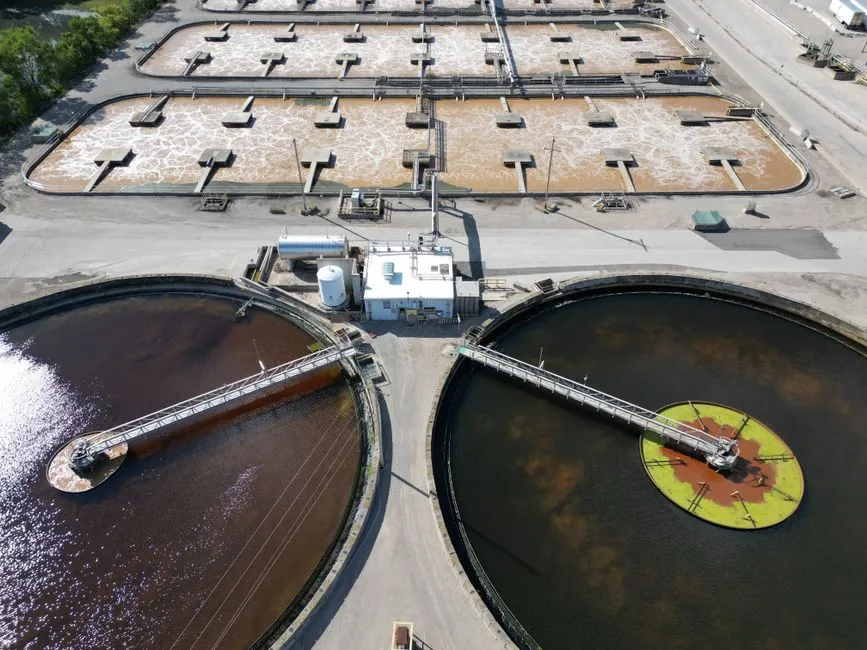
The A/O package plant is a conventional biological treatment route with compact civil requirements, while MBR adds membrane solids separation to protect reuse or tighter discharge performance. The correct choice depends on required effluent quality, available land, operating resources and the receiving point.
| Selection factor | Underground A/O package sewage treatment plant | MBR membrane bioreactor system |
|---|---|---|
| Treatment route | Integrates anoxic and aerobic biological contact oxidation, sedimentation and disinfection in a single buried unit. | Combines activated sludge with submerged PVDF membrane filtration. |
| Catalog capacity | 1–80 m³/h. | 10–2,000 m³/day. |
| Filtration | Solid separation is provided by the package process rather than the membrane route described for MBR. | Filtration below 1 μm. |
| Land and visibility | The buried configuration can preserve landscaping above the installation. | Occupies 60% less space than conventional systems. |
| Operation | Fully automated and requires no operator, subject to the supplier’s operating and maintenance requirements. | Requires supplier-defined membrane maintenance, controls and operating support. |
| Best fit for screening | Compact biological sewage treatment where the outlet and required solids separation do not justify membrane filtration. | Wastewater reuse or stringent solids separation where the added process provides greater value. |
The underground A/O package sewage treatment plant is suitable where resort landscaping must remain visually unobstructed and routine staff time is limited. Its published process includes anoxic and aerobic biological contact oxidation, followed by sedimentation and disinfection within one buried unit. Its stated flow range is 1–80 m³/h, while the published configuration is fully automated and requires no operator. These are catalog specifications, not a recommendation to size the plant at the upper limit.
The MBR membrane bioreactor system combines activated sludge with submerged PVDF membrane filtration. The published specification gives filtration below 1 μm, a capacity range of 10–2,000 m³/day and a footprint 60% less than conventional systems. These characteristics make MBR the stronger candidate when wastewater reuse or stringent solids separation is a defined project objective. A higher-value reuse application does not remove the need to specify pretreatment, membrane maintenance, standby power and the receiving conditions for the final effluent.
Do not select either route from occupancy or site area alone. Confirm design flow, required effluent quality, backup power, sludge handling, maintenance access and outlet conditions. For A/O, also confirm how the buried installation is affected by groundwater, flood level and access to desludging. For MBR, ask specifically how membrane cleaning, replacement, standby operation and membrane waste are addressed.
Build the site-screening and sizing brief
A defensible shortlist starts with measured property data and explicit discharge or reuse requirements. Catalog limits show what each supplier offers; they do not establish the required capacity for the hotel or resort.
| Screening input | Record for the property | Route decision supported |
|---|---|---|
| Wastewater demand | Average daily flow, peak flow, water-meter history, occupied-room count, seasonal occupancy and flows from the pool, kitchen, laundry and other facilities. | Sets the design basis for on-site equipment and identifies equalization or pretreatment needs. |
| Site and installation | Available area, soil and groundwater conditions, flood level, maintenance access and tanker access for septic-tank desludging or sludge removal. | Tests whether a buried A/O package plant or an MBR installation is physically practical. |
| Utilities and operations | Power availability, backup-power requirement, odor-control provisions, noise limits, automation, remote monitoring and staff operating responsibility. | Compares lifecycle obligations rather than equipment purchase price alone. |
| Outlet and reuse | Receiving point, ownership, access, effluent conditions, intended discharge or reuse application and sampling requirements. | Determines whether A/O, MBR or sewer discharge is technically suitable. |
| Commercial scope | Required capacity, treatment standard, civil works, power, sludge handling, commissioning, controls, training and operating support. | Allows quotations to be compared on the same scope. |
Send the same brief to each supplier. Ask each one to document its design basis, process route, capacity margin, control philosophy, commissioning tests and operating support. The supplied technical ranges—1–80 m³/h for the WSZ and 10–2,000 m³/day for the MBR—are catalog limits only.
Require evidence for sludge removal, standby power, odor control, noise, automation and remote monitoring before comparing quotations. If the property currently relies on septic tanks, include plate-and-frame filter-press sludge dewatering considerations in the waste-handling scope where applicable. Record who empties the tanks, where the residual sludge goes and how the proposed plant changes that operating chain.
For the final shortlist, apply three tests: the route must accept the verified flow and pollutant profile; it must meet the actual receiving-point or reuse requirements; and the supplier must price the complete installation, including civil work, utilities, commissioning, sludge handling and controls. If a municipal sewer option is included, use the current written authority response as the benchmark against which on-site capital, operating and compliance costs are compared.
Frequently Asked Questions
How should an A/O package plant or MBR system be sized for a Gazipur hotel?
Size the system from verified wastewater flow and the required treatment duty, not from room count alone. Record average daily and peak flows from water meters, account for seasonal occupancy and pool, kitchen and laundry operations, and document the required effluent quality. The supplier should then show its design basis, capacity margin, peak-flow response and equalization provisions. Treat the published 1–80 m³/h A/O range and 10–2,000 m³/day MBR range as catalog limits, not recommended capacities.
What inputs are needed for a comparable treatment-system price?
Request a defensible quotation only after fixing the route, design flow, treatment standard, intended reuse or discharge point, available installation area and utility requirements. The quote should separate equipment, civil works, installation, power and backup power, controls, commissioning, training, sludge handling, maintenance and any sewer connection contribution. Without these inputs, a single project price would conceal major scope differences between A/O, MBR and municipal-sewer options.
How should a treatment supplier be selected?
Evaluate the proposed process, sizing basis, performance guarantees, commissioning tests, installation scope and local service capability. Ask how the supplier will address membrane cleaning and replacement for an MBR, buried-unit access and desludging for an A/O package, sludge handling, odor control, noise, automation and backup power. Reference projects should be relevant to the proposed operating conditions rather than used as a substitute for the property-specific design.
Which compliance risks should be resolved before accepting a treatment route?
Obtain written confirmation from the authority responsible for the specific receiving point. Confirm the applicable discharge conditions, connection requirements, monitoring obligations and whether irrigation or another reuse application is permitted for the proposed effluent. For a sewer route, establish that service is available to the property rather than merely planned at city level. The December 2020 IFC infrastructure announcement cannot serve as current proof of connection availability or a 2026 discharge standard.