Identify the controlling discharge requirement
A mining or metals plant discharging to a sewer near Moscow, US generally complies through a POTW pretreatment program under Clean Water Act §307(b) and 40 CFR Part 403, not through an NPDES permit for that sewer discharge. Applicable categorical standards may include 40 CFR Part 437 or Part 433, while the receiving POTW’s sewer-use ordinance can impose more stringent requirements. A practical train is pH adjustment, metal precipitation, DAF or lamella clarification, multimedia filtration, optional disinfection and sludge dewatering. Final equipment selection depends on confirmed local limits, flow, pH, suspended solids, oil, metals and sludge volume; the supplied research does not establish Moscow-specific limits, so the current POTW ordinance must be obtained before sizing.
The governing pathway should be separated before procurement. EPA states that mining point-source discharges require NPDES authorization, including discharges from associated impoundments (US EPA, Industrial Wastewater, 19 January 2017 snapshot). NPDES therefore remains relevant to direct surface-water or separate authorized discharges, but it is not the permit governing an industrial user’s indirect sewer discharge.
For the sewer connection, the control authority is the POTW where an approved pretreatment program exists; otherwise, it is the approval authority. That authority identifies applicable standards and applies the most stringent applicable requirements (US EPA, Pretreatment Standards and Requirements—Applicability, publication date not stated). Mining and metals facilities may be categorical industrial users, but classification and applicability must be confirmed against the facility’s actual operation and the applicable subcategory. The mining and metals sewer-pretreatment requirements provide a useful sequence for this check.
| Document or determination | What it establishes | Procurement consequence |
|---|---|---|
| Current POTW sewer-use ordinance and industrial-user permit | Local limits, prohibitions, monitoring, sampling, surcharge and enforcement terms | Use these as the controlling sewer-discharge design basis |
| Applicable categorical standard and subcategory | Federal pretreatment requirements that may apply to the industrial user | Confirm applicability before treating Part 437 or Part 433 as controlling |
| Current NPDES permit for separate discharges | Requirements for point-source surface-water or other authorized discharges | Keep the NPDES and sewer-pretreatment scopes separate |
| Compliance basis and permit correspondence | Applicable parameters, averaging periods, monitoring points and approved deviations | Convert permit requirements into guaranteed performance criteria |
No verified Moscow-specific numerical limit appears in the supplied research. Request the current ordinance, permit, applicable subcategory, sampling requirements and any approved deviation before asking a supplier to size equipment.
Map wastewater characteristics to treatment objectives
The design envelope is defined by measured contaminants and flow variability, not by the phrase “mining wastewater.” Raw streams described in the supplied research can contain acidic pH, suspended solids, dissolved metals including Pb, Cu, Zn, Cd, Ni and As, and elevated sulfate and TDS (HydropureWater, How Mining & Metals Plants Meet Pretreatment Limits Before Sewer Discharge, publication date not stated). Those characteristics divide into soluble treatment, solids separation, filtration and residuals-management duties.
Obtain a 12-month influent characterization, current discharge-monitoring reports and operating records before final sizing (HydropureWater, How Mining/Metals Plants Near Price, US Meet 2026 Pretreatment Limits, publication date not stated). The record should cover average and peak flow, campaign and batch-discharge patterns, pH, TSS, oil and grease, target metals, sulfate, TDS, and the variability of each. It should also identify the origin of contact water, process water and stormwater entering the proposed sewer connection.
Equalization is the upstream control that protects chemical dosing and clarification. The supplied research recommends 8–24 hours of average daily flow for batch mining flows (HydropureWater, How Mining & Metals Plants Meet Pretreatment Limits Before Sewer Discharge, publication date not stated). That recommendation should be tested against actual dump-leach, shift-change and mill-cleanout data rather than converted automatically into a basin volume.
| Influent condition | Treatment objective | Design evidence required |
|---|---|---|
| Acidic pH and dissolved metals | Raise pH into the required precipitation range and generate metal-hydroxide solids | pH range, titratable acidity, metal species and jar-test results |
| High TSS or variable solids | Remove settleable and floatable material before filtration | TSS profile, particle-size distribution and solids settleability |
| Oil, grease or colloidal fines | Recover floatable material and capture fine precipitates | Oil and grease concentration, emulsivity and colloid characterization |
| Batch campaigns and clean-outs | Equalize flow and chemical demand before clarification | Hourly flow records, campaign duration and dump-leach or mill-cleanout data |
| Metals requiring very low residuals | Add sulfide polishing or another verified polishing step | Confirmed local limit, precipitation pH and residual-metal tests |
Choose precipitation and clarification equipment
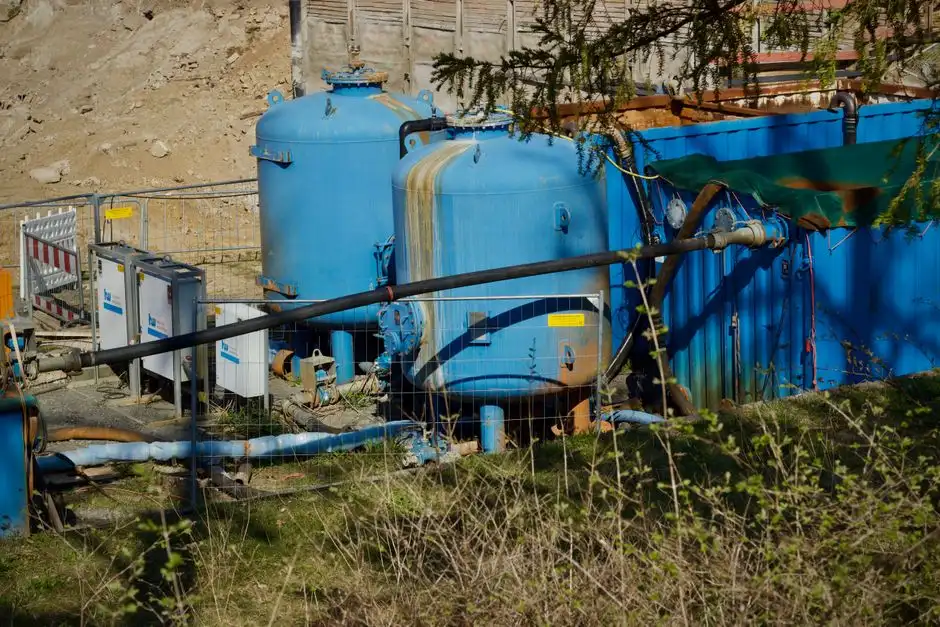
Hydroxide precipitation is the baseline treatment because lime and sodium hydroxide are comparatively simple and well understood, but pH correction must precede reliable solids separation (HydropureWater, How Mining & Metals Plants Meet Pretreatment Limits Before Sewer Discharge, publication date not stated). A PLC-controlled chemical dosing skid should stage acid or alkali and coagulant feed from measured flow and pH. Jar tests should establish the operating pH, dose and coagulant aid before the control setpoints are fixed.
Sulfide polishing becomes relevant when the confirmed local limit leaves an unattainable dissolved-metal residual after hydroxide treatment. The supplied research reports residual Cu, Zn, Cd and Ni of 0.01–0.05 mg/L with sulfide precipitation, versus 0.5–2.0 mg/L with hydroxide precipitation; it also reports 2–4× higher reagent cost and requires sealed reactors with scrubbed H₂S vents (HydropureWater, How Mining & Metals Plants Meet Pretreatment Limits Before Sewer Discharge, publication date not stated). This comparison supports a hydroxide train with slipstream sulfide polishing only where the limit and residual test justify the added safeguards.
DAF is preferred when oil, grease or fine colloidal metals are present because the microbubbles float oil-coated and colloidal particles. The supplied DAF data show 90–98% TSS removal and 85–95% oil and grease removal in mining and metal-finishing service, with hydraulic loading of 5–25 m/h; the product range covers 4–300 m³/h across 13 models (HydropureWater, How Mining & Metals Plants Meet Pretreatment Limits Before Sewer Discharge, publication date not stated; product catalog excerpt). A DAF system for mining wastewater clarification should therefore be evaluated against the measured oil and colloid load, not selected merely because DAF is available.
Lamella is the stronger candidate for predominantly metal-hydroxide sludge at higher flow and where floor area is constrained. The supplied surface-loading range is 20–40 m/h, and lamella handles dense metal-hydroxide flocs effectively, but it removes free oil and colloidal fines less effectively than DAF (HydropureWater, How Mining & Metals Plants Meet Pretreatment Limits Before Sewer Discharge, publication date not stated). The side-by-side comparison of DAF and lamella clarifiers for mining wastewater provides the relevant equipment-side decision framework.
| Decision condition | Preferred route | Required proof |
|---|---|---|
| Oil, grease or significant colloidal metal load | DAF clarification | Oil and grease tests, colloid characterization and DAF jar or pilot performance |
| Primarily metal-hydroxide sludge at higher flow and constrained site | Lamella clarification | Floc settleability, sludge density and surface-loading calculation |
| Ordinary hydroxide residual meets the confirmed limit | Hydroxide precipitation followed by selected clarifier | Jar-tested pH, residual metals and settleability |
| Local limit requires very low dissolved-metal residual | Hydroxide precipitation plus sulfide polishing | Confirmed limit, sulfide jar tests, sealed-reactor design and H₂S scrubber scope |
| Metal-finishing applicability | Separate Part 433 review | Confirm whether Part 433.15 applies; its cited figures are copper 3.38 mg/L daily maximum and 2.07 mg/L monthly average, and total chromium 2.77 mg/L daily maximum and 1.71 mg/L monthly average (HydropureWater, How Mining & Metals Plants Meet Pretreatment Limits Before Sewer Discharge, publication date not stated) |
Add filtration, disinfection and sludge handling
Clarification does not replace final filtration when suspended solids carryover can compromise a sewer limit. The supplied research recommends a multimedia filter after clarification, with a filtration rate of 1–2 m/h and residual TSS below 10 mg/L (HydropureWater, How Mining & Metals Plants Meet Pretreatment Limits Before Sewer Discharge, publication date not stated). Backwash must be designed around the actual media configuration, recovery requirement and waste stream rather than average production flow alone.
Disinfection is conditional rather than automatic. The POTW ordinance and collection-system conditions determine whether residual disinfectant is required; the supplied chlorine dioxide range is 1–5 mg/L, while UV is the chemical-free option where residual oxidants are discouraged (HydropureWater, How Mining & Metals Plants Meet Pretreatment Limits Before Sewer Discharge, publication date not stated). If contact water or shared infrastructure creates a microbiological requirement, include disinfection in the performance schedule and confirm the required residual with the control authority.
Metal-bearing sludge is part of the treatment system, not a residual afterthought. Clarifier and DAF sludge can be dewatered with a plate-and-frame filter press; the supplied research reports 25–35% dry solids and identifies off-site disposal or metal recovery as possible routes, subject to applicable waste rules (HydropureWater, How Mining & Metals Plants Meet Pretreatment Limits Before Sewer Discharge, publication date not stated). Filter-press sizing requires actual sludge volume, solids concentration, batch duration and filtrate-return capacity.
| Process step | Purpose | Procurement or acceptance input |
|---|---|---|
| Multimedia filtration | Remove residual TSS and protect the discharge limit from clarifier carryover | Media selection, filtration rate, backwash sequence, filtrate destination and demonstrated TSS performance |
| Disinfection | Address a POTW requirement for microbiological control | Written ordinance basis, contact or dose criteria, residual monitoring and UV intensity or oxidant verification as applicable |
| Plate-and-frame dewatering | Produce a manageable metal-bearing cake | Sludge mass and volume, operating cycle, cake dry-solids result, filtrate return and approved disposal route |
| Residuals management | Ensure sludge and filter waste have lawful destinations | Generator-status review, waste characterization, transporter information and applicable disposal documentation |
The metals-plant pretreatment compliance guide can support a parallel check for metal-finishing operations, but it does not replace the receiving POTW’s current Moscow-area requirements.
Build a procurement-ready acceptance checklist

A purchase order should be backed by a written compliance basis, measured influent envelope and guaranteed performance schedule. The supplied research does not provide a verified Moscow-specific limit, so the current POTW ordinance and industrial-user permit must be the first documents obtained (HydropureWater, How Mining & Metals Plants Meet Pretreatment Limits Before Sewer Discharge and How Mining/Metals Plants Near Price, US Meet 2026 Pretreatment Limits, both publication dates not stated; US EPA, Pretreatment Standards and Requirements—Applicability, publication date not stated).
Require the supplier to state pH, TSS, copper, zinc and every other specified metal as guaranteed acceptance parameters at the stated average and peak flow conditions. The schedule should identify test methods, sample locations, averaging periods, startup stabilization, turndown, automatic-control tests, alarm functions and consequences for failed acceptance testing. Supplier references and comparable service should be checked against the actual chemistry and operating mode.
The procurement sequence supported by the research is: verify current permits and local limits; obtain DMR data; complete the 12-month influent characterization; perform jar tests; select the treatment train; issue performance-based bids; and complete witnessed commissioning (HydropureWater, How Mining/Metals Plants Near Price, US Meet 2026 Pretreatment Limits, publication date not stated).
| Category | Required item | Acceptance check |
|---|---|---|
| Compliance basis | POTW, ordinance version, categorical subcategory, local limits, monitoring frequency and prohibited discharges | Signed by plant compliance personnel and reconciled to permit language |
| Design basis | 12-month influent characterization, campaign data, current permits, DMR data and jar-test report | Traceable to measured flow, pH, TSS, oil and grease and specified metals |
| Performance guarantee | Guaranteed pH, TSS, copper, zinc and other specified metals at average and peak flow | Witnessed sampling using identified test protocols and sample points |
| Chemical and solids balance | Reagent consumption, sludge yield, backwash volume and filtrate return | Measured or verified mass balance during commissioning |
| Controls and utilities | PLC, alarms, power, air, water, drainage and installation boundaries | Functional test and utility demand reconciled with site services |
| Commissioning and support | Operator training, site acceptance test and after-sales support | Documented handover, training records and corrective-action closure |
Frequently Asked Questions
How should a buyer compare DAF and lamella equipment without a firm quotation?
Request a priced offer against the measured influent, confirmed local limits and average and peak flows. Ask each supplier to identify whether oil, grease or colloidal fines drive the selection, the guaranteed solids and metal performance, chemical consumption, sludge yield, utility demand and turndown. The supplied research supports the comparison but does not provide vendor-specific prices.
When is sulfide polishing preferable to hydroxide precipitation?
Consider sulfide polishing when the confirmed local limit cannot be met by hydroxide precipitation and jar testing demonstrates the required residual improvement. The supplied comparison gives sulfide residuals of 0.01–0.05 mg/L for Cu, Zn, Cd and Ni versus 0.5–2.0 mg/L for hydroxide, with 2–4× higher reagent cost and sealed H₂S-control requirements (HydropureWater, How Mining & Metals Plants Meet Pretreatment Limits Before Sewer Discharge, publication date not stated).
What inputs are required before sizing a mining wastewater treatment train?
Provide the 12-month influent characterization, current POTW ordinance and permit, applicable categorical determination, DMR data, campaign-flow record and jar-test results. Equalization, precipitation, clarification, filtration and sludge dewatering must then be sized from those inputs rather than from a generic flow assumption.
How can a buyer reduce compliance and supplier-selection risk?
Require a signed compliance basis, a performance guarantee tied to specified test methods and sampling points, a complete chemical and solids balance, functional PLC and alarm tests, and evidence of comparable mining or metal-finishing service. Do not release the equipment order until the current POTW and categorical requirements have been verified; the supplied research does not establish a Moscow-specific permit determination.