Define the Fruit Wastewater Separation Duty
A decanter centrifuge is suitable for the heavy, solids-rich sludge side of fruit-processing wastewater when large fibres, seeds, skins and other debris are screened out first. A two-phase unit is normally the practical choice for separated cake and clarified liquid; three-phase equipment adds value only when a distinct light liquid such as oil must also be recovered. The supplied fruit-processing guide identifies 2,500–4,000×g for pectin-rich sludge, highlights the need to screen a 0.5–5 mm solids fraction, and recommends SS 316L or, under harsher CIP conditions, Duplex 2205. Final sizing must use site-specific flow, solids-loading and feed-analysis data, plus jar testing for conditioning.
The fit-for-purpose screen starts with the wastewater stream rather than the fruit type. A light organic stream may need clarification and biological treatment; a heavy sludge stream may need dewatering; a mixed stream usually needs both, with DAF or clarification before the decanter. The commercial fruit-processing guide gives a screening envelope of COD 5,000–25,000 mg/L, BOD₅ 3,000–18,000 mg/L, TSS 2,000–8,000 mg/L, pH 3–5 and 25–55 °C, citing food-industry effluent surveys from 2024–2025. These values are screening references, not design loads. The same guide describes 2–3× seasonal shifts in COD and pectin concentrations, so campaign-specific data must be requested.
Ask the plant team to provide average and maximum hourly flow, TSS, oil and grease, pH, temperature, soluble-solids concentration, particle-size distribution and the dry-solids loading entering the proposed decanter. Do not use fruit type alone to select a machine. S3 identifies a 0.5–5 mm fraction of fibre, seed, pulp and skin in juice streams; these particles affect feed density, bowl balance, torque and wear even when the bulk TSS appears manageable. A DAF versus clarifier selection for food and beverage wastewater comparison is useful when deciding where the solids split occurs.
| Selection input | Evidence to request | Decision affected |
|---|---|---|
| Stream identity | Light organic, heavy solids-rich sludge or mixed stream | DAF, two-phase decanter or three-phase decanter |
| Hydraulic load | Average, peak and campaign maximum flow | Bowl and feed-rate capacity |
| Solids load | TSS and dry-solids mass per hour | Solids handling and torque reserve |
| Particle distribution | Representative sieve analysis, including fibre and skin | Screen spacing and pretreatment |
| Process chemistry | pH, temperature, oil and grease, soluble solids | Materials, corrosion review and three-phase decision |
Choose the Right Decanter Configuration
A two-phase decanter is the default for a dewatering train because it separates a heavy solids phase from one clarified liquid phase and discharges dewatered cake. S4, a commercial food and beverage equipment source, describes two-phase solid-bowl decanters as common for solid-liquid separation in food and beverage processing. Use that configuration when DAF or clarification has already removed the floatable and troublesome light fraction and the remaining objective is to reduce sludge solids for handling or disposal.
A three-phase decanter is justified only when the feed contains a distinct light-liquid phase that must be recovered separately from the heavy liquid and solids. S4 states that the two liquid phases must be immiscible and have different densities, with the solids as the heaviest phase. In a fruit-processing plant, that means a measurable oil or grease stream, not merely an assumption that some oil is present. If oil and grease are captured upstream and the requirement is cake plus clarified water, a two-phase unit is sufficient.
Do not confuse sludge dewatering with high-G clarification. S4 describes disc-stack separators as clarification equipment for lower-solids streams, while decanters handle higher-solids feeds and cake discharge. The fruit-processing guide states that the often-listed 2 μm cut point is a floor for fully liberated solids; juice wastewater typically contains much larger fibre, seed, pulp and skin fractions. A generic food-industry cut point therefore cannot be used as a guarantee. Evaluate the DAF pretreatment for fruit-processing wastewater and the resulting heavy-solids flow before sizing the decanter.
| Decision point | Two-phase decanter | Three-phase decanter |
|---|---|---|
| Product streams | Clarified liquid and dewatered cake | Heavy liquid, light liquid and cake |
| Preferred fruit-processing duty | Heavy sludge after DAF or clarification | Feed with a recoverable immiscible oil phase |
| Main configuration test | Are floatables and fibres adequately removed upstream? | Are the liquids immiscible and sufficiently different in density? |
| Buying consequence | Specify centrate quality and cake dryness | Specify all three outlets, phase interfaces and oil-recovery criteria |
Protect the Bowl with Front-End Treatment
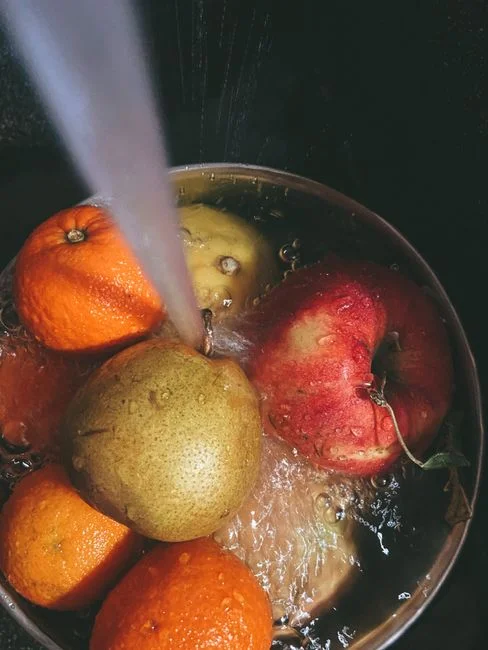
A decanter should receive a screened, equalized and chemically stable feed rather than the raw fruit-processing wastewater. S3 specifies continuous fine screening before DAF and the decanter, with a GX rotary bar screen using 5–10 mm bar spacing for fruit lines. It states that tighter 2–3 mm spacing is needed where the downstream DAF is small or equalization-tank hydraulic retention time is below 8 hours. The selected screen must remove stones, seeds, skin fragments and rags that could wrap the scroll or unbalance the bowl.
The sequence in S3 begins with a rotary bar screen and grit chamber, followed by equalization and pH neutralization. Grit removal protects the feed and rotating assembly from abrasive material; equalization limits short-duration load surges; pH control protects both the equipment and downstream conditioning chemistry. Use the GX rotary bar screen for fruit-processing headworks as the reference point when preparing the headworks specification, then confirm the final screen opening against measured particle distribution and downstream equipment limitations.
Define how centrate will return to the process. S3 reports that directly returning decanter centrate to the head of the plant can raise equalization-tank COD by 10–20%. The guide gives two corrective options: a dedicated centrate buffer or additional equalization volume. For procurement, require the vendor to show the hydraulic and contaminant return path rather than treating recycle as an invisible flow.
- Screen the raw stream for stones, seeds, skin and fibrous material.
- Remove grit before the feed reaches DAF or the decanter.
- Equalize hydraulic and solids loading and neutralize pH within the confirmed equipment envelope.
- Apply flow-paced pectin-rich sludge conditioning only after confirming the jar-test dose.
- Define centrate routing, buffer capacity and downstream polishing before finalizing the train.
Translate the Duty into Equipment Specifications
Translate the measured duty into separation force, bowl geometry, materials and controls rather than requesting a machine by bowl diameter alone. S3 gives a pectin-rich sludge screening range of 2,500–4,000×g and a wider horizontal-decanter range of 2,000–4,000×g at the bowl wall. Specify the minimum operating separation force required at the selected feed condition and ask the supplier to explain how bowl speed, feed rate, pond depth and scroll differential maintain that duty.
Bowl length-to-diameter ratio also affects cake transport and machine stability. S3 identifies 3.5–4.5 as the working range for pectin-rich sludge and notes that pushing above 4.5 increases scroll torque and vibration sensitivity. Require the proposal to state the selected L/D ratio, not merely describe a “long bowl,” and include the supplier’s calculation or performance basis for the predicted cake dryness.
Materials must follow the actual cleaning and process regime. S3 specifies SS 316L for pH 3–4 juice service. It also states that Duplex 2205 is required where chloride-based CIP exceeds 200 ppm Cl⁻ and cleaning temperature exceeds 60 °C. Obtain the plant’s actual CIP chemistry, residual chloride exposure, temperature and cleaning duration; then require every wetted bowl, scroll and feed-contact component to be listed by grade.
Request variable-frequency drives for both bowl and scroll operation, together with torque monitoring and control interlocks. S3 identifies both drives as necessary for campaign load swings. Include an automatic chemical dosing system, flow-paced against the measured dry-solids feed rate, because pectin-rich sludge conditioning must remain stable when the feed changes.
| Procurement field | Minimum information for supplier response | Reference basis |
|---|---|---|
| Sized duty | Peak hourly flow and dry-solids loading, with feed basis stated | Measured site data; no generic catalogue selection |
| Separation force | Required bowl-wall force and operating control range | S3: 2,500–4,000×g for pectin-rich sludge |
| Bowl geometry | Bowl diameter, L/D ratio and beach arrangement | S3: L/D working range 3.5–4.5 |
| Wetted materials | Grade for bowl, scroll, feed parts and exposed fasteners | S3: SS 316L for pH 3–4; Duplex 2205 review under stated CIP conditions |
| Controls | Bowl VFD, scroll VFD, torque monitoring and interlocks | S3 control recommendation |
| Feed conditioning | Automatic, flow-paced dosing skid with control range | S3 CPAM jar-test and dosing recommendation |
| Capacity reference | Proposed machine capacity at the guaranteed feed envelope | S3 commercial range: roughly 1–80 m³/h across LW250–LW1100 |
Set Performance and Acceptance Criteria
Acceptance should test the guaranteed feed envelope, not just a clean-water run or a short commissioning sample. S3 gives a CPAM screening window of 3–8 kg per tonne of dry solids for pectin-rich sludge, but the final dose must come from site jar testing. The supplier should witness or approve the conditioning trial, document feed dry-solids concentration and dose rate, and demonstrate stable operation over the selected campaign load.
Use S3’s cake benchmarks as preliminary targets rather than unconditional guarantees: 18–22% dry solids for unconditioned cake and 28–34% after conditioning. Define the sampling method, sample location and acceptance tolerance. Also specify the guaranteed centrate solids limit, because centrate quality determines the load carried into biological or membrane polishing. The guide states that decanter centrate can retain suspended fines and should not be treated as final effluent.
The acceptance protocol should include start-up, steady run-rate, maximum-envelope operation, cake discharge, centrate sampling, torque stability, vibration limits, CIP access and wear-part inspection. Use the automatic chemical dosing system as the control reference for the conditioning package, and require the operator to demonstrate setpoint tracking during a simulated feed swing.
| Acceptance item | Test method or evidence | Acceptance record |
|---|---|---|
| Feed envelope | Test at maximum hourly flow, TSS, particle distribution, pH, temperature and permitted chemical residuals | Signed operating envelope and deviation log |
| Conditioning | Site jar test followed by flow-paced dosing trial | Confirmed CPAM dose in kg per tonne of dry solids |
| Cake | Independent dry-solids sampling at discharge | Result against the agreed dryness target |
| Centrate | Sampling under steady and peak-load conditions | TSS result against guaranteed centrate limit |
| Machine stability | Record torque, vibration and drive status through load changes | No excursion outside the agreed operating envelope |
| Maintenance and CIP | Inspect wear parts and demonstrate cleaning access | Punch list closed with inspection records |
Frequently Asked Questions
Can a decanter centrifuge for fruit processing wastewater be sized from fruit type alone?
No. Fruit type does not establish hydraulic flow, dry-solids loading, particle distribution or peak campaign load. Require measured peak hourly flow, TSS, dry-solids mass rate, oil and grease, pH, temperature and particle-size data. Use these inputs to test whether a two-phase decanter can meet the cake and centrate targets before requesting a final price.
When is a three-phase decanter justified?
Specify
Frequently Asked Questions
How do I size a decanter centrifuge for fruit processing wastewater?
Sizing is primarily determined by the hydraulic flow rate (m³/h) and the solids loading (kg/h) of the wastewater stream. You must calculate the peak influent flow, accounting for seasonal variations in fruit processing, and define the required solids capture rate, typically targeting 90% to 98% recovery. The centrifuge bowl diameter and length-to-diameter (L/D) ratio are selected based on the settling velocity of the specific fruit solids and the required residence time to achieve the desired cake dryness, often ranging between 20% and 35% dry solids content.
Do I need a two-phase or three-phase decanter for fruit juice wastewater?
A two-phase decanter is sufficient if your goal is solely to separate solid fruit pomace from the wastewater. However, if the wastewater contains high concentrations of oils or fats—common in citrus or specific tropical fruit processing—a three-phase decanter is required. This configuration allows for the simultaneous separation of three distinct phases: a clarified liquid phase (centrate), a concentrated solid phase (sludge/pomace), and a separated oil/fat phase, which is essential for preventing downstream emulsification issues.
What should I include in a decanter centrifuge supplier specification?
Your specification must detail the influent characteristics, including pH levels, temperature, particle size distribution, and chemical oxygen demand (COD/BOD). Require technical data on the bowl speed (RPM), g-force capacity, material of construction (typically 316L stainless steel for food-grade corrosion resistance), and the drive system specifications. Additionally, define the expected cake dryness percentage, centrate quality requirements (suspended solids concentration), and noise level limits, usually specified at less than 85 dB(A) at a distance of one meter.
Is DAF required before a decanter centrifuge in a fruit processing plant?
Dissolved Air Flotation (DAF) is not always required, but it is highly recommended as a pretreatment step if the wastewater has high concentrations of fats, oils, and greases (FOG) or fine suspended solids that do not settle readily. Using a DAF unit before the decanter reduces the solids loading on the centrifuge, significantly improving the centrifuge's performance and reducing the polymer dosage required for effective flocculation. Without DAF, high FOG content can lead to rapid blinding of the centrifuge and inconsistent cake discharge.
What operating and acceptance tests prove the decanter is performing correctly?
Acceptance testing should involve a continuous 8-hour performance trial under full-load conditions to verify the solids capture rate and cake dryness against the design specifications. Key measurements include calculating the mass balance of the influent, centrate, and cake using gravimetric analysis to determine total solids removal efficiency. Furthermore, vibration monitoring and motor torque readings should be recorded to ensure the machine operates within the manufacturer’s mechanical safety thresholds and that the scroll conveyor is effectively transporting solids without overloading.