Separate the wastewater streams before selecting equipment
A Nellore data center needs two coordinated treatment decisions: treat cooling-tower blowdown for controlled discharge or reuse, and treat sanitary or process wastewater separately before discharge. Blowdown requires source-water characterization because evaporation concentrates salts, metals, biocides, corrosion inhibitors and treatment chemicals. A practical reuse train commonly combines pretreatment, RO and disinfection; conventional brackish-water RO is typically limited to 75–80% recovery before scaling becomes unmanageable. UF pretreatment for cooling-blowdown RO can protect downstream membranes, while an industrial RO system for blowdown reuse can be specified around a measured recovery target.
Create a separate stream register rather than one combined “wastewater” balance. Cooling-tower blowdown is the concentrated residual left when water evaporates from the circulating loop. Sanitary wastewater requires its own biological and load assessment. Process wastewater, equipment drainage, floor washdown and laboratory drains should remain separate until their chemistry, variability and disposal routes are verified.
For each stream, document average and peak flow, operating hours, cooling tower cycles of concentration, chemical program, temperature, pH, make-up-water source and intended discharge or reuse point. The cooling chemical program should identify biocides, corrosion inhibitors and antiscalants, including their product names and dosing ranges. Water Utility Report, updated 2026-04-14, states that cooling-tower blowdown can contain elevated salts, heavy metals, biocides, corrosion inhibitors and altered pH depending on source water and chemical treatment.
The available evidence does not establish Nellore sewer limits, receiving-water conditions or reuse eligibility. These requirements must be obtained from the relevant authority before combining streams or issuing a compliance-based equipment tender. Use the data-center wastewater and cooling-blowdown design guide as a structural reference, but verify the receiving route locally.
| Stream | Minimum design record | Default treatment boundary | Decision still required |
|---|---|---|---|
| Cooling-tower blowdown | Average and peak flow; cycles of concentration; temperature; chemical program | Separate pretreatment and reuse train | Make-up-water quality and concentrate destination |
| Sanitary wastewater | Peak flow; load; discharge point; operating hours | Do not route through the blowdown package by default | Applicable treatment and sewer acceptance conditions |
| Process or equipment wastewater | Source and chemistry; batch versus continuous flow | Separate assessment | Compatibility with any proposed common header |
Build the source-water sampling and risk profile
The source-water dataset must describe the actual blowdown entering treatment, as make-up-water chemistry alone cannot establish membrane-feed or scaling conditions. Request TDS or conductivity, total hardness, calcium, alkalinity, silica, sulfate, chloride, pH, residual oxidant, relevant metals, and the identity and concentration of biocides, corrosion inhibitors and antiscalants. Include total suspended solids, turbidity, colloid potential and biological indicators so pretreatment selection addresses both membrane protection and operational control.
Sample across representative operating conditions rather than relying on one grab sample. The sampling programme should reveal changes caused by source-water quality, cycles of concentration, chemical dosing, cleaning events and blowdown variation. The supplied sources do not establish a universal Nellore sampling interval, so specify coverage and frequency after the operating envelope is understood.
Also obtain the receiving constraints in writing: sewer discharge limits, reuse eligibility, receiving-water considerations, pretreatment requirements and any monitoring or reporting obligations. This documentation provides the basis for transitioning from a general treatment concept to a Nellore-specific compliance strategy. If authority requirements are unavailable, suppliers should price a clearly identified contingency and state which guarantees cannot be made until the limits are confirmed.
Use the analysis to populate three supplier inputs: membrane-feed envelope, chemical-use limits and monitoring requirements. The distinction between removable solids and dissolved scale formers is critical when comparing UF versus DAF for blowdown pretreatment.
| Parameter group | Information to obtain | Design question answered |
|---|---|---|
| Solids and biological load | TSS, turbidity, colloid potential, biological indicators | Whether DAF, UF or another solids barrier is required before RO |
| Scaling chemistry | Calcium, alkalinity, silica, sulfate, hardness, temperature, cycles of concentration | Which recovery and antiscalant control are technically credible |
| Corrosion and treatment chemistry | pH, chloride, metals, residual oxidant, biocide, inhibitor and antiscalant identity | Materials, disinfection and cooling-loop compatibility |
| Authority inputs | Sewer or discharge limits, reuse conditions, receiving-water requirements | Which guarantees can be included in the tender |
Choose a treatment route by stream and recovery target
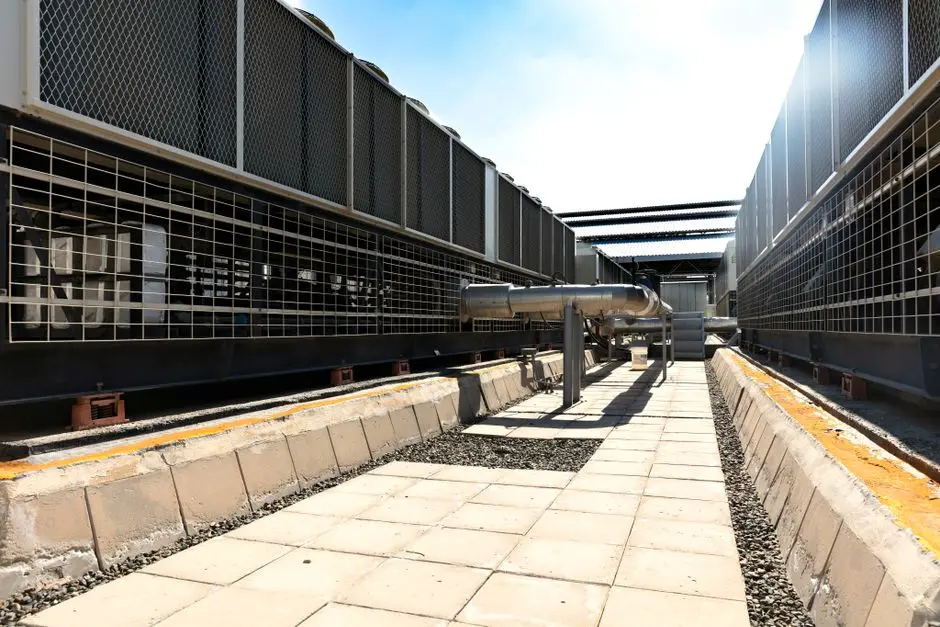
For conventional make-up-water reuse, evaluate pretreatment followed by RO and disinfection. The pretreatment choice must follow measured suspended solids, turbidity, colloids, scaling species and the selected RO feed specification; it should not be based on nominal permeate quality alone.
Chemical dosing should be applied against a defined control objective, such as coagulation, pH adjustment or specialty treatment. The automatic dosing system provides PLC-controlled injection of coagulants, flocculants, pH adjusters and specialty chemicals. Bid the chemical, dose-control range, duty cycle, containment and operator verification—not merely the pump count.
For higher recovery, distinguish a proven conventional design from a more complex salt-management concept. IDE Tech, 2026, reports that conventional brackish-water RO generally plateaus at 75–80% recovery before scaling becomes unmanageable. It describes controlled precipitation of sparingly soluble salts and dynamic RO operation as a higher-recovery approach. Its reported industrial case combined cooling-tower, RO-brine and process wastewater and states that the desalter operated at around 95% recovery with permeate silica of about 1 mg/L. That is a case-specific benchmark, not a guaranteed Nellore result.
Compare routes on whole-system recovery, concentrate destination, energy demand, chemical consumption, pretreatment complexity, reuse-water quality, maintainability and compliance burden. A route with high membrane recovery is not high recovery if concentrate recycling, cleaning downtime or storage constraints are excluded.
| Route | Select when | Main design issue | Evidence status |
|---|---|---|---|
| Source control plus segregated discharge | Receiving conditions allow the verified blowdown discharge route | Authority limits, sewer load and cumulative discharge | Nellore conditions not established by supplied research |
| Dosing plus clarification | Measured solids, oil, grease or colloids require removal | Sludge, chemical control and variable feed | DAF supplier range stated; Nellore duty requires water balance |
| UF plus RO plus disinfection | Solids control and reliable reuse are required | Feed chemistry, recovery, cleaning and concentrate | UF specification supplied; conventional RO benchmark reported by IDE Tech, 2026 |
| Controlled salt recovery | Higher recovery is justified and the solids route is available | Precipitation, dynamic operation and residual brine | Around 95% recovery and 1 mg/L silica reported for one IDE Tech case |
Size the system from measured flow and water balance
Size the package from measured or warranted average and peak flows. Add sanitary or process wastewater only to the treatment stage that will actually receive it. A preliminary schedule should identify feed flow, treated-water output, concentrate or residual discharge, storage and operating redundancy for every stream.
Build the cooling water balance around evaporation, drift, blowdown, make-up water and selected recovery. Raising the cooling tower cycles of concentration reduces blowdown and chemical consumption, but it does not automatically reduce total water demand because evaporation remains. Any proposed saving must reconcile these flows rather than subtract treated permeate from facility consumption without accounting for where the permeate returns.
Size pretreatment on its feed duty and RO on its feed and permeate duties. Confirm that the selected recovery remains compatible with scaling control and the concentrate-disposal route. Published recovery figures are benchmarks, not guarantees: HydropureWater describes industrial RO as rated up to 95%, while IDE Tech’s 75–80% figure describes the conventional brackish-water limit. Neither establishes the recovery of an unspecified Nellore feed.
Include membrane cleaning, replacement, instrumentation, treated-water storage and redundancy in the preliminary equipment schedule. These items affect both capital cost and availability. A data-center wastewater and cooling-blowdown design guide can support workflow development, but the site water balance remains the sizing authority.
| Worksheet item | Input required | Output for sizing | Bid instruction |
|---|---|---|---|
| Cooling water balance | Evaporation, drift, make-up, blowdown and cycles of concentration | Average and peak blowdown; fresh-water displacement | State which values are measured and which are warranted |
| Recovery basis | Feed chemistry and concentrate destination | Permeate, residual and concentrate flows | Guarantee recovery at a stated feed envelope |
| Pretreatment duty | Measured TSS, turbidity, oil, grease and colloids | UF, DAF, filtration or dosing train | Price alternate feed and cleaning cases |
| Storage and resilience | Peak demand, operating hours and recovery outage | Treated-water storage and standby strategy | Identify critical spares and response times |
Set acceptance criteria and monitor reuse-water quality
Acceptance criteria should define guaranteed feed and permeate flow, recovery, availability and performance limits at the completed source-water analysis and Nellore operating envelope. If the authority has not issued applicable conditions, require the bidder to state that limitation and price the compliance assumptions rather than imply local approval.
Specify online monitoring for flow, pressure, conductivity, pH and differential pressure. Each instrument needs a defined alarm set point, sampling response, shutdown function and operator action. Recovery testing should demonstrate the relationship between feed flow, product flow and concentrate flow; permeate conductivity alone does not demonstrate the promised water balance.
Where microbiological control is required, include an appropriate disinfection step. HydropureWater’s chlorine dioxide generators range from 50 g/h to 20,000 g/h and are listed for industrial cooling loops. Select the output only after defining contact conditions, demand, residuals and compatibility with the cooling chemical program.
The reuse case must also be evaluated as a life-cycle system. Open Engineering’s 2026 study found that its wastewater scenario had about twice the global warming potential of the freshwater case, with treatment energy accounting for roughly 80% of the difference. The study also reported that the UF-plus-RO scenario used more than five times the energy of the freshwater scenario, while improved cycles of concentration reduced blowdown and chemical consumption. These findings show why savings calculations need both water and impact accounting.
Require the commercial comparison to include avoided freshwater, reduced blowdown, disposal cost, chemical consumption and energy. Automatic chemical dosing with PLC control and chlorine dioxide generation for cooling-loop disinfection should be priced where they are part of the selected operating strategy.
| Acceptance item | Supplier information required | Verification |
|---|---|---|
| Feed and permeate flow | Guaranteed operating range and test conditions | Calibrated flow measurements across the site water balance |
| Recovery and concentrate | Recovery guarantee, feed envelope and concentrate destination | Simultaneous flow and chemistry records |
| Water quality | Permeate and reuse-water limits with sampling methods | Independent samples during sustained operation |
| Controls and availability | Alarms, shutdown logic, cleaning and response requirements | Functional test and operating demonstration |
| Life-cycle economics | Freshwater, disposal, chemical and energy assumptions | Reviewed calculation using measured or warranted site data |
Frequently Asked Questions
What does a Nellore data center need to request before comparing treatment-equipment prices?
Request a representative source-water analysis, a completed cooling and wastewater water balance, the chemical program, peak and average flows, and written receiving-system or reuse conditions. These inputs are needed for a defensible CAPEX and OPEX comparison. Suppliers should separate quoted equipment, pretreatment, RO, disinfection, controls, storage, concentrate handling, chemicals, energy, maintenance and commissioning costs. A price based only on nominal permeate capacity is not comparable.
How should a buyer select and size UF, DAF, RO or a high-recovery
Frequently Asked Questions
What does a data center in Nellore need for cooling-tower blowdown treatment?
Due to high ambient temperatures and humidity in the Nellore region, data centers experience high evaporation rates, leading to rapid concentration of dissolved solids and silica in cooling loops. Treatment systems must be capable of managing high conductivity, typically ranging from 2,000 to 5,000 µS/cm, and high silica levels often exceeding 150 mg/L. Essential components include a robust pre-treatment stage to handle suspended solids and a high-recovery reverse osmosis (RO) system designed for anti-scalant dosing to prevent membrane fouling.
Should a Nellore data center use UF or DAF before its blowdown RO system?
Ultrafiltration (UF) is generally preferred over Dissolved Air Flotation (DAF) for cooling tower blowdown in data centers unless there is a high oil and grease contamination risk. UF provides a superior barrier against silt density index (SDI) fluctuations, typically achieving SDI values below 3.0, which is critical for protecting RO membranes from colloidal silica fouling. DAF is primarily designed for removing light suspended solids and emulsified oils, which are rarely the primary contaminants in closed-loop data center cooling systems.
How do I size a cooling-blowdown reuse system without site water-analysis data?
In the absence of site-specific data, sizing should be based on the design evaporation rate of the cooling towers and the target Cycles of Concentration (CoC). A standard estimation assumes that blowdown volume is roughly 15% to 25% of the total makeup water volume. Equipment should be sized for a 20% surge capacity above the calculated peak blowdown flow rate to account for seasonal variations in Nellore’s climate and potential changes in cooling load density.
What should a wastewater-equipment supplier guarantee for a data-center blowdown bid?
A supplier should provide a performance guarantee covering the percentage of water recovery, typically targeting 75% to 85% for RO-based systems, and specific permeate quality metrics such as conductivity and silica concentration. Additionally, the supplier must guarantee the chemical consumption rate per cubic meter of treated water and the projected membrane lifespan under the specified feed water conditions, usually backed by a minimum 12-month operational warranty.
What Nellore permits and sewer limits must be checked before selecting wastewater equipment?
Equipment selection must comply with Andhra Pradesh Pollution Control Board (APPCB) standards and local Nellore municipal sewer discharge norms. Key parameters to verify include Total Dissolved Solids (TDS) limits, which are often restricted to below 2,100 mg/L, and Chemical Oxygen Demand (COD) limits, typically under 250 mg/L. It is mandatory to obtain a Consent for Establishment (CFE) and Consent for Operation (CFO) from the state board before commissioning any wastewater treatment infrastructure.