Start with the controlling Centre sewer requirements
Mining and metals plants near Centre meet sewer pretreatment limits by treating wastewater against the receiving POTW’s requirements and any applicable categorical pretreatment standards, rather than relying only on generic treatment targets. The compliance path starts with permits, local limits, industrial-user requirements and representative wastewater data; it then applies equalization, pH control, metal precipitation, solids separation, filtration and any required polishing or disinfection. EPA’s guidance identifies the core local-limit workflow as determining pollutants of concern, collecting and analyzing data, calculating MAHLs, implementing limits and addressing collection-system concerns. Final equipment sizing must be based on site-specific chemistry, flow variation, monitoring results and applicable state requirements.
EPA’s Local Limits Development Guidance, published in 2021, is a framework rather than a binding limit: if guidance conflicts with a permit or regulation, the permit or regulation controls. For a sewer connection, the controlling package should include the industrial user discharge permit, current local pretreatment limits, sewer-use requirements, monitoring obligations, slug-control provisions and applicable state conditions. Request current BMPs and prohibitions addressing treatment-plant interference, pass-through, collection-system damage and worker exposure.
Determine the actual operation before choosing a categorical standard. HydropureWater’s 2026 mining and metals pretreatment guidance identifies 40 CFR Part 430 for ore mining and dressing and Part 433 for metal finishing. A direct point-source discharge is different: EPA states that point-source discharges from mining operations, including discharges from associated impoundments, require NPDES authorization. A POTW connection belongs to the pretreatment and industrial-user framework.
| Document or authority | What it controls | Engineering consequence |
|---|---|---|
| Industrial user discharge permit | Site-specific discharge conditions, monitoring and reporting | Use as the primary equipment-performance envelope |
| POTW local limits and sewer-use rules | Constituent limits, prohibitions, BMPs and discharge authorization | Translate each condition into a treatment barrier |
| 40 CFR Part 430 or Part 433, if applicable | Categorical pretreatment requirements | Determine the applicable subcategory and applicable provisions |
| State conditions and residual rules | State operating, monitoring and waste-management requirements | Include monitoring, sludge characterization and disposal in design |
| EPA Local Limits Development Guidance, 2021 | Method for developing and implementing local limits | Use as workflow guidance, not as a substitute for binding requirements |
The US mining and metals pretreatment compliance guide provides a useful document-to-decision sequence for facilities facing the same issue elsewhere in the country.
Characterize the wastewater before selecting a process
Representative wastewater data, not an annual average, must define the design envelope for a mining or metals plant. Separate or characterize pit dewatering, concentrator slurry water, contact stormwater, acid mine drainage and metal-finishing rinsate before deciding whether they can share one treatment train. Each stream has a different pollutant fingerprint, and mixing them can hide the worst operating condition.
Build the sampling program around ore grade, mill throughput, storm events and campaign or continuous operation. HydropureWater’s 2026 industry research describes hourly flow and load swings and recommends a 24-hour composite sampler plus online pH and conductivity at the headworks. For an acid mine drainage treatment train, the same research identifies low-pH water, dissolved iron, sulfate and elevated TDS as important variables to measure.
EPA’s 2021 guidance identifies the need for data from controlled and uncontrolled sources when evaluating industrial users. Create the same split for this plant: continuous process streams, controlled wash water, hauled waste if accepted, stormwater, upset streams and any source that can bypass or overwhelm normal operations. Measure pH, suspended solids, dissolved and total metals, oil and grease, cyanide where relevant, fluoride, organics associated with flotation reagents, sulfate, TDS and every constituent named in the permit. Flow data should be reconciled with concentration data to calculate loads.
| Design input | Minimum evidence | Decision supported |
|---|---|---|
| Source characterization | Separate samples by stream and operating condition | Whether streams can be combined |
| Flow and load | Controlled and uncontrolled source flows with corresponding analyses | Equalization, chemical feed and solids-handling capacity |
| Variability | Mill campaigns, ore changes, storm periods and batch discharges | Worst credible combined condition and slug controls |
| Process chemistry | pH, alkalinity, hardness, metals and relevant ligands | Precipitation chemistry and chemical demand |
| Data status | Record measured, calculated and missing information | Jar testing, pilot verification and design-basis decisions |
Do not fill gaps with assumed values. Where representative data are unavailable, make jar testing and pilot verification prerequisites for final sizing. The DAF versus clarifier selection for mining wastewater is useful for understanding why chemistry and solids character, not just peak flow, determine the solids-removal barrier.
Translate each pollutant into a treatment barrier
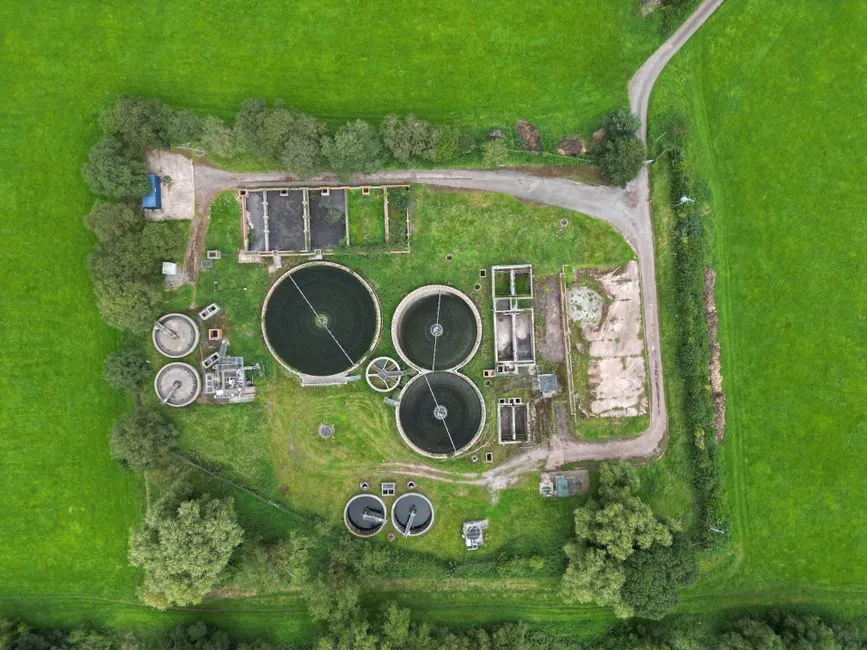
A staged treatment train is stronger than a single generic unit because pH control, precipitation, solids separation and filtration address different failure modes. Use an equalization tank first to buffer flow, concentration and batch-campaign variability while protecting downstream pumps, dosing systems and treatment units. Then use PLC-controlled acid or alkali dosing for pH adjustment. HydropureWater’s 2026 process guidance states that pH correction enables iron, arsenic and manganese to precipitate as hydroxides and must precede reliable downstream coagulation and filtration.
Add coagulation and flocculation after pH control, then remove the metal hydroxide flocs through DAF or clarification. DAF is appropriate where suspended solids, oil and grease or colloidal material must be removed; a lamella clarifier is relevant where compact solids separation is needed. The industrial DAF system for mining pretreatment and the lamella clarifier for metal-laden wastewater should be evaluated against the measured solids, oil, colloid and loading envelope.
| Pollutant or risk | Primary treatment barrier | Verification point |
|---|---|---|
| Variable flow, concentration and slug loads | Equalization tank | Level, flow and retained-volume records |
| Dissolved iron, arsenic, manganese and other precipitable metals | PLC-controlled pH adjustment followed by coagulation and flocculation | Metal hydroxide solids at solids-removal stage |
| Suspended solids, oil and grease, and colloidal material | DAF and, where justified, lamella clarification | TSS, oil and grease, and solids carryover |
| Residual suspended solids | Multi-media filtration or integrated sedimentation-filtration package | Final permitted TSS and turbidity |
| Organics, microorganisms or permit-specific pollutants | Biological polishing and/or disinfection where required | Specific permit constituent |
| Metals-bearing residual | Thickening and filter-press dewatering | Residual characterization and disposal acceptance |
HydropureWater’s integrated coagulation, flocculation, sedimentation, filtration and automatic-backwash product is offered from 10–200 m³/h for mine-water treatment, subject to project-specific verification. Use multi-media filtration for suspended-solids polish as a final barrier before discharge, not as the primary mechanism for dissolved metals.
Reserve UF for reuse or protection of downstream membranes. HydropureWater’s cited UF system uses 0.03 micron PVDF membranes, accepts turbidity up to 300 ppm and operates from 2,000–40,000 L/h; the UF system for reuse and RO pretreatment therefore requires a defined next process step and feed-water envelope.
Include metals-bearing sludge in the process scope. HydropureWater’s filter press for metals-bearing sludge offers 1–500 m² filtration areas and manual, hydraulic or fully automatic PLC-controlled operation. Resolve state and federal waste classification, acceptance testing and disposal responsibilities before equipment selection.
Design the train for compliance, not just average performance
Equipment capacity must follow the worst credible combined flow and load identified by the wastewater characterization. Create a compliance matrix listing every permit constituent, source stream, applicable limit or prohibition, treatment barrier, monitoring point and responsible operator. This preserves the chain from legal requirement to equipment performance and exposes any requirement that has no assigned barrier.
Size equalization, chemical feed, clarification and filtration against that envelope rather than average flow. Set pH, chemical dose, solids loading, filter run time and backwash as controlled variables. HydropureWater’s automatic chemical dosing systems are PLC-controlled and skid-mounted for pH adjusters, coagulants, flocculants and specialty chemicals; the PLC-controlled pH and chemical dosing skid should therefore be specified with interlock and alarm logic, not treated as a simple pump package.
For DAF selection, use HydropureWater’s 2026 catalogue range of 4–300 m³/h across 13 standard models as an initial equipment screen, then confirm performance through site-specific testing. For lamella clarification, treat the published 20–40 m/h surface-loading range and up to 30% chemical-consumption reduction as supplier performance information. Project design must verify actual loading, sludge-blanket control and chemistry rather than treating those figures as guaranteed site performance.
Define alarm, bypass, hold-tank and slug-control responses so an upset does not send untreated or off-spec wastewater to the sewer. Specify automatic backwash, air scour, differential-pressure monitoring and membrane or filter-integrity controls where required by the selected equipment. The DAF and clarifier comparison for fabricated-metals wastewater provides a useful equipment-level check, but the final design must remain tied to Centre-area permit conditions and site chemistry.
Verify compliance through monitoring and operating records
Compliance monitoring must follow the industrial-user permit and POTW schedule, with representative samples collected at the required locations and frequencies. EPA’s 2021 data-quality framework calls for sampling and analytical records, review of results and flow data alongside pollutant concentrations and loads. Preserve the chain from source identification through sampling, analysis, loading calculation and permit reporting.
Trend pH, flow, metals, TSS, chemical use and every permit-specific constituent. Calibrate online pH and conductivity instruments and verify them against the analytical laboratory program. Continuous readings support process control; compliance samples support reporting and must not be replaced by uncontrolled online values.
Retain chain-of-custody records, laboratory reports, instrument calibration records, chemical batch records, operating logs, bypass reports, corrective actions and sludge-disposal records. Establish sampling points that isolate pH control, precipitation, solids separation, filtration and any polishing stage, so a failure can be assigned to a process barrier rather than treated only as a plant-wide exceedance.
Test the full train under a representative operating period before relying on the design. The acceptance protocol should demonstrate the permit envelope under documented flow, concentration and control conditions. Automated wastewater compliance reporting can reduce manual assembly errors, but it cannot replace sampling quality, calibration records or corrective-action documentation.
Choose between sewer discharge, partial reuse and ZLD
The discharge strategy should follow permit feasibility, water demand and the long-term residual burden—not a generic flowsheet. Sewer discharge is appropriate when the treatment train can reliably meet every local limit and industrial-user condition, the sewer has capacity, and fees plus chemical and sludge costs remain acceptable. Partial reuse becomes credible when the site has a process-water demand and additional UF or RO can recover value, provided membrane-feed protection, energy, chemical recovery and concentrate disposal are included.
ZLD requires a stronger case because it adds treatment and residual-management complexity. It may be justified by water scarcity, discharge constraints, corporate sustainability targets or the risk of tightening limits. It also introduces air-permit and operational questions that the sewer decision does not avoid. None of these routes should be selected using treatment price alone.
| Decision factor | Sewer discharge | Partial reuse | ZLD |
|---|---|---|---|
| Controlling basis | Every local limit and permit condition | Local limits plus reuse-water quality | Zero-liquid-discharge objectives and applicable permits |
| Key benefits | Simplest route when sewer capacity and treatment performance are reliable | Reduces freshwater demand and sewer volume | Maximizes water recovery and reduces discharge dependency |
| Residual burden | Chemical sludge and POTW fees | Chemical sludge, membrane concentrate and energy | Concentrate, salt or crystallization product |
| Decision evidence needed | Permit, characterization, sewer capacity and operating cost inputs | Process demand, recovery target, membrane data and concentrate plan | Water balance, energy study, solids balance and permit review |
| Principal risk | Limit tightening or noncompliance | Fouling, scale and concentrate management | High capital, energy and operational complexity |
Include POTW fees, freshwater cost, chemical consumption, energy, sludge disposal, monitoring, permit exposure, concentrate management and labor. Document why the selected route is the lowest-risk option for this site. Sewer discharge remains defensible when its permit envelope is met reliably; reuse or ZLD becomes more attractive where they avoid future constraints or supply needed process water.
Procurement checklist for a defensible treatment system
A procurement package should preserve traceability from the permit requirement to the selected equipment and acceptance test. Before requesting detailed proposals, issue the industrial user discharge permit and limits package, wastewater characterization, flow and load envelope, process objectives, residual-handling requirements and site utility constraints. If a requirement or stream remains undefined, record it as an open design input rather than allowing the supplier to fill it with an assumption.
Request a guaranteed process design tied to the specified influent and effluent envelope. Require written statements on materials of construction, controls, alarms, redundancy, commissioning tests and operating assumptions. The supplier should explain how the train responds to an upset, how off-spec water is contained and how each unit contributes to the permit result.
Require chemical-consumption and sludge-generation estimates tied to the proposed process. Ask for supporting jar-test, pilot-test or comparable operating data. For the mine-water case, bidders should address pH and corrosion risk, solids carryover, filter or membrane fouling, sludge dewatering, chemical storage, maintenance access and remote monitoring.
Do not accept a generic performance guarantee that omits the controlling limits. Evaluation should include the pollutant-to-unit-operation mapping, source data, operating assumptions, residual plan, test protocol and named responsible parties. The mining-plant pretreatment compliance guide provides another example of the permit-first procurement sequence.
Frequently Asked Questions
What is the cheapest way to meet Centre-area sewer pretreatment limits?
There is no defensible universal minimum price. The appropriate train depends on the current POTW limits, categorical standards, wastewater chemistry, flow variation, monitoring requirements and residual handling. Before comparing bids, request the current industrial user discharge permit, local limits, wastewater characterization, flow and load data and the required sludge-disposal route. A lower equipment price can be offset by chemical use, residual disposal, monitoring or off-spec operation.
Should a mine select DAF, a lamella clarifier or both?
DAF is suited to suspended solids, oil and grease, and colloidal removal; a lamella clarifier provides compact inclined-plate solids separation. A DAF-followed-by-clarification arrangement can be justified when the influent and final permit envelope require both barriers. Make the decision from representative solids and contaminant data, then verify the selected arrangement in pilot or site testing.
How much wastewater data should be collected before ordering equipment?
Collect representative flow, concentration and load data across normal production, mill campaigns, ore changes, storms and batch discharges. Include every constituent named in the permit and distinguish controlled from uncontrolled sources. HydropureWater’s 2026 research recommends a 24-hour composite sampler and online pH and conductivity at the headworks. Where data remain incomplete, require jar testing and pilot verification before final sizing.
Can UF replace metal precipitation before sewer discharge?
No. The cited HydropureWater UF system uses 0.03 micron membranes and is designed to remove bacteria, colloids and suspended solids. The 2026 process guidance positions UF after clarification for reuse or RO protection rather than as a substitute for dissolved-metal removal. Use precipitation and solids separation to address dissolved metals, then add UF only when the next process step or reuse target requires it.
What should a supplier demonstrate to reduce compliance risk?
Require a process guarantee tied to site-specific limits and influent data, a pollutant-to-unit-operation mapping, controls and alarm strategy, sludge plan, commissioning protocol, maintenance plan and supporting test data. Also require written operating assumptions and a clear chain from each legal requirement to its monitoring point and acceptance test.