What Separates DAF From a Mining Clarifier
For mining and metals wastewater in Tok, neither dissolved air flotation nor a clarifier wins by default. A clarifier is the lead unit for dense, settleable mineral fines and metallurgical sludge; DAF is the better lead unit for oil, grease, flotation reagents, emulsions, biological flocs, and conditioned buoyant solids. If both fractions are material, the defensible starting point is bulk clarification followed by DAF polishing. DAF microbubbles measure 30–50 microns, and reliable flotation depends on jar-tested coagulation and flocculation (Clearwater Industries, April 27, 2026). Final selection requires stream characterization, permit review, vendor guarantees, and an integrated sludge-handling design.
Dissolved air flotation uses pressurized air released into the wastewater as microbubbles. The bubbles attach to conditioned particles, lift them to the surface, and move into a float collection trough from which a skimmer removes them. Heavier solids may settle into a bottom collection zone instead (Clearwater Industries, April 27, 2026). This mechanism makes DAF particularly relevant when the target material is buoyant or can be made floatable through chemical conditioning. An industrial DAF system for mining wastewater should therefore be specified around the particle flotation response, recycle system, chemical conditioning, and float-removal capacity—not simply around tank flow.
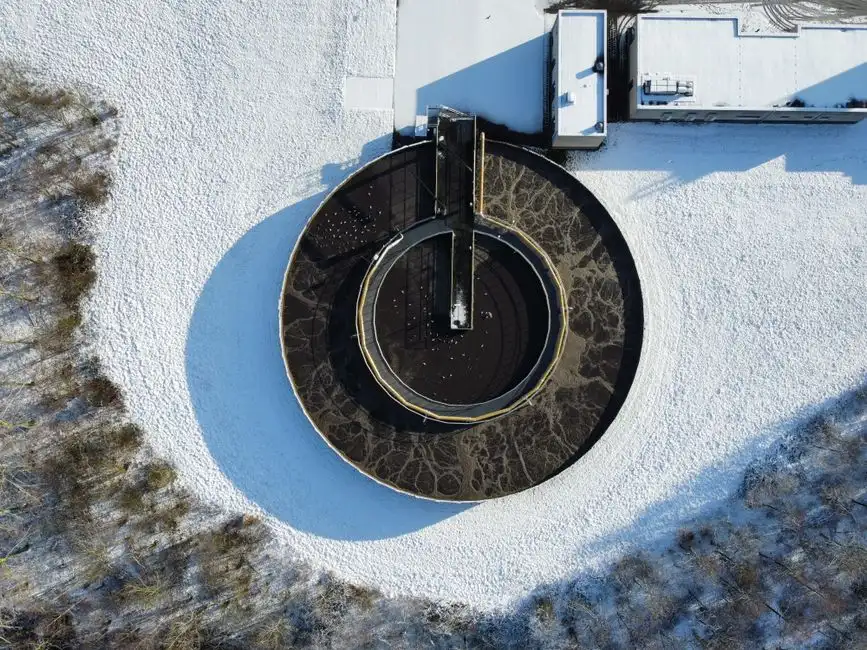
A clarifier separates solids by gravity. Performance depends on particle settleability, hydraulic loading, and reliable sludge withdrawal. Lamella plates increase the effective settling area within a smaller tank volume; they do not change the underlying mechanism. Dense mineral fines with a specific gravity greater than water can settle, while emulsified oils, colloids, surfactants, and dissolved contaminants may remain in the overflow. A lamella clarifier for dense mineral solids is consequently a bulk-solids separator, not a substitute for chemical precipitation or polishing for dissolved metals.
Available DAF configurations reinforce the need to match equipment to the stream. Clearwater Industries identifies the FPBC as a high-profile separator using lamella-pack technology, the FPAC as a low-profile cross-flow arrangement for small-to-medium flows with very high solids loads, and the FPHF as a configuration combining cross-flow and countercurrent flow for higher flows with low-to-large solids loads (Clearwater Industries, April 27, 2026).
The principal limitation is equally important. DAF is not well suited to streams containing high levels of heavy, non-floating particles such as silt and clay, according to the HydropureWater source review published in 2026. Neither mechanism directly resolves every dissolved metal. Heavy metals precipitation may require pH control and chemical addition, followed by clarification, flotation, filtration, or another appropriate polishing step where the reuse or discharge objective demands it.
Match the Equipment to the Wastewater Stream
Dense, readily settling solids should enter the clarification step; buoyant and conditioned material should enter flotation. Start by separating streams rather than averaging them into one plant total. A mixed mill discharge, truck-wash runoff, cutting-oil waste, and contact stormwater may have different flow, chemistry, and reuse priorities even when they ultimately discharge through the same outfall.
For dense mineral fines, tailings-derived solids, and metallurgical sludge, gravity clarification is the controlling mechanism. A high-rate lamella clarifier is appropriate where its hydraulic basis is supported by representative settling data and the underflow can be withdrawn reliably. For free or emulsified oil, grease, residual flotation reagents, biological flocs, and conditioned fine precipitates, DAF is the better fit. Heavy metals precipitation often creates floc that must be conditioned before effective separation; it does not remove the need to select a solids-separation step.
For a combined mill or metals stream, bulk clarification followed by DAF polishing is the default sequence because the clarifier removes the heavy particulate load that can overwhelm flotation. An oil-contaminated stream is different: upstream oil control or DAF-first treatment may be necessary if oil carryover would undermine the clarification result or create the greater discharge and reuse risk. A useful broader mining and metals wastewater selection framework can support this stream-by-stream review.
DAF should be preceded by coagulation and flocculation. Clearwater Industries states that chemical conditioning increases particle size and bubble contact and is necessary for optimal solids removal. Coagulant, pH adjustment, and flocculant should be selected through representative jar testing, not transferred from another plant. An automatic chemical dosing and coagulation skid should therefore be included in the equipment scope and tied to the tested dose window.
| Representative stream or load | Controlling fraction | Lead equipment | Required follow-up |
|---|---|---|---|
| Tailings overflow and dense metallurgical sludge | Settleable mineral fines | Clarifier or high-rate lamella clarifier | Conditioning as needed; underflow dewatering |
| Wash water with oil, grease, or flotation reagents | Buoyant or emulsified contaminants | DAF with chemical conditioning | Clarification or filtration for residual solids |
| Cutting-oil or truck-wash runoff | Free or emulsified oil plus suspended solids | Upstream oil control and DAF | Clarifier if dense solids are material |
| Mixed mill discharge with dense solids and buoyant contaminants | Both fractions are material | Clarifier first, then DAF polishing | Filtration or membranes if required for reuse |
| Dissolved copper, lead, zinc, or iron | Dissolved contaminant | Precipitation or another approved chemical process | Solids separation and downstream polishing |
A defensible treatment train proceeds through equalization and screening; pH control or precipitation where required; chemical conditioning; bulk clarification for dense solids; DAF for buoyant or colloidal material; filtration or membranes where reuse requires it; and sludge dewatering. Screening can be provided through an industrial wastewater screening pretreatment stage. Process-water recycling objectives and dissolved-metal limits must be evaluated across this full train, not against DAF or clarifier capacity alone.
DAF vs Clarifier: What Changes the Decision
The comparison should begin with the contaminant fraction and end with the interfaces: a clarifier and DAF make different demands on site, reagents, sludge handling, and downstream treatment. The table below distinguishes sourced equipment facts from design inputs that still require project-specific verification.
| Decision variable | Dissolved air flotation | Clarifier or lamella clarifier |
|---|---|---|
| Primary contaminant target | Oil, grease, flotation reagents, biological flocs, buoyant material, and conditioned fine precipitates | Dense mineral fines, tailings solids, and metallurgical sludge with suitable settleability |
| Separation mechanism | 30–50 micron microbubbles attach to conditioned particles; a skimmer removes the float | Gravity settling with bottom sludge withdrawal; lamella plates increase effective settling area |
| Typical role | Primary for oil-dominated streams or polish after bulk clarification | Primary bulk separator; upstream of DAF in a combined train |
| Chemical dependence | Coagulation and flocculation should precede flotation; optimum chemistry requires jar testing | Coagulant aid may be optional; settling rate and sludge withdrawal remain central |
| Sludge route | Properly conditioned float may require little or no further dewatering (Clearwater Industries, April 27, 2026) | Underflow usually proceeds to a thickener or filter press, according to the HydropureWater source review, 2026 |
| Available configuration | Standard construction is 304SS, with 316SS, polypropylene, and other materials available (Clearwater Industries, April 27, 2026) | HydropureWater specifies 20–40 m/h surface loading for its lamella clarifier; this is a product specification, not a universal design value |
| Documented product coverage | HydropureWater states 4–300 m³/h across 13 standard models | Project-specific configuration and capacity must be established from the design basis |
| Downstream need | Additional solids removal may be needed for reuse or discharge | Colloidal, buoyant, and dissolved loads may require DAF, precipitation, or polishing |
Footprint must be checked against the actual site rather than treated as a universal DAF advantage. The HydropureWater source review reports a smaller DAF footprint than a conventional circular clarifier, but that comparison does not replace a Tok civil review. Tank dimensions, access roads, foundations, chemical storage, sludge removal, snow storage, utilities, and future maintenance space can reverse a simple footprint ranking.
Do not place unsupported figures in the quotation. The supplied research does not establish a reliable 2026 Tok unit price, a universal energy band, a universal clarifier loading range, a guaranteed DAF removal efficiency, or a guaranteed sludge dry-solids percentage. Require each bidder to identify the design basis and test method behind its numbers. The 20–40 m/h figure associated with HydropureWater’s lamella clarifier, for example, must be checked against particle settleability, hydraulic variation, and the proposed plate configuration.
Sludge handling is part of the equipment decision. Clearwater Industries says properly conditioned DAF float can require little or no further dewatering, while the HydropureWater review routes clarifier underflow to a thickener or filter press. Both routes should be costed with a sludge filter press for mining wastewater solids or other project-selected dewatering method.
Build an RFQ Both Vendors Can Design Against
A useful RFQ makes two vendors solve the same defined problem and exposes any unsupported assumptions before pricing begins. Do not send only an averaged plant total. Require separate characterization for tailings or mill discharge, thickener overflow, wash water, contact or stormwater, cutting-oil streams, truck-wash runoff, and any stream that combines them.
- Provide operating and peak flow for every stream, including flow duration and seasonal variation.
- Provide TSS, particle-size distribution, pH, temperature, oil and grease, and relevant metal concentrations, including copper, lead, zinc, and iron where applicable.
- Submit representative jar-test results and a written conditioning recommendation covering coagulant, pH adjustment, polymer, mixing method, and expected dose range.
- Require each bidder to state its complete design basis and the project data needed to confirm that basis.
- Price the treatment train, interfaces, controls, civil work, winterization, conditioning, sludge handling, and downstream polishing.
- Attach guarantees to a defined influent envelope and sampling protocol.
For DAF, ask each bidder to identify recycle and saturation capacity, solids loading, float-removal method, materials of construction, and any pilot-test basis. For a clarifier, request the settling basis, loading rate, plate configuration, sludge-collection arrangement, and underflow capacity. These are the values that distinguish a designable proposal from a catalog selection.
The chemical-conditioning package should not be separated from the flotation bid. The automatic chemical dosing and coagulation skid should be tied to the jar-tested chemistry, with control logic, storage, day tanks, containment, alarms, and verification methods specified.
The Logan, Utah study illustrates why a transferable dose cannot be substituted for local testing. Its 30 mg/L aluminum-sulfate optimum was specific to the tested lagoon effluent (Elder, 2011, Utah State University). That value does not establish the optimum dose for a Tok mine stream.
Price the entire route. A DAF-only bid is incomplete if it omits chemical conditioning and sludge dewatering. A clarifier bid is incomplete if it omits precipitation chemistry or downstream removal of colloidal and buoyant contaminants. Where process-water recycling is required, ask bidders to price filtration and membrane treatment as applicable, using an multimedia filtration step or an industrial reverse-osmosis treatment step only where the confirmed water-quality objective supports it.
Performance guarantees should state influent TSS and contaminant limits, operating flow, conditioning regime, sampling points, sampling frequency, laboratory methods, and acceptance criteria. Generic removal percentages do not define a guarantee for the actual stream.
Plan for Cold Weather, Corrosion, and Serviceability
Tok installation design must treat freeze protection as an engineering requirement and reject unsupported universal cold-weather sizing margins. The supplied research identifies freeze protection as important, but it does not support a universal percentage increase in equipment capacity. The bidder should review exposed piping, recycle lines, valves, pressure-saturated equipment, sludge lines, and unheated structures against the actual temperature profile and operating schedule.
Materials should follow the chemistry, temperature, and abrasion conditions of the selected stream. Clearwater Industries offers standard DAF construction in 304SS, with 316SS, polypropylene, and other materials available upon request (April 27, 2026). That is evidence of configuration options, not proof that one material is suitable for every Tok wastewater. Acidic, alkaline, saline, or chemically aggressive streams require a documented compatibility review.
Access for inspection and maintenance can determine reliability more than nameplate capacity. Require clear access for float removal, sludge withdrawal, plate-pack inspection, cleaning, sensor maintenance, and winter work. Also verify safe handling of the float or underflow between the unit and the selected sludge filter press for mining wastewater solids.
Controls and instruments need an operating-environment review. Confirm sensor suitability, PLC functions, alarm response, chemical-dosing control, power loss behavior, and local maintenance access. Do not accept a control narrative that assumes uninterrupted heating, stable reagent viscosity, or uninterrupted compressed air unless those conditions are documented.
Compare lifecycle inputs rather than generic energy estimates: reagent consumption, compressor and recycle power, scraping or pumping duty, sludge volume and dewatering demand, standby strategy, wearing-part replacement, and operator attention. Require vendors to identify the assumptions and provide comparable information so that the RFQ can be evaluated on the same basis.
The 2026 Decision and Supplier-Selection Checklist
The selection sequence is: characterize each stream; identify the controlling contaminant fraction; select the lead separation mechanism; add conditioning, polishing, and sludge treatment; verify the complete train against the current permit; and then compare lifecycle cost. This sequence prevents a general preference for a DAF or clarifier from substituting for project data.
Choose a clarifier when dense, readily settleable solids dominate and oil is not the main control risk. Choose DAF when oil, grease, flotation reagents, emulsions, or buoyant and conditioned colloidal solids dominate. Choose a combined train when both bulk solids and buoyant or colloidal loads are material. In that case, put the unit first that prevents the more consequential failure: oil carryover, excessive solids loading, or loss of the required reuse quality.
Qualify suppliers through references on comparable metallurgical streams, documented test methods, project-specific guarantees, materials documentation, control-system details, and local service capability. The industrial DAF system for mining wastewater and lamella clarifier for dense mineral solids should be evaluated against the same complete-train scope.
Require the bidder to acknowledge the facility’s current permit conditions and the EPA Effluent Guidelines for the Ore Mining and Dressing Point Source Category. Neither technology is universally mandated by regulation. Do not award the purchase on equipment price alone; compare civil work, chemicals, energy, sludge handling, maintenance, reuse value, and compliance risk over the selected lifecycle.
Frequently Asked Questions
What will a DAF or clarifier cost for mining wastewater treatment in Tok?
The supplied research does not establish a reliable 2026 unit price for either unit in Tok. Request budgetary quotations using the separate flow and contaminant profile of each stream, required materials, civil work, controls, chemical conditioning, sludge handling, winterization, and installation requirements. Require vendors to identify exclusions and quote the complete train so that a lower equipment price is not offset by omitted conditioning or dewatering scope.
How should DAF and clarifier capacity be sized?
DAF capacity and performance depend on the solids envelope, chemical-conditioning response, recycle and saturation system, and flotation loading. Clarifier sizing requires particle settleability, hydraulic loading, plate configuration where applicable, and sludge-withdrawal data. Supply representative testing and the operating and peak flow envelope; a flow figure alone is not an adequate design basis.
What should buyers verify before selecting a mining wastewater equipment supplier?
Request references for comparable metallurgical streams, a defined test method, project-specific performance guarantees, materials and controls documentation, and local service support. Also verify how the supplier will handle jar-test recommendations, control integration, commissioning, spare parts, winter operation, and corrective actions after an influent change. Each check should be tied to the offered equipment rather than supplied as a general capability statement.
Does choosing DAF or a clarifier establish regulatory compliance?
No. Compliance depends on the current permit, the complete treatment train, and demonstrated performance under the actual influent envelope. Require a permit review and a full-train mass balance covering dissolved metals, suspended solids, oil and grease, pH, and the specified reuse or discharge objectives. Confirm chemical-conditioning, polishing, and sludge-handling interfaces before accepting a performance guarantee.
Related Equipment
- industrial DAF system for mining wastewater — specifications, capacity range, and technical data