
Determine Which Sewer Limits Actually Apply in Montgomery
The enforceable discharge requirements for a petroleum plant near Montgomery come from the current control mechanism issued by the receiving POTW, together with applicable federal pretreatment standards—not from generic engineering benchmarks. 40 CFR Part 403.5(a) applies even when the POTW has not issued an industrial-user permit, while 40 CFR Part 419 provides categorical standards for petroleum-refining operations. The plant must verify its POTW, point of connection, industrial-user status, applicable categorical subcategory, numerical limits, monitoring requirements, narrative prohibitions, and best management practices before sizing equipment.
EPA’s pretreatment standards and local-limits guidance explains that local limits are site-specific and may be numerical or narrative, including BMPs. EPA imposes local limits at the end-of-pipe discharge where the industrial user connects to the POTW collection system. The agency’s Local Limits Development Guidance evaluates NPDES requirements, receiving-water criteria, biosolids management, treatment operations, and other POTW concerns when determining local limits.
The governing permit is the controlling procurement input. A Montgomery-area permit may impose a stricter oil-and-grease, sulfide, phenol, pH, or monitoring requirement than a federal categorical standard or published engineering range. EPA’s guidance is not itself a regulation and does not substitute for the plant’s permit or applicable regulations.
| Verification item | Evidence to obtain | Design consequence |
|---|---|---|
| Receiving POTW and connection | Current control mechanism, sewer map, discharge manhole | Identifies the actual regulator and sampling point |
| Industrial-user status | Classification and applicable requirements | Determines whether categorical, local, or both controls apply |
| Part 419 applicability | Facility operations, SIC activity, and categorical subcategory | Prevents omission of petroleum-refining requirements |
| Numerical and narrative limits | Permit tables, prohibitions, BMPs, monitoring schedule, and reporting forms | Sets equipment objectives and compliance schedule |
| Methods and sampling | Required sample type, frequency, method, and compliance averaging period | Determines monitoring configuration and recordkeeping |
Do not treat research-derived values as Montgomery limits. For example, 50–100 mg/L oil and grease, 1–10 mg/L sulfides, and 0.5–5 mg/L phenols are general engineering ranges reported in the HydropureWater petroleum pretreatment article dated 2026, not enforceable Montgomery requirements. Use them only as screening references until the plant’s current permit is obtained. The industrial pretreatment limits and compliance workflow provides a useful verification structure for comparing the permit with categorical requirements.
Map Refinery Wastewater to Pass-Through and Interference Risks
Pass-through and interference are legal consequences at the receiving POTW, not merely exceedances of refinery targets. Under 40 CFR Part 403.3(p), pass-through occurs when an industrial discharge exits the POTW and causes an NPDES violation, including increasing the magnitude or duration of an existing violation. Under 40 CFR Part 403.3(k), interference occurs when a discharge disrupts POTW operations or sludge processes and causes an NPDES or applicable sludge-disposal violation. A refinery can therefore pass a routine average yet cause an acute interference event.
The risk begins with stream segregation. Desalter brine can carry emulsified oil, salts, and trace metals; spent caustic can carry sulfides and phenols at high pH; sour-water stripper bottoms can contain dissolved hydrogen sulfide and ammonia; tank draw can contain free oil and bottom sludge. Loading-rack water, ballast water, and oily utility water add further variability. Combining a large batch discharge with otherwise routine flow can expose the POTW to a pollutant mix that no routine composite represents. The HydropureWater petroleum pretreatment article dated 2026 identifies the same stream-to-pollutant relationships and treats current slug-prevention discipline as part of the treatment basis.
| Parameter | Primary refinery risk | Legal pathway | Primary control barrier |
|---|---|---|---|
| Oil and grease | Free or emulsified hydrocarbon | Pass-through and treatment interference | Primary separation, DAF, monitoring |
| TSS | Bottom sludge and colloidal solids | Pass-through and solids loading | Source control, DAF, filtration or membrane capture |
| Dissolved and total sulfides | Spent caustic and sour water | Interference with POTW biology | Equalization, neutralization, biological oxidation |
| Phenols | Spent caustic and refinery process streams | Interference and odor/corrosion risk | Equalization and biological polishing |
| Benzene and total BTEX | Soluble hydrocarbons | Pass-through; acute toxicity | Source control, biological polishing, compliance sampling |
| Ammonia-nitrogen | Sour water and other process streams | POTW process interference | Equalization and biological treatment |
| pH | Spent-caustic pushes | Operation and biological interference | Equalization, neutralization, monitored interlock |
| Hexavalent chromium | Cooling-tower blowdown and historical contamination | Pass-through and biosolids concern | Source control, reduction or precipitation, filtration |
| COD | Concentrated refinery organics | Treatment loading and pass-through | Equalization and biological treatment |
The source-control plan should identify each stream, its normal flow and pollutant range, the sewer destination, batch-discharge controls, and the action taken when a slug threatens the treatment train. This mapping is more useful than equipment names alone. A comparison of petroleum plant pretreatment approaches near Morrilton provides a transferable treatment perspective, but the applicable Montgomery permit—not that article—sets the local obligations.
Build the Treatment Train from Free Oil to Final Protection
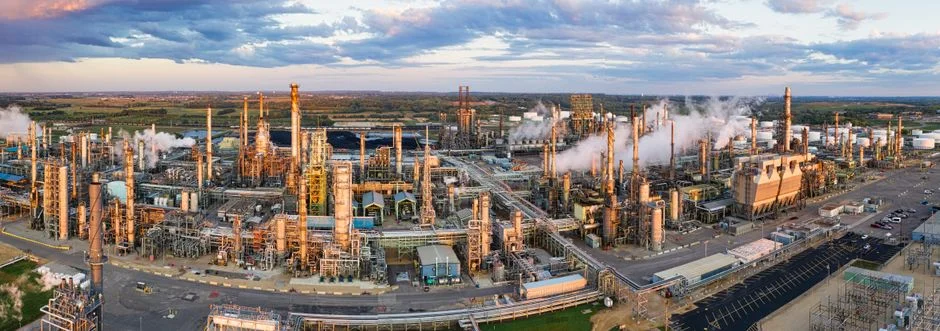
A refinery pretreatment train should remove pollutants in sequence: gravity separation for free oil, flotation for emulsified oil and colloidal solids, equalization and neutralization for hydraulic and pH control, biological treatment for soluble organics and ammonia, and final monitoring or polishing for residual solids. The HydropureWater petroleum pretreatment article dated 2026 reports that a well-operated API separator or corrugated-plate interceptor typically leaves 100–200 mg/L oil and grease in the water phase; these are engineering benchmarks, not permit limits.
- Primary oil removal: Use an API separator or corrugated-plate interceptor to remove gravity-separated free oil before pumps, membranes, and sensors. It establishes the incoming emulsified-oil load but does not reliably remove stable emulsions.
- Flotation polishing: Place DAF or induced gas flotation after primary separation to remove emulsified oil, FOG, and colloidal TSS. The cited 2026 commercial engineering reference reports roughly 15–30 mg/L oil and grease, an air-to-solids ratio of 0.02–0.06, 15–30 minutes hydraulic retention, and saturator recycle of 20–50% of forward flow. These are design references for vendor verification, not Montgomery limits. A DAF system for emulsified oil and TSS removal should therefore be evaluated against actual emulsion characteristics and peak oil load.
- Equalization and neutralization: Buffer flow and pH variation before biological treatment. The cited commercial reference gives 8–24 hours hydraulic retention and adjustment to pH 6–9 before biology. The actual basin volume and controls must follow the permit, flow record, slug characterization, and chemical demand.
- Biological polishing: Use MBBR or MBR treatment for phenols, sulfides, benzene, and ammonia-nitrogen. For the cited MBR configuration, flat-sheet PVDF membranes have a pore size below 1 μm, retain biomass at 8,000–12,000 mg/L, and produce less than 5 mg/L TSS and less than 1 NTU turbidity. A MBR wastewater treatment system for biological polishing combines biological treatment with a solids-retention barrier.
- Final protection: Add filtration where required, an online oil-in-water analyzer, and pH or conductivity monitoring. The cited analyzer alarm band is 10–20 mg/L, so the selected alarm must be tied to the actual permit and downstream consequence rather than applied automatically.
An MBR is not a substitute for source control, primary oil removal, neutralization, or slug management. Free oil can overwhelm biological systems, and no downstream unit can reliably repair an uncontrolled batch discharge. Require the equipment proposal to state guaranteed final-effluent parameters, test methods, hydraulic loading, chemical consumption, turndown, redundancy, startup sequence, alarm interlocks, and worst-case slug response. For the hydraulic basis, review DAF configuration and operating considerations alongside refinery wastewater data; the feed chemistry must remain the controlling input.
Choose Equipment Using Risk and Flow, Not Equipment Names
Equipment selection should begin with representative wastewater data and the permit-derived residual concentration—not with a catalog capacity. The HydropureWater petroleum bulk-plant pretreatment article dated 2026 recommends at least 30 days of characterization covering instantaneous and daily-average flow, oil and grease, TSS, sulfides, phenols, BTEX, ammonia-nitrogen, COD, and pH. For a refinery, the sampling plan should also capture batch-discharge conditions because a daily average can conceal the event that controls equipment size.
Give suppliers three separate design inputs: peak instantaneous flow, daily pollutant mass load, and required residual concentration. Specify whether the peak includes coalescer dumps, tank transitions, loading-rack releases, or other approved batch flows. A vendor that quotes only daily average flow has not received enough information to select a separator, DAF, equalization basin, or biological system reliably.
| Decision | Primary criterion | Buyer check |
|---|---|---|
| API versus CPI | Free-oil capture, footprint, slug tolerance, and maintenance | Require demonstrated removal of the actual free-oil condition |
| DAF after primary separation | Peak flow and emulsified-oil load | Require emulsion-specific performance and oil-load criteria |
| Equalization | Batch volume, flow variation, and chemical demand | Request a slug simulation or operating response |
| Biological treatment | Organic, sulfide, ammonia, and hydraulic load | Confirm removal with representative wastewater |
| Final monitoring | Permit compliance point and fail-safe action | Define sampling, alarm, diversion, and notification logic |
Use commercial catalog ranges only to screen feasibility. The 2026 commercial source lists DAF equipment from 4–300 m³/h and MBR systems from 10–2,000 m³/day; neither range establishes a Montgomery capacity or compliance guarantee. Final sizing requires the site dataset, permit, treatment objectives, redundancy requirements, and available footprint.
For chemical dosing, request an automatic chemical dosing system proposal tied to measured pH, alkalinity, oil characteristics, and required coagulant or neutralizer demand. Ask suppliers to identify what performance remains after simulated upset conditions and who owns the guarantee when the wastewater differs from the submitted dataset.
Turn Monitoring and Records Into a Defensible Compliance File
The compliance file must demonstrate that the required treatment and monitoring controls operated during every compliance period. Use the sampling frequency, analytical method, sample type, reporting form, and averaging rule in the current Montgomery-area control mechanism. The HydropureWater petroleum pretreatment article dated 2026 describes 24-hour flow-weighted composites, typically monthly for oil and grease, TSS, sulfides, phenols, and ammonia, with quarterly monitoring for metals, BTEX, and hexavalent chromium; those cadences are examples, not Montgomery permit terms.
For bulk-plant or oil-and-grease sampling, the cited 2026 source references EPA Method 1664A for hexane-extractable material. The applicable permit determines whether HEM is the required parameter and which analytical method applies. Sample points must represent the permit-defined discharge, and operators need a defensible method for flow-proportional or time-proportional collection.
| Record | Evidence retained | Audit purpose |
|---|---|---|
| Monitoring | Analytical reports, flow data, chain of custody, sample notes | Shows representative compliance sampling |
| Equipment operation | Calibration, alarms, bypass logs, chemical inventory, operating trends | Shows controls were available and functioning |
| Reporting | Discharge monitoring reports or local equivalents, submission receipts | Confirms required reporting occurred |
| Slug control | Current plan, training, batch-discharge records, notifications | Shows interference controls were implemented |
| Exceedances and upsets | Containment, reporting assessment, cause, corrective action, prevention revision | Supports event-specific compliance defense |
| Program management | BMP audits, operator training, instrument calibration, procedure revisions | Shows the treatment system was managed, not merely installed |
The slug-control plan should define a slug operationally, identify responsible personnel, specify containment and diversion actions, and establish POTW notification. Accidental-discharge procedures should address upstream isolation, downstream protection, reporting, investigation, and correction. A plate-and-frame filter press may support solids handling, but it does not replace source control, biological treatment, monitoring, or the compliance record.
Make the Final Discharge Decision from Current Permit Evidence
A treatment train is ready for sewer discharge only when the current Montgomery-area POTW control mechanism, site characterization, validated equipment performance, monitoring results, and operating records align. Meeting a generic federal category or published engineering benchmark does not prove compliance with a stricter local limit or satisfy narrative permit conditions such as slug control, monitoring, recordkeeping, or prohibited discharges.
Review the basis-of-design as an auditable engineering record. It should identify included refinery process-wastewater streams, excluded streams, peak and average flows, pollutant loads, treatment objectives, redundancy, chemical demand, alarm interlocks, sampling locations, and diversion provisions. It should also explain how each source stream reaches the train and how batch discharges are contained.
Treat an upset, bypass, or accidental discharge separately from routine performance. Immediately contain the event, preserve records, determine applicable notification obligations, assess POTW impact, and document corrective and preventive actions. A final go/no-go decision should be signed against the permit text and verified evidence—not against a general treatment checklist or an equipment brochure.
Frequently Asked Questions
Does the Montgomery-area permit override the federal pretreatment rules?
No. The current permit, applicable regulations, and categorical standards must all be satisfied; the more stringent applicable requirement controls. EPA’s local-limits guidance explains the POTW framework, but it is guidance rather than a binding site permit. Obtain the current control mechanism before final sizing.
Is DAF the main treatment unit for refinery wastewater?
Generally, no. DAF is normally the polishing stage after primary free-oil removal because it targets emulsified oil, FOG, and colloidal TSS that a separator does not reliably remove. Equalization, neutralization, biological treatment, and final monitoring remain necessary according to the wastewater characterization and permit.
What should a buyer request before comparing equipment prices and suppliers?
Request representative wastewater data, the current permit, peak and average flows, batch-discharge information, target residual concentrations, site constraints, and a written performance guarantee tied to the defined feed and test protocol. Separately request pricing, lead time, startup support, redundancy, chemical consumption, maintenance, and turndown. Because the research provides no comparable Montgomery-area quotation, a defensible budget requires site-specific proposals rather than a generic price.
How should a refinery manage a slug without treating it as an acceptable operating condition?
Segregate the source, contain the discharge, route it to an approved holding or treatment path, and protect downstream biological capacity. Follow the current permit and slug-control plan for POTW notification and reporting, then document the cause, corrective action, and revised prevention measures. A multi-media filtration stage may provide additional solids protection, but it does not justify sending the slug directly to the sewer.
Related Equipment
- DAF system for emulsified oil and TSS removal — specifications, capacity range, and technical data