What System Does a Factory in Warsaw Need?
A Warsaw factory usually needs dissolved air flotation when suspended solids, oil and grease, FOG, or colloidal material dominate and must be removed before biological treatment. It needs a broader effluent treatment plant when the wastewater also requires biological or advanced final treatment. DAF is a physicochemical separation step, not a complete substitute for an ETP. Selection should follow confirmation of peak flow, pollutants, pH, discharge route, and required pretreatment performance; Warsaw’s Czajka plant is municipal infrastructure, not a factory-equipment benchmark.
Use the wastewater—not a preferred equipment name—as the selection basis. If the objective is industrial wastewater pretreatment ahead of a biological stage, start with a industrial DAF system, subject to treatment tests and duty calculations. DAF can remove suspended solids, oil and grease, FOG, and conditioned colloidal material. It is particularly useful where emulsified oil or fine solids could interfere with downstream biological treatment.
An ETP is the broader choice when the required train includes primary physical or chemical separation, secondary biological treatment, and possibly tertiary polishing. According to the supplied Quora explanation of an ETP, secondary treatment may operate aerobically or anaerobically, while tertiary treatment provides final cleaning. Those biological and polishing stages are outside the normal function of a DAF skid.
For Warsaw, the project definition must also establish whether the factory discharges to sewer or to a receiving-water system, what pretreatment the receiving operator requires, and whether water will be reused. The supplied WTE source describes Warsaw’s municipal Czajka complex and cannot establish the appropriate capacity or process train for an individual factory. The 2026 industrial DAF selection framework provides a useful structure for comparing treatment duty and supplier proposals.
Why Warsaw-Specific Planning Matters
Czajka was designed for roughly 2,100,000 population equivalent and treats more than 435,000 m³ of wastewater per day, demonstrating the scale and process integration of municipal wastewater infrastructure (WTE Wassertechnik, Czajka project page, current project information accessed in 2026). That scale is not transferable to factory pretreatment.
WTE reports a daily intake of 450,000 m³ and potential peak intake of 515,000 m³ per day at the Czajka plant (WTE Wassertechnik, current project information accessed in 2026). The reported project includes screening, a sand trap, preliminary clarification, digestion, sludge treatment, and biogas use. These are municipal treatment interfaces; none establishes the required hydraulic capacity or pollutant loads for a Warsaw factory.
The factory must instead resolve four local questions:
- Does the final discharge enter a municipal sewer or a receiving-water system?
- What pretreatment performance does the receiving sewer operator require?
- Are there current conditions from the relevant water-management authority?
- Will treated water be reused, sewered, or discharged directly?
These checks also prevent a scale error. The supplied industrial wastewater and cooling-blowdown treatment reference reinforces the need to identify the actual treatment objective before adapting a process concept.
Importantly, the supplied research contains no current Polish factory-specific effluent limits. The design basis must therefore use the factory’s current permit, the applicable receiving-authority or sewer-operator requirements, and written confirmation of the discharge route. Generic municipal capacity or generic European treatment descriptions cannot fill that gap.
DAF or Full ETP: Make the Decision from the Wastewater
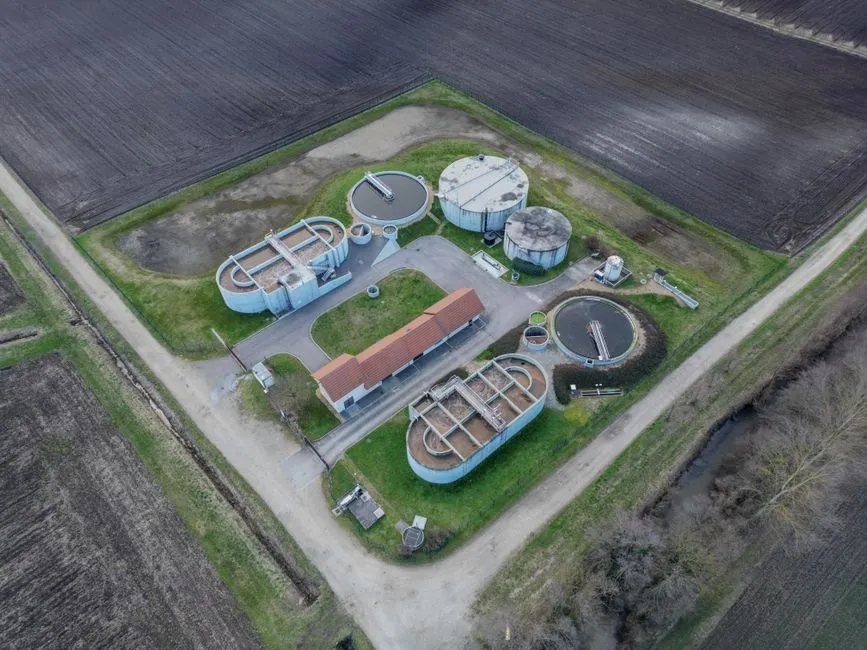
DAF separates material that can be floated; a full ETP must also address soluble organic loading and the required final discharge quality. The distinction determines both equipment scope and the data needed from the supplier.
In the supplied Quora mechanism description, part of the clarified effluent is pressurized and saturated with air, then returned to the flotation tank. As pressure falls, micro-bubbles form, attach to suspended solids and small oil droplets, and carry them to the surface for mechanical skimming. That source describes micro-bubbles as generally 10–100 microns, but this is a mechanism reference—not a guaranteed Warsaw design specification. Bubble size must be checked against the actual wastewater and selected equipment.
| Decision basis | DAF-centered solution | Broader ETP solution |
|---|---|---|
| Primary treatment need | Suspended solids, oil and grease, FOG, and conditioned colloidal material | Primary physical and chemical separation |
| Soluble organic loading | Not removed as the biological treatment stage; requires separate assessment | Secondary aerobic or anaerobic biological treatment where needed |
| Final polishing | Not inherent in a DAF skid | Tertiary treatment where the permit or reuse objective requires it |
| Chemical treatment | pH adjustment, coagulation, flocculation, and emulsion destabilization may be required | Chemical treatment integrated with biological and tertiary stages |
| Supply scope | Treatment skid, controls, equalization interface, and sludge removal | Civil works, process equipment, biological design, sludge handling, controls, and operating strategy |
| Best fit | Factory pretreatment ahead of biological treatment or a separate solids-removal objective | Factory discharge compliance requiring an integrated treatment train |
Chemical coagulation can improve DAF performance when particles or oil droplets require destabilization before flotation. However, a catalog description is not a process guarantee. The industrial DAF system should be selected against representative wastewater, peak hydraulic demand, required removal performance, and sludge-handling constraints.
A full ETP introduces additional interfaces: aeration or gas handling, biological solids separation, nutrient management, sludge treatment, odor control, and final polishing. It may be necessary, but it should not be specified until soluble organic loading, biodegradability, toxicity, and the receiving route are understood. This separates an engineered treatment plant from a collection of equipment selected by catalogue capacity.
Process Flow for a Warsaw Factory
A defensible factory treatment train starts with collection and equalization, then protects downstream equipment before removing the contaminants that govern the treatment objective. The exact sequence must follow the wastewater characterization and applicable discharge route.
- Collect and equalize. Equalization should accommodate production, cleaning, and discharge cycles while stabilizing the load presented to treatment equipment.
- Screen where necessary. If rags or coarse solids could damage pumps, valves, or downstream biological equipment, continuous fine screening may be required. A rotary mechanical bar screen is a relevant pretreatment option for that application.
- Adjust and condition locally. A PLC-controlled chemical dosing skid can support pH adjustment, coagulation, flocculation, and emulsion destabilization before flotation.
- Remove floatable and suspended material. Select DAF or gravity clarification according to the oil, FOG, solids, colloid, and hydraulic data.
- Add biological treatment where required. Soluble organics may require aerobic or anaerobic treatment; DAF alone does not provide that stage.
- Add tertiary treatment if required. The permit, receiving authority, or reuse specification determines whether further cleaning is necessary.
- Handle sludge. Route DAF float or clarification sludge to the appropriate sludge-treatment system.
The refinery explanation in the supplied Quora source identifies the principal pretreatment risk: tight oil-in-water emulsions and ultrafine solids can pass into biological reactors. The source states that emulsified oil can coat bacteria, interfere with oxygen transfer, and damage the microbial population. Conditioned DAF can therefore serve as a protective barrier between raw wastewater and biological treatment.
Sludge handling must be designed at the same time as the liquid process. A plate-and-frame filter press is an option where batch solid–liquid separation suits the sludge volume and operating cycle. The DAF FOG interception case study shows how an overload response can affect the selected equipment basis, although its case-specific flow and wastewater data must not be transferred to another factory.
What Data the Supplier Needs Before Sizing?
Representative wastewater data and peak-flow information are the minimum basis for sizing; average flow and a generic process description are not enough to establish treatment duty.
| Data category | Information to request | Why it affects selection |
|---|---|---|
| Hydraulic profile | Peak hourly flow, peak daily flow, minimum flow, operating schedule, and stormwater separation | Defines equalization and hydraulic loading |
| Representative samples | Samples across production, cleaning, and discharge cycles | Captures variable pollutant and emulsion conditions |
| Core analysis | COD, BOD, TSS, oil and grease, FOG, pH, temperature, and conductivity | Distinguishes physical, chemical, and biological duties |
| Site contaminants | Sector-specific substances relevant to the factory | Identifies process inhibition or treatment barriers |
| Compliance route | Current permit, receiving operator, sewer or direct-discharge route, and reuse objective | Defines required treatment performance |
| Biological design | Soluble organic loading, biodegradability, nutrient needs, toxicity, and required biological solids concentration or process configuration | Determines whether an ETP is justified and how it must be engineered |
| Material balance | Chemicals, air, power, sludge, and reject streams | Exposes whole-life operating consequences |
For DAF screening, HydropureWater’s supplied catalogue range covers 4–300 m³/h across 13 models. This is a vendor-supplied screening range, not an engineered plant-capacity statement. The selected model must be checked against peak flow, wastewater tests, operating schedule, equalization, and the required removal duty. A European industrial DAF buyer guide can support that comparison, but it does not replace project-specific analysis.
Request raw analytical results, sampling dates and methods, and any variability data. For a biological ETP, obtain enough information to define the organic load, nutrient balance, process configuration, sludge concentration, and toxicity controls. For DAF, provide the oil and solids characteristics, emulsion behavior, required skimming rate, chemical trials, and disposal route for the resulting float.
Finally, request a mass balance for chemicals, compressed air, power, sludge, and reject streams. This allows procurement to compare operating consequences rather than treating the lowest equipment quotation as the lowest compliant solution.
Evaluate DAF and ETP Packages on Whole-Life Performance
Technical compliance depends on the guaranteed duty and operating consequences of the proposed package, not on whether the equipment is labelled DAF or ETP.
| Evaluation item | DAF proposal | ETP proposal |
|---|---|---|
| Guaranteed duty | Defined flow and contaminant loading with wastewater-specific test conditions | Defined effluent performance across the stated hydraulic and organic loads |
| Equipment performance | Flotation, skimming, solids separation, controls, turndown, and sludge removal | Primary, biological, tertiary, solids separation, aeration or gas handling, and sludge systems |
| Operating inputs | Chemicals, compressed air, power, operator attention, and maintenance | Chemicals, air or gas, power, nutrients, operator attention, maintenance, and sludge handling |
| Installation scope | Skid, foundations, utilities, equalization interface, controls, and local installation | Civil works, process equipment, piping, utilities, buildings, controls, and commissioning |
| Local support | Commissioning, spares, service access, and supplier availability for the project location | Same, plus biological-process support and operator handover |
Require a wastewater-specific performance guarantee and a sampling protocol covering sampling points, timing, laboratory method, operating conditions, acceptance criteria, and resolution of disputed results. Generic removal claims should not be accepted without test conditions.
Compare total operating inputs, not just purchase price. For DAF, chemical demand and compressed-air use may determine operating cost. For a biological ETP, assess sludge separation, aeration or anaerobic performance, odor control, and the consequences of emulsified oil entering the biological stage. A DAF cost and pricing guide can structure commercial questions, while the engineering comparison of DAF and alternatives can support technical review.
Also request installation footprint, utility connections, winterization where relevant, service access, spare-parts policy, commissioning support, training, documentation, and local supplier capability. WTE’s Czajka project, which included screening, sand trapping, preliminary clarification, digestion, sludge treatment, and biogas utilization in one municipal train, demonstrates that integrated treatment requires multiple disciplines and equipment interfaces. It is not evidence of factory-equipment performance.
Build a Warsaw Project Plan from Survey to Commissioning
A controlled sequence from wastewater survey to commissioning reduces the risk of buying a unit against an assumed flow or pollutant profile.
- Survey and characterize. Measure production, cleaning, and discharge flows; collect representative wastewater samples; identify wastewater sources, contaminants, temperature, pH, and documented operating cycles.
- Confirm the compliance route. Establish the current permit, receiving authority or sewer operator, discharge destination, reuse objective, and any pretreatment conditions.
- Develop the preliminary process train. Define treatment objectives and establish peak flow, contaminant loads, equalization requirements, and equipment sizing criteria.
- Resolve uncertainty by trial work. Where emulsions or chemical response remain uncertain, conduct a pilot trial to confirm chemical demand, flotation performance, sludge generation, and operating controls.
- Compare suppliers technically. Check wastewater-specific references, performance guarantees, scope boundaries, installation responsibilities, commissioning support, and service capability for the project location.
- Define commissioning and handover. Put performance tests, operator training, documentation, maintenance tasks, spare parts, and acceptance procedures into the purchase order.
The long-term operating dashboard should cover flow, pH, TSS, oil and grease, nutrients where relevant, chemical use, sludge yield, and every parameter controlled by the current permit. If the discharge route or permit changes, reassess the treatment train rather than assuming the original equipment remains adequate.
Frequently Asked Questions
What flow and wastewater data are needed to size a DAF system for a Warsaw factory?
Average flow is insufficient. Provide peak hourly and daily flow, operating schedule, minimum flow, stormwater arrangements, and representative samples covering production, cleaning, and discharge cycles. Analyze COD, BOD, TSS, oil and grease, FOG, pH, temperature, conductivity, and factory-specific contaminants. Use those results to check hydraulic loading, contaminant duty, equalization, chemical demand, and turndown. The supplied catalogue range is a screening tool, not proof that a model is correctly sized.
How should a buyer select between a DAF supplier and a full ETP supplier?
Check references for comparable wastewater and operating conditions, require wastewater-specific performance guarantees, and compare the complete scope of supply. A DAF supplier should demonstrate flotation duty, skimming, sludge removal, controls, utilities, and test conditions. An ETP supplier must also demonstrate biological-process design, solids separation, aeration or anaerobic performance, odor and sludge arrangements, civil interfaces, and operator handover. Service capability and commissioning support for the project location should also be verified.
How should the budget compare DAF and full ETP quotations?
Compare installed and whole-life cost, not equipment purchase price alone. Request a transparent mass balance for chemicals, compressed air or process gas, power, sludge, maintenance, operator attention, and reject streams. Ask for an installed-scope breakdown covering civil works, foundations, piping, controls, utilities, commissioning, training, and spares. If quotations are not available from the supplied research, require the bidder to price the same wastewater-specific scope and operating basis for both options.
Which requirements determine factory discharge compliance in Warsaw?
The final design must follow the factory’s current permit and the requirements of the relevant receiving authority or sewer operator. Confirm whether the discharge is sewered or direct, whether water will be reused, and what pretreatment performance is required. The supplied research does not establish current Polish factory-specific numeric effluent limits, so obtain the controlling requirements in writing and incorporate them into the guarantee, sampling protocol, and operating dashboard.