Start With the Ahvaz Water Balance, Not a Treatment Catalog
An Ahvaz data center needs two wastewater trains designed around actual source-water analysis, cooling chemistry and permitted disposal: a domestic/process train and a separate cooling-tower blowdown (CTBD) train. CTBD commonly carries 1,200–6,000 mg/L TDS and 10–50 mg/L suspended solids, so it normally requires solids removal, chemical control and membrane pretreatment before reuse. The preferred pathway is generally filtration/UF followed by RO, with MVC added where discharge is restricted; full ZLD can reach 95–99% recovery but carries the highest cost and residual-management burden.
The first procurement document should therefore be a water balance, not a membrane catalogue. It should define IT load, cooling architecture, evaporative or closed-loop operation, makeup-water source, tower cycles of concentration, domestic population, planned expansion and expected reliability. IDE Tech’s 2026 benchmark indicates that a 100 MW data center may require up to 2 million litres of water per day; this is a scale indicator only, not an Ahvaz design flow. The project team must replace it with measured and forecast flows.
Request source-water analysis for calcium, magnesium, silica, alkalinity, chloride, sulfate, TDS, turbidity and temperature. Obtain the complete cooling-water chemical program, including biocide, corrosion inhibitor, antiscalant and phosphate or chromate history. The permitted disposal route is equally important: each stream must be assigned to reuse, sewer discharge, surface-water discharge, hauling, injection or zero-liquid-discharge treatment. These choices determine the process train.
For a greenfield project, model closed-loop direct-to-chip cooling as an alternative to wet towers, while recognizing that it is not an automatic retrofit for an existing wet-tower campus. The broader data-center wastewater treatment guide for a water-stressed city provides a useful regional comparison, but its figures must not be transferred to Ahvaz without local verification.
| Design-basis input | Information required | Why it changes the plant |
|---|---|---|
| Cooling configuration | Evaporative, closed loop or hybrid; wet and dry equipment; planned expansion | Determines CTBD generation and whether blowdown treatment is required |
| Source water | Ca, Mg, silica, alkalinity, chloride, sulfate, TDS, turbidity and temperature | Controls scaling, pretreatment, membrane selection and recovery |
| Cooling chemistry | Biocides, inhibitors, antiscalants, dispersants and legacy chemicals | Determines neutralization, residual control and membrane compatibility |
| Domestic load | Restrooms, canteen, dormitory population and wastewater characteristics | Sets biological-treatment capacity and disinfection requirements |
| Disposal route | Reuse, sewer, surface water, injection, hauling or ZLD | Sets the required polishing, concentration and residual-management stages |
| Reliability target | Maximum outage, redundancy, storage autonomy and staffing model | Determines standby capacity, chemical storage and bypass provisions |
Separate the Wastewater Streams Before Designing the Plant
Separating streams prevents high-TDS CTBD from contaminating sanitary treatment and avoids sending clean humidification water through an unnecessarily expensive biological train. The initial block flow diagram should separately identify CTBD, sanitary/process wastewater, humidification bleed, generator-scrubber liquor, equipment-wash water, membrane backwash and stormwater. The segregation logic used for the wastewater stream segregation for data centers remains applicable, but Ahvaz flows must be measured rather than inferred from regional analogies.
Sanitary flows from canteens and restrooms need biological treatment. CTBD instead requires mineral, solids and chemical control because it carries concentrated scaling species and treatment-chemical residues. Low-strength humidification water should be evaluated separately as a reuse candidate rather than automatically combined with CTBD.
Genesis Water Technologies’ 2025 CTBD envelope is 1,200–6,000 mg/L TDS, 10–50 mg/L suspended solids, concentrated scaling minerals and treatment-chemical residues. These are international reference values, not assumed Ahvaz conditions. RSP Engineers likewise distinguishes sanitary sewage from industrial process wastewater: CTBD has a different permit pathway and normally requires separate pretreatment before a sewer connection is considered.
Before equipment sizing, specify collection separation, equalization, hot-water cooling, chemical-resistant materials, spill containment, odour control and independent monitoring. Generator-scrubber liquor must remain isolated until its ammonia and chemical composition are established. Membrane backwash should return to the appropriate process stream rather than mixing with sanitary sewage by default.
| Stream | Primary characteristics | Provisional destination | Design hold point |
|---|---|---|---|
| Cooling-tower blowdown | Elevated dissolved salts, scaling minerals, suspended solids and chemical residues | Filtration and membrane recovery; partial or full ZLD if required | Complete tower-water analysis and destination approval |
| Sanitary and canteen wastewater | BOD, COD, solids and pathogens | Biological treatment and disinfection | Population, peak factors and permit route |
| Humidification bleed | Potentially low-strength water with corrosion products or treatment chemicals | Filtration, chemical control and direct reuse assessment | Quality and reuse compatibility test |
| Generator-scrubber discharge | Potential ammonia and scrubber chemicals | Separate ammonia removal or treatment | NH₃-N and chemical-package analysis |
| Equipment wash and membrane backwash | Variable solids, detergents and concentrated salts | Equalization and stream-specific treatment | Chemical inventory and reuse assessment |
| Stormwater | Variable runoff and possible site contamination | Isolation; no uncontrolled process mixing | Drainage study and contamination controls |
Match Pretreatment to the Blowdown Chemistry

Pretreatment must remove the specific foulants and scale-forming species identified in the Ahvaz source and blowdown samples. The Isfahan regional guide cites a 10–25 µm self-cleaning screen at 1–5% of circulation flow and a generic installation range of $50,000–$200,000; these are reference values requiring local pricing and project-specific sizing.
Where RO or NF needs stronger solids protection, use UF pretreatment for data-center blowdown. The operating envelope supplied by Genesis Water Technologies in 2025 is 0.01–0.1 µm, 10–30 psi and 90–95% recovery. UF does not remove dissolved hardness or silica, so it complements rather than replaces chemistry-specific pretreatment.
Media filtration can remove suspended solids and colloids. Softening may reduce hardness-related loading, but it should not be selected without calcium, magnesium, alkalinity and sulfate data. Automatic antiscalant and biocide control can protect the system, provided doses are established through analysis and membrane testing rather than generic recipes. An automatic chemical dosing system should be interlocked with flow, residual chemistry and feed-water quality.
RSP Engineers identifies extreme pH and residual biocides as common discharge concerns. Include pH neutralization, dechlorination or the selected biocide-neutralization process only where analysis and the disposal permit justify them. Require analysis of calcium, magnesium, silica, alkalinity, sulfate, chloride, TDS and the complete chemical package before fixing membrane type, antiscalant dose or recovery.
| Stage | Reference performance | Design function | Decision input |
|---|---|---|---|
| Side-stream filtration | 10–25 µm screen at 1–5% of circulation flow; $50,000–$200,000 installation reference (Genesis Water Technologies, 2025) | Remove suspended solids and protect downstream treatment | Tower circulation flow, solids and local price |
| UF | 0.01–0.1 µm, 10–30 psi, 90–95% recovery (Genesis Water Technologies, 2025) | Reduce colloids and protect RO or NF | Feed SDI, turbidity and temperature |
| Media filtration | No universal performance range established in the supplied research | Remove residual suspended solids and colloids | Particle loading and filtrate specification |
| Softening | No universal performance range established in the supplied research | Reduce selected hardness-related loading | Ca, Mg, alkalinity, sulfate and discharge route |
| Chemical control | Dose must follow site analysis | Control scale, corrosion, biofouling and pH | Complete chemical inventory and residual tests |
| RO or NF | Selected only after pretreatment compatibility is established | Produce reusable permeate and concentrated reject | Scale analysis, recovery trial and residual route |
Compare Reuse, Partial ZLD and Full ZLD
The recovery decision depends on the receiving route, freshwater value, concentrate disposal and electrical reliability. Cooling-tower makeup reuse is the default benchmark at 60–85% recovery, with RO applicable when the chemistry and pretreatment permit it. The cooling-tower blowdown treatment decision guide provides a useful structure, but the final Ahvaz choice must be supported by local permits and concentrate handling.
Genesis Water Technologies in 2025 reports RO performance of 50–85% recovery and 10–50 mg/L permeate TDS at 75–150 psi. It also reports that conventional brackish-water RO is commonly limited to 75–80% recovery because of scaling. NF is an alternative where partial softening is sufficient: 70–85% recovery, 75–150 psi and permeate TDS at 30–50% of feed.
Partial ZLD with RO plus MVC can reduce discharge volume by 80–90%. The MVC reference recovery is 95–98%, with distillate below 10 mg/L TDS and energy demand of 15–25 kWh per 1,000 US gallons. Full ZLD reaches 95–99% overall recovery with solids below 1% of original blowdown volume, but the benchmark CAPEX is $3–8 million and OPEX is $5–15 per 1,000 gallons. These costs are international reference values, not Ahvaz quotations.
Do not specify MVC or crystallization until the outlet, waste classification, trucking route, injection feasibility, evaporation performance and electricity reliability are confirmed. For an industrial RO system for cooling-tower blowdown reuse, the concentrate is an operating liability, not an incidental stream.
| Pathway | Reference performance and cost | Best fit | Procurement hold point |
|---|---|---|---|
| RO reuse | 50–85% recovery; 10–50 mg/L permeate TDS; 75–150 psi. A 50,000 GPD skid has benchmark installed CAPEX of $250,000–$500,000 and OPEX of $1.50–$3.00 per 1,000 gallons (Genesis Water Technologies, 2025) | Permitted concentrate discharge and valuable cooling makeup | Ahvaz source chemistry, pilot recovery and concentrate route |
| NF reuse | 70–85% recovery, 75–150 psi and permeate TDS at 30–50% of feed (Genesis Water Technologies, 2025) | Partial softening is sufficient | Feed chemistry and cooling-water quality acceptance |
| Partial ZLD | RO plus MVC reduces discharge volume by 80–90%; MVC recovery is 95–98%; 15–25 kWh per 1,000 US gallons. A 10,000–30,000 GPD MVC benchmark adds $1–3 million (Genesis Water Technologies, 2025) | Restricted discharge with an approved brine route | Injection, hauling or controlled-discharge authorization |
| Full ZLD | 95–99% overall recovery; solids below 1% of blowdown volume; $3–8 million CAPEX and $5–15 per 1,000 gallons OPEX (Genesis Water Technologies, 2025) | No acceptable liquid discharge route | Crystallizer residue classification, handling and power supply |
Build the Domestic and Process Treatment Train
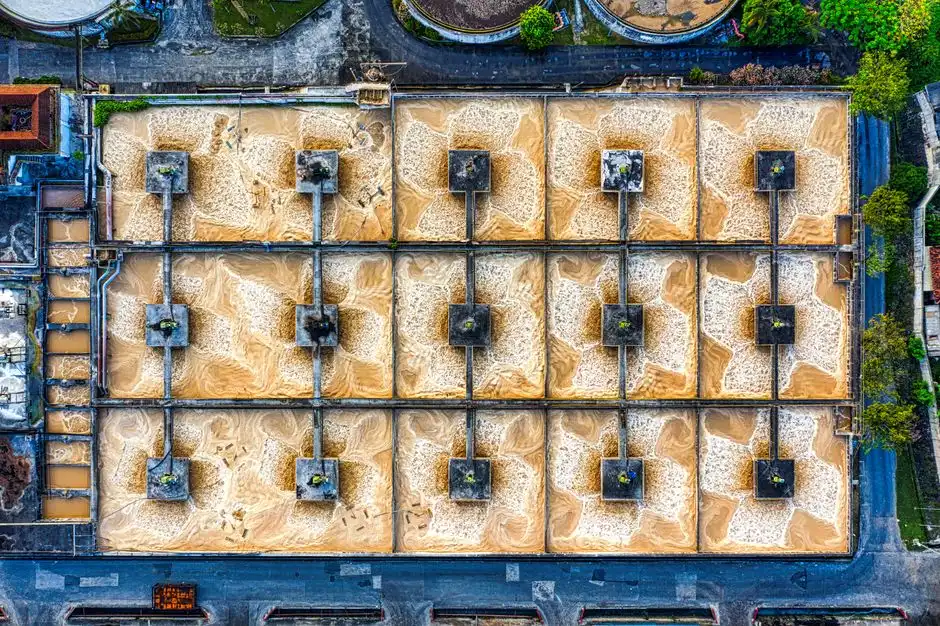
The domestic train should treat canteen, restroom and dormitory wastewater with an MBR or equivalent biological process rather than mixing it with high-TDS CTBD. The Isfahan regional benchmark gives an MBR-equipped plant energy demand of 0.8–1.6 kWh/m³ and a DAF-only treatment range of 0.4–0.9 kWh/m³. These are preliminary energy-screening values from HydropureWater’s 2026 regional article, not guaranteed Ahvaz consumption.
Keep clean humidification bleed separate where practical and evaluate direct reuse after filtration and chemical-control steps. Generator-scrubber ammonia also requires a separate decision. The Isfahan guide cites 50–500 mg/L NH₃-N where wet scrubbing is present, so this stream must be characterized and, if necessary, treated by ammonia stripping or nitrification before integration with the biological train.
Domestic sizing needs flow history or a defensible population and fixture-unit basis, peak and diurnal factors, BOD/COD, ammonia, solids and temperature. The CTBD plant needs independent flow, chemistry, chemical-residuals and reuse-quality data. Do not use a combined site flow to hide uncertainty in either stream.
Confirm current discharge requirements with the Iran Department of Environment and an Ahvaz environmental consultant. The supplied research establishes no Ahvaz-specific numerical effluent limits, so the permit envelope must remain an explicit design hold point. The regional values cited for Isfahan, including BOD₅, COD, TSS, free chlorine and total chromium benchmarks, should not be presented as Ahvaz rules.
The civil scope should cover screening, equalization, biological treatment, sludge removal, disinfection, chemical storage, drainage, ventilation and access. A containerized MBR-integrated treatment package may suit the domestic train, while a DAF unit may provide solids equalization ahead of biological treatment; both selections require actual flow and wastewater data.
Plan the Compliance, Logistics and Operating Case
Permit and disposal-path due diligence must begin during project definition. Confirm the receiving authority, discharge point, sampling regime, residual route and application of site-specific limits before freezing the process. Permit risk arises from the whole treatment concept, including concentrate, sludge, chemical storage and stormwater isolation—not only the final effluent line.
Genesis Water Technologies in 2025 gives a benchmark of $250,000–$500,000 installed CAPEX and $1.50–$3.00 per 1,000 gallons OPEX for a 50,000 GPD blowdown RO skid. For a 10,000–30,000 GPD MVC stage, its benchmark addition is $1–3 million. These are US reference values; Iran-specific duties, port handling, inland transport, spares, commissioning and energy costs require separate quotations.
The bid must state FOB terms, containerization, destination and inland haulage, customs responsibility, workshop pre-commissioning, on-site commissioning, spare parts and warranty scope. The supplied research does not provide an Iran-bound lead time, so the supplier should provide a written schedule broken into manufacturing, shipment, customs, transport, installation and commissioning milestones.
Allocate space early for tanks, membranes, chemicals, sludge handling, drainage, ventilation, access and truck movements. Late civil changes can dominate both cost and schedule. The operating package should also address chemical storage, clean-in-place chemicals, membrane replacement, monitoring, sampling, operator competence and the destination of every residual stream.
| Commercial package item | Supplier response required | Buyer acceptance check |
|---|---|---|
| Process guarantee | Flow, recovery, permeate quality and operating envelope tied to the agreed Ahvaz feed analysis | Guarantee conditions, exclusions and remedy |
| CAPEX and OPEX | Equipment, civils, installation, chemicals, power, spares and residual handling | Scope exclusions and cost-allocation schedule |
| Shipment | FOB point, containerization, dimensions, weights and destination | Route, port and inland-transport responsibilities |
| Commissioning | Workshop tests, site start-up, training and performance test | Acceptance criteria and data package |
| Compliance | Permit support, monitoring provisions and sampling points | Local consultant review and authority acceptance |
| Residuals | Concentrate, sludge and chemical-waste quantity and handling method | Approved destination and annual operating plan |
Frequently Asked Questions
What treatment train is most suitable for an Ahvaz data center with wet cooling?
Use separate domestic and CTBD trains. For CTBD, the provisional sequence is equalization and hot-water cooling, side-stream filtration, chemistry-specific control, UF where required, and RO for makeup reuse. Add MVC only where discharge restrictions justify partial ZLD. A closed-loop cooling alternative should be evaluated separately during greenfield design.
How much does wastewater and cooling blowdown treatment cost in 2026?
For screening, Genesis Water Technologies in 2025 gives $250,000–$500,000 installed CAPEX and $1.50–$3.00 per 1,000 gallons OPEX for a 50,000 GPD RO skid, plus $1–3 million for a 10,000–30,000 GPD MVC stage. These are international benchmarks, not Ahvaz prices. Request itemized Iran quotations covering equipment, civils, freight, customs, inland transport, commissioning, utilities, spares, chemicals and residuals.
Should the project choose RO reuse, partial ZLD or full ZLD?
Choose RO reuse when permeate quality is suitable and the concentrate has an approved route. Choose partial ZLD when discharge is restricted but injection, hauling or controlled disposal is feasible. Use full ZLD only when no acceptable liquid-discharge route exists and the $3–8 million CAPEX and $5–15 per 1,000 gallons OPEX benchmark is acceptable under Genesis Water Technologies’ 2025 figures.
What should an Iranian wastewater-equipment supplier include in the bid?
Require FOB terms, container details, destination and inland haulage, customs allocation, workshop pre-commissioning, site commissioning, operator training, spare parts, warranty and performance-test criteria. Also require a complete equipment list, power and chemical demand, control philosophy, residual-management plan and a milestone schedule. The supplied research provides no Iran-specific lead time, so an unsupported delivery promise should not be accepted.
What site data is required before final treatment equipment sizing?
Provide measured source and CTBD analyses, cooling-water chemical inventories, tower operating data, domestic flow and loading data, permitted disposal route, residual destinations, site power reliability and planned expansion. For membranes, include calcium, magnesium, silica, alkalinity, sulfate, chloride, TDS, turbidity, temperature and the complete biocide and inhibitor package. Without this information, the equipment can be configured but should not be finally sized.