
Choose the treatment train from the discharge obligation
For most Casablanca housing developments, the best initial fit is a buried WSZ A/O packaged sewage treatment plant, provided there is no contractual requirement for unrestricted-irrigation effluent. HydropureWater’s Morocco residential wastewater treatment guide identifies A/O as the cost-defensible default for subdivisions between 50 and 500 population equivalents, while its WSZ catalogue covers 1–80 m³/h. Select an integrated MBR wastewater treatment system instead when the developer must deliver reuse-grade effluent, has severe footprint constraints or faces a sensitive receiving environment. Final sizing must use site-specific flow and influent data, including BOD, COD, TSS, NH₃-N, temperature, pH and conductivity.
Decree 2-97-787 provides the local surface-discharge floor: BOD₅ not more than 40 mg/L, COD not more than 120 mg/L, TSS not more than 50 mg/L and pH from 6.5 to 8.5, according to HydropureWater’s Residential Wastewater Treatment in Morocco 2026. The permit, commune conditions and any reuse contract must be checked against that floor because they may be stricter. Where unrestricted-irrigation quality is required, the guide specifies MBR treatment with chlorine-dioxide or UV polishing.
Do not select equipment from catalogue limits alone. The WSZ range of 1–80 m³/h and the integrated MBR range of 10–2,000 m³/day are catalogue envelopes, not evidence that either unit suits a particular estate. The procurement decision follows the discharge obligation: compliant surface discharge without contracted reuse normally supports buried A/O; an enforceable reuse requirement, severe space constraint or sensitive receiving environment points to MBR.
Convert occupancy and demand into a defensible design flow
HydropureWater’s Morocco residential wastewater treatment guide reports domestic water consumption of 130–180 L per capita per day and subdivision design peaking factors of 2.0–2.5 times average daily flow. These are preliminary design inputs, not substitutes for the developer’s occupancy schedule or metered water demand. Confirm the number and phasing of residents, unit mix, visitor use and any commercial or communal flows before converting population into wastewater flow.
- Multiply design population by the agreed per-capita demand to obtain average daily flow.
- Apply the accepted peak factor and test the resulting peak against aeration, equalization and hydraulic capacity.
- Present average flow in m³/day and peak flow in m³/h so that the supplier does not compare incompatible units.
- Reserve separate capacity analysis for wet-weather infiltration and storm-water entry.
| Design check | Procurement requirement | Evidence or input needed |
|---|---|---|
| Average daily flow | Confirm the unit is rated for expected occupancy and development phasing. | Design population, per-capita demand and occupancy schedule |
| Peak flow | Check aeration, equalization and downstream conveyance without relying on average flow. | Peak factor, wet-weather assessment and hydraulic profile |
| Organic load | Require both hydraulic and BOD loading to be confirmed. | Measured or representative BOD, COD and flow data |
| Catalogue coverage | Use the supplier’s rating as one screening criterion only. | WSZ A/O: 1–80 m³/h; integrated MBR: 10–2,000 m³/day |
The technical sequence is therefore: establish sanitary wastewater demand, test the peak, verify organic loading and exclude uncontrolled storm-water entry. A separate sanitary-sewer design, controlled infiltration and an equalization assessment are necessary where wet-weather inflow could otherwise be mistaken for domestic demand. This prevents an aeration tank or membrane system from being selected against an overstated average flow while still being under-sized for the actual peak.
Verify the local influent before choosing biological equipment
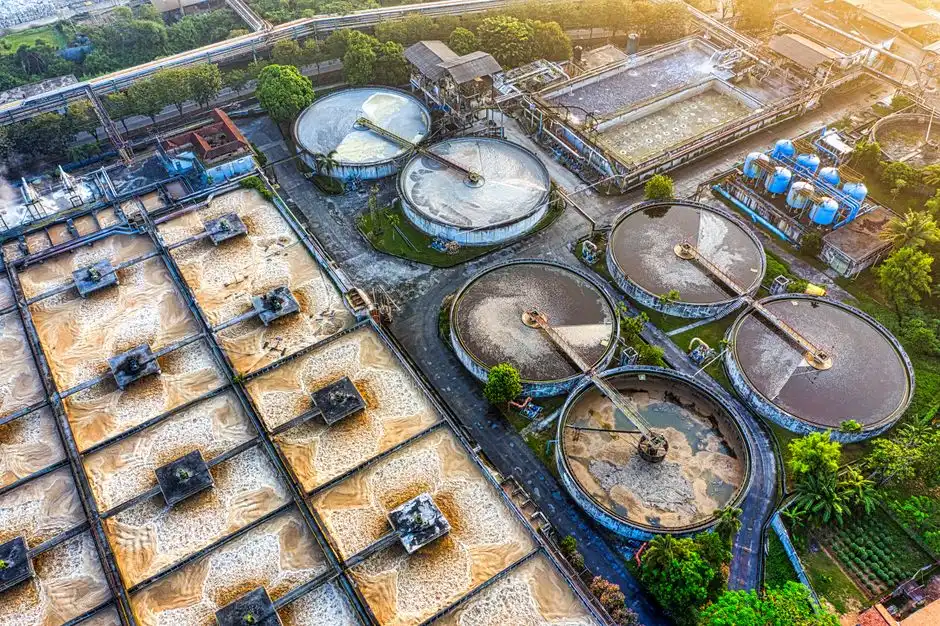
The Faculty of Sciences Ben M’M’Sick campus measurements reported in HydropureWater’s Casablanca domestic sewage treatment engineering guide recorded wastewater temperatures from 17.64 to 19.55 °C, pH from 7.18 to 8.18 and electrical conductivity from 2.47 to 3.98 mS/cm. These values describe a mesophilic, near-neutral stream with moderate dissolved solids, conditions compatible with A/O, activated sludge and MBR biological treatment. They do not establish the influent at another estate.
| Parameter | FSBM campus measurement | Design implication |
|---|---|---|
| Temperature | 17.64–19.55 °C | Within the mesophilic range reported for biological treatment; no site-specific heating assumption should be made without further data. |
| pH | 7.18–8.18 | Near neutral, supporting biological treatment without assuming aggressive chemical correction. |
| Electrical conductivity | 2.47–3.98 mS/cm | Indicates moderate dissolved solids; assess separately for reverse osmosis or sensitive crop-irrigation reuse. |
Before the final equipment proposal, require temperature, pH, conductivity, BOD, COD, TSS, NH₃-N and oil-and-grease data. Use the results to establish actual organic and solids loading rather than relying only on population-equivalent assumptions. For a housing development, sampling should represent the connected sewer under ordinary and peak domestic conditions; the sampling plan and laboratory methods should be agreed in the tender.
Conductivity is not, by itself, a biological-treatment blocker. It becomes important when the proposed reuse route includes membrane treatment or irrigation where crop and salinity criteria are more restrictive. The same distinction applies to all measured parameters: they inform equipment selection and downstream polishing, but they do not replace a permit-specific effluent guarantee.
Compare A/O and MBR for the development brief
The WSZ buried A/O package combines anoxic/aerobic contact oxidation, sedimentation and disinfection in one underground unit, operates automatically and does not require a full-time on-site operator. The integrated MBR couples activated sludge with submerged PVDF membrane filtration to produce near-reuse-quality effluent in a smaller footprint. Both can serve a housing estate, but they answer different discharge and operating obligations.
| Decision criterion | Buried WSZ A/O | Integrated MBR |
|---|---|---|
| Default application | Cost-defensible default for 50–500 p.e. subdivisions without a reuse mandate | Preferred where reuse is contractual, land is constrained or the receiving environment is sensitive |
| Process | Anoxic/aerobic contact oxidation, sedimentation and disinfection | Activated sludge with submerged PVDF membrane filtration |
| Effluent route | Surface discharge where the decree, permit and commune requirements are met | Surface discharge or reuse, subject to specified polishing |
| Operator requirement | Automatic operation without a full-time on-site operator | Automatic operation, with closer membrane and monitoring requirements |
| Site footprint | Buried installation preserves buildable area | Compact arrangement suits tighter sites |
| Sludge route | Requires sludge storage, pump-out and disposal planning | Requires membrane cleaning and waste-sludge management |
| Upgradeability | Reserve space and hydraulic capacity for UV or ClO₂ polishing if reuse may be contracted later | Polishing remains necessary for the most demanding reuse specifications |
HydropureWater’s Morocco guide identifies the buried A/O package as the lower-cost and lower-OPEX choice for a typical 50–500 p.e. subdivision without a reuse mandate. It identifies MBR as the appropriate premium where landscape or agricultural reuse is required, the footprint is constrained or the receiving water is sensitive. The guide also states that conventional activated sludge is generally over-specified for compounds, hotels and private campuses within the 1–80 m³/h domestic-flow envelope.
For unrestricted irrigation, HydropureWater’s Morocco guide gives the WHO 2006 benchmarks as fecal coliform not more than 200 CFU/100 mL and turbidity not more than 2 NTU, with MBR plus chlorine-dioxide polishing. For ordinary surface discharge, the same guide reports that ONEE practice and downstream disinfection typically target not more than 2,000 CFU/100 mL at the outfall; Decree 2-97-787 itself does not fix a numerical fecal-coliform limit. Specify the stricter applicable obligation in the tender, and leave upgrade provision where reuse remains possible.
Design the buried installation for access, odour and maintainability
A buried A/O installation puts the process tank below grade and leaves landscaping above it, preserving buildable area while retaining automatic operation without a full-time on-site operator. The arrangement must be drawn as a maintainable asset rather than treated as a sealed underground box. Covered or buried process units also help control odour, although the mild coastal temperature range described in HydropureWater’s Casablanca guide does not remove odour-management requirements in dense residential settings.
Show access to the media, aeration system, sludge hopper, controls and drainage on the site plan. Landscaped finishes must not obstruct routine inspection, lifting or sludge removal. Define how the unit is entered safely, how components are withdrawn, where temporary power is available and how tank drainage is isolated and disposed of. These requirements should become drawings and access clearances in the tender, not general maintenance notes.
Upstream debris is a separate mechanical risk. Where sewer conditions indicate rags, plastics or grit, assess a GX rotary mechanical bar screen before the biological or membrane stage. Confirm its inclusion, duty and grit-handling arrangement; a protected biological train is not a substitute for adequate headworks.
Equipment ratings come after these installation constraints are known. HydropureWater’s Casablanca guide records the WSZ underground A/O envelope as 1–80 m³/h and the integrated MBR envelope as 10–2,000 m³/day. Those are selection limits, not evidence that either installation fits the estate. The civil design must accommodate the quoted unit, its access routes, sludge handling and any future polishing equipment.
Price power, sludge and the complete packaged scope
HydropureWater’s 2026 Morocco guide gives a 1–20 m³/h WSZ A/O package as a 2026 Moroccan market range in MAD, with the quotation basis including equipment, civil works and two years of spares but excluding land and grid-connection fees. The guide also states that 1 USD is approximately 10 MAD. Obtain a project quotation against the written design basis because the catalogue range does not establish a price for a particular estate.
The cited power benchmark for a 100 m³/day residential A/O plant is 1.2–1.8 kW·h/m³, according to HydropureWater’s 2026 Morocco guide. Use it as an early operating-cost reference, not a guaranteed site value. Ask the bidder to state connected load, working power demand, aeration-control assumptions and expected operating profile.
Sludge must be included in the tender. HydropureWater’s 2026 Morocco guide reports A/O production of 0.3–0.5 kg of dry sludge per m³ treated and 30–50 kg of dry solids daily from a 100 m³/day plant, equivalent to approximately 300–500 L of thickened sludge at 4% dry solids. Its field data from 2025 are the source for the sludge-production figures. The same guide states that plants below 2 m³/day of waste-activated sludge can use integrated storage for 6–12 months, while larger developments need dewatering. It identifies 90-day pump-out intervals for subdivisions and 180 days for remote riad clusters.
| Bid item | Basis stated by HydropureWater’s 2026 Morocco guide | Action for the buyer |
|---|---|---|
| WSZ A/O package | 2026 Moroccan market range for 1–20 m³/h; equipment, civil works and two years of spares included | Request a site-specific quotation and state exclusions. |
| Grid connection and land | Excluded from the stated package basis | Allocate these items to the civil or infrastructure package. |
| Power | 1.2–1.8 kW·h/m³ for a 100 m³/day residential A/O plant | Request connected-load and consumption details. |
| Sludge | 0.3–0.5 kg dry sludge per m³; 30–50 kg dry solids daily and about 300–500 L thickened sludge at 4% DS for a 100 m³/day plant | Price storage, pumping, dewatering, transport and licensed disposal. |
| Dewatering | Plants above 2 m³/day of waste-activated sludge generally require dewatering | Assess a plate-and-frame filter press where the sludge volume warrants it. |
Price sludge disposal as an operating obligation. Where on-site dewatering reduces the volume hauled to a licensed off-site destination, include the filter press, cake handling, transport and disposal in the commercial comparison.
Turn the supplier quotation into a procurement checklist
Do not ask bidders merely to confirm that their plant is “compliant.” Require them to price and guarantee a package against one written design basis. The basis should contain design daily flow, peak factor, temperature, pH, conductivity, BOD, COD, TSS, NH₃-N, discharge route, reuse target, installation constraints and sludge-disposal route.
- Request a sizing schedule showing rated hydraulic load and BOD load at the agreed design point.
- Require guaranteed effluent values against the current permit or reuse target, including how each parameter will be demonstrated.
- Ask for media or membrane replacement intervals, consumables, expected sludge production and the recommended maintenance access.
- Obtain the manufacturing, shipping and commissioning schedule, including delivered lead time to Casablanca and local after-sales coverage.
- Confirm how incoming sewer debris will be removed and whether a screen is outside the quoted package scope.
- Reserve space, power and hydraulic capacity for UV or chlorine-dioxide polishing if reuse may be contracted later.
Polishing equipment should be selected against the actual reuse route rather than included by default. The Casablanca engineering guide identifies downstream UV or chlorine-dioxide treatment for reuse pathways, including the UV sterilizer for water treatment and chlorine-dioxide generator product options. If no polishing is currently required, the supplier should still identify the interfaces needed for later installation without civils rework.
Commercial evaluation should compare like-for-like scope: equipment, civil works, installation, commissioning, controls, access structures, two-year spares where included, power connection, sludge handling, training and local service. A low equipment price that omits these obligations is not a comparable offer. Require clarification in writing before award and incorporate the accepted guarantees, drawings, exclusions and dates into the purchase order and performance schedule.
Frequently Asked Questions
Which packaged sewage treatment plant is best for a Casablanca housing development?
A buried WSZ A/O package is the default for a typical 50–500 p.e. subdivision without contracted unrestricted-irrigation reuse. Choose an integrated MBR when reuse quality is mandatory, the site is severely constrained or the receiving environment is sensitive. The final choice remains conditional on the permit, commune requirement and measured site influent.
How large should the plant be for a housing estate?
Size it from the occupancy schedule, agreed per-capita demand, peak factor and measured organic loading—not from population alone. HydropureWater’s 2026 Morocco guide gives 130–180 L per capita per day as preliminary residential consumption and 2.0–2.5 as the subdivision peaking-factor range. Request a sizing schedule confirming both rated hydraulic and BOD loads, plus an assessment of wet-weather inflow.
Is an MBR necessary if the treated water will be discharged to a surface watercourse?
Not necessarily. For ordinary surface discharge, design to the applicable permit and Decree 2-97-787 conditions; A/O can meet the stated discharge floor. MBR becomes necessary when the project must satisfy the stricter WHO 2006 unrestricted-irrigation benchmarks, tighter consent conditions or a sensitive receiving environment. Do not use a surface-discharge description as a substitute for checking the actual consent.
How much does a packaged sewage treatment plant cost in Morocco in 2026?
HydropureWater’s 2026 Morocco guide gives a market range for a 1–20 m³/h WSZ A/O package in MAD, using an exchange reference of approximately 10 MAD per USD. The stated basis includes equipment, civil works and two years of spares, but excludes land and grid-connection fees. Request a quotation based on the site’s flow, treatment duty, civil access works and sludge route; no project-specific price can be inferred from the catalogue range alone.
What should a supplier guarantee before an equipment order?
Require guaranteed effluent values against the specific discharge or reuse target, not a general compliance statement. The bidder should confirm the unit against the written flow, peak and influent envelope; provide hydraulic and BOD loading, media or membrane replacement intervals, sludge assumptions, commissioning dates, delivered lead time and local service coverage. The offer must also identify exclusions, debris-removal responsibility and space reserved for future UV or chlorine-dioxide polishing.