
Why Domestic Sewage Treatment in Casablanca Is a 2026 Priority
Greater Casablanca is the largest urban agglomeration in Morocco, and its peri-urban fringe is where new housing compounds, hotel developments and private campuses are being connected to wastewater infrastructure. The peri-urban Greater Casablanca study (S3) frames this receiving environment as one where agricultural reuse is being actively evaluated, which pushes 2026 plant designs away from a "discharge-only" mindset and toward reuse-grade trains.
Casablanca's coastal climate keeps incoming sewage in a mild temperature band, which is favourable for biological kinetics but does not remove the need for covered or buried process units to control odour in dense residential settings. Engineers working in the region are also responding to a flow envelope dominated by domestic users rather than heavy industry: compounds, small hotels, hospitals and private campuses with flows in the 1–80 m³/h range sit squarely in the packaged-plant envelope. A WSZ underground packaged A/O sewage plant is representative of how that envelope is typically procured for sites without an on-site operator.
Aligning a packaged or membrane-based train with Casablanca influent reality and a peri-urban reuse pathway ensures design compliance with local requirements.
Measured Influent Characteristics for Casablanca Domestic Sewage
The strongest local data anchor is the Faculty of Sciences Ben M'Sick (FSBM) campus characterisation (S2), which reported wastewater temperatures between 17.64 and 19.55 °C, pH between 7.18 and 8.18, and electrical conductivity between 2.47 and 3.98 mS/cm — values that describe a near-neutral, mildly mineralised domestic stream well suited to biological treatment without aggressive pH correction or heating.
These parameters matter for process selection in three ways. First, the temperature band sits inside the conventional mesophilic range, so activated sludge, A/O contact oxidation and MBR kinetics all work without enclosure heating. Second, the near-neutral pH removes any need for chemical balancing before biological stages. Third, conductivity in the 2.47–3.98 mS/cm range signals moderate total dissolved solids, which is acceptable for biological effluent but should be flagged for any downstream reverse osmosis or sensitive crop-irrigation reuse. The same logic is reinforced at country level in the Morocco-wide 2026 engineering guide, which covers complementary design parameters across the national portfolio.
Where site-specific sampling is not yet available, the engineer should request at minimum temperature, pH, conductivity, BOD, COD, TSS, NH₃-N and oil/grease from the operating facility, the septic-tank hauler or the upstream sewer authority before finalising a process train (S2). The table below summarises the FSBM-measured envelope and the design implication for each parameter.
| Parameter | FSBM measured range (S2) | Design implication for 2026 |
|---|---|---|
| Temperature | 17.64 – 19.55 °C | Mesophilic range; no heating required for A/O, CAS or MBR |
| pH | 7.18 – 8.18 | Near-neutral; biological stages can run without chemical balancing |
| Electrical conductivity | 2.47 – 3.98 mS/cm | Moderate TDS; flag RO/irrigation reuse as a separate decision |
Process Options for 2026: Packaged A/O, MBR, and Conventional Activated Sludge
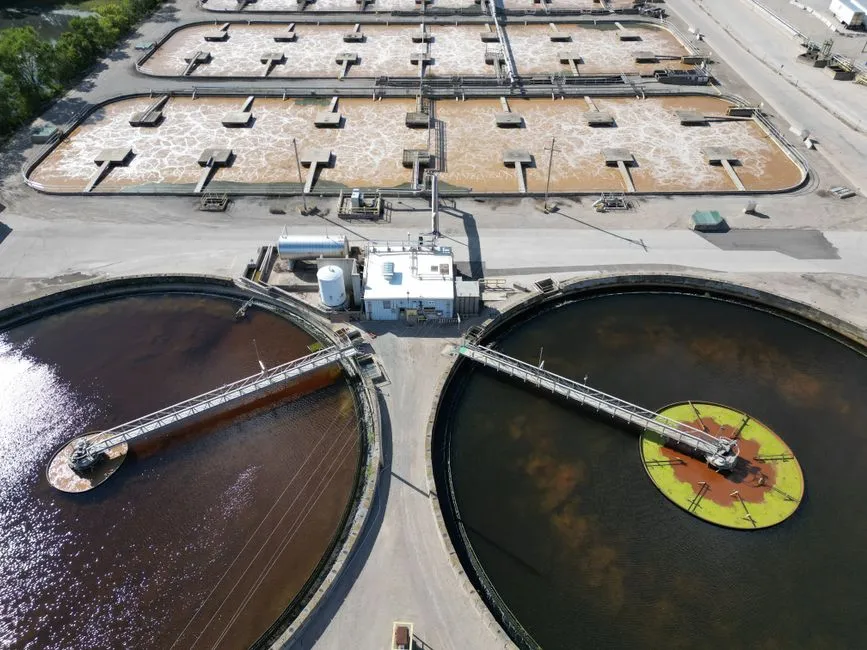
Three process families dominate the procurement conversation for Casablanca domestic sites: underground packaged A/O plants, integrated MBR systems, and conventional activated sludge.
The first is underground packaged A/O plants, exemplified by the WSZ underground packaged A/O sewage plant, which combines anoxic/aerobic contact oxidation with sedimentation and disinfection in a single buried unit, runs fully automatically without an on-site operator, and covers 1–80 m³/h. The second is the integrated MBR membrane bioreactor system, which couples activated sludge with submerged PVDF membrane filtration to deliver near-reuse-quality effluent in a smaller footprint than conventional layouts. The third is conventional activated sludge with secondary clarification, which remains appropriate for very large municipal works but is typically over-specified for compounds, hotels and private campuses inside the domestic flow envelope.
Beyond these three, the academic literature documents vermifiltration and constructed-wetland hybrids for decentralised semi-arid domestic treatment (S5, S1). Both are land-hungry, slow and harder to permit in dense Casablanca settings, so they tend to appear in pilot or rural applications rather than in mainstream procurement for 2026 housing and hotel projects.
Collection-sewer design also shapes plant choice. Separate sanitary sewers with controlled infiltration/inflow protect biological and MBR units from hydraulic shock, while combined-sewer systems carry a documented wet-weather overflow risk that any buried A/O or MBR package must be sized to absorb (S4). The headworks design should include a GX rotary mechanical bar screen where rags, plastics or grit are expected from upstream sewer conditions. The table below compares the three realistic options for Casablanca domestic projects.
| Process | Footprint | Operator requirement | Effluent quality | Best fit in Casablanca |
|---|---|---|---|---|
| Underground packaged A/O (WSZ-type) | Small (buried) | None — fully automatic | Discharge-grade, reuse with UV/ClO₂ | Compounds, small hotels, rural residential |
| Integrated MBR | Compact (above or below grade) | Low — membrane maintenance | Near-reuse quality directly | Hospitals, campuses, reuse-driven sites |
| Conventional activated sludge + clarifier | Large | Dedicated operator | Discharge-grade, reuse with polishing | Large municipal works only |
Matching the Process to the Site: Hotels, Hospitals, Compounds and Campuses
Residential compounds and small hotels with stable occupancy patterns and no on-site operator are the canonical fit for buried packaged A/O units in the 1–80 m³/h envelope, and the WSZ underground packaged A/O sewage plant is sized for exactly this duty. Where the site is constrained at grade and the developer wants the tank out of sight, burying the unit and landscaping over it is a standard configuration.
Hospitals and clinics that need a higher disinfection barrier and a smaller surface footprint are better matched to an integrated MBR membrane bioreactor system with downstream UV or chemical disinfection, because MBR effluent already approaches reuse quality and reduces the polishing load on the disinfection stage. University or corporate campuses — including the FSBM case study (S2) — often justify an MBR or A/O/MBR train because the same effluent can be reused for landscape irrigation or toilet flushing, which directly aligns with the peri-urban reuse logic in S3. Industrial estates discharging domestic sewage should still protect downstream biology with a GX rotary mechanical bar screen at the headworks to remove rags, plastics and grit before they reach the aeration tank.
Sizing Checklist and Reuse Pathway for Casablanca Projects

A procurement-ready input list for a Casablanca project should confirm, before any equipment is ordered: design daily flow in m³/day, peak factor, influent BOD, COD, TSS and NH₃-N, the FSBM-style local parameters of temperature, pH and conductivity, and the required effluent quality (S2). The reuse pathway decision follows the peri-urban Casablanca logic: if the effluent will go to urban-agriculture irrigation or landscape reuse, the design must be checked against crop-specific water-quality criteria documented in S3, and downstream pipeline UV sterilizer or chlorine dioxide polishing should be specified accordingly.
Sludge handling is often the most under-sized line item. Any buried A/O or MBR plant produces waste activated sludge that should be dewatered on site using a plate-and-frame filter press to reduce hauling cost and stabilise the cake before disposal, and this should be priced into the bid rather than added later. Where aeration energy is a concern, the aeration energy optimisation guide gives the operating-cost levers a Casablanca buyer should request from the supplier, and any discharge into a municipal sewer should also be cross-checked against the 2026 effluent discharge guidelines for applicable pre-treatment limits.
Frequently Asked Questions
What flow range is realistic for a packaged domestic sewage plant in Casablanca?
Most compounds, small hotels, private hospitals and rural residential sites fall inside the 1–80 m³/h packaged envelope documented for the WSZ underground packaged A/O sewage plant; flows above that band typically justify an MBR or conventional activated sludge layout instead.
Should the plant be designed for discharge or for reuse?
Design for the stricter of the two: the peri-urban reuse pathway in S3 is increasingly the binding constraint because crop-irrigation criteria are tighter than typical discharge consent. If reuse is not yet contracted, the engineer should still leave space and hydraulic capacity for a UV or ClO₂ polishing stage so the train can be upgraded later without civils rework.
How do I choose between an A/O packaged plant and an MBR for a Casablanca site?
Use a packaged A/O unit when there is no on-site operator, the footprint is tight and reuse is not yet contracted. Choose an MBR when the site is a hospital, campus or hotel that already plans landscape or toilet-flushing reuse, or when discharge consent is tighter than a standard biological envelope. A helpful procurement check is to ask each supplier to confirm their quoted unit against the FSBM temperature, pH and conductivity envelope (S2) so the design is anchored in measured local data.
What should I confirm with a Moroccan supplier before placing an order?
Ask for the rated hydraulic and BOD load, the guaranteed effluent quality against the reuse or discharge target, the membrane or media replacement interval, the delivered lead time to Casablanca, and the local after-sales coverage. No quotation should be accepted without a written influent envelope — temperature, pH, conductivity, BOD, COD, TSS and NH₃-N — that the supplier has confirmed against the site characterisation (S2) and the peri-urban reuse criteria in S3.
Related Equipment
- integrated MBR membrane bioreactor system — specifications, capacity range, and technical data