Why Rural Sewage Treatment Is a Water-Security Issue in Iraq
Rural sewage treatment in Iraq requires technology matched to dispersed settlements, water scarcity, local maintenance capacity and the intended reuse of treated effluent. Decentralized options range from an underground package sewage treatment plant to MBR systems for higher-quality reuse, but their suitability depends on verified site flows, wastewater characteristics and project-specific discharge requirements. The decision should follow a defined sequence: characterize the sewage, establish the reuse objective, size the plant, assess site and operating conditions, then verify effluent and sludge management. The following sections turn that sequence into an engineering and procurement workflow.
The Journal of Food Protection review, published in January 2024, reports diminished Tigris and Euphrates flows, overloaded water-distribution systems and wastewater treatment plants needing upgrades. It also records seawater intrusion from the Persian Gulf reaching 110 km inland as far as Basra. These conditions make rural wastewater treatment a water-security issue because untreated sewage can contaminate scarce surface and groundwater resources used by communities and agriculture.
EPIC reports that millions of cubic metres of sewage enter Iraqi rivers each day and describes a near-total lack of treatment capacity in the upstream Kurdistan provinces. Decentralized sewage treatment can reduce that local pollution where sewer extensions are impractical, but a package plant addresses a defined site—not the national infrastructure deficit. The project must still address collection, reliable operation, disinfection and the safe management of residuals.
International figures require the same discipline. The International Plasma Technology Center’s estimate of 62.5 billion gallons, or approximately 235 million tons, of sewer water collected per day refers specifically to US sanitary sewer systems. It is not an estimate of Iraqi rural demand, and neither that figure nor the source’s modelled energy results should be transferred to an Iraqi project without local analysis.
Define the Treatment Objective Before Selecting Equipment
The required outcome determines the treatment train: basic rural sanitation, environmental protection, irrigation reuse, industrial reuse and potable-water production are not interchangeable objectives. The Journal of Food Protection review’s January 2024 finding links inadequate sanitation and wastewater conditions with continued exposure to enteric diseases, so pathogen control cannot be treated as an optional refinement.
Before requesting equipment, the owner should identify the receiving water, proposed irrigation crops and application method, groundwater conditions, public-health exposure and whether the contract includes collection sewers, pumping, treatment, reuse storage or only on-site treatment. The project must also establish the applicable discharge, irrigation or reuse requirements with the receiving authority; the supplied research does not establish a universal Iraqi effluent standard.
Wastewater characterization should cover the verified flow and its variation, organic load, suspended solids, nutrients, pathogens and any locally relevant industrial contaminants. A hydraulic flow figure alone cannot establish biological capacity or reuse suitability.
| Decision input | Information the buyer must establish | Effect on equipment selection |
|---|---|---|
| Intended use | Sanitation, environment, irrigation, industrial reuse or potable-water production | Defines the required treatment and disinfection scope |
| Receiving environment | Watercourse, groundwater, irrigation area and public-health exposure | Determines the confirmed compliance route |
| Project boundary | Collection, pumping, treatment, storage, reuse and residuals management | Prevents gaps between separate suppliers |
| Influent quality | Flow, organic load, solids, nutrients, pathogens and industrial contaminants | Sets hydraulic and biological design duties |
This objective-first approach gives the engineer a defensible basis for comparing offers. It also supports the package wastewater treatment plant cost and supplier checklist: a comparable quote must refer to the same treatment objective, site inputs and acceptance obligations.
Compare Decentralized Treatment Routes for Iraqi Rural Sites
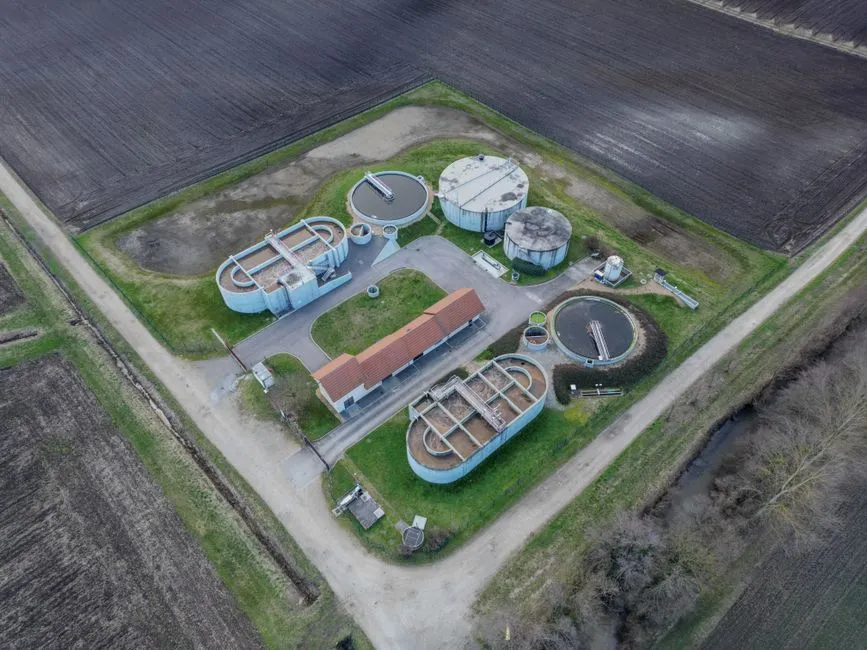
Buried A/O package treatment, MBR treatment, mobile demonstration and sludge-to-energy are distinct routes, not interchangeable equipment categories. A package plant is primarily a treatment option, an MBR is a process and filtration configuration, the mobile unit is a small demonstration reference, and sludge-to-energy is a residuals-recovery concept requiring separate feasibility work.
The verified configuration of the underground WSZ package sewage treatment plant combines anoxic/aerobic biological contact oxidation, sedimentation and disinfection in one buried unit. It is fully automated, requires no operator, handles 1–80 m³/h, can be installed below grade and can be mounted on a trailer for mobile deployment. These characteristics suit residential clusters, hotels, hospitals, factories and rural sites where a compact footprint and limited routine attendance are priorities.
The verified MBR membrane bioreactor for reuse-oriented projects combines activated sludge with submerged membrane filtration. Its published capacity is 10–2,000 m³/day, filtration is below 1 μm and the footprint is 60% smaller than conventional systems. These are verified equipment attributes; the source supports municipal-sewage and reuse applications, but each intended reuse still requires engineering validation.
EPIC’s mobile demonstration is compact, affordable and easy to operate, with stated capacity up to 5 m³ of raw sewage per day. It demonstrates deployable treatment within Iraq, but that figure must not be presented as the capacity of a full rural community system.
The International Plasma Technology Center models syngas and power from sewage sludge and biogas, with modelled thermal efficiency approaching 85% in its most efficient configuration. The source also gives biosolids a calorific value of about 12 MJ/kg. That value is a cited characteristic, not proof for an Iraqi site; actual sludge composition, energy content, logistics and implementation conditions require verification.
| Route | Verified scope | Best-supported role | Principal constraint |
|---|---|---|---|
| Buried A/O package plant | 1–80 m³/h; integrated contact oxidation, sedimentation and disinfection | Compact decentralized treatment | Still requires verified waste characterization, site works and residuals management |
| MBR system | 10–2,000 m³/day; below-1 μm filtration; 60% smaller footprint than conventional systems | Municipal sewage or higher-quality reuse applications | Reuse claim must be tied to the intended application and confirmed criteria |
| Mobile demonstration | Up to 5 m³ of raw sewage per day | Iraqi demonstration and evaluation | Not a full-community capacity benchmark |
| Sludge-to-energy | Modelled syngas and power; thermal efficiency approaching 85% in the most efficient configuration | Feasibility study for suitable sludge resources | Local feedstock, energy value and implementation must be demonstrated |
Build a Site-Specific Treatment and Reuse Flow
A complete rural wastewater system follows collection, headworks, equalization, biological treatment, solids separation, disinfection and the selected reuse or discharge route. Where coarse screening is required, the project should evaluate the mechanical removal performance and maintenance requirements of a rotary mechanical bar screen, rather than adding it as an unverified default.
- Collection and headworks: define the sewerage arrangement, remove obstructive material and establish the flow entering the treatment unit.
- Equalization: account for flow variation and provide the process with a controlled hydraulic feed.
- Biological treatment: apply the selected contact-oxidation or activated-sludge process according to the verified organic load.
- Solids separation: capture and route the solids stream to inspection, removal and an approved disposal or reuse route.
- Disinfection: apply the required treatment before discharge or reuse; a UV sterilization system can be evaluated where electrically suitable.
- Final use or discharge: confirm the receiving route and meet the applicable project-specific requirements.
In the WSZ route, A/O contact oxidation, sedimentation and disinfection are consolidated below grade, leaving the surface available for specified site uses. In an MBR route, activated sludge provides biological treatment and submerged membranes provide solids separation before the reuse assessment.
The solids-management train must include capture, inspection, scheduled removal, odour control and site safety. If dewatering is required, the plate-frame filter press should be evaluated against the sludge characteristics, dewatering objective and disposal route.
Energy and water recovery should be reviewed, not assumed. The International Plasma Technology Center supports technical feasibility research, but it does not establish rural Iraqi economics. A rural project should not depend on energy recovery unless local feedstock, demand, maintenance capability and a confirmed implementation pathway justify it.
Size the Plant from Verified Inputs, Not Generic Rural Assumptions
Wastewater plant sizing begins with verified current and design flow, including seasonal variation, groundwater infiltration, peak demand and industrial inflows. The supplied research provides equipment envelopes but no universal peak factor, redundancy rule or rural population formula, so the owner and engineer must establish those criteria instead of importing an unsupported rule.
Flow capacity must then be checked against organic and solids loading. BOD or COD, suspended solids, nutrients, pathogens and industrial contaminants determine biological and solids-handling duties; they cannot be replaced by a flow calculation alone. Published capacities provide screening limits, not final selection: WSZ covers 1–80 m³/h, while MBR covers 10–2,000 m³/day.
Site constraints can eliminate an otherwise suitable process. Check available land, excavation and burial conditions, vehicle access for maintenance and sludge removal, electrical supply, backup arrangements, odour setbacks and the distance to receiving waters or reuse areas. Confirm who will operate the plant and provide routine service before assigning an automated configuration.
| Sizing or screening input | Evidence required before selection | Decision affected |
|---|---|---|
| Hydraulic flow | Verified current flow, design flow, seasonal variation, infiltration and peak demand | Treatment flow envelope and equalization |
| Organic and solids load | BOD or COD and suspended-solids characterization | Biological and solids-handling capacity |
| Water-quality risk | Nutrients, pathogens and relevant industrial contaminants | Treatment and disinfection requirements |
| Reliability | Owner-selected peak, standby and redundancy criteria | Installed capacity and backup provision |
| Site and operations | Land, access, power, odour, receiving-water distance and maintenance capability | Process configuration and commercial scope |
Plan Commissioning, Operation and Performance Verification
Acceptance should be contractual evidence, not a visual impression after installation. The supply scope should require factory testing, installation inspection, mechanical and electrical checks, biological start-up and site performance testing. For package and MBR systems, these obligations should be defined against the selected underground package sewage treatment plant configuration or the selected MBR membrane bioreactor configuration, including the confirmed influent duty and intended reuse route.
The acceptance plan should identify sampling points, parameters, laboratories, frequencies and thresholds against the project’s confirmed discharge or reuse requirements. Unsupported numerical limits should not be inserted into the contract. Sampling must represent the agreed operating period and distinguish start-up performance from established performance.
| Stage | Procurement and handover check | Record required |
|---|---|---|
| Factory acceptance | Mechanical, electrical, control and equipment checks | Factory test report and deficiencies closed |
| Installation | Civil works, connections, access, safety and power | Inspection and punch-list records |
| Start-up | Biological establishment, controls, alarms and disinfection | Operational start-up record |
| Performance testing | Sampling against confirmed project criteria | Accredited or agreed laboratory results |
| Operational review | Flow, effluent performance, energy, chemicals, downtime and residuals | Measured operating review before expansion |
Operational readiness includes automatic controls, alarm response, defined power-failure behaviour, access to spare parts and operator training. The maintenance schedule should cover screening, aeration, sludge removal, disinfection, media or membrane condition, odour control and housekeeping.
EPIC’s mobile demonstration shows that compact treatment can be deployed and evaluated in Iraq, while its stated capacity remains up to 5 m³ of raw sewage per day. Before broader deployment, the project should use measured operating data covering flow, treatment performance, energy use, chemical consumption, downtime and residual handling. That review determines whether the installation should be expanded, adjusted or replaced.
Frequently Asked Questions
How should a rural sewage treatment plant in Iraq be sized?
Begin with verified flow and wastewater characterization, then compare those duties with the manufacturer’s selected design-flow envelope. WSZ equipment is published at 1–80 m³/h and MBR equipment at 10–2,000 m³/day, but the final design must also address organic load, suspended solids, seasonal variation, peak conditions and the owner’s redundancy criteria. No universal rural population formula is established by the supplied research.
How should buyers compare and select an Iraqi wastewater equipment supplier?
Request process-suitability evidence, factory-test records, installation references, local support arrangements, spare-parts availability, operating and maintenance documentation and a performance-acceptance method. Verify that the supplier has assessed the actual influent and intended reuse rather than offering a standard unit. Local delivery experience and a clear responsibility for commissioning defects are particularly important where access and service coverage are constrained.
What information is required to obtain a reliable rural treatment-plant quotation?
The supplied research does not provide a reliable Iraq-specific price, so request a site-specific quotation after defining capacity, treatment process, civil works, power, controls, commissioning, sludge handling, odour controls, reuse requirements and site conditions. Ask the supplier to state exclusions and identify any design assumptions. Separate equipment, works and lifecycle costs so that comparison is not distorted by an undefined scope.
What should be confirmed before treated wastewater is used for irrigation or other reuse?
The intended reuse and receiving authority determine the applicable project-specific requirements. Confirm the reuse method, public-health exposure, groundwater and receiving-water conditions, and the required sampling and performance evidence before equipment is selected or installed. The January 2024 Journal of Food Protection review’s association between inadequate sanitation and continuing enteric-disease exposure makes pathogen control a core design requirement rather than an optional addition.