Choose the treatment route before selecting a package
No single packaged sewage treatment plant fits every Nagoya housing development. The first decision is whether the site can connect to a public sewer: sewer-extension costs are approximately $100,000–$500,000 per kilometer, so distance can outweigh package-equipment cost (HydropureWater, 2025). If no connection is available and a flush toilet is installed, Japanese practice requires an on-site Johkasou; the ADBI/Hiyoshi technical profile identifies a Packaged Aerated Wastewater Treatment Plant as the standard system (2021). If the discharge enters a municipal sewer, surface water or an on-site reuse system, the required treatment level changes. A package should therefore be selected only after the route, effluent destination, flow, load, footprint and maintenance access are known. A comparison of buried wastewater systems and alternatives is useful for testing that route against the site rather than comparing tank photographs.
Do not treat a domestic package as an industrial wastewater shell. Domestic wastewater is generally around 200–300 mg/L BOD, while loads above about 1,000 mg/L BOD require stronger pretreatment or a hybrid or MBR-assisted flowsheet (HydropureWater, 2025). For a housing estate, the practical workflow is: verify the public sewer route; establish the discharge or reuse destination; obtain measured flow and water-quality data; then compare aerobic Johkasou, buried WSZ and MBR against the same site constraints.
Build the housing development design basis
A housing-development design basis must combine measured flow and loading with the site and approval conditions, rather than rely on unit count or catalogue capacity. Collect daily and peak flow, BOD and TSS concentrations, temperature, sewer distance, available footprint, power supply, sludge-access route, groundwater conditions and the required discharge or reuse specification. A population equivalent is a loading measure; it is not a substitute for measured hydraulic flow, because fixtures, occupancy patterns and infiltration can produce different relationships between residents and wastewater flow.
Apply the approximately 20% peak-flow buffer used in Japanese packaged-unit design practice. The source notes that 10 m³/day average duty is commonly specified at about 12 m³/day (HydropureWater, 2025). Modular Johkasou products commonly cover 0.5–50 m³/day, so a multi-block development may require several modules instead of one oversized unit. The typical aerobic footprint reference is 1.5–3 m² per m³/day of design flow for 5–500 population equivalents; that is a feasibility check, not a substitute for a site plan. Continuous temperatures below 5°C require insulated aerobic packages according to the 2025 Japan guide. Package approval typically takes about 8–14 weeks from design submission to operating approval, compared with about 20 weeks for many custom civil plants (HydropureWater, 2025).
| Design input | Evidence-based basis | Decision to record |
|---|---|---|
| Average and peak flow | 10 m³/day average is commonly specified at about 12 m³/day with a ~20% peak-flow buffer (HydropureWater, 2025). | Number and arrangement of modules |
| Influent strength | Domestic wastewater is generally around 200–300 mg/L BOD; above about 1,000 mg/L BOD calls for pretreatment or a hybrid/MBR-assisted flowsheet (HydropureWater, 2025). | Standard aerobic, hybrid or MBR process |
| Footprint | Aerobic reference: 1.5–3 m² per m³/day for 5–500 population equivalents (HydropureWater, 2025). | Tank, access and maintenance envelope |
| Temperature | Continuous temperatures below 5°C require insulated aerobic packages (HydropureWater, 2025). | Insulation and heat-tracing scope |
| Approval | Packaged units typically take 8–14 weeks from design submission to operating approval (HydropureWater, 2025). | Permit-specific programme |
For nutrient-sensitive receiving waters, use a total nitrogen removal technology comparison to check whether the proposed train needs anoxic and anaerobic stages, recycle pumps or chemical dosing.
Compare Johkasou, buried WSZ and MBR packages
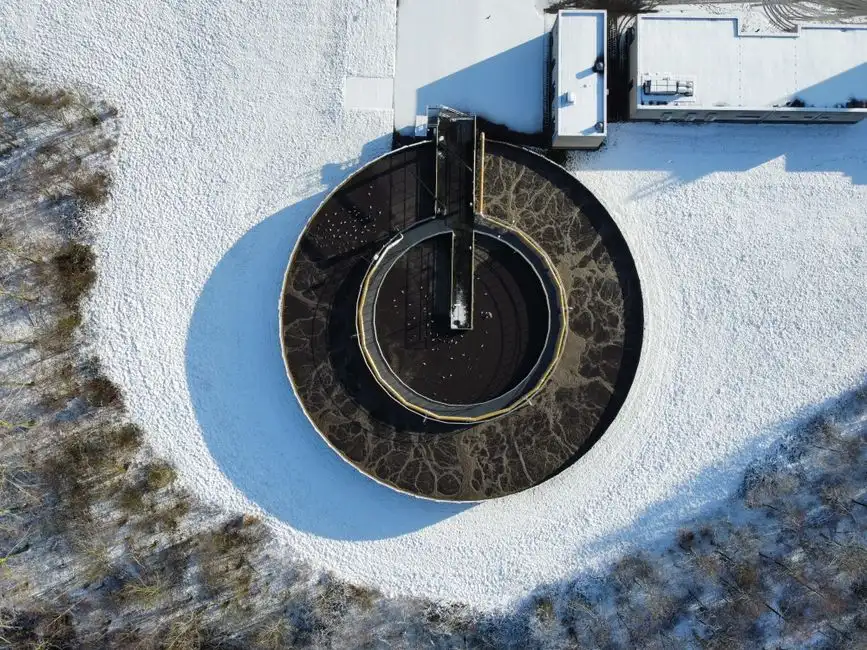
An aerobic Johkasou is the baseline for conventional domestic-strength housing sewage when the required BOD performance is sufficient and a registered local maintenance provider is available. Standard-type performance is BOD ≤20 mg/L, with optional BOD targets of 15, 10 or 5 mg/L under the MOEJ performance evaluation system (MOEJ, as reported by HydropureWater, 2025). Common discharge targets also include TSS <30 mg/L (HydropureWater, 2025). These figures are not automatic permission to discharge: the receiving route and permit must still be checked.
An anaerobic package has lower energy use—about 0.1–0.3 kWh/m³—but BOD removal is lower at 60–80%; it is generally more appropriate for remote or low-power applications than a conventional urban estate (HydropureWater, 2025). A hybrid A2O arrangement is the more defensible starting point when nitrogen or phosphorus removal is required because it adds anoxic and anaerobic stages before aeration and increases equipment complexity.
A buried WSZ-style package is the alternative when underground integration and visual-minimizing landscaping are priorities. The underground integrated sewage treatment plant has a listed capacity of 1–80 m³/h, so the manufacturer’s model and unit arrangement still require project-specific verification. Excavation, groundwater control, structural design and dewatering can outweigh the equipment-price difference.
An MBR is justified where the project needs very low suspended solids, near-reuse-quality output or a reuse destination that an ordinary aerobic package cannot meet. The Nagoya MBR guide reports BOD5 <5 mg/L, COD <20 mg/L and turbidity <2 NTU (Scribd MBR design basis, 2025-09). Against that performance, the integrated MBR wastewater treatment system carries higher capital, maintenance and membrane-replacement exposure. For every buried option in Japan, require seismic design under the Building Standards Act and a documented JIS-rated tank structure, together with groundwater and dewatering plans.
| Package | Best-fit condition | Main constraint |
|---|---|---|
| Aerobic Johkasou | Domestic housing sewage with conventional effluent requirements | Local registered maintenance and sludge access |
| Buried WSZ | Underground installation with limited visible plant area | Excavation, seismic design, groundwater and lifting access |
| Hybrid A2O | Nutrient limits requiring anoxic and anaerobic treatment stages | Greater process and equipment complexity |
| MBR | Very low solids, tight effluent limits or defined reuse | Capital cost, membrane cleaning and replacement |
Map each package to a Nagoya site scenario
For a Nagoya housing development, the best package is determined by the site scenario rather than by effluent quality alone. The table below converts the available site information into a provisional selection and identifies the condition that must be confirmed before a supplier is short-listed.
| Scenario | Provisional choice | Critical confirmation |
|---|---|---|
| A: public sewer nearby | Compare the sewer connection against an on-site package; a short connection may be less disruptive. | Obtain the actual extension route and price; the $100,000–$500,000 per kilometer figure is an indicative source benchmark (HydropureWater, 2025). |
| B: long sewer route with landscaped estate | Prioritize a buried WSZ-style package. | Check excavation, seismic, groundwater, dewatering, access openings and landscape loading. |
| C: small clustered housing site | Prioritize an aerobic Johkasou. | Verify that BOD ≤20 mg/L and the annual maintenance route satisfy the permit (HydropureWater, 2025). |
| D: reuse-driven development | Assess MBR where a defined high-quality destination exists. | Validate toilet flushing, irrigation, cooling-tower makeup or laundry demands against the project quality specification; these reuse applications are identified in the Nagoya MBR guide (2026). |
| E: nutrient-sensitive receiving water | Do not accept a standard aerobic package without reviewing T-N and T-P requirements. | Select optional performance tiers or a hybrid A2O route only after the applicable limit is confirmed. |
Maintenance is part of the site decision. Confirm access for registered maintenance contractors, annual inspections, desludging, wet-sludge handling and disposal for every scenario. The ADBI/Hiyoshi technical profile notes that PAWTP maintenance is conducted by vendors registered with the local government and that certified operators visit sites under the relevant regulatory frequency (2021). A packaged sewage treatment selection for housing developments provides a useful cross-check for applying these same access and maintenance tests.
Compare capital cost, operating cost and land impact
The available cost evidence is a set of indexed equipment and lifecycle benchmarks, not a turnkey Nagoya quotation. For a 10 m³/day aerobic Johkasou, the 2025 equipment-scope benchmark is $30,000–$50,000, covering the tank, internals and commissioning. At the same 10 m³/day scale, conventional SBR equipment is approximately $40,000–$65,000 and MBR is approximately $60,000–$90,000 (HydropureWater, 2025). Local civil works, electrical tie-ins, pumps, controls and installation are separate; the figures must not be used as project prices.
Annual OPEX benchmarks are approximately $0.15–$0.30 per m³/day of capacity for aerobic Johkasou, $0.25–$0.45 for SBR and up to $0.40–$0.70 for MBR when chemical cleaning and 5–7 year membrane replacements are included (HydropureWater, 2025). The cited 15-year lifecycle comparison is roughly $80,000–$120,000 for Johkasou versus $140,000–$200,000 for MBR at 10 m³/day. The same source states that Johkasou packages generally use about 50% less footprint than many SBR or MBR trains and can reduce acquisition cost where land exceeds about $100/m². These are comparative source benchmarks, not a Nagoya land valuation.
The sewer alternative remains a separate commercial test. The source states that on-site upgrades may pay back in 3–7 years where collector-pipe length is high (HydropureWater, 2025). Do not convert that statement into a project saving without the actual pipe length, route, easements, local civil rates and authority connection charges. For sludge, ask whether the package requires dewatering and how wet sludge is transferred and disposed; a plate-frame filter press may be needed as a separate scope item.
| 10 m³/day comparison | Aerobic Johkasou | SBR | MBR |
|---|---|---|---|
| 2025 equipment scope | $30,000–$50,000 | $40,000–$65,000 | $60,000–$90,000 |
| Annual OPEX per m³/day of capacity | $0.15–$0.30 | $0.25–$0.45 | Up to $0.40–$0.70 |
| 15-year lifecycle benchmark | $80,000–$120,000 | Not stated in the supplied research | $140,000–$200,000 |
| Included in the equipment benchmark? | No. Local civil work, electrical supply, installation and site-specific sludge handling require separate quotation. | ||
All values in this table are from HydropureWater’s 2025 Japan package-plant guide. Request quotations that separate equipment, underground or above-ground civil work, electrical supply, installation, commissioning, annual maintenance, inspections, sludge transport, disposal and membrane replacement.
Build a compliant procurement and supplier-selection checklist
Procurement should test the process, compliance and service evidence before comparing price. Require a performance guarantee tied to the project’s design flow, influent basis and applicable BOD, TSS, T-N, T-P, disinfection and reuse limits. The bid should include actual hydraulic and process calculations demonstrating accommodation of the approximately 20% peak-flow buffer, rather than a catalogue flow statement.
Require evidence that manufacture, installation, maintenance and desludging comply with the Johkasou Act and applicable building rules. Annual inspection by a designated agency remains mandatory under the framework described by HydropureWater (2025). The operator should be identified by name, with response time, inspection scope, sludge-removal interval, wet-sludge transfer method and disposal route. Also require spare-parts lead times, membrane or blower replacement support, remote-monitoring options and a contingency for a single blower or other critical equipment.
For buried equipment, request seismic certification, groundwater and dewatering information, access openings, lifting provisions and landscape-loading details. Treat 8–14 weeks as the cited typical packaged-unit approval interval from design submission to operating approval, but place a project-specific date in the contract schedule; permit conditions and design changes can affect that programme.
A service and maintenance protocol can be used to check whether the operator’s inspection, cleaning and desludging arrangements are complete rather than anecdotal, using the containerized wastewater treatment maintenance guide as a procedural reference.
- Confirm sewer availability, discharge route and permit criteria.
- Measure flow, BOD, TSS and temperature; establish the peak-flow basis.
- Shortlist aerobic Johkasou, buried WSZ and MBR against the same footprint and maintenance envelope.
- Issue an RFQ with separated equipment, civil, electrical, commissioning, maintenance and sludge-disposal costs.
- Verify approvals, operator coverage, inspection access, critical spares and project dates before award.
Frequently Asked Questions
Which packaged sewage treatment plant usually fits a Nagoya housing development without a public sewer connection?
An aerobic Johkasou is usually the baseline choice for domestic housing sewage. Choose a buried WSZ-style package when underground integration or landscaping is the controlling site requirement, and assess MBR where the discharge specification or reuse destination is more demanding. The final choice still depends on measured flow, loading, permit criteria, footprint and local maintenance coverage.
What cost should a buyer budget for a 10 m³/day Johkasou?
Use the $30,000–$50,000 figure only as the 2025 equipment-scope benchmark for the tank, internals and commissioning, not as a turnkey housing-development price (HydropureWater, 2025). Request separate quotations for local civil work, electrical supply, pumps, controls, installation, commissioning, maintenance, inspections, sludge handling and disposal.
How should a supplier be selected for maintenance and compliance?
Ask bidders to identify the registered local operator, response time, annual inspection scope, sludge-removal interval, wet-sludge transfer method and disposal route. Require evidence of Johkasou Act and building-rule compliance, and obtain the spare-parts and critical-equipment support commitments in the contract rather than accepting general assurances.
Is BOD ≤20 mg/L sufficient to freeze the package specification?
No. BOD ≤20 mg/L is the standard-type performance floor described in the supplied research, but the project must confirm the actual discharge or reuse specification and any T-N, T-P, pathogen or site-specific requirements. Use the permit and receiving-water criteria—not the standard-type label alone—to select the process tier.