
How MBR Treats Commercial Laundry Wastewater
MBR for commercial laundry wastewater combines biological degradation with membrane separation, making it suitable for treating the biodegradable organic load and surfactants that enter industrial laundry effluent. In an industrial pilot, the process removed 91%-93% of COD, 99% of BOD, 87%-95% of anionic surfactants, and 94%-95% of nonionic surfactants. The membrane fouled after about 11 days, but permeability was fully recovered following chemical cleaning. A reliable project therefore requires more than a membrane module: equalization, screening, pH and nutrient control, biological treatment, fouling management, and a defined discharge or reuse destination.
A membrane bioreactor is not a membrane-only appliance. The biological reactor provides the degradation stage, while the membrane retains biomass and suspended solids and separates the treated permeate from the mixed liquor. The biological stage reduces the biodegradable organic load before it reaches the membrane, helping limit the solids accumulation that would otherwise increase cleaning demand.
Laundry wastewater varies with the fabrics handled and the detergents, bleach, and other cleaning chemicals used. Equipment selection should therefore follow site-specific wastewater characterization rather than a generic surfactant-removal claim. The pilot figures above came from a 600 dm3 installation using a ZeeWeed 10 module under defined operating conditions. They demonstrate potential performance, not universal guarantees for every laundry.
The resulting permeate has low suspended solids, but MBR does not automatically remove dissolved salts or every contaminant addressed by advanced treatment. Reverse osmosis polishing is justified when the reuse application requires additional solute removal. For a complete equipment basis, compare an integrated MBR wastewater treatment system against the treatment objectives and operating responsibilities before comparing membrane formats.
Laundry Wastewater Characteristics That Drive MBR Design
Laundry wastewater must be characterized by flow, organic load, surfactant type, and chemical use before an MBR can be sized or guaranteed. A large industrial MBBR study found that the wastewater contained mainly surfactants and impurities originating from washed fabrics; the same study noted that wastewater quality depends on the materials laundered and the cleaning materials used (ScienceDirect, 2018).
Obtain average and peak flow, the operating-day profile, pH, COD, BOD5, total and split surfactant fractions, nutrients, suspended solids, temperature, and the chemical products used by the laundry. The analysis should distinguish biodegradable from non-biodegradable organics and separate anionic from nonionic surfactants. That distinction matters: the industrial MBR pilot reported 87%-95% removal of anionic surfactants and 94%-95% removal of nonionic surfactants (ScienceDirect, 2014).
Nutrient and pH control may be necessary. In the MBBR study, urea was added to supplement nitrogen and acid was added to correct pH before biological treatment (ScienceDirect, 2018). Whether a new MBR needs equivalent dosing must be established from its nutrient balance and influent variability, not assumed from the laundry process.
Equalization and fiber removal should be evaluated upstream. Lint, textile fibers, and variable cleaning-chemical inputs can affect biological treatment and membrane condition. A rotary mechanical bar screen may be considered where fiber capture is required, while pH correction should be specified through an automatic chemical dosing system where the influent characterization demonstrates the need.
| Design input | Why the buyer needs it | Procurement consequence |
|---|---|---|
| Average and peak flow; operating hours | Defines hydraulic loading and equalization duty | Reactor, membrane, and storage basis |
| COD and BOD5 | Indicates biodegradable organic loading | Biological volume, aeration, and sludge production |
| Anionic and nonionic surfactants | Tests whether the proposed biological process addresses the actual detergent profile | Surfactant limits and treatment-performance guarantee |
| pH, nutrients, and temperature | Defines biological operating conditions and dosing need | Controls, heating, and chemical dosing |
| Suspended solids and fiber characteristics | Indicates pretreatment and membrane-fouling risk | Screening and solids-management scope |
| Discharge or reuse destination | Sets the required effluent quality | Disinfection, UF, RO, and acceptance criteria |
The Albatros laundry illustrates why site data matters. It generated approximately 600 m3/d of wastewater, with a maximum of 800 m3/d (ScienceDirect, 2018). These are case-specific values, not default design capacities. During the MBBR testing period, raw daily flow was 0.6-1.0 m3/d, which demonstrates how strongly the influent basis can differ between a research test and full laundry operation.
Recommended Treatment Process for a Laundry MBR
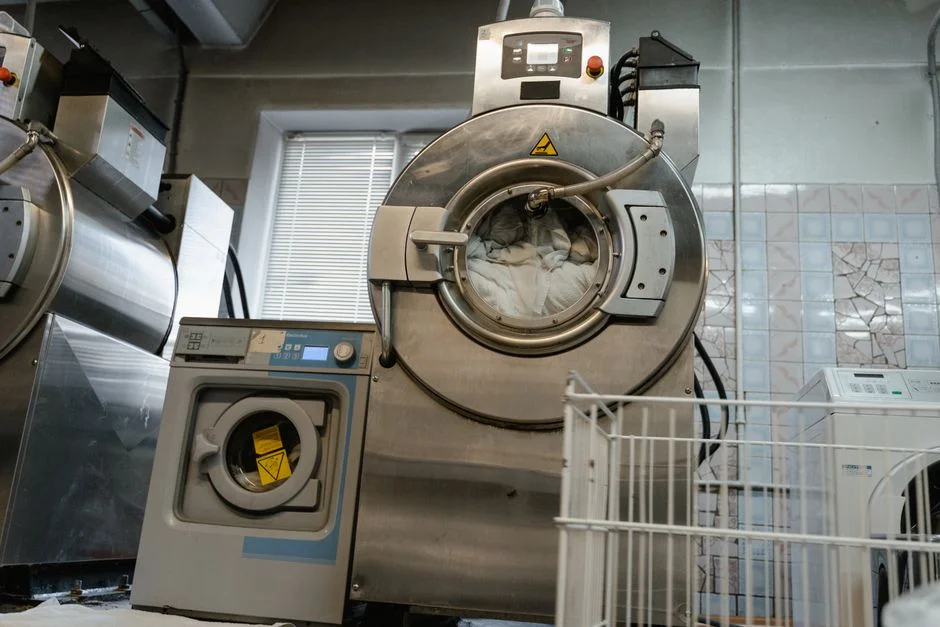
A complete laundry MBR treatment train should be defined from collection through final discharge or reuse, not from the membrane module outward. The process flow is collection and equalization, screening and fiber removal, pH and nutrient adjustment, biological degradation, membrane separation, optional disinfection, and final discharge or reuse.
- Collect and equalize. Balance variable production flows and prevent short-duration organic or chemical peaks from overloading the biological reactor.
- Screen and remove fibers. Capture lint and textile material before they enter the biological and membrane stages.
- Adjust pH and nutrients. Add only the chemicals required by the confirmed biological balance.
- Degrade organics biologically. Reduce the biodegradable organic load and surfactants before membrane separation.
- Separate solids in the membrane stage. Retain biomass and suspended solids to produce low-solids permeate.
- Disinfect and polish as required. Add treatment determined by the reuse or discharge point.
The biological reactor is the first major barrier to membrane fouling. It reduces soluble biodegradable material and surfactants while the membrane performs clarification, retaining biomass and suspended solids. The commercial MBR source describes high-quality effluent suitable for recycle as a principal advantage (Ecolab, 2026).
Footprint claims need their source and boundary conditions. HydropureWater’s verified product catalog reports that its integrated MBR system is 60% smaller than conventional systems, while Ecolab reports a 50% reduction in land requirement for MBR versus conventional biological treatment (HydropureWater verified product catalog; Ecolab, 2026). These are supplier claims from different comparison bases and should not be combined into one space-saving estimate.
Advanced treatment should follow the water destination. A published industrial water-reuse design used an MBR plus RO process with a capacity of 200 m3/d and included a commercial-laundry case (Procedia Engineering, 2012). That case supports a combined MBR-RO route where the reuse specification requires additional solute removal. It does not mean RO should be added to every laundry MBR. An RO water purification system should be specified against the required permeate chemistry and equipment compatibility at the point of use.
For procurement, require the treatment train to define membrane protection, effluent quality, disinfection, sludge handling, and the final destination. A proposal that ends at permeate production leaves material operating and compliance questions unresolved.
Membrane Fouling, Cleaning, and Recovery
The industrial laundry MBR pilot fouled after about 11 days of operation despite periodic relaxation and backflushing; chemical cleaning became necessary, and membrane permeability was fully recovered after the applied procedure (ScienceDirect, 2014). This is a documented pilot result, not a guaranteed cleaning interval for a commercial installation.
Fouling in laundry MBR is a combined problem. Surfactants, suspended fibers, colloids, and mixed-liquor solids can increase membrane resistance and cleaning demand. The biological stage should reduce the organic load entering the membrane, but it does not remove upstream fibers or eliminate the need for membrane scouring, controlled backwashing, or relaxation.
Specify the operating controls before acceptance: pretreatment performance, aeration consistency, membrane scouring, backwash or relaxation sequence, cleaning trigger, chemical dosage, and recovery acceptance criteria. A cleaning plan without defined permeability baselines leaves the operator without an objective way to distinguish normal decline from corrective-action conditions.
The pilot used three biological tanks with a total capacity of 600 dm3, a biological feed rate of 25 dm3/h, and membrane-reactor recycling at 125 dm3/h (ScienceDirect, 2014). These operating relationships help explain how biological treatment and membrane separation were staged, but they cannot be transferred directly to a full-scale system.
HydropureWater’s DF-series submerged MBR membrane module is a relevant configuration example: 0.1 μm PVDF membranes, an integrated aeration box, replaceable elements, and module configurations from 80-225 m2 with stated production of 32-135 m3/day. These are catalog configurations, not selection limits.
| Supplier commitment | Required definition | Buyer check |
|---|---|---|
| Normalized permeability trend | Reference conditions and measurement method | Ask for the trend definition and baseline, not only peak flow |
| Cleaning frequency | Operating basis, trigger, and expected recovery | Check whether the estimate reflects the proposed laundry wastewater |
| Chemical recovery criteria | Acceptable post-cleaning permeability and method | Define how recovered performance is measured |
| Spare-membrane strategy | Quantity, storage, change procedure, and supply conditions | Confirm coverage for planned and unscheduled outages |
| Expected performance recovery | Documented procedure and acceptance threshold | Use the pilot’s full permeability recovery only as a technical reference |
Sizing and Selecting the Right MBR Configuration
MBR sizing should start from the laundry’s average and peak flow, operating hours, hydraulic and organic load, recovery strategy, and biological growth requirements. A supplier should not scale a catalog range without the site data. The DF-series modules span 32-135 m3/day, while HydropureWater’s integrated-system catalog spans 10-2,000 m3/day (HydropureWater verified product catalog); neither range substitutes for process design.
The MBBR laundry case demonstrates the need to distinguish test conditions from operating conditions. Testing used 0.6-1.0 m3/d of raw wastewater, while the operating laundry generated approximately 600 m3/d with peaks up to 800 m3/d (ScienceDirect, 2018). A design based only on an average or only on the peak would miss the operating basis.
At decision level, submerged and side-stream MBR concepts should be compared against site constraints, aeration, recoverability, and maintenance access. The industrial water-reuse paper notes that submerged MBR systems are often preferred because of their robustness and flexibility (Procedia Engineering, 2012). That is a general selection consideration, not a site-specific conclusion.
Separate supplier scopes before comparing commercial offers. An integrated biological-membrane project includes process equipment, controls, aeration, piping, and commissioning. A membrane-module supply project may leave biological treatment, pretreatment, and controls to another contractor. A downstream UF or RO package addresses final polishing but does not replace biological treatment or membrane fouling controls. The MBR treatment cost per m3 guide provides a useful basis for checking how quoted scope affects cost comparisons.
| Procurement scope | What the supplier should define | Main interface risk |
|---|---|---|
| Integrated biological-membrane system | Influent basis, biological sizing, membrane area, aeration, controls, sludge handling, commissioning, and guarantees | Performance responsibility may be shared between biological and membrane subsystems |
| MBR membrane-module supply | Module configuration, membrane material, operating envelope, cleaning method, controls interface, and spare strategy | The buyer must confirm compatibility with the biological reactor and existing controls |
| Advanced UF or RO polishing package | Feed-water assumptions, target chemistry, reject handling, pretreatment, cleaning, and integration | Polishing capacity can be misapplied if upstream MBR performance is not guaranteed |
Require a guaranteed performance basis tied to the actual influent: COD, BOD, surfactant fractions, flow profile, pH, and the specified discharge or reuse target. The proposal should also identify membrane material and pore size, aeration strategy, cleaning method, controls, sludge handling, alarms, spare parts, installation requirements, and acceptance testing.
The pilot removals—87%-95% for anionic surfactants, 94%-95% for nonionic surfactants, 91%-93% for COD, and 99% for BOD (ScienceDirect, 2014)—are technical benchmarks, not offer terms. Ask the supplier to confirm how its proposed configuration and operating regime support the same performance basis.
When MBR Is the Right Choice for Laundry Water Reuse
MBR is appropriate where laundry wastewater requires biological treatment and low suspended solids at the reuse or discharge point. It is not a universal high-purity treatment system. Dissolved salts, residual chemistry, and contaminants specific to the reuse application may require further assessment or reverse osmosis polishing.
A published industrial project designed an MBR plus RO water-reuse process with a capacity of 200 m3/d, including a commercial-laundry case (Procedia Engineering, 2012). The key lesson is configuration discipline: MBR handles the biological load and solids separation; RO is added where the required water quality needs additional solute removal.
Relative to conventional biological treatment, Ecolab reports high-quality effluent suitable for recycle, a 50% reduction in land requirement, and lower biosludge production (Ecolab, 2026). These are commercial comparison claims and should be checked against the project’s equipment boundary, treatment targets, and site constraints.
Define the point of use before selecting the train. Assess expected water chemistry, client or code requirements, equipment compatibility, and whether reused water will contact washers, heat exchangers, boilers, or other assets. A reverse osmosis water purification system may be necessary for a specified application, but it should follow—not replace—the definition of the MBR duty.
Where additional filtration is required, clarify the role of the downstream equipment. A RO and UF membrane elements package supports polishing; it is not an MBR substitute because it does not perform the biological degradation stage. The decision is therefore based on destination-specific water quality, not on membrane count or technology preference.
Frequently Asked Questions
How much does an MBR for commercial laundry wastewater cost?
The supplied research does not establish a universal price for an MBR for commercial laundry wastewater. A defensible quotation must separate the wastewater flow and organic load, equalization and screening, pH and nutrient dosing, biological and membrane equipment, aeration, controls, cleaning chemicals, installation, sludge handling, commissioning, and any UF or RO polishing. Request both equipment and life-cycle cost breakdowns, including membrane replacement and cleaning assumptions. The MBR treatment cost per m3 guide can be used to verify whether competing quotations cover the same scope.
What site data is needed to size an MBR?
Provide average and peak flow, operating hours, COD, BOD5, total surfactant concentration, anionic and nonionic fractions, suspended solids, pH, nutrients, temperature, and chemical products. Also state the discharge or reuse requirement and any operating-hour restrictions. These inputs determine hydraulic and organic loading, equalization, biological treatment, membrane area, controls, and whether polishing is required.
How should a supplier be selected for laundry wastewater?
Require evidence tied to laundry wastewater, not only generic MBR performance. The proposal should define guaranteed effluent limits and the influent conditions on which they apply, along with membrane material, aeration, cleaning strategy, normalized permeability monitoring, alarms, spare-membrane policy, sludge handling, service support, and acceptance testing. The supplier should also explain how it will address fibers, surfactants, pH variation, and the proposed recovery point without relying on undocumented assumptions.
Can the treated laundry wastewater be discharged without additional treatment?
Compliance depends on the jurisdiction, receiving water, permit conditions, and the quality of the final discharge. The MBBR study reported that treated Albatros laundry wastewater met applicable legal requirements after start-up (ScienceDirect, 2018), but that result cannot be transferred to another jurisdiction or site. Obtain a site-specific permit review and define MBR, disinfection, and polishing requirements against the receiving point.
What is the difference between MBR and UF for laundry wastewater?
MBR combines biological degradation with membrane separation: the biological reactor treats the biodegradable load, and the membrane retains solids to produce low-solids permeate. UF is a filtration step designed to remove bacteria, colloids, and suspended solids; it does not replace the biological reactor. In a combined MBR-RO arrangement, each stage performs a defined function based on the final reuse specification.
Further Reading
- comparison of submerged and side-stream MBR configurations