Start With the Factory's Wastewater, Not the Equipment Name
A Bandung factory needs DAF when industrial wastewater contains suspended solids, oil and grease, FOG, or colloidal material that must be separated before biological treatment. It needs a fuller ETP when the wastewater also requires equalization, biological degradation, and final clarification. Many factories need both: DAF or another solids/oil pretreatment followed by aeration and clarification. The correct choice cannot be determined from location alone; it requires wastewater analysis, average and peak flow, contaminant loads, pH, discharge route, and sludge-handling requirements. A Bandung PET-industry study assessed an average ETP flow of 39.5 m³/h and used DAF, flocculation, lamella clarification, aeration, and clarifier units, illustrating why equipment sizing must be verified against actual operating data.
An effluent treatment plant is designed specifically to treat industrial wastewater before discharge. In contrast, a sewage treatment plant handles domestic wastewater, while a water treatment plant treats raw water for consumption or industrial use (Ady Water, 2023). Dissolved air flotation is one treatment process within an ETP: pressurized air is released as microscopic bubbles, the bubbles attach to suspended contaminants, and the buoyant material is skimmed from the surface. The flotation equipment is not, by itself, a complete biological treatment plant.
Before requesting a quotation, the factory should document the wastewater source, production process, average and peak flow, sampling results, pH, suspended solids, oil and grease or FOG, BOD, COD, relevant metals, discharge destination, and intended reuse. The request should also identify separate streams. Mixing an oily or high-FOG stream with a biologically treatable stream can make flotation and aeration more difficult to operate.
The 2024 Bandung PET-industry study is a useful local warning. PT. X operated separate treatment systems for the fiber plant and polymer plant because spin-finish oil in the fiber-plant wastewater could promote foam and interfere with biological degradation during aeration. The study also reported average inflows of 16.2 m³/h to the SFTP and 39.5 m³/h to the ETP. Those values describe that installation, not a generic Bandung factory design.
| Information to obtain | Why it changes equipment selection |
|---|---|
| Source and production process | Identifies whether oil, FOG, fibers, colloids, metals, or biodegradable organics dominate the stream. |
| Average and peak flow | Establishes hydraulic demand and whether equalization or peak-flow provision is required. |
| TSS, oil and grease, FOG, BOD, COD, pH, and relevant metals | Determines whether DAF, chemical conditioning, biological treatment, or additional polishing is justified. |
| Discharge destination and reuse intent | Sets the required treatment objectives and compliance or reuse basis. |
| Sludge destination and site constraints | Defines collection, conditioning, dewatering, disposal, footprint, and access requirements. |
Use the 2026 DAF engineering specs and selection framework to develop the technical basis before comparing equipment.
Choose DAF, Biological ETP, or a Combined Treatment Train
DAF is the appropriate primary separation stage when suspended solids, oil, grease, FOG, metals, or colloidal material must be removed before biological treatment. PT Hydromart Utama Indonesia describes DAF as a process that clarifies wastewater by releasing microscopic bubbles that attach to suspended matter, allowing it to float and be removed by a skimming device. The same source identifies suspended solids, fats, oils, metals, and non-soluble BOD among the contaminants DAF can remove.
A biological ETP is needed when the wastewater requires equalization, aerobic degradation of biodegradable organics, and final separation of biological solids. DAF alone does not replace aeration and final clarification. An integrated MBR wastewater treatment system is one biological-solids separation option, but it is not automatically equivalent to DAF because its selection depends on biological loading, membrane requirements, footprint, reuse objectives, and operating conditions.
A combined treatment train is the practical choice where an oily, fibrous, or high-solids stream could impair downstream biological treatment. In the assessed PT. X installation, the fiber-plant stream received coagulation and L-DAF treatment, followed by polymer and caustic dosing, flocculation, lamella clarification, and a dump tank. The SFTP and polymer-plant streams then entered equalization, aeration, and clarification. This sequence separates pretreatment duties from the biological stage.
- Control coarse material: screen or remove debris before pumps and fine treatment equipment.
- Equalize the wastewater: blend flows and reduce short-term hydraulic and concentration shocks where required.
- Condition the stream: adjust pH and apply coagulant or polymer only after jar or pilot testing.
- Remove floatable and suspended material: use DAF or another clarification method suited to the contaminant profile.
- Remove biodegradable organics: provide aeration or another biological process when BOD and COD require it.
- Separate final solids: clarify biologically generated solids or use membrane separation where the treatment objective requires it.
- Handle sludge: collect, condition, dewater, and route the residuals to an approved destination.
The decision should follow the contaminants and treatment objectives, not the name of a catalog unit. Use the following comparison when preparing a supplier brief.
| Configuration | Dominant contaminants | Principal benefit | Main limitation | Key design inputs |
|---|---|---|---|---|
| DAF-led ETP | Suspended solids, oil, grease, FOG, metals, colloids | Physical separation of floatable and buoyant solids before downstream treatment | Does not provide biological degradation or final biological solids separation by itself | Flow, peak demand, TSS, oil and grease or FOG, pH, conditioning tests, recycle basis, sludge destination |
| Biological ETP | Biodegradable dissolved and suspended organics | Organic-load removal through biological degradation | Requires solids control and clarification; oils, FOG, and certain industrial compounds may inhibit the process | BOD, COD, flow, biodegradability, pH, nutrients, aeration demand, sludge production |
| Combined ETP/DAF train | Mixtures of oils, FOG, solids, colloids, and biodegradable organics | Protects the biological stage and provides physical, chemical, biological, and final separation stages | Greater equipment, control, space, operating, and sludge-management complexity | All stream-specific data plus peak flow, treatment objectives, reuse requirements, site layout, and utilities |
For a DAF-centered comparison, review the industrial dissolved air flotation system against the complete ETP scope, not only the flotation vessel.
Size the DAF From Flow, Solids, and Operating Reality
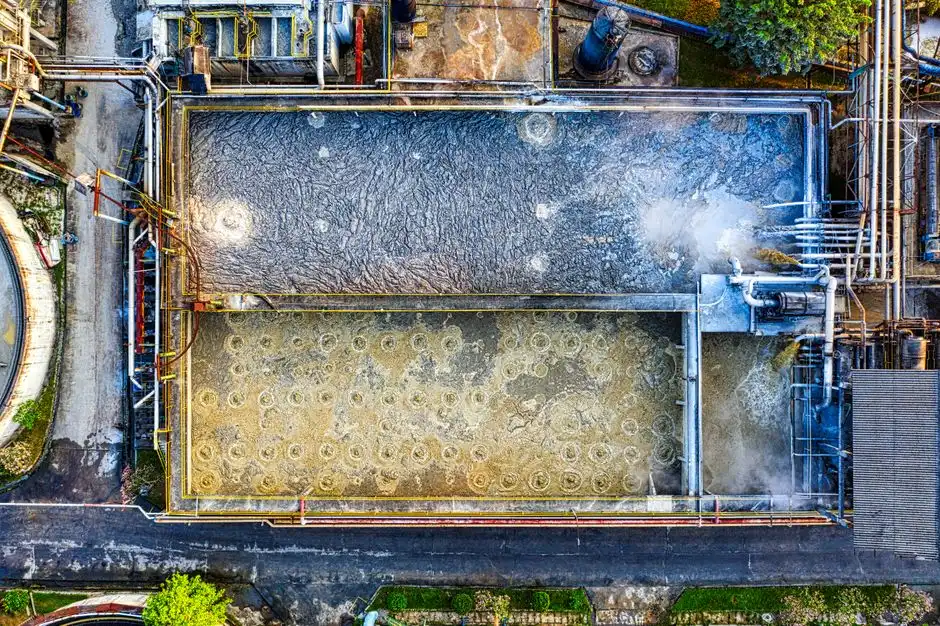
A defensible DAF design must satisfy both hydraulic and contaminant-loading criteria. The 2024 PT. X study cited the following design criteria: an air-solids ratio of 0.5, detention time of 20–30 minutes, gas solubility at 28°C of 16.3 ml/l, saturated gas fraction of 0.5, and air density of 1.2928 gr/l. The study reported an L-DAF volume of 7.81 m³ and a detention time of 31.24 minutes, which exceeded the cited detention-time range of 20–30 minutes.
That calculation illustrates why a model name is not a completed design. Average flow alone cannot establish the required flotation surface area, solids-loading rate, recycle rate, operating pressure, or chamber configuration. The supplier must show how the proposed unit handles the measured flow, suspended-solids load, oil and grease or FOG load, and expected peak demand.
Use each treatment stage’s own inflow. PT. X reported an average SFTP flow of 16.2 m³/h and an average ETP flow of 39.5 m³/h, based on April–September data reported in the 2024 study. The ETP therefore cannot be sized directly from the SFTP flow, and neither average value replaces a peak-flow check.
HydropureWater’s published DAF range is 4–300 m³/h. That range can be used as a preliminary compatibility screen, but it is not evidence that any model within it is correctly sized for a Bandung factory. Selection still requires wastewater analysis, peak-flow provision, contaminant loading, treatment objectives, and site constraints.
| Design input or operating basis | Purpose in DAF sizing | Evidence or input required |
|---|---|---|
| Average flow | Establishes the normal hydraulic basis | PT. X study: 16.2 m³/h at SFTP and 39.5 m³/h at ETP; factory-specific flow data for a new design |
| Peak flow | Tests equalization, recycle, and hydraulic capacity | Measured or production-based peak-flow data |
| TSS and suspended-solids loading | Determines solids-handling and flotation-area requirements | Representative sampling results and the supplier’s loading method |
| Oil and grease or FOG | Establishes floatable-solids demand and pretreatment needs | Representative stream-specific test results |
| BOD and COD | Shows whether biological treatment is required after flotation | Representative analysis, including biodegradability where relevant |
| pH | Defines chemical-conditioning and corrosion requirements | Operating range across production conditions |
| Recycle and saturation basis | Defines the air-release design | Design assumptions stated against the cited air-solids ratio, saturation, solubility, and density values |
| Sludge destination | Sets collection, conditioning, and dewatering requirements | Expected sludge characteristics, removal method, and disposal or reuse route |
Use the 2026 DAF engineering specs and selection framework to request the missing test, peak-flow, and loading information in a structured brief.
Build the Complete ETP Around Solids Separation and Sludge Handling
A treatment train must account for the solids it creates, not only the clarity of the final liquid. DAF forms a floated sludge bed that must be collected, conditioned, and routed to disposal or reuse. A lamella clarifier can provide a solids-separation option after suitable conditioning; HydropureWater publishes a surface-loading range of 20–40 m/h and states that its high-efficiency sedimentation tank can reduce chemical consumption by up to 30%. Those are published product claims, not Bandung field measurements, and the proposed surface loading must be checked against the wastewater and sludge characteristics.
An MBR configuration may be appropriate where biological treatment and membrane solids separation are both required. HydropureWater publishes an MBR capacity range of 10–2,000 m³/day and filtration below 1 μm. Again, these figures define a product envelope, not a completed factory design. MBR and lamella clarification should be compared against DAF because the contaminant profile, biological load, footprint, reuse target, and sludge properties—not the equipment category—determine the appropriate route.
Chemical dosing should be automatic where coagulant or pH control is required. In the PT. X case, the fiber-plant stream underwent coagulation before L-DAF, while DAF overflow received polyelectrolyte and caustic soda before flocculation and lamella clarification. The sequence demonstrates that DAF performance depends on the chemical and flocculation steps arranged around it.
The commercial scope should also include sludge removal and dewatering. The high-efficiency sedimentation tank and plate-frame filter press are relevant equipment options to evaluate when the selected separation process produces a dewaterable sludge stream. Their suitability still depends on sludge volume, rheology, conditioning chemistry, operating hours, and the final disposal route.
Check Bandung Compliance, Installation, and Supplier Risk Before Ordering
The applicable effluent limits must be confirmed from the factory’s current permit and the receiving authority. The supplied research does not provide a Bandung-specific numeric effluent limit, so a general industrial standard should not be substituted for permit confirmation.
Each supplier should state the flow basis, wastewater test results, design detention time, solids-loading method, recycle arrangement, materials of construction, and included ancillaries. The buyer should also verify physical fit, local power availability, sludge-removal access, installation method, operator training, spare parts, and maintenance access. A standard model is not an accepted design until these conditions are reconciled with the site.
The quotation should distinguish the DAF vessel from the complete treatment scope. Request explicit inclusion or exclusion of equalization, chemical dosing, air supply, controls, monitoring, sludge collection, commissioning, and performance testing. Where applicable, request automatic chemical dosing because the 2024 PT. X study used Fe₂SO₄ coagulation, polyelectrolyte, and caustic soda in its treatment sequence. The automatic chemical dosing system should therefore be evaluated as part of process control rather than as an optional accessory.
The PT. X study found that several installed units did not meet their stated design criteria and recommended dimensional changes, including to the L-DAF, flocculation, lamella-clarifier, aeration, and clarifier units. That 2024 finding is a procurement lesson: compare the proposed and installed geometry with the design basis rather than treating a model designation as proof of capacity.
| Procurement check | Document or evidence to request | Decision consequence |
|---|---|---|
| Compliance basis | Current permit, receiving-authority confirmation, and proposed compliance schedule | Reject an untraceable compliance claim |
| Design basis | Average and peak flow, wastewater analyses, loading method, detention-time calculation, and recycle arrangement | Confirm that the quotation addresses the actual wastewater |
| Installed scope | General arrangement, dimensions, utilities, foundations or supports, access routes, controls, and ancillaries | Identify installation and site-interface risk |
| Operation and maintenance | Training plan, maintenance schedule, spare-parts list, monitoring points, and troubleshooting procedure | Assess operability after handover |
| Performance | Commissioning protocol, acceptance tests, guarantees, and deficiency correction | Define how non-performance is resolved |
Make the Decision With a Supplier Brief
The correct output is a process proposal, not an isolated equipment price. Ask each supplier to state the selected treatment train, design flow, peak-flow provision, wastewater basis, treatment objectives, equipment schedule, utilities, controls, sludge-handling scope, and exclusions. Require a water and solids mass balance so that the claimed effluent, sludge, and chemical consumption can be checked against the proposed equipment.
The brief should also include a control narrative, maintenance plan, commissioning protocol, operator-training scope, and acceptance criteria. Where the wastewater can meet pretreatment, biological, and reuse objectives through different routes, ask for at least two technically credible configurations and state the basis for recommending one. This comparison is more useful than ranking vessels by nameplate flow alone.
Do not request a final price from flow alone. First establish the treatment basis, site data, guarantees, and scope boundaries. The same DAF engineering guide for wastewater testing, peak flow, solids loading, and equipment selection can serve as the reference for pre-quotation data collection.
The final selection should follow one auditable chain: measured wastewater characteristics and flow, contaminant-based process choice, hydraulic and loading checks, complete ETP integration, permit confirmation, and contractual acceptance criteria. If a supplier cannot demonstrate that chain, its capacity claim is not yet a defensible basis for ordering.
Frequently Asked Questions
Does a Bandung factory need DAF or a complete ETP?
Choose DAF-led treatment when the primary requirement is removing suspended solids, oil, grease, FOG, metals, or colloidal material before biological treatment. Choose a fuller ETP when equalization, biological degradation, and final clarification are also required. A combined train is appropriate when pretreatment is needed to protect downstream biological treatment.
What information is needed to size a DAF system?
Request representative wastewater analyses, average and peak flow, TSS, oil and grease or FOG, BOD, COD, pH, and sludge information, together with the proposed loading method and recycle basis. Average flow alone is insufficient because hydraulic capacity does not establish contaminant-loading performance.
What should a buyer check when selecting a treatment supplier?
Request the process basis, design calculations, equipment drawings, utility requirements, controls, ancillaries, materials of construction, commissioning protocol, performance guarantees, training, and maintenance scope. Check that each guarantee identifies the wastewater, flow, and acceptance conditions to which it applies.
How much does an industrial DAF or ETP system cost?
The supplied research does not provide a defensible quotation for a Bandung factory, so a price should not be inferred from flow alone. Request a priced bill of quantities after the wastewater basis, treatment objectives, flow range, selected process, site constraints, guarantees, and scope exclusions are established.
What compliance risk should be checked before ordering?
Confirm the required effluent parameters with the factory’s current permit and the receiving authority; the supplied research contains no Bandung-specific numeric effluent limit. Also verify that the proposed treatment train and acceptance tests address those confirmed requirements, including operating and maintenance conditions.