What treatment does a Gqeberha data center actually need?
A data center in Gqeberha generally needs a site-specific treatment train for cooling-tower blowdown, not a generic wastewater plant. The required configuration depends on the cooling design, cycles of concentration, water quality, reuse target and discharge route. For an evaporative system, treatment may need side-stream filtration, scale control, disinfection, conductivity and turbidity control, plus softening or reverse osmosis if blowdown will be reused as make-up water. Sanitary sewage, condensate, chiller purge and accidental dielectric-fluid leaks require separate assessment. No compliant plant or equipment capacity should be selected until these inputs and the discharge route are confirmed.
Open evaporative cooling creates the largest cooling-water discharge stream, whereas closed-loop cooling can cut water consumption by up to 70% compared with open evaporative cooling, at the cost of higher electricity demand and greater system complexity, according to HydropureWater’s 2026 engineering guide. The likely treatment boundary therefore includes cooling-tower blowdown, sanitary sewage, chiller purge, humidifier bleed, air-handling condensate and a separate dielectric-fluid spill contingency. A dielectric-fluid incident needs containment and a dedicated response procedure; direct liquid and immersion cooling make this the principal wastewater risk rather than ordinary cooling-water treatment.
The supplied research contains no verified Gqeberha-specific discharge limits, water tariff, make-up-water quality or sewer pretreatment rules. These are mandatory local verification items, not facts to infer. The engineering sequence is:
- Define the cooling architecture and operating strategy.
- Measure the data center water balance.
- Analyse the chemistry of each waste stream.
- Identify the reuse endpoint or authorised discharge route.
- Select, size and test the treatment train.
For comparable regional decision-making, the regional data center blowdown treatment guide and African data center wastewater treatment guide provide process context, but neither establishes Gqeberha requirements.
Map every water stream before selecting treatment equipment
Cooling-tower blowdown is the controlled purge used to keep cooling tower cycles of concentration within an operable range; it carries concentrated dissolved solids, suspended matter, residual treatment chemicals and heat. It should be mapped separately from smaller streams because combining sanitary sewage, condensate and occasional spill water can change the treatment duty and make the resulting reuse water unsuitable for its intended purpose.
Humidifier bleed, chiller purge, air-handling condensate and dielectric-fluid leakage are secondary streams. HydropureWater’s 2026 guide identifies a dielectric-fluid leak as a PFAS pathway; it should therefore be excluded from the normal blowdown system and connected to containment, isolation and a separate spill-response decision. Sanitary sewage is generally present but minor relative to cooling water in a water-cooled data center. It requires its own treatment assessment rather than automatic entry into the blowdown plant.
The process-flow diagram should show the cooling loop, blowdown withdrawal, sample points, equalisation, treatment skid, reuse destinations, sludge removal and authorised discharge route. Sample points should allow representative feed monitoring before treatment and verification after each polishing stage.
| Stream | Principal condition or risk | Engineering response |
|---|---|---|
| Cooling-tower blowdown | Concentrated salts, suspended matter, treatment chemicals and heat | Primary water-balance stream; treatment duty derives from chemistry and selected endpoint |
| Humidifier bleed | Concentrated cooling-water constituents | Confirm source, flow and compatibility with the blowdown train |
| Chiller purge | Cooling-loop chemistry and concentrated solids | Establish whether discharge, return or separate treatment is permitted |
| Air-handling condensate | Potentially low in dissolved solids but variable in quality | Test before directing to reuse; do not assume suitability |
| Sanitary sewage | Organic matter, nutrients and pathogens | Separate sanitary treatment assessment |
| Dielectric-fluid spill | PFAS pathway identified by HydropureWater’s 2026 guide | Dedicated containment, isolation and spill-response procedure |
Once streams are separated, the make-up source also needs a treatment review. A reclaimed or alternative source can add particulate, microbial, ammonia, phosphorus and dissolved-solids control requirements. HydropureWater’s 2026 guide describes depth filtration, granular activated carbon and chlorination for reclaimed municipal make-up, with UF plus RO as an alternative; either route must be tested against the actual source water and the cooling-loop operating envelope.
Use the water balance to estimate blowdown and compare cooling options

Cooling tower cycles of concentration, or CoC, is the ratio of dissolved-solids concentration in circulating water to the corresponding concentration in make-up water. Genesis Water Technologies states that blowdown at 4 CoC equals 25% of make-up-water volume, while the ratio at 6 CoC is 20%. The move from 4 to 6 CoC therefore reduces blowdown by 20% relative to the 4-CoC case, not by 50%.
Its illustrative scenario is a 10 MW evaporative-cooled facility at 4 CoC taking in 15 million gallons monthly; applying the 25% ratio gives 3.75 million gallons represented as blowdown. These values are an example from Genesis Water Technologies, not a Gqeberha design allowance. A local water balance must replace the scenario with measured or vendor-supported site data.
| Cooling option | Water-demand implication | Wastewater character | Decision issue |
|---|---|---|---|
| Open evaporative cooling | Consumes water through evaporation and drift and produces a continuous blowdown stream | Concentrated cooling-water chemistry and heat | Usually the largest direct treatment duty |
| Closed-loop cooling | Can reduce water consumption by up to 70% versus open evaporative cooling, according to HydropureWater’s 2026 guide | Smaller blowdown stream | Higher electricity use and system complexity must be evaluated |
| Direct liquid or immersion cooling | Shifts the principal water issue away from tower blowdown | Dielectric-fluid spill or leakage risk | Requires containment, spill response and a separate dielectric-fluid strategy |
Request ambient wet-bulb conditions, target PUE, evaporation rate, drift rate, target CoC, operating hours and seasonal variation. These inputs, together with measured make-up water, are needed to convert the water balance into treatment flow rates. Genesis Water Technologies also reports that actual blowdown can exceed theoretical calculations by 15–30% because of unmeasured losses and emergency dumps; therefore, the design flow should be tested against operating records rather than established from theory alone.
Compare options across water demand, wastewater character, energy use and treatment complexity, not water consumption alone. A closed-loop system can reduce water demand while increasing electricity demand. An open system can provide lower electricity use per kW of IT load but create the larger water-treatment and discharge burden. The correct architecture depends on the heat load, climate, utility conditions and local approval pathway, none of which can be finalised from IT load alone.
Match treatment to the water chemistry and reuse target
The test programme should determine pH, conductivity, total dissolved solids, hardness, alkalinity, silica, suspended solids, turbidity, temperature and the cooling chemicals in use. HydropureWater’s 2026 guide identifies concentrated calcium, magnesium, silica and alkalinity in blowdown, with possible anti-corrosion agents, anti-scaling agents, biocides, chlorine compounds and glycols in the programme. These constituents determine whether filtration alone is adequate, whether softening is required and whether membrane pretreatment can be sustained.
For a physical-separation solution followed by non-critical reuse, evaluate side-stream multi-media filtration and then targeted treatment for the contaminants that actually limit the destination. A multi-media pretreatment filter can protect downstream equipment, but the selected filter medium, loading and backwash requirements must follow the measured feed chemistry.
For cooling make-up reuse, evaluate softening or reverse osmosis with a multi-media filter upstream. Request the membrane vendor’s feed-SDI envelope rather than assuming a pretreatment value. The industrial RO purification option should be selected only after the vendor confirms membrane compatibility, scaling exposure, recovery assumptions and cleaning requirements for the actual blowdown.
IDE Tech reports that conventional brackish-water RO commonly plateaus at 75–80% recovery because silica, calcium carbonate and calcium sulfate constrain operation. It also reports an industrial high-recovery application operating at around 95% recovery with permeate silica of about 1 mg/L. That application demonstrates that high recovery is chemistry-specific; it does not establish 95% recovery as a default for Gqeberha blowdown.
| Intended endpoint | Indicative treatment sequence | Critical acceptance checks |
|---|---|---|
| Authorised discharge | Equalisation, filtration, targeted chemistry control, disinfection where required, temperature management and controlled discharge | Local discharge chemistry, residuals, temperature and route requirements |
| Non-potable reuse | Multi-media or side-stream filtration followed by treatment for contaminants limiting the reuse application | End-use quality, storage stability, biological risk and user requirements |
| Cooling-tower make-up reuse | Multi-media filtration, optional clarification or softening, optional RO, then disinfection as required | Membrane feed envelope, recovery, scaling, permeate quality and cooling-loop compatibility |
Disinfection options include chlorine dioxide or UV, selected against the approved chemical programme, water matrix and downstream requirements. HydropureWater’s 2026 guide identifies chlorine dioxide as the usual option and UV as an alternative where chlorinated by-products are a concern, but the supplied research establishes no universal dose. Residual chemicals, reaction by-products and local approval must be considered before either route is specified.
Build a treatment train that can be commissioned and maintained
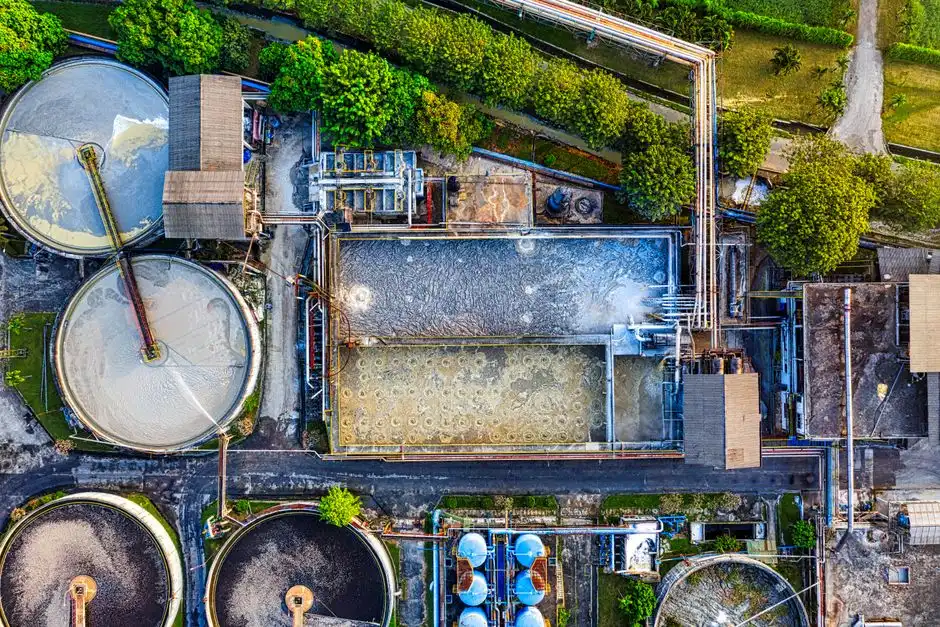
A practical treatment sequence is equalisation and sample point, multi-media or side-stream filtration, optional clarification or softening, optional reverse osmosis, disinfection where required, storage, and controlled reuse or discharge. The arrangement should also include bypasses that fail to a defined state, normally closed or open according to the risk assessment, rather than allowing untreated water to reach a reuse destination.
Solid-generation capacity belongs in the design. If softening, clarification or membrane pretreatment produces sludge, the liquid-output capacity alone is incomplete. HydropureWater’s 2026 guide requires on-site sludge dewatering and says sludge volume should be determined through jar tests on the actual blowdown. A UF system may be included where particulate or microbial control is required, but the filter-press option for sludge dewatering must be matched to the solids that jar or pilot testing actually produces.
Use a PLC-controlled chemical dosing skid for pH adjustment and any required coagulation, flocculation, antiscalant or specialist cooling chemical. Interlocks should prevent dosing into unsuitable conditions and coordinate treatment with the cooling-loop operating state. Vendor design inputs should include chemical concentrations, residual targets, dosing-control limits and the consequences of an empty chemical tank.
Disinfection should use chlorine dioxide or UV according to the approved chemistry and downstream requirements. The chlorine-dioxide treatment option and UV disinfection option require site-specific control, containment and maintenance provisions; the research does not establish a universal dose.
Specify flow, conductivity, pressure, turbidity, temperature and critical chemistry monitoring. The documentation package should include P&ID drawings, cause-and-effect logic, calibration, operator training, preventive maintenance, membrane-cleaning criteria, membrane replacement, sludge handling and spare parts. A system that cannot be sampled, cleaned or operated by the site team is not commissioned merely because its outlet meets a laboratory result.
Compare discharge control with closed-loop reuse
The preferred pathway depends on the legally available discharge route, the cost of make-up water, cooling-water demand and the quality required by the reuse destination. Equipment cost alone is not a sufficient comparison: avoided freshwater, wastewater charges, chemicals, energy, labour, membrane replacement and residual disposal determine the operating position.
| Option | Capital cost | Operating cost | Recovered water value | Discharge and energy effect | Operator and residual burden |
|---|---|---|---|---|---|
| Controlled discharge | Lower if treatment requirements remain limited | Chemicals, energy, labour and sewer or disposal charges | No recovered-water value | Maintains the discharge flow; cooling energy unchanged | Permit and pretreatment compliance; chemical and thermal residuals remain relevant |
| Filtration plus non-potable reuse | Moderate; depends on contaminant removal and storage | Filtration, chemicals, energy, labour and cartridge or media replacement | Displaces water used for toilet flushing or equipment washing | Reduces part of the discharge and freshwater demand | Requires monitoring for the receiving use |
| Softening or RO for make-up reuse | Higher because of pretreatment, membranes, controls and storage | Energy, chemicals, membrane replacement and skilled operation | Displaces cooling-tower make-up water | Can reduce blowdown while increasing treatment energy | Concentrate and pretreatment sludge require a route |
| Cooling-architecture change | Potentially substantial because it changes the thermal system | Higher electricity demand may accompany lower water consumption | Avoided make-up and discharge depend on the revised balance | Closed-loop can cut water consumption by up to 70% versus open evaporative cooling, according to HydropureWater’s 2026 guide | Complexity shifts from water treatment toward thermal-system operation |
Genesis Water Technologies observes that hyperscale treatment combinations can be disproportionately complex and expensive at smaller facilities because dedicated operators, capital expenditure and economies of scale may not apply. It identifies a modular 100–300 GPM blowdown-treatment system as a potential starting point for enterprise and colocation facilities, but that range is not a Gqeberha sizing result. The final duty must come from the local water balance, operating profile and confirmed reuse flow.
The conditional recommendation is filtration plus non-critical reuse if the site has a defined demand for toilet flushing or equipment washing and the chemistry can be treated reliably. Make-up reuse through softening or RO should proceed only when the water balance, pilot data and lifecycle comparison support the added energy, membrane and residual-handling burden. Controlled discharge is a fallback only if the local route and treatment requirements are confirmed. A cooling-architecture change is not a treatment-train option, but it should remain in the early design comparison because it can remove the largest discharge stream rather than treating it.
Plan approvals, procurement and performance testing
Compliance cannot be resolved from generic international guidance. Confirm the Gqeberha water source, sewer or receiving-water route, client environmental requirements, thermal-discharge controls and any proof-of-treatment requirements with the relevant authorities and environmental consultants. The supplied research provides no verified Gqeberha-specific limits, and U.S. permit provisions cited in the 2026 guide should not be imported as South African law.
Obtain representative samples through a defined campaign covering normal operation and relevant seasonal or chemistry variations. Jar or pilot testing should precede final selection of filtration, clarification, softening or membrane technology. The tests must establish solids production, scaling tendency, membrane compatibility, recovery, chemical demand and the quality achievable for the intended reuse.
| Procurement stage | Buyer-required evidence | Acceptance or contractual outcome |
|---|---|---|
| Design basis | Water balance, representative chemistry, reuse flow, discharge route and local requirements | Confirmed equipment duty and treatment objective |
| Supplier selection | Chemistry-specific design, recovery assumptions, controls, guarantees and support | Process guarantees linked to the agreed feed and operating envelope |
| Manufacturing and integration | Approved drawings, utility requirements, control narrative, residual plan and schedule | Inspection and factory or site testing as applicable |
| Commissioning | Installed flow, pressure, analytical results, controls response and safety checks | Demonstrated flow, recovery and target-water quality |
| Handover | Training, maintenance intervals, calibration, spares, membrane replacement and sludge route | Complete operating and maintenance records |
HydropureWater’s 2026 guide gives a lead-time benchmark of 20–34 weeks for a standard modular blowdown-treatment skid. Use that as a planning reference, not a guaranteed Gqeberha date: local fabrication, approvals, integration and validation can affect the schedule. Performance guarantees should state the agreed feed chemistry, flow, recovery, target-water quality and operating envelope rather than promise generic “treated water.”
The bid list should also cover consumables and service parts, including RO and UF replacement elements and treatment valves and media. Before award, confirm delivery dates, local support, operator training, maintenance response, membrane warranties, sludge handling, calibration and performance validation. A locally verifiable treatment train is preferable to an imported configuration whose chemistry, controls or approval assumptions have not been tested.
Frequently Asked Questions
How should treatment capacity be sized for a Gqeberha data center?
Size the plant from the measured make-up-water flow, evaporation, drift, selected cooling tower cycles of concentration, operating hours and required reuse flow, not from IT load alone. Confirm the result against operating records because Genesis Water Technologies reports actual blowdown can exceed theoretical calculations by 15–30% through unmeasured losses and emergency dumps. Include instantaneous, average and emergency dump conditions in the design.
What does wastewater and cooling blowdown treatment cost?
Request a total-cost-of-water comparison, not only an equipment quotation. The operating comparison should include avoided make-up-water purchases, wastewater charges, chemicals, energy, labour, membrane replacement, media replacement and sludge disposal. The supplied research contains no verified Gqeberha tariff, wastewater charge or equipment price, so request the local utility and disposal inputs before accepting a payback or lifecycle-cost claim.
How should a treatment supplier be selected?
Require chemistry-specific design data, stated recovery assumptions, output guarantees, control narratives, operator training and maintenance support. Ask the supplier to identify the applicable feed-water envelope, residual-stream route, membrane-cleaning requirements and commissioning tests. The 20–34 week modular-skid lead-time benchmark disclosed by HydropureWater’s 2026 guide should be included in the programme review, with delivery and local-service commitments stated contractually.
What wastewater discharge compliance must be confirmed in Gqeberha?
No Gqeberha-specific chemical, temperature or flow limit can be inferred from the supplied material. The project must establish the discharge destination and obtain the applicable local authority or environmental-consultant requirements for chemistry, suspended solids, temperature, cooling chemicals, disinfection residuals and proof of treatment. Those confirmed limits should then be written into the equipment guarantee and acceptance test.