The Federal Floor That Governs Every Fresno Sewer Discharge
Chemical plants in the Fresno area that discharge to a publicly owned treatment works (POTW) are bound first by the federal pretreatment program at 40 CFR Part 403, regardless of what the local control authority has or has not codified. Under 40 CFR 403.3(j), pretreatment standards are pollutant discharge limits that apply to Industrial Users (IUs) of a POTW, and pretreatment requirements are substantive or procedural requirements applied to those IUs (EPA, 40 CFR 403 — General and Specific Prohibitions).
The general prohibitions at 40 CFR 403.5(a) forbid any discharge of pollutants that cause pass through or interference, and the eight specific prohibitions at 40 CFR 403.5(b) translate that broad language into enforceable numeric and qualitative floors, including pH not lower than 5.0, flashpoint not lower than 140°F (60°C), and a temperature cap of 40°C (104°F) at the POTW treatment plant unless alternate limits are approved (EPA, 40 CFR 403.5).
These rules apply to every nondomestic discharger that sends wastewater to a POTW and apply whether or not the POTW has an approved pretreatment program and whether or not the discharger has been issued a control mechanism or permit (EPA). 40 CFR 403.5 is therefore the universal backstop, and any Categorical Standard under 40 CFR Parts 414, 415, 417, 419, 422, 423, 447, and 468 that applies to the plant's SIC code is a stricter overlay on top of that backstop, not a substitute for it. The engineer should treat the federal minimum as the floor every process has to clear first.
Pass-Through, Interference, and the Eight Specific Prohibitions
Two definitional tests drive nearly every federal enforcement action a Fresno chemical plant will see: pass through and interference. Pass through, defined at 40 CFR 403.3(p), is a discharge that exits the POTW into waters of the United States in quantities or concentrations that, alone or in conjunction with discharges from other sources, is a cause of a violation of any requirement of the POTW's NPDES permit, including an increase in the magnitude or duration of a violation (EPA, 40 CFR 403.3). Interference, defined at 40 CFR 403.3(k), is a discharge that both inhibits or disrupts the POTW, its treatment processes, its sludge processes, use, or disposal, and therefore is a cause of a violation of the POTW's NPDES permit or of the prevention of sewage sludge use or disposal in compliance with Section 405 of the Clean Water Act, RCRA, the Clean Air Act, the Toxic Substances Control Act, or the Marine Protection, Research and Sanctuaries Act (EPA).
On top of those two umbrella tests, 40 CFR 403.5(b) lists eight specific prohibitions that were issued to "enhance control of hazardous wastes entering POTWs" (55 FR 30082, as quoted by EPA). The numeric thresholds attached to these prohibitions are the values a Fresno plant gets cited on most often, and they are summarized in the table below.
| Prohibition | Regulatory Citation (40 CFR 403.5(b)) | Hard Numeric Limit Where Specified |
|---|---|---|
| (1) Fire or explosion hazard | Closed-cup flashpoint test methods in 40 CFR 261.21 | Flashpoint < 140°F (60°C) prohibited |
| (2) Corrosive structural damage | — | pH < 5.0 prohibited unless POTW designed for it |
| (3) Solid or viscous pollutants | Obstruction-causing amounts | No numeric floor; qualitative |
| (4) Oxygen-demanding pollutants (BOD, etc.) | Flow rate/concentration causing interference | No numeric floor; tied to interference test |
| (5) Heat | Temperature at the POTW treatment plant | > 40°C (104°F) prohibited without alternate approval |
| (6) Petroleum oil, nonbiodegradable cutting oil, mineral oil | Amounts causing interference or pass through | No numeric floor; tied to interference/pass through |
| (7) Toxic gases, vapors, or fumes | Acute worker health and safety | No numeric floor; qualitative |
| (8) Trucked or hauled pollutants | Discharge only at POTW-designated points | No numeric floor; location-based |
Of these, prohibitions (1), (2), and (5) are the only ones with hard numeric floors that do not depend on a downstream pass-through or interference finding. Prohibitions (3), (4), (6), (7), and (8) are enforceable whenever the discharge meets the qualitative condition, regardless of whether the POTW has measured an actual upset (EPA, 40 CFR 403.5).
From Rule to Unit Process: Building the Pretreatment Equipment Train

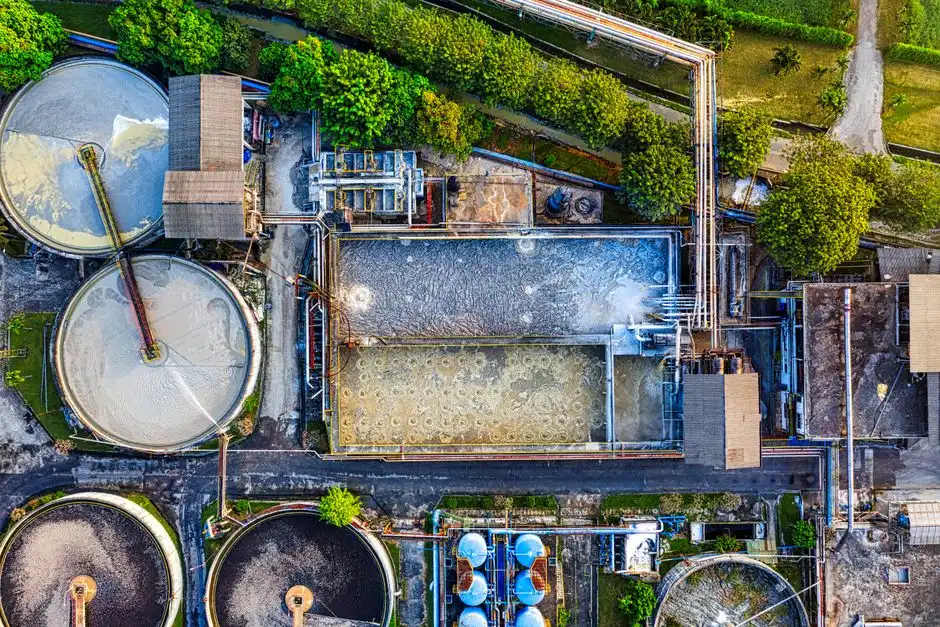
Each prohibition in 40 CFR 403.5(b) maps to a unit process the engineer can put on a P&ID. Treating the rule as an abstract citation leaves a Fresno chemical plant exposed; treating each prohibition as a design driver is what turns compliance into something the operations team can verify on the floor.
Prohibitions (1) on flashpoint below 140°F (60°C) and (2) on pH below 5.0 are the design drivers for an equalization basin plus acid/caustic dosing, typically automated with a PLC-controlled chemical dosing skid for pH correction that runs continuous online monitoring rather than grab sampling. Prohibition (5) caps the temperature at the POTW treatment plant at 40°C (104°F) without alternate approval, which drives a quench or cool-down step before discharge instead of relying on dilution in the sewer (EPA, 40 CFR 403.5(b)(5)).
Prohibition (3) on obstruction-causing solids maps to headworks protection, typically a rotary mechanical bar screen for headworks that removes rags, plastics, and fibrous debris before they damage downstream pumps, valves, and biological treatment. Prohibition (6) on petroleum oil, nonbiodegradable cutting oil, and mineral oil products maps to oil and grease removal, typically a DAF unit for petroleum and cutting oil removal sized for the specific oils present on site rather than for generic food-industry loads. Prohibition (4) on BOD and other oxygen-demanding pollutants that cause interference drives a biological step — typically an MBR or activated sludge system — sized to the plant's specific loading.
Metals and toxics tied to sludge and biosolids quality, the second leg of the interference test at 40 CFR 403.3(k), drive pH-controlled coagulation and flocculation followed by sedimentation or filtration to drop suspended solids and precipitate metals before the biological step. The chain is not complete without sludge handling, and prohibition (8) on trucked or hauled pollutants makes a plate and frame filter press for sludge dewatering a near-universal requirement: dewatering reduces hauled volume, clarifies the chain of custody, and confines sludge discharges to POTW-designated points.
Step-by-Step: How a Fresno Plant Sequences the Train
The defensible sequence for a Fresno chemical plant pretreatment train maps each step back to a specific prohibition in 40 CFR 403.5(b) so an auditor can walk the P&ID and the rule side by side. The residence times, chemical doses, and removal efficiencies behind each step are site-specific and must be confirmed with the control authority and a qualified vendor before final sizing; the research does not supply them, and they should not be assumed from generic industrial-wastewater references.
- Influent screening. A rotary mechanical bar screen for headworks removes rags, plastics, and fibrous debris that would otherwise violate prohibition (3) and damage downstream equipment.
- Equalization and pH adjustment. A flow-equalization basin with a PLC-controlled chemical dosing skid for pH correction drives pH away from the prohibition (2) floor of 5.0 and damps slug loads before they propagate through the train.
- Oil and grease removal. A DAF unit for petroleum and cutting oil removal targets prohibition (6) on petroleum oil, nonbiodegradable cutting oil, and mineral oil products that would cause interference or pass through.
- Coagulation, flocculation, and sedimentation. Chemical dosing plus a lamella clarifier for metals and TSS reduction precipitates metals and drives down suspended solids before biological treatment.
- Biological polishing. An MBR system for biological polishing reduces the oxygen-demanding load addressed by prohibition (4) and stabilizes the wastewater for discharge.
- Sludge dewatering. A plate and frame filter press for sludge dewatering produces a handleable cake so that any sludge sent off-site satisfies prohibition (8) on trucked or hauled pollutants.
Engineers who want a deeper dive on the chemistry behind step 2 can review a chemical dosing system working principle reference, and on the biology behind step 5 a tertiary ammonia removal guide covers the polishing logic. For plants operating outside California, the same train structure carries over; a parallel Logan chemical plant pretreatment guide and Austin pharma plant pretreatment guide show how the same prohibitions apply across jurisdictions.
The Local Layer: What the Fresno POTW Can Add on Top
40 CFR 403.5 is the floor, not the ceiling. The federal framework expressly allows the local control authority to set site-specific limits stricter than the 40 CFR 403.5(b) prohibitions, and a Fresno chemical plant has to design to those stricter local limits because they are the binding numbers for compliance, surcharge calculations, and equipment sizing (EPA, 40 CFR 403 framework).
The City of Fresno's sewer and wastewater programs and permits page is the public entry point for the local pretreatment program at fresno.gov/publicutilities/sewer-wastewater/programs-permits/, but the public URL returned a 400 Bad Request when scraped for this article, so the engineer should request the current local program document directly from the City rather than relying on the cached version. Fresno Municipal Code Article 3 (Sewage and Water Disposal), Section 6-310, is hosted on the Municode codification at library.municode.com, and the engineer should pull the current codification to confirm local discharge limits, surcharges, and reporting cadences; the public scrape of that page also returned no body content, which is why the current numeric local limits cannot be quoted here.
Two additional federal overlays can tighten the design further. First, Significant Industrial User (SIU) status, plus sampling and reporting under 40 CFR 403.12, must be confirmed with the control authority, because those obligations govern the monitoring and self-reporting footprint the engineer has to design around from day one (EPA, 40 CFR 403.12). Second, Categorical Standards under 40 CFR Parts 414, 415, 417, 419, 422, 423, 447, and 468 may impose subpart-specific numeric limits that are stricter than 40 CFR 403.5(b); the applicable subpart depends on the plant's SIC code and the chemistries actually produced, and the engineer must identify it with the control authority before finalizing the equipment train.
Equipment Specification Checklist Before You Buy
The procurement lead and the process engineer should lock down the following items in writing before any equipment order is released, because each one is what separates a defensible 40 CFR 403.5(b) design from a notice of violation.
- Confirm the applicable Categorical subpart and any local limits with the Fresno control authority in writing before sizing equalization, DAF, and biological units. The federal floor is not enough on its own.
- Specify pH adjustment with continuous online monitoring, not grab sampling, because prohibition (2) sets a hard floor at pH 5.0 with no lower excursion allowed (EPA, 40 CFR 403.5(b)(2)).
- Require confirmation that the oil-removal step handles the specific oils used on site — petroleum, nonbiodegradable cutting oil, and mineral oil products per prohibition (6) — rather than relying on generic food-industry removal rates.
- Require that any hauled sludge or trucked waste stream be discharged only at POTW-designated points per prohibition (8); a plate and frame filter press reduces hauled volume and clarifies the chain of custody (EPA, 40 CFR 403.5(b)(8)).
- Plan for 40 CFR 403.12 sampling, reporting, and recordkeeping from day one so the monitoring footprint is built into the plant, not retrofitted after a notice of violation.
The supplied research does not provide Fresno-specific numeric local limits, residence times, chemical doses, or removal efficiencies, so the checklist deliberately points the engineer back to the control authority and qualified vendors rather than supplying remembered values that would not survive an inspector's review.
Frequently Asked Questions
What federal rule controls chemical plant discharges to a sewer in Fresno?
40 CFR Part 403, including the general prohibitions at 40 CFR 403.5(a) on pass through and interference, and the eight specific prohibitions at 40 CFR 403.5(b) covering flashpoint, pH, solids, oxygen demand, heat, oils, toxics, and hauled wastes. These apply to every nondomestic discharger that sends wastewater to a POTW, whether or not the local POTW has an approved pretreatment program and whether or not the discharger has been issued a control mechanism or permit (EPA, 40 CFR 403.5).
What are the hard numeric limits a Fresno chemical plant has to meet before discharge?
The federal floor is pH not lower than 5.0, flashpoint not lower than 140°F (60°C) by the test methods in 40 CFR 261.21, and temperature at the POTW treatment plant not above 40°C (104°F) without alternate approval, plus the pass-through test at 40 CFR 403.3(p) and the interference test at 40 CFR 403.3(k) (EPA). Local limits can be stricter and must be confirmed with the Fresno control authority.
How much does a compliant pretreatment equipment train cost for a Fresno chemical plant in 2026?
The supplied research does not contain a cost figure for Fresno chemical plant pretreatment trains, and no defensible price range can be quoted here without knowing the applicable Categorical subpart, the local limits, the plant's flow and load, and the chemistries actually produced. The engineer should request a site-specific budget from qualified vendors after those inputs are confirmed with the control authority.
How do I pick a pretreatment equipment supplier for a Fresno chemical plant?
Verify that the supplier has direct experience with 40 CFR 403.5(b) compliance, can deliver a unit process for each prohibition (screening, pH correction, oil removal, biological treatment, sludge dewatering), and can deliver a packaged control narrative that maps each unit to a specific prohibition and to the local control authority's reporting requirements under 40 CFR 403.12. Ask for at least one reference installation that has cleared a 40 CFR 403.12 compliance audit, not just a design-build reference.