

Why Phnom Penh factories need their own ETP in 2026
Phnom Penh's municipal wastewater path ends in natural treatment wetlands, not engineered industrial plants. The city's 1.5 million population (2009) is served by a combined sewer system that pumps flow to naturally occurring wetlands before discharge to the Mekong River system, with Boeng Cheung Ek acting as the largest of these treatment wetlands (Computational Hydraulics International, 2025-08 PCSWMM study). This system was sized for sanitary flow, not factory effluent.
Two pressures now collide: industrial growth in segments like bubble tea and beverage processing — Cambodians have an intense, growing market for bubble tea brands such as Tiger Sugar, Xing Fu Tang, KOI, and Gong Cha, per a 2024 ACLEDA University study — generates high-FOG wastewater that does not match municipal characterization, and parts of Boeng Cheung Ek are being filled in for development, with Boeng Kak in the north already being filled in entirely (Computational Hydraulics International, 2025-08). Molyvann's earlier observation that Phnom Penh's pumping stations were neither numerous enough nor powerful enough remains structurally relevant. The combined-sewer pumping capacity and the wetland receiving capacity were both designed for a smaller, pre-industrial Phnom Penh, so a factory discharging raw effluent into this network risks surcharge, non-compliance, and harm to the receiving wetland. A purpose-built industrial ETP sized to the factory's own flow and load is the only defensible path for a 2026 facility.
What an industrial ETP actually does: the three-stage architecture
An effluent treatment plant is a sequence of three treatment levels, each removing a different class of contaminant. Per a Quora-summarized engineering answer (Quora / OpenBlueprint, 2025-07) the architecture is well-defined: primary treatment combines physical settling of settleable particles like suspended solids with chemical treatment for pH control and flocculation; secondary treatment uses biological processes under aerobic or anaerobic conditions to consume dissolved organic load; and tertiary treatment applies chlorine and alum to remove remaining inorganic compounds and pathogens before release. The DAF unit sits inside primary treatment as a high-rate clarifier that replaces or augments gravity settling. A dissolved air flotation unit in this role injects chemical coagulants to destabilize emulsions and then lifts the resulting oil-coated solids out of the water column, acting as the protective barrier between raw physical separation and the delicate biological polishing stage (Quora / OpenBlueprint, 2025-07). For a Phnom Penh factory, all three stages are typically packaged as a modular system because site civil works are constrained by plot size, and skilled operator availability is limited relative to mature industrial markets. A dissolved air flotation unit engineered for industrial wastewater is normally the first major equipment package a buyer evaluates because it sets the hydraulic envelope for everything downstream. For a deeper mechanism walk-through with calculation examples, see the engineering deep-dive linked in the paragraph above.
Why DAF is the preferred primary clarifier for Cambodian factories
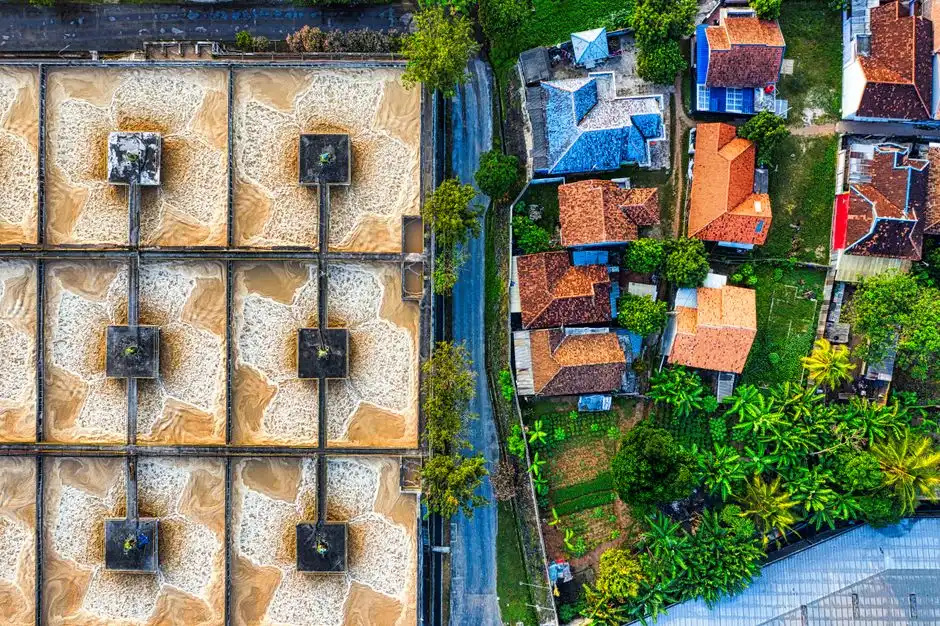
The DAF mechanism translates directly into factory-floor benefits that match Cambodian conditions. The system takes a portion of clarified effluent, pressurizes and saturates it with air in a dedicated drum, then returns this supersaturated liquid to the flotation tank; the pressure drop at atmospheric conditions creates millions of microscopic bubbles, usually 10–100 microns in diameter, that attach to suspended solids and oil droplets and float them to a surface skimmer (Quora / OpenBlueprint, 2025-07). Four operational benefits follow for a Phnom Penh plant. DAF systems are designed with a compact footprint, making them ideal for facilities with limited space and allowing installation in existing treatment plants or smaller facilities without requiring significant structural modifications (alantech.in, 2025). DAF tolerates fluctuations in influent flow rates and contaminant concentrations without sacrificing performance, which matters in monsoon-driven tropical hydraulics. DAF systems typically require lower chemical usage compared to other treatment methods, particularly in terms of coagulants and flocculants, reducing operating cost and chemical import logistics (alantech.in, 2025). DAF's ability to lift emulsified FOG protects downstream biological reactors from suffocation — critical for food and beverage plants producing dairy, sugar, or frying waste. The combination of a Dissolved Air Flotation (DAF) system as primary clarifier plus a packaged secondary/tertiary train is the configuration most often specified for Southeast Asian light-industry sites. Engineers comparing alternative equipment should review the best DAF unit engineering decision framework to validate that the chosen model matches their influent envelope.
DAF vs sedimentation: 2026 decision framework for a Phnom Penh factory
The choice between DAF and a lamella plate clarifier is an influent-driven engineering decision. The decision logic below is what an experienced process engineer applies when sizing a primary clarifier for a tropical light-industry site.
| Decision factor | Use DAF | Use lamella sedimentation |
|---|---|---|
| Emulsified FOG / fine colloids in influent | Yes — bubble attachment is more effective on emulsified oils, fats/grease, and fine colloids than quiescent settling (Quora / OpenBlueprint, 2025-07) | No — only effective on settleable, free-floating phases |
| Site footprint | Yes — compact footprint avoids the large basin footprint of conventional clarifiers (alantech.in, 2025) | Requires generous civil footprint for plate packs and sludge hoppers |
| Influent variability (monsoon / batch) | Yes — DAF tolerates fluctuations in flow and load without loss of performance (alantech.in, 2025) | No — performance drops when hydraulic loading shifts rapidly |
| Chemical budget | Higher polymer/coagulant use, but lower total reagent per kg removed (alantech.in, 2025) | Lower polymer demand, but limited FOG removal forces upstream grease traps |
| Sludge handling downstream | Float scum → thickener → dewatering (e.g., plate and frame filter press) | Settled sludge → thickener → dewatering |
For most food & beverage, garment wash-water, and light-manufacturing ETPs in Phnom Penh, the influent carries enough emulsified FOG or fine solids to make DAF the safer technical default. Lamella becomes appropriate only when the wastewater is low in FOG and colloids, the factory already has a generous civil footprint, and the chemical budget is constrained. The total installed cost should be reviewed against DAF using a structured cost-comparison such as the DAF vs sedimentation 2025 engineering comparison and the DAF vs sedimentation cost difference breakdown. For a Phnom Penh buyer who wants both, the comparison and ROI frameworks linked in this section show the installed-cost and operating-cost math side by side.
Sizing the DAF: inputs a Phnom Penh factory must gather before ordering

Accurate sizing starts with a specific set of factory-side measurements, not a catalog curve. A buyer who collects the parameters below can request binding quotes and reject guess-priced proposals. The data the supplier needs before they can size a DAF properly is summarized in the table that follows.
| Input parameter | Why the supplier needs it | Phnom Penh–specific note |
|---|---|---|
| Peak and average hourly wastewater flow (m³/h) | Sets hydraulic loading and DAF tank cross-section | Capture wet-season peaks, since Phnom Penh's rainy-season hydraulics influence downstream flow at Boeng Cheung Ek and the pumping network (Computational Hydraulics International, 2025-08) |
| Influent TSS, FOG, BOD/COD, pH | Determines air-to-solids ratio, recycle rate, and polymer demand on the DAF | Beverage and food sites should measure FOG by grab sample across a production shift, not just end-of-day |
| Available plot area and headroom | DAF units are selected for footprint, not just flow (alantech.in, 2025) | Tropical monsoon drainage and roof clearance may constrain tank height |
| Discharge destination and target limits | Determines whether tertiary treatment (chlorine, UV, ozone) is required downstream of biology (Quora / OpenBlueprint, 2025-07) | Surface-water or on-site reuse targets typically force tertiary polishing; sewer-only discharge may relax this |
For a Phnom Penh buyer who has not yet characterized their wastewater, request at least one week of composite sampling covering both a normal production day and a cleaning-in-place cycle. The food-processing food-processing DAF engineering specs and selection guide lays out a parameter-by-parameter path for this exercise, while the dissolved air flotation system cost and pricing guide is the right reference when converting those inputs into a budgetary envelope. No quotation should be requested until the parameter list above is complete.
2026 supplier selection checklist for Cambodia-bound ETP and DAF systems
Phnom Penh logistics change the supplier shortlist relative to mature markets. Four checks should clear before signing a purchase order. First, verify the supplier can ship a containerized or skid-mounted DAF unit that fits Phnom Penh port logistics and limited on-site heavy-lift capacity — oversized skids that worked in a domestic yard may be uneconomic to handle at a Cambodian site. Second, confirm whether the supplier provides remote commissioning support, because Phnom Penh-based factory staff may have limited prior experience running DAF units and cannot rely on a regional field service team for the first start-up. Third, request documented case studies in tropical-climate industrial applications, since ambient temperature and humidity affect biological-stage oxygen demand and DAF air-saturation efficiency; a unit sized for a temperate climate may underperform without correction. Fourth, verify the supplier can supply spare parts and consumables — polymer dosing pumps, skimmer wear parts, membranes for any downstream MBR membrane bioreactor system — within an acceptable lead time, because import lead times into Cambodia are a real operating risk. The DAF supplier shortlist itself is best filtered using the best DAF unit engineering decision framework, and chemical dosing accuracy should be cross-checked with a PLC-controlled chemical dosing system so that polymer and pH adjustments are reproducible once the plant is running.
Frequently Asked Questions
What budget should a Phnom Penh factory plan for an industrial ETP with DAF in 2026?
The 2025 pricing references for industrial DAF units are catalog-driven and depend on flow, materials of construction, and the level of tertiary polishing. A factory buyer should not request a fixed price without first delivering the four sizing inputs listed earlier (flow, TSS/FOG/BOD/COD, footprint, discharge destination), then asking each shortlisted supplier for a budgetary quotation against the same specification. This converts a vague question into a like-for-like comparison.
How do I select the right DAF and ETP supplier for a Phnom Penh factory in 2026?
Filter suppliers on four practical items: containerized or skid-mounted equipment that matches port and on-site lifting limits, remote commissioning capability, documented tropical-climate references, and a verified spare-parts lead time into Cambodia. A supplier who passes all four is a credible shortlist candidate; a supplier who cannot answer any one of them is a risk to flag in the technical evaluation.