
Why 40 CFR Part 430 Governs a Lake Mary Pulp & Paper Pretreatment Program
A pulp, paperboard, tissue, or non-integrated mill near Lake Mary, Florida, that discharges to a sanitary sewer is regulated as an indirect discharger under 40 CFR Part 430, the U.S. EPA Pulp, Paper and Paperboard Effluent Guidelines. The EPA first promulgated the rule in 1974 and 1977, amended it in 1982 and 1986, and issued a major amendment covering toxic pollutants in 1998 (EPA, "Pulp, Paper and Paperboard Effluent Guidelines"). For a Lake Mary facility, that history matters: the 1998 "cluster rules" revision allows local pretreatment coordinators to enforce toxic-pollutant parameters on an indirect discharger, even though the rule has not been re-promulgated since.
Part 430 applies to direct dischargers through NPDES permits and to indirect dischargers through POTW pretreatment programs (EPA, "Pulp, Paper and Paperboard Effluent Guidelines"). A mill that pipes its effluent to a publicly owned treatment works does not escape the categorical rule; the local pretreatment coordinator applies it. The first engineering task is not equipment selection but subcategory identification, because the regulated pollutants vary by subcategory (EPA, "Pulp, Paper and Paperboard Effluent Guidelines").
The subcategories most plausibly assigned to a Central Florida indirect mill are Unbleached Kraft; Semi-Chemical; Groundwood, Chemi-Mechanical, and Thermo-Mechanical; Deink; Wastepaper (non-corrugating medium, corrugating medium, tissue without deinking, molded products, and builders' paper/roofing felt); Fine and Lightweight Papers from Purchased Pulp; and Tissue, Filter, Non-woven, and Paperboard from Purchased Pulp (EPA, "Pulp, Paper and Paperboard Effluent Guidelines"). Tissue, paperboard, and non-integrated operations are over-represented in Florida because the regional furnish base favors recycled fiber and purchased market pulp over integrated pulping. Confirm the assigned subcategory in writing with the local POTW before sizing any unit operation.
The Pollutants a Lake Mary Mill Must Actually Pretreat
Pulp and paper mill effluents carry a characteristic mix of organic matter, suspended solids, chlorinated by-products, color, and residual toxicity. The major classes — BOD, COD, TSS, AOX, color, and toxicity — are the parameters the local POTW will translate into numeric discharge limits inside a categorical pretreatment determination (Hubbe et al., "Wastewater treatment and reclamation: a review of pulp and paper industry practices and opportunities," BioResources).
The BOD/COD ratio indicates biodegradability: it represents the fraction of organics that are easy to degrade (Hubbe et al., BioResources). Mills with a high share of poorly biodegradable organics must push harder on polishing, because conventional activated sludge leaves that fraction largely untouched. Chemical pulping has been reported to generate more than 40% poorly biodegradable organics within the total effluent organic matter (Dahlman et al. 1995, cited in Hubbe et al., BioResources), which is a direct warning sign for any kraft or sulfite operation that selects biological treatment as the sole polishing step.
AOX, or adsorbable organic halides, is generally proportional to chlorine consumption in bleaching (Savant et al. 2006, cited in Hubbe et al., BioResources), and industry-wide AOX emissions have been reduced by over 80% since 1990 (Friere et al. 2003, cited in Hubbe et al., BioResources). Mills that have executed elemental chlorine free (ECF) or totally chlorine free (TCF) bleaching will have lower AOX loadings, but residual AOX remains on the typical indirect-discharge pollutant list. Color and acute/chronic toxicity are the parameters most likely to push a mill beyond conventional activated sludge and toward advanced oxidation, membrane filtration, or enhanced dissolved air flotation polishing (Hubbe et al., BioResources).
Source control and reuse are upstream of any discharge decision. Mills can use up to 70 m³ of water per metric ton of paper, with about 70% of intake dedicated to process water, depending on raw material, product, and the extent of water reuse (Rintala and Puhakka 1994; Latorre et al. 2007, cited in Hubbe et al., BioResources). The industry has cut water consumption by nearly half over 20 years and by 95% per tonne of paper over 30 years (Blanco et al. 2004, cited in Hubbe et al., BioResources). Any 2026 design that ignores the reuse and source-control layer misses an opportunity for cost-effective pollutant reduction.
| Pollutant | What it measures | Why it matters for a Lake Mary indirect discharger |
|---|---|---|
| BOD | Biodegradable organics | Drives oxygen demand at the POTW; primary target of biological treatment |
| COD | Total oxidizable organics | Captures the non-biodegradable fraction; drives polishing and AOP selection |
| TSS | Total suspended solids | Reduced by screening, DAF, and clarification; affects sewer solids loading |
| AOX | Adsorbable organic halides from bleaching | Proportional to chlorine use; addressed by bleach sequence changes and adsorption |
| Color | Lignin-derived chromophores | Often a regulated visual parameter; addressed by AOP, membrane, or activated carbon |
| Toxicity | Acute and chronic effects on aquatic life | Driver of the 1998 cluster-rule amendment; can trigger whole-effluent toxicity limits |
A 2026 Treatment Train That Clears Typical Sewer Limits
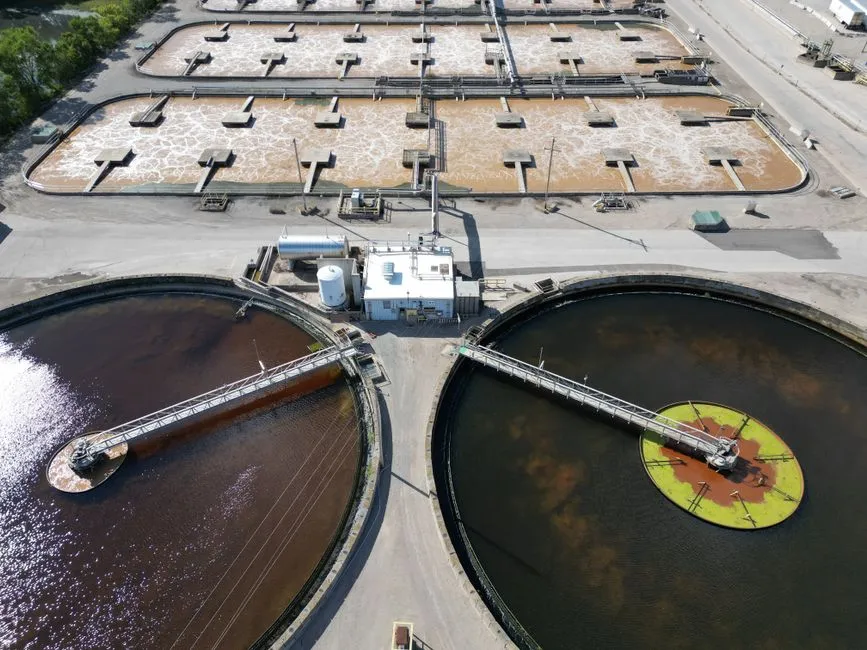
A defensible 2026 reference train for an indirect-discharge P&P mill near Lake Mary runs in six stages. To achieve compliance, mills must address both physical and chemical pollutant characteristics through the following sequence.
- Mechanical screening and grit removal. Protect downstream pumps, DAF units, and biological reactors from fibers, rags, plastics, and grit that would otherwise foul nozzles, tear rotating equipment, and accumulate in basins.
- Flow and load equalization. Smooth the BOD, COD, and TSS swings characteristic of pulping, washing, screening, and bleaching operations (Hubbe et al., BioResources). Equalization is also the cheapest place to blend hot and cold streams and to dampen pH excursions before they upset the biological stage.
- Dissolved air flotation (DAF) for suspended solids, colloids, and FOG. DAF is one of the proven upstream P&P interventions, alongside save-alls and kidney loops (Hubbe et al., BioResources). A properly sized DAF system for pulp and paper wastewater removes fibers, fines, and entrained air that primary clarifiers handle poorly, and it sets a low-solids feed for the biological stage.
- Primary clarification followed by activated sludge. Conventional primary clarification plus activated sludge is the workhorse configuration widely implemented across the P&P industry (Hubbe et al., BioResources). Where footprint or loading demands it, an anaerobic stage upstream, an MBR system for pulp and paper biological polishing, or a moving-bed bioreactor can be substituted; each raises the bar on effluent quality at the cost of more sophisticated operations.
- Polishing for residual COD, color, and AOX. When local sewer limits are tight, a tertiary multi-media filter for tertiary solids reduction handles carryover solids, and advanced oxidation (e.g., Fenton) or membrane filtration (UF/RO) handles recalcitrant COD, color, and AOX fractions (Hubbe et al., BioResources).
- Sludge handling. A plate and frame filter press for P&P sludge dewaters the combined biological and chemical sludge before off-site disposal. Build this line into the project scope from day one: sludge volumes scale directly with chemical dosing intensity and with biological yield.
The source-control layer should be treated as a parallel workstream. Filtration save-alls and kidney-like operations purify process water, reduce pollutant load, and shrink the volume sent to end-of-pipe treatment (Hubbe et al., BioResources). Given that the industry has reduced water consumption by 95% per tonne of paper over 30 years (Blanco et al. 2004, cited in Hubbe et al., BioResources), the marginal kilogram of pollutant avoided upstream is almost always cheaper than the kilogram polished out downstream.
Sizing DAF and Biological Stages for P&P Effluent Variability
Effluent matrices shift with furnish and grade changes, so sizing the DAF and biological stages requires careful calculation. Separation rates in settling or flotation units can be accelerated by chemical treatments (Leitz 1993; Al-Jasser 2009, cited in Hubbe et al., BioResources), and biological sludge digestion conditions can be tuned to speed solids handling (Elliott and Mahmood 2012, cited in Hubbe et al., BioResources). Chemical dosing control is part of the sizing exercise: a PLC-controlled coagulant and flocculant dosing skid tied to inline streaming-current or pH probes keeps the DAF running at design surface loading through grade changes.
For the biological stage, the over 40% poorly biodegradable organics figure reported for chemical pulping (Dahlman et al. 1995, cited in Hubbe et al., BioResources) is the headline constraint. Hydraulic retention time and solids retention time must be conservatively sized, and the F/M ratio set with the non-biodegradable fraction in mind; otherwise the clarifier or MBR will be loaded with slowly degrading residuals that degrade effluent quality and force more aggressive polishing downstream. An MBR is a defensible option where the POTW enforces tight BOD or TSS, because it retains biomass and reduces solids breakthrough under variable loading.
Specific numeric loading values — surface loading rate, HRT, MLSS, F/M — are site-specific and must be confirmed through jar tests on the actual DAF feed, bench-scale biological assays on the screened and equalized wastewater, and a review of the local POTW's discharge limits. Requesting site-specific performance data from the equipment vendor before purchase is the responsible engineering move.
What to Confirm with Your POTW and Engineering Team Before You Build
A 2026 pretreatment upgrade for a Lake Mary mill stands or falls on five confirmations that must be documented before moving past schematic design.
- Subcategory assignment in writing. Ask the local pretreatment coordinator which 40 CFR Part 430 subcategory has been assigned to the facility (EPA, "Pulp, Paper and Paperboard Effluent Guidelines"). The pollutant list, and therefore the unit operations, depend on that answer.
- Local numeric limits. Request the POTW's specific limits for BOD, COD, TSS, AOX (where applicable), color, pH, temperature, and any metals. These are typically tighter than the federal categorical limits and drive the final polishing design.
- Baseline loading across grades. Document the mill's baseline loading through 24-hour composite sampling across all operating grades, and cite the up to 70 m³/tonne upper-bound water-use figure (Rintala and Puhakka 1994; Latorre et al. 2007, cited in Hubbe et al., BioResources) when justifying reuse and equalization capacity to the POTW and to internal finance reviewers.
- Source-control upgrades in parallel. Plan save-alls, kidney loops, and counter-current washing upgrades in parallel with end-of-pipe work, leveraging the 95% per-tonne water reduction the industry has achieved over 30 years (Blanco et al. 2004, cited in Hubbe et al., BioResources).
- Sludge handling from day one. Build a thickener plus plate and frame filter press for P&P sludge into the project from day one, because biological and chemical sludge volumes scale with chemical dosing intensity and with biological yield — a polishing train that successfully hits the sewer limits still creates a downstream solids problem if dewatering is left out of scope.
Frequently Asked Questions
What regulation applies to a pulp and paper mill discharging to a sewer near Lake Mary?
A Lake Mary mill discharging to a POTW is regulated as an indirect discharger under EPA's 40 CFR Part 430 Pulp, Paper and Paperboard Effluent Guidelines, originally promulgated in 1974 and 1977 and substantially amended for toxic pollutants in 1998 (EPA, "Pulp, Paper and Paperboard Effluent Guidelines"). The categorical rule is enforced locally through the POTW pretreatment program, so
Frequently Asked Questions
What regulation applies to a pulp and paper mill discharging to a sewer near Lake Mary, Florida?
Pulp and paper mills discharging to a Publicly Owned Treatment Works (POTW) near Lake Mary must comply with the federal General Pretreatment Regulations found in 40 CFR Part 403, along with industry-specific Categorical Pretreatment Standards under 40 CFR Part 430. Locally, facilities must adhere to the specific ordinances and wastewater discharge permits issued by the City of Lake Mary or the Seminole County Environmental Services Department, which set site-specific numerical limits for parameters such as BOD, TSS, pH, and heavy metals.
How is a DAF system sized for pulp and paper wastewater?
Dissolved Air Flotation (DAF) units are sized based on the hydraulic loading rate, typically measured in gallons per minute per square foot (gpm/ft²), and the specific solids loading rate of the mill's effluent. For typical pulp and paper wastewater, surface overflow rates range from 1.5 to 3.0 gpm/ft², depending on the flocculation characteristics of the fiber and chemical additives present. Engineers must calculate the peak flow rate, accounting for production surges, to ensure the rise velocity of the air-solids aggregate does not exceed the unit's hydraulic capacity.
What is a realistic capital budget for a 2026 pulp and paper pretreatment upgrade in the US?
A realistic capital budget for a comprehensive pretreatment upgrade—including primary clarification, DAF systems, and automated pH neutralization—ranges from $2 million to $7 million for a medium-sized facility. Costs are heavily influenced by the complexity of the influent profile, the degree of automation required for 2026 compliance, and site-specific civil works. Factoring in current inflationary pressures and lead times for specialized stainless steel equipment, project managers should allocate an additional 15-20% for contingency and integration engineering.
How do I choose a wastewater equipment supplier with pulp and paper experience?
When vetting suppliers, require documented performance data from at least three installations handling high-consistency fiber or specific bleaching effluents characteristic of your process. Evaluate the supplier's ability to provide bench-scale or pilot-scale testing on your specific wastewater stream, as pulp and paper waste chemistry varies significantly based on wood species and pulping methods. Ensure the vendor can provide references for equipment longevity under harsh, corrosive operating environments and has local service support to meet rapid response requirements for regulatory compliance.
What happens if a pulp and paper plant exceeds local sewer pretreatment limits?
Exceeding local pretreatment limits triggers immediate enforcement actions, starting with a Notice of Violation (NOV) and potential administrative fines. Continued non-compliance can lead to the assessment of surcharges for high-strength waste, the issuance of a Cease and Desist order, or the revocation of the facility's sewer discharge permit, which effectively halts production. In severe cases, the local municipality may refer the matter to state or federal environmental agencies, resulting in civil penalties under the Clean Water Act that can exceed $60,000 per violation, per day.