Why Palatka Mills Are Re-Examining Primary Solids Separation in 2026
Palatka, on the St. Johns River in Putnam County, hosts integrated pulp, paperboard and recycling operations whose discharge permits are administered by FDEP and whose receiving water is governed by St. Johns River Water Management District rules. The 1971 U.S. EPA Draft Second Report on Waste Profiles of the Paper Industry documented that "the trend in the industry is strongly toward the mechanical clarifier" and counted more than seventy-five mechanical clarifiers among the 118 U.S. kraft mills at the time, with 25 of 39 NSSC mills and at least 30 waste paperboard mills also running clarifiers (EPA 1971 waste-profile survey).
The 1973 EPA State-of-the-Art Review of Pulp and Paper Waste Treatment confirmed that sedimentation, flotation and filtration are all standard mill tools, so the question in 2026 is not whether these technologies exist but which one fits a specific sub-process stream. Recent drivers — fiber-loss cost, whitewater heat reuse and tightening color, TSS and BOD limits — push Palatka mills to ask whether gravity settling or dissolved air flotation better matches their particular effluent. The remainder of this article works through EPA performance data, vendor specifications and a sub-process decision matrix, and closes with a Palatka-specific sizing and compliance checklist.
How a Gravity Clarifier Performs on Pulp & Paper Effluent
Mechanical clarifiers remain the default U.S. primary step because, when properly designed, they remove over 95% of settleable suspended solids across kraft, NSSC, fine paper, tissue, linerboard, newsprint and waste paperboard effluents (EPA 1971 waste-profile survey). On a total suspended solids basis the same survey reports average removals above 80% for every mill type surveyed except deinking, which averaged just under 70% because the peptizing agents used in deinking keep inorganic fines, fillers and ink in a highly dispersed state that resists settling.
BOD5 reduction through settling is sub-process dependent. The EPA 1971 data show that tissue and fine paper mills — whose effluent is dominated by suspended fiber with little dissolved organic matter — see BOD5 reductions above 90% on settling, while waste paperboard and pulping effluents retain roughly a third of their original BOD even when clarified to visual clarity, because the dissolved organics carried in from old paper or pulping liquor pass straight through the clarifier. The 1973 EPA State-of-the-Art Review of Pulp and Paper Waste Treatment adds that even after settling, effluents containing titanium dioxide, carbon black, ink, iron oxides and starch-coated broke remain turbid; chemical coagulation cannot deliver the near-100% TSS reduction needed to clear that opalescence, and a similar haze can persist after biological treatment.
Two clarifier operational notes from the EPA reports matter for any 2026 retrofit. First, bleach-plant effluent is often bypassed around the clarifier because direct mixing of chlorination-stage (acid) and alkaline extraction (alkaline) streams upstream causes foaming that disrupts the sludge blanket. Second, screening ahead of the clarifier is treated as non-optional — bar racks at half-inch openings and fine screens remove debris that would otherwise wreck rake mechanisms. Clarifier underflow is typically dilute and usually needs thickening (gravity, centrifuge or press) before dewatering or incineration, which is one of the cost line items a Palatka mill should carry into any replacement study.
How Dissolved Air Flotation Handles the Same Wastewater
A dissolved air flotation unit pressurizes a side stream of clarified water with dissolved air, then releases that pressure inside a flotation tank. The pressure drop forces millions of micro-bubbles out of solution; those bubbles attach to suspended particles, increase their buoyancy, and lift a thick sludge blanket to the surface where a skimmer removes it, leaving clarified water at the bottom of the tank (Ecologix, DAF for pulp & paper). The mechanism is built for the same job a clarifier performs, but it is structurally better suited to particles whose density is close to that of water — fiber fines, fillers, ink and coated-paper broke — which the 1973 EPA review flags as the opalescence-causing residuals that defeat settling.
Krofta's published DAF specifications for the pulp and paper sector state that the technology achieves clarification in 3–5 minutes, against the longer residence times required by gravity clarifiers, and is widely used for whitewater, fiber recovery, shower-nozzle reuse and raw-water clarification in tissue, towel and recycled-paper mills (Krofta, DAF for pulp and paper). The same DAF cell that clarifies also captures saleable or reusable fiber, which is why the Supracell-style DAF is specified for deinking, ceiling-tile and recycled-fiber mills where the captured solids go back into the furnish.
DAF's standard use in the industry has therefore converged on three duties: (1) whitewater clarification in tissue and towel mills, (2) fiber recovery in deinking and recycled-paperboard operations, and (3) raw-water clarification or hot-whitewater reuse where heat capture matters. A DAF unit applied to a kraft or linerboard stream as a primary clarifier is unusual in U.S. practice; the EPA 1971 survey data already explain why — heavy settleable fiber settles easily, and the long-standing clarifier base of installed equipment reflects that fit.
DAF vs Clarifier: Head-to-Head on the Numbers That Matter
The comparison below draws on the EPA 1971 and 1973 performance data and the Krofta DAF reference specifications. Where a value is qualitative, the table calls out the input a buyer must obtain from a vendor or from their own plant data rather than fabricating a number.
| Parameter | Gravity clarifier | DAF | Source |
|---|---|---|---|
| TSS removal — kraft, linerboard, fine paper, tissue, NSSC | > 80% average | Comparable; not separately tabulated in EPA survey | EPA 1971 waste-profile survey |
| TSS removal — deinking effluent | Just under 70% average (peptized pigments, ink) | More reliable on low-density pigmented loads | EPA 1971 survey; 1973 EPA review |
| Settleable solids removal — properly designed unit | > 95% across mill types | Not directly comparable; DAF removes floatable fraction | EPA 1971 survey |
| BOD5 reduction — tissue / fine paper (mostly suspended fiber) | > 90% | Comparable at primary stage; couples with fiber capture | EPA 1971 survey |
| BOD5 reduction — waste paperboard, pulping streams | ~ 33% of original BOD remains even after visual clarity | Same primary-stage limit; dissolved BOD passes both units | EPA 1971 survey |
| Hydraulic residence time | Longer settling time | 3–5 minutes | Krofta DAF reference data |
| Footprint for a given throughput | Larger for equivalent flow | Smaller; compact skid | Krofta DAF reference data |
| Best-fit particle type | Heavy settleable fiber (kraft, linerboard) | Near-neutral-buoyancy fiber, fillers, ink, coated broke | EPA 1971, 1973; Ecologix DAF page |
| Sludge / float consistency | Dilute underflow; usually needs thickening before pressing | Thicker, fiber-rich float; easier to dewater or reuse | EPA 1971, 1973; Krofta DAF page |
| Stream compatibility | Bleach effluent often bypassed to avoid foaming | Handles whitewater and broke streams that foaming-prone acid/alkaline mixes would disrupt | EPA 1971 survey |
The numbers are not symmetric. A clarifier on a kraft or linerboard primary stream is the lower-cost, well-understood choice supported by decades of EPA-cataloged performance. A DAF on a deinking or coated-paper stream is the choice supported by the same EPA reviews' explicit warning that settling cannot clear the opalescence from those effluents. The decision is driven by sub-process, not by which technology is "better" in the abstract.
Matching the Technology to the Mill Sub-Process
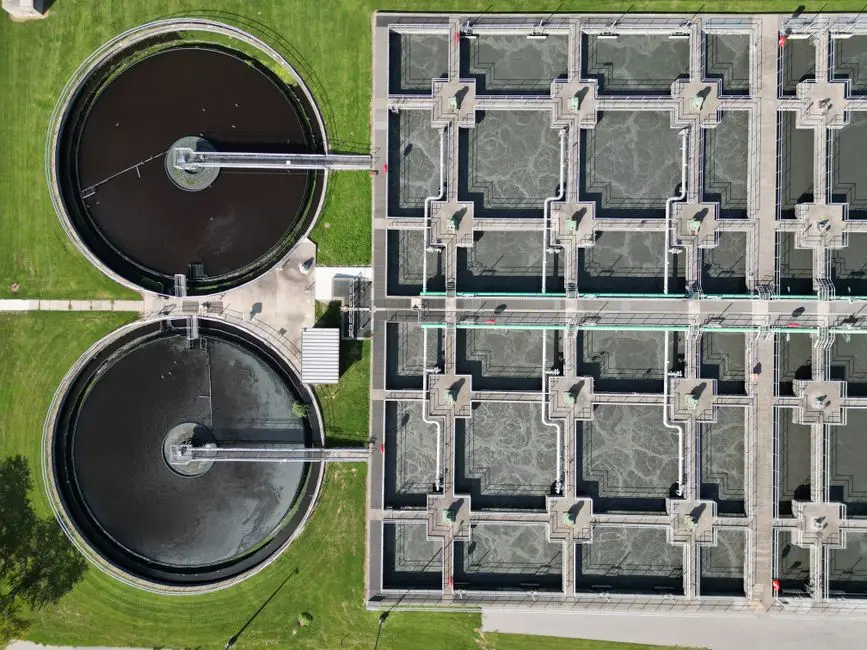
The decision matrix below maps the four sub-process streams a Palatka mill is most likely to run to the technology the EPA data and vendor specifications actually support.
| Mill sub-process | Dominant particle type | Recommended primary step | Why |
|---|---|---|---|
| Kraft and linerboard (integrated, bleached or unbleached) | Heavy settleable fiber, bark fines, pulping liquor | Mechanical clarifier (default) | EPA 1971: > 95% settleable-solids removal, > 80% average TSS across kraft and linerboard mills; clarifier already dominant U.S. practice |
| Deinking, coated / fine paper, waste paperboard | Peptized pigments, ink, fillers, starch-coated broke | DAF (often with coagulation) | EPA 1971: deinking clarifier TSS only just under 70%; EPA 1973: settling cannot clear opalescence from these effluents |
| NSSC and tissue mills with hot whitewater loops | Short fiber, fines, heat-bearing whitewater | DAF for fiber/heat recovery; clarifier as optional polish | Krofta: 3–5 min DAF retention, established whitewater-clarification duty for over 40 years |
| Mixed mill (pulping + papermaking or recycling) | Combined heavy and light loads on separate streams | Clarifier on pulping stream + DAF on whitewater / recycle stream | EPA 1971: in-mill flotation plus external sedimentation is an established pattern; the 1973 review confirms both as standard mill tools |
The matrix resolves to a single rule: choose the technology that matches the dominant particle in the stream, not the technology that has the best marketing literature. For a kraft-only primary stream, the EPA numbers make a clarifier the defensible 2026 answer. For a deinking or coated-broke primary stream, the same EPA numbers make a DAF unit the defensible answer. For a mixed Palatka site, the EPA reports explicitly document the in-mill use of flotation alongside external sedimentation, and that combined approach is the pattern to follow.
Sizing and Spec Checklist for a Palatka 2026 Project
Before approaching a supplier, a Palatka engineer should assemble the following plant-side data. Without it, neither a DAF nor a clarifier vendor can return a defensible 2026 budget number.
- Average and peak influent flow (m³/h) for the stream under evaluation, including the share that is bleach, whitewater, or coating-broke effluent. The EPA 1971 survey documents that bleach effluent is often bypassed around the clarifier, so the stream mix drives unit selection as much as the total flow.
- Influent TSS, BOD5, temperature, and pH — the 1973 EPA review shows that dissolved organics pass through both clarifier and DAF, so BOD5 reduction is bounded by sub-process chemistry, not by tank choice.
- Particle characterization: heavy settleable fiber vs near-neutral-buoyancy fines, fillers and ink. The 1971 EPA survey shows this is the single biggest determinant of which technology will hit target.
- For DAF: request air-to-solid ratio, hydraulic retention time, polymer type and dose, and skimmer-solids percentage. For clarifiers: request surface overflow rate, weir loading, sludge volume index and expected underflow solids.
- FDEP permit limits on TSS, BOD5, color and pH, and any St. Johns River Water Management District basin requirements that apply in 2026. The supplier should confirm in writing that the proposed unit meets those limits under the design load.
For a sizing reference, the HydropureWater DAF catalog documents units that handle 4–300 m³/h across 13 standard models, with documented applications in pulp and paper, food processing, textile, metalworking, petrochemical and municipal pre-treatment duty (HydropureWater, DAF system product page). That range covers the whitewater and broke-loop flows typical of a tissue, deinking or recycled-paperboard line, and serves as a useful benchmark when comparing supplier proposals.
Downstream of either primary step, the float or underflow will need thickening and dewatering. The filter press sizing for the resulting float or underflow follows different solids-percentage assumptions for a DAF float than for a clarifier underflow, and that difference belongs in the same spec conversation. Mills evaluating a DAF retrofit on a low-density stream can also compare the technology against parallel applications in other industries, including a DAF-vs-clarifier comparison for mining and metals wastewater and the DAF design specifics for oily or low-density streams used at airport wastewater plants, where the same near-neutral-buoyancy particle problem is the design driver.
Frequently Asked Questions
When is DAF clearly better than a clarifier for pulp and paper?
DAF is the structurally stronger choice on deinking, coated / fine paper, waste paperboard and NSSC whitewater streams. The 1971 EPA survey shows deinking clarifiers averaging just under 70% TSS removal because of peptized pigments and ink, and the 1973 EPA review concludes that settling — even with chemical coagulation — cannot deliver the near-100% TSS removal needed to clear the opalescence those effluents produce. On heavy settleable fiber from kraft or linerboard, a clarifier remains the better fit.
What information should a Palatka mill give a DAF or clarifier supplier to get a 2026 budget number?
Bring the average and peak flow (m³/h), influent TSS, BOD5, temperature, pH, and the share of the stream that is bleach, whitewater or coating-broke effluent, plus the FDEP permit limits on TSS, BOD5, color and pH and any St. Johns River Water Management District basin requirements that apply in 2026. Without those inputs, a vendor quotation is not comparable to a competitor's. Any returned budget figure that does not state the assumed flow, load and polymer dose is incomplete.
Can a new DAF or clarifier be installed without re-opening an FDEP industrial wastewater permit?
That is a permit-modification question that depends on whether the equipment change alters design capacity, effluent character, or monitoring points under the existing FDEP industrial wastewater permit. A Palatka mill should request a written determination from its permit reviewer before placing the order; a change-in-process-character determination usually triggers a permit modification, and the supplier's role is to provide the design data the permit reviewer needs.
What flow range should a 4–300 m³/h DAF skid be considered for in pulp and paper duty?
The HydropureWater DAF catalog documents 13 standard models covering 4–300 m³/h with documented pulp and paper applications. That range maps to typical whitewater, broke-loop and recycle-stream flows in tissue, deinking and recycled-paperboard mills. For a primary clarifier retrofit on a larger integrated kraft or linerboard stream, a single skid at the top of that range is typically undersized and a custom clarifier or multi-skid DAF arrangement should be evaluated against the actual peak flow.