Why Data Centers Are Reusing Water in 2026
Yes — most data centers that pursue water reuse do it through closed-loop cooling towers fed by either on-site polished effluent or municipal reclaimed water, and the practice is accelerating in 2026 because roughly one quarter of global data centers now sit in water-stressed regions (Rosa et al., Environ Sci Technol, 09 Oct 2026, 60(39):27780-27791). Cooling towers typically account for 20–30% of a power plant's water demand (Stillwell & Webber, 2014, as cited in Cartagena Vaca et al., engrxiv preprint 7240, 2026), so swapping in reclaimed water is the largest single freshwater lever a site has. The 2026 life-cycle analysis by Cartagena Vaca et al. confirms the substitution is effectively 1:1 in water terms, but adds energy and a higher global warming potential that drops sharply as the local grid decarbonizes.
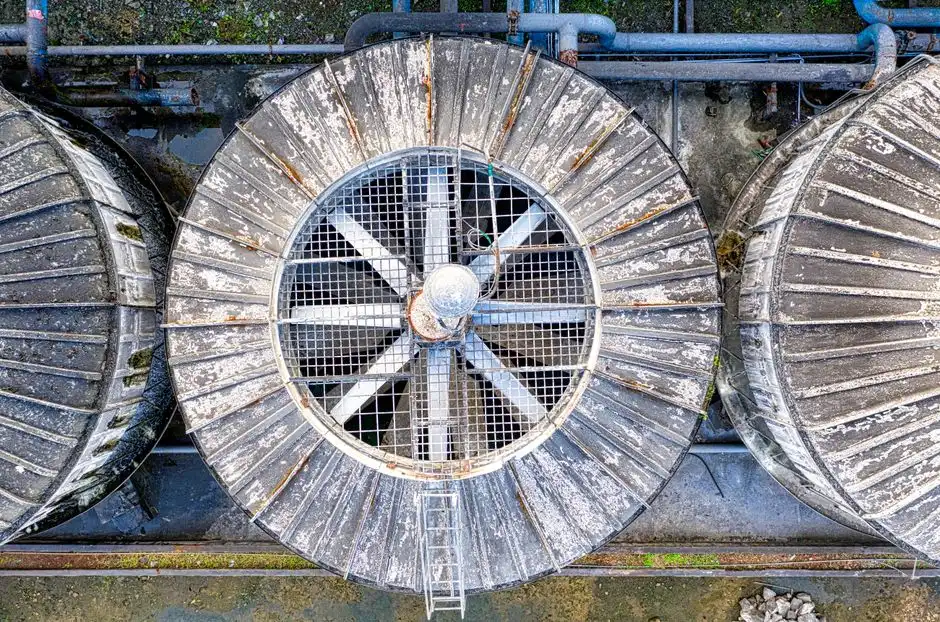
The two water roles inside a data center are once-through cooling and recirculating cooling towers. Once-through plants use water once and discharge it; recirculating towers evaporate a fraction of the flow and concentrate the rest. The reuse conversation is almost entirely about recirculating towers, because that is where evaporative loss concentrates demand and where cycles of concentration (COC) give the operator a real knob to turn.
Rosa et al. (09 Oct 2026) put the structural pressure in plain numbers: about one quarter of global data centers sit in water-stressed basins, which is why reclaimed-water offtake agreements with utilities in arid US regions are moving from ESG slides into signed capital plans. The Stillwell & Webber (2014) figure — cooling towers at 20–30% of power-plant water demand, and up to 300 million gallons per day of Texas freshwater withdrawals displaceable through municipal wastewater substitution — is the same logic applied to data centers, and it is the reason 2026 is the inflection point. The question is no longer whether sites will reuse water; it is which train to specify, and whether to own it or buy it from a utility.
What 'Reuse' Actually Means in a Data Center Cooling Loop
Reclaimed water for cooling comes in three real-world delivery modes. Mode one is municipal reclaimed water replacing freshwater make-up, delivered through a purple pipe or equivalent. Mode two is on-site polishing of municipal wastewater or another non-potable source before the tower. Mode three is on-site reuse of cooling-tower blowdown within the same loop, with sidestream softening or reverse osmosis feeding concentrated stream back into the tower.
Cycles of concentration (COC) is the operating knob that links all three modes. Raising COC means more evaporation per unit of make-up, which lowers freshwater demand but raises dissolved solids, scale risk, and the chemistry load on blowdown. Operators typically run cooling towers at COC values between roughly 3 and 7, and pushing higher requires either better feedwater quality (which is where reuse trains earn their place) or more aggressive blowdown treatment. The reuse decision and the discharge volume decision are the same decision.
Blowdown is the secondary reuse target because it still has usable heat-exchange capacity; it is hot, mineralized, but not depleted. Routing blowdown through a sidestream softener or an industrial RO unit lets the recovered permeate return to the same tower while the concentrate goes to a smaller, more concentrated disposal stream. Industry sometimes calls blowdown recovery "zero liquid discharge" aspirationally — real ZLD requires crystallization and is a separate, more expensive scope that this article does not treat as the default reuse path.
The On-Site Treatment Train: What Reclaimed Water Must Become Before a Cooling Tower Will Accept It
The 2026 LCA by Cartagena Vaca et al. evaluates two polishing trains. The baseline is depth filtration followed by granular activated carbon (GAC) and chlorination, which is the primary polishing sequence used in the study. The higher-recovery option pairs ultrafiltration (UF) with reverse osmosis (RO) and runs at higher COC, trading energy and equipment for lower blowdown volume and lower chemical demand.
The on-site equipment map below translates those trains into categories a buyer can request quotes against. The exact step selection depends on the feedwater — secondary or tertiary municipal effluent, greywater, or sidestream blowdown — and on the cooling tower's chemistry limits, which are set by the OEM and the water treatment vendor together.
| Process step | Function | Equipment category | Typical placement in the train |
|---|---|---|---|
| Screening and grit removal | Protect downstream equipment from debris | Bar screens, grit chambers | Head of the train |
| Pre-clarification | Remove suspended solids and floatables | DAF pre-clarifier or lamella plate settler | After screening, before filtration |
| Turbidity and SDI reduction | Protect RO membranes and lower fouling | Multi-media depth filter or ultrafiltration polishing stage | Before GAC or RO |
| Organics and chlorine demand | Remove TOC, reduce disinfection byproduct formation | Granular activated carbon (GAC) contactors | After filtration, before RO (if present) |
| Dissolved solids reduction | Lower TDS to allow higher COC operation | Industrial RO unit | After UF, before the cooling tower |
| Biological control | Control Legionella, biofilm, and planktonic bacteria | On-site chlorine dioxide generator or UV | Final polishing before the tower |
The 2026 LCA finds that the basic train carries about 2× the global warming potential (GWP) of a freshwater scenario, while the UF+RO train drives energy use to over 5× freshwater. The implication for an engineer is that the train has to be sized to the site's water stress and the local grid carbon intensity, not selected from a generic "best available" menu. A site in a low-carbon grid with a stressed aquifer can absorb the UF+RO penalty; a site on a coal-heavy grid with cheap freshwater cannot.
The Real Trade-Offs: PUE, Energy, and Carbon
Reclaimed water saves water and costs carbon and electricity. Quantifying that trade-off is what turns reuse from a sustainability claim into a defensible capital decision. The 2026 LCA by Cartagena Vaca et al. gives the numbers a board or a permitting authority will actually ask for.
| Metric | Freshwater baseline | Basic reuse train (depth filtration + GAC + chlorination) | UF+RO reuse train (higher COC) | Source |
|---|---|---|---|---|
| Global warming potential | 1× (reference) | ~2× freshwater | Higher than basic train | Cartagena Vaca et al., 2026 |
| Treatment energy share of GWP difference | — | ~80% of the GWP difference | Dominant contributor | Cartagena Vaca et al., 2026 |
| Energy use vs. freshwater | 1× (reference) | Higher than freshwater | >5× freshwater | Cartagena Vaca et al., 2026 |
| Indirect upstream water penalty | — | ~0.93 L/m³ (less than 0.1% of direct displacement) | Same order of magnitude | Cartagena Vaca et al., 2026 |
| Net water substitution | — | ~1:1 in water terms | ~1:1, with lower blowdown | Cartagena Vaca et al., 2026 |
The decarbonization result is what makes the trade-off recoverable. Under a fully decarbonized grid, the GWP penalty of reclaimed water becomes negligible while the freshwater savings stay intact (Cartagena Vaca et al., 2026). A cooling system commissioned in 2026 is expected to operate through 2050, which means the majority of its service life will run under grid conditions where the carbon penalty collapses but the water benefit is unchanged. The 0.93 L/m³ indirect upstream water penalty is the cost of the extra electricity and chemicals, and it is less than 0.1% of the direct displacement benefit.
PUE is the second-order question. Cooling towers keep PUE down compared with air-cooled architectures in most climates, so a reuse train that keeps the tower online protects the PUE number. The risk is that a poorly specified polishing train lets biological fouling or scaling force the tower offline or onto chilled-water bypass, which raises PUE and erases the original water benefit. The 2026 LCA is explicit that the engineering case for reuse depends on the train, not on the source.
On-Site Polishing vs. Municipal Reclaimed-Water Partnership
The decision a project team actually gets asked to make is delivery model: does the data center own and operate the polishing train, or does the utility treat wastewater to a reuse spec and deliver it through a reclaimed-water main? The 2026 LCA flags municipal partnerships as a delivery model whose benefits cannot be captured by an operational LCA of a single data center, because the treatment and distribution energy sit on the utility side of the meter.
| Decision axis | On-site polishing train | Municipal reclaimed-water partnership | What to request from the utility or EPC |
|---|---|---|---|
| Capex | Site carries full treatment capex | Utility carries treatment capex; site may pay a connection fee | Site-specific EPC capex estimate vs. utility connection and tariff terms |
| Electricity exposure | Site load rises with train energy; counts toward PUE | Energy sits on the utility side of the boundary | Train-specific kWh/m³ and site PUE impact |
| Permitting complexity | Site permits the treatment plant and discharge | Utility holds the reuse permit; site may need an offtake agreement | Permit holder and offtake agreement status |
| Operational risk | Site staffs and maintains the train | Utility operates; service-level risk transfers via contract | Service-level agreement terms and redundancy provisions |
| Carbon accounting boundary | Includes train energy in scope 2 | Treatment energy typically outside site scope 2 | Whether the utility publishes a reuse-specific emission factor |
| Absolute impact at scale | Single site | Up to 300 million gal/day across Texas power plants via municipal substitution (Stillwell & Webber, 2014, cited in Cartagena Vaca et al., 2026) | Utility-offtake volume potential and growth plan |
Three questions settle the choice on most sites. First, does the local utility have a reclaimed-water main within pipeline distance of the site's make-up demand, and what is the tariff? Second, what is the carbon intensity of the local grid, and does it justify a lower-energy on-site train instead of a high-recovery UF+RO system? Third, does the site have the footprint, the discharge permit, and the operating staff to host a polishing train? A negative answer to any of the three is a strong signal toward a municipal partnership, where the off-the-shelf reference points come from regional guides such as the data center blowdown treatment guide for Vadodara, the data center blowdown treatment guide for Diyarbakir, and the data center blowdown treatment guide for Santa Cruz de la Sierra.
When Reuse Is the Wrong Answer
Reuse is not a default. The 2026 LCA and the water-stress geography point to a small number of conditions where pushing the site toward reclaimed water is the wrong engineering or commercial call, and naming them keeps the rest of the recommendation honest.
If the site sits outside a water-stressed basin and the local freshwater tariff is low, the energy and carbon penalty of reuse may not pay back in either water savings or compliance value. If the local grid is high-carbon and the planned train is UF+RO, the >5× energy use cited by Cartagena Vaca et al. (2026) translates directly into a large CO₂ penalty the operator cannot easily offset, and a basic train still costs about 2× the GWP of freshwater. If the utility cannot or will not sign a reclaimed-water offtake and the site cannot host a polishing train — footprint, permitting, staffing, or all three — reuse collapses to a one-off pilot with no scale. Finally, if the cooling architecture is already air-cooled or liquid-to-liquid with no evaporative step, there is no cooling-tower loop to receive reclaimed water, and the question is moot. In each of these cases the engineering answer is to do nothing and reassess when the basin, the grid, or the architecture changes.
Frequently Asked Questions
Is reclaimed water a 1:1 substitute for freshwater in a data center cooling tower?
Effectively yes in water terms. The 2026 LCA by Cartagena Vaca et al. finds the direct substitution is ~1:1, with an indirect upstream water penalty of about 0.93 L/m³ — less than 0.1% of the direct displacement benefit. The trade-off is energy and GWP, not water volume.
What does a reclaimed-water cooling train actually cost compared with freshwater?
The 2026 LCA does not provide a capital or levelized cost figure, so a buyer must request a site-specific capex and opex estimate from an EPC for each train option (basic depth filtration + GAC + chlorination versus UF+RO at higher COC), and a levelized $/m³ from the utility for a municipal reclaimed-water tariff, before comparing.
How should a data center qualify a supplier or system integrator for a reuse train?
Ask for three inputs that map directly to the 2026 LCA categories: the train-specific kWh/m³ (energy exposure), the expected cycles of concentration and resulting blowdown volume (water and chemistry), and a reference list of operating data-center or power-plant cooling reuse trains. A supplier who can answer all three has the operational depth; a supplier who quotes only on capex has not.
When does reuse fail to pencil out for a hyperscale or colocation site?
When the site is outside a water-stressed basin, the local grid is high-carbon, the planned train is UF+RO, and the utility has no reclaimed-water offtake available. In that combination the GWP penalty (about 2× for the basic train and >5× energy use for UF+RO, per Cartagena Vaca et al., 2026) cannot be recovered, and a freshwater baseline is the defensible choice.