Why Domestic Sewage Treatment in Jubail Demands a Different Design Lens
Jubail is a semi-arid industrial city, and that single fact reshapes how a domestic sewage treatment plant is selected and sized. The InTechOpen vermifiltration study (S5, 2022) explicitly ties wastewater reuse in semi-arid regions to climate-driven water shortages, framing reuse as a strategic, not discretionary, design objective. Domestic flows in Jubail are dominated by residential compounds, schools, and worker camps, which generate sharp diurnal peaks at shift-change hours. The US EPA municipal wastewater framework (S4) notes that significant flow increases from wet weather or surge events can reduce treatment efficiency, reliability, and unit-process control at the downstream facility; the same peak-management logic applies to camp-style morning and evening surges.
Combined sewers are not a realistic option in new Saudi developments. The EPA framework (S4) records that state and local authorities have generally not allowed new combined sewers since the first half of the 20th century because they isolate peak stormwater from biological process trains, and the same separation principle governs new-build KSA collection systems. Sanitary sewers are not watertight in practice, however; the EPA (S4) flags cracks, faulty seals, and improper connections as pathways for infiltration and inflow (I/I) that can cause sanitary sewer overflows and operational problems. For a Jubail engineer, the design question is therefore not "should we build a sewer" but which compact, hot-climate-tolerant biological train fits the site envelope, the discharge pathway, and the reuse target.
The Core Process Trains Used for Domestic Flows in Jubail
Four biological trains are realistic candidates for a sewage treatment plant in Jubail, and they differ mostly in footprint, operator demand, and effluent quality rather than in influent tolerance.
Package A/O plants combine anoxic and aerobic contact oxidation with sedimentation and disinfection in a single buried unit. The buried package A/O sewage treatment plant in the HydropureWater WSZ series covers 1–80 m³/h, is fully automated, requires no full-time operator, and can be installed below grade with landscaping above or trailer-mounted for mobile camp use (HydropureWater WSZ catalog, S6). MBR integrates activated sludge with submerged PVDF membrane filtration, producing near-reuse effluent in a footprint that is roughly 60% smaller than conventional activated sludge at equivalent load. The integrated MBR wastewater treatment system is rated for 10–2,000 m³/day, making it suitable for compounds, hospitals, and mid-sized communities.
Conventional activated sludge remains a baseline for large municipal works but loses on footprint, operator skill, and reuse-readiness when compared to MBR for flows under roughly 2,000 m³/day, which covers the majority of Jubail worker-camp and compound sites. Low-tech options such as vermifiltration are documented in the InTechOpen study (S5) as decentralised, low-expertise alternatives to centralised systems, but the case study is scoped to domestic septic-tank sewage in Zimbabwe, not large-scale KSA industrial-city deployment, so it is a reference point rather than a default specification for a 2026 Jubail project. All four trains share the same upstream logic: coarse screening, grit and FOG removal where present, flow equalisation, and only then biological oxidation.
Package A/O vs MBR: A Side-by-Side Comparison for Jubail Buyers
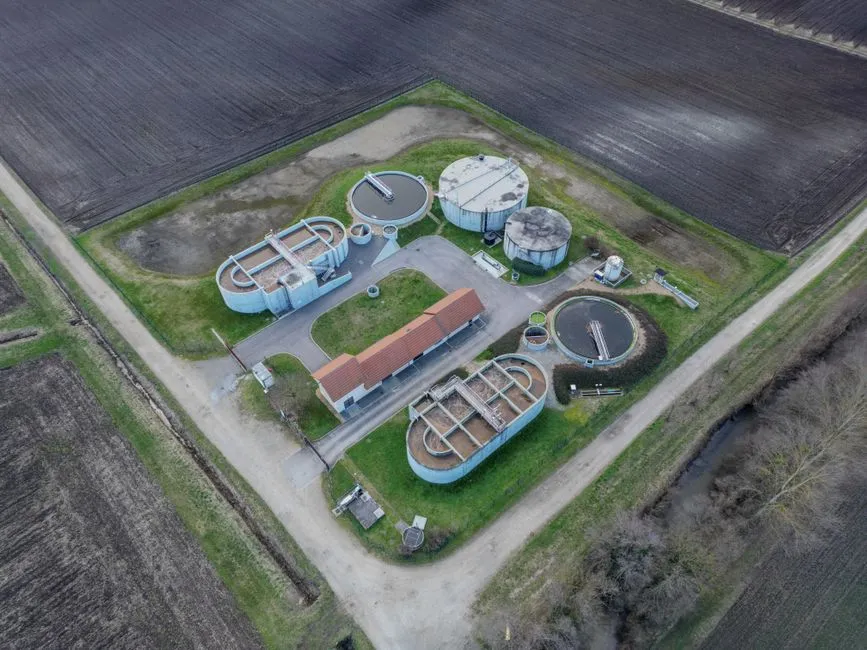
Package A/O is the right default when discharge to irrigation or sea outfall is acceptable and reuse is not mandatory. MBR is the right default when toilet-flushing reuse, cooling-tower make-up, or stringent irrigation discharge is in scope, and the operator wants a smaller surface footprint.
| Parameter | Package A/O (WSZ) | MBR Integrated System | MBR Flat-Sheet DF Module |
|---|---|---|---|
| Capacity envelope | 1–80 m³/h (S6) | 10–2,000 m³/day (catalog) | 32–135 m³/day per cassette (catalog) |
| Membrane / separation | Sedimentation + disinfection | Submerged PVDF <1 μm (catalog) | Submerged PVDF 0.1 μm flat-sheet (catalog) |
| Membrane area per module | N/A | Per system design | 80–225 m² per cassette (catalog) |
| Footprint vs CAS | Buried; recovers surface | Roughly 60% smaller than CAS (catalog) | Compact flat-sheet cassette |
| Energy profile | Low (S6) | Standard immersed MBR | 10–20× lower than external cross-flow (catalog) |
| Effluent quality | Disinfected secondary, irrigation-grade | Near-reuse, low TSS / turbidity | Near-reuse, suitable for toilet flush / cooling |
| Operation | Fully automated, no operator (S6) | Fully automated, membrane maintenance added | Periodic chemical cleaning, cassette swap |
| Best-fit Jubail use | Compounds, schools, hotels | Reuse-driven sites, mid-size communities | Modular capacity uplift on an existing MBR train |
The 0.1 μm PVDF flat-sheet MBR module matters when an existing MBR train needs capacity uplift without civil expansion: each DF cassette occupies a small footprint and slots into a skid, which suits retrofit projects on already-built compounds. The comparison shows that the two families are not competing on the same axis; A/O competes on simplicity and buried footprint, while MBR competes on effluent polish and reuse-readiness.
How to Size a Domestic STP for a Jubail Worker Camp or Compound
Sizing is a four-step exercise that ties population to equipment envelope, then locks the train to the effluent target. The steps below follow the peak-and-I/I logic in the EPA municipal wastewater framework (S4), adapted to camp-style flows.
- Establish population and per-capita flow. Confirm the design population from the camp or compound master plan, apply a per-capita domestic water-use assumption consistent with the local authority, and multiply by a peak factor for morning and evening surges. The EPA (S4) explicitly links peak flows to reduced treatment efficiency and control, so the peaking must be carried through equalisation design rather than absorbed silently by the biological stage.
- Add an I/I allowance. Even separate sanitary sewers admit infiltration through faulty seals and cracks, and the EPA (S4) flags I/I as a known cause of SSO and operational upsets during wet weather. For a Jubail context, request the local rainfall and groundwater assumptions from the consultant and design for the higher flow case.
- Match the resulting flow to an equipment envelope. Small compounds and worker camps of roughly ≤80 m³/h map to the HydropureWater WSZ series (S6). Larger or reuse-driven sites map to the 10–2,000 m³/day MBR integrated system (catalog), with DF cassettes added modularly for capacity uplift.
- Confirm the effluent target before locking the train. If the discharge pathway is reuse for irrigation, cooling, or toilet flushing, the MBR train (DF series at 0.1 μm) is the appropriate default; if the discharge is to a sea outfall or evaporation pond, package A/O with disinfection is usually sufficient.
| Sizing parameter | Data source / input | How it is used |
|---|---|---|
| Design population | Camp / compound master plan | Drives average daily flow |
| Per-capita water use (L/c·d) | Local authority or utility benchmark | Converts population to flow |
| Peak factor (× average) | Camp-style diurnal profile; EPA S4 | Sizes equalisation and hydraulics |
| I/I allowance | Groundwater depth, sewer material; EPA S4 | Uplifts wet-weather design flow |
| Equipment envelope | WSZ 1–80 m³/h (S6); MBR 10–2,000 m³/day (catalog) | Selects the train family |
| Effluent target | Reuse vs discharge pathway | Selects A/O vs MBR |
Headworks screening must be specified alongside the biological train, and a rotary mechanical bar screen for STP headworks is the right default for camp flows where rags and fibrous debris are common.
Upstream and Downstream Equipment You Should Not Overlook
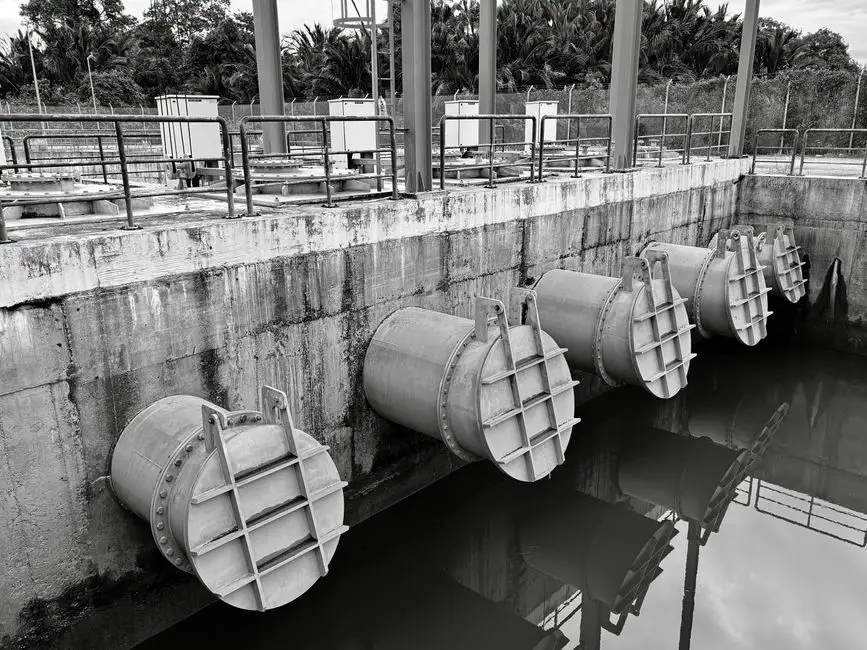
A biological train is only as good as its headworks, disinfection, and sludge handling. A rotary mechanical bar screen for STP headworks protects downstream pumps, valves, and biological processes from rags, plastics, and fibrous debris, and is non-negotiable for camp and residential flows. Disinfection can be chemical-free via a UV pipeline unit, which is effective against chlorine-resistant organisms and avoids handling chlorine on site; chlorine dioxide generation is an alternative where a residual is required downstream of the STP.
Sludge handling is the most undersized line item in small domestic STPs. Once the biological train produces waste activated sludge, the plant needs a plate and frame filter press for sludge dewatering or a lamella clarifier for thickening, otherwise the sludge train becomes the bottleneck. A PLC-controlled automatic chemical dosing system is also required for pH correction, coagulant, or anti-foam even on small A/O or MBR plants. A domestic STP without a sludge train and a dosing skid is not a complete plant, regardless of the quality of the biological stage.
KSA and Royal Commission Compliance: What to Put in Your Specification
The discharge pathway drives which limits are binding, but the supplied research does not contain specific KSA numerical limits, so the engineer must request the current Royal Commission and Presidency of Meteorology and Environment (PME) limits from the shortlisted supplier and confirm against the latest 2026 circulars before locking the specification. The reuse logic in the InTechOpen study (S5) applies, and the spec should align effluent quality with the planned end use: irrigation, cooling-tower make-up, or toilet flushing. Operator and automation language should be explicit: specify "fully automated, PLC-controlled, no full-time operator required", a feature both the WSZ (S6) and the integrated MBR systems meet, and require an O&M manual in English and Arabic. The spare-parts clause matters as much as the equipment clause: require stocking of replacement DF cassettes, RO or UF elements, and dosing-pump spares inside Saudi Arabia rather than on international indent, because lead time on imported membranes is the most common cause of unplanned downtime on KSA MBR sites.
Frequently Asked Questions
How much does a domestic sewage treatment plant for a worker camp in Jubail cost in 2026?
The supplied research does not contain a price for a complete domestic STP, so the engineer must request a line-item quotation covering the biological train, headworks, disinfection, sludge dewatering, and commissioning. Ask the supplier to break out membrane replacement cost per cassette, expected membrane life under Jubail ambient conditions, and annual O&M consumables as separate lines, because membrane replacement is the single largest lifecycle cost on an MBR plant and is often hidden inside the capital quotation.
How do I choose a supplier for a packaged STP in Saudi Arabia?
Shortlist suppliers that can demonstrate an installed reference in the Kingdom, hold local spare-parts stock for DF cassettes and dosing pumps, and can deliver an O&M manual in English and Arabic. Require a compliance statement that names the Royal Commission and PME circulars the equipment is designed against, and ask for the supplier's last two membrane-replacement lead-time records in KSA, since membrane logistics are the dominant operational risk on a Jubail MBR plant.
Which is better for a residential compound in Jubail, package A/O or MBR?
Package A/O is the right default if the discharge target is irrigation or sea outfall and reuse is not required, because the WSZ series (S6) is buried, automated, and needs no full-time operator. MBR is the right default if the compound targets toilet-flushing reuse, cooling-tower make-up, or stringent irrigation discharge, because the 0.1 μm PVDF DF membrane delivers near-reuse effluent in a footprint that is roughly 60% smaller than conventional activated sludge (HydropureWater MBR catalog).
What is the main sizing risk for a domestic STP in hot-climate industrial cities?
The main sizing risk is under-estimating peak flow from worker-camp diurnal surges and I/I during the rare wet-weather event. The US EPA municipal wastewater framework (S4) links peak flows to reduced treatment efficiency, reliability, and unit-process control, so the peak factor and I/I allowance must be carried through equalisation design rather than absorbed silently by the biological stage. Confirm the per-capita water-use assumption and the peak factor with the local authority before finalising equipment selection.