
Why Copenhagen Projects Need a Different Sizing Approach
Most online membrane bioreactor (MBR) sizing calculators assume a warm-season design temperature of 20–30 °C, but Copenhagen's winter sewage temperatures drop below that band for months at a time, causing plants sized only against hydraulic charts to run cold-loaded, low-flux, and short of nitrification. Pure Aqua's containerized MBR system ships with a stated design temperature of 20 °C (68 °F) and an operating range of 20–30 °C (68–86 °F), per the Pure Aqua MBR-C product page; that range defines the biological-activity envelope, so it must be treated as a derating input for any North European site.
A second variable is catchment type: most of Copenhagen's inner districts run a separate sewer system, meaning MBR effluent is typically planned for on-site reuse, such as toilet flushing or irrigation, rather than discharge to a combined sewer. The effluent quality target—and therefore the sizing margin—is set by the reuse case, not by a downstream WWTP. Finally, MENA-Water documents that its containerized MBRs require only one to two chemical cleanings per year; however, the membrane supplier should still confirm how the submerged hollow-fiber modules behave at low mixed-liquor temperatures, as viscosity and fouling kinetics change significantly in cold weather.
Step 1: Convert Population and Use Pattern to Average and Peak Flow
The design population is the primary variable on every Copenhagen RFQ sheet, with the Pure Aqua MBR-C documentation anchoring at 50 gallons per capita per day (gpd), or approximately 0.19 m³ per person per day. Converted to SI, a 150-person residential block generates about 28 m³/day on an average basis before applying a peak factor. Residential base load is relatively flat, so a peak factor of 1.5–2.0× is usually sufficient; conversely, camps, construction sites, and festival occupancies exhibit strong diurnal peaks, requiring a higher factor to be agreed upon with the supplier and local kommune. Distinguishing between "resident equivalents" (steady state) and "design occupancy" (peak head count) is critical, as conflating these two metrics is the most frequent cause of undersized packaged plants.
| Input | Residential block | Camp / construction |
|---|---|---|
| Per-capita flow (Pure Aqua MBR-C baseline) | 50 US gpd ≈ 189 L/person/day | 50 US gpd ≈ 189 L/person/day |
| Population basis | Resident equivalents (steady) | Design occupancy (peak head count) |
| Peak factor (typical — confirm with supplier) | 1.5–2.0× average | 2.0–3.0× average |
| Example: 150 people at 0.19 m³/p/d | ~28 m³/day average | ~28 m³/day with sharper diurnal peak |
Step 2: Convert Flow to Organic and Nutrient Load
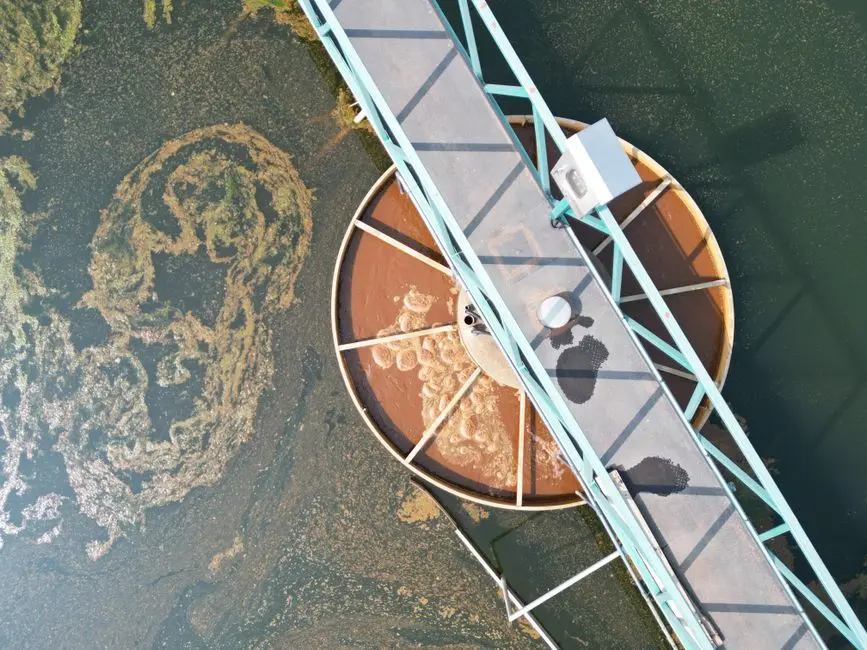
Bioreactor volume and membrane area depend on organic loading, not just hydraulic flow. Pure Aqua's MBR-C documentation highlights BOD removal as a primary advantage, meaning the aeration tank is sized against BOD mass loading rather than flow volume alone. For domestic sewage, the per-capita BOD load serves as the standard input; because specific figures vary, the supplier’s design basis or Danish guidance should be requested before locking in the bioreactor volume. Pure Aqua's MBR-C includes an anoxic zone for denitrification, which is sized against the TKN load; an undersized anoxic zone will result in nitrate slip even if BOD removal is successful. Because the 1.5 mm drum screen on the MBR-C removes coarse solids, the loading calculation must reflect the screened load rather than the raw influent.
Step 3: Translate Load into Membrane Area and Container Envelope
MENA-Water reports that more than 1,200 m³/day can be filtered in a single 40-foot ISO container, establishing a clear upper bound for a single-unit plant. Below that threshold, a 40' HC unit typically offers the most efficient installation. Pure Aqua offers the MBR-C in both 20' and 40' HC configurations using 0.04 µm PVDF membranes, where the cassette count—not just the flow—determines the container size required to maintain flux at lower mixed-liquor temperatures. The membrane area should be calculated at a conservative design flux agreed with the PVDF MBR membrane module supplier, rather than the nominal warm-weather datasheet rating. Because pre-engineered plants arrive factory-tested, that specific rating serves as the binding capacity for Copenhagen regulatory permits.
| Design daily flow (m³/day) | Suggested envelope | Key sizing caveat |
|---|---|---|
| ≤ ~50 | Single 20' HC container (Pure Aqua MBR-C) | Confirm cold-season flux with PVDF module supplier |
| ~50 to ~1,200 | Single 40' HC container (Pure Aqua MBR-C or MENA-Water MBR) | Membrane cassette count, not just flow, drives the fit |
| > ~1,200 | Multi-container or multi-skid layout (MENA-Water) | MENA-Water's >1,200 m³/day claim is the documented single-container ceiling |
Step 4: Match the Layout to Camp, Residential, or Mixed Use
The same membrane cassette can be housed in various envelopes, ranging from standard 40' HC containers to underground tanks or integrated skids, depending on project constraints. For stable residential blocks, a 40' HC container is generally the most cost-effective solution, provided the capacity is verified against the 1,200 m³/day ceiling. For temporary camps with significant diurnal surges, an upstream equalization buffer is essential to maintain a constant flux across the membranes and protect the biological activity within the bioreactor. Where site conditions limit visibility or noise, such as in urban infill projects, utilizing an underground U-Version or a fully integrated I-Version allows the PVDF MBR membrane module to operate within a smaller footprint, shifting the design effort from process risk to civil works.
| Project type | Recommended envelope | Reasoning |
|---|---|---|
| Stable residential block | Single 40' HC container | Lowest cost, fastest install; factory-tested rating is the binding capacity |
| Camp / dormitory with diurnal peaks | Single 40' HC + upstream equalization | Buffer dampens peaks so bioreactor and membrane flux stay near design |
| Site with visual or noise constraints | MENA-Water U-Version (underground) or I-Version (fully integrated skid) | Same membrane module, different civil envelope |
Copenhagen Compliance, Effluent Reuse, and What to Send the Supplier
EU Urban Waste Water Directive 91/271/EEC provides the overarching compliance framework, but local Danish statutory orders (spildevandsbekendtgørelsen) apply to installations below 30 m³/day and 30 PE, requiring consultation with the local kommune. For reuse applications, the 0.04 µm PVDF ultrafiltration provides a robust barrier, though additional downstream UV disinfection downstream of the MBR or chemical treatment is frequently required to meet specific reuse standards. An effective RFQ for a Copenhagen project must include: design population, peak factor basis, influent BOD/COD/TKN, cold-month design temperature, discharge route, footprint constraints, and noise limitations. For further technical validation, the flat-sheet MBR membrane design criteria guide and the warm-climate containerized MBR sizing comparison provide useful benchmarks for evaluating supplier quotes.
Frequently Asked Questions
What is the right per-capita flow to use when sizing a containerized MBR in Copenhagen?
Use the 50 US gallons per capita per day baseline from the Pure Aqua MBR-C product page, converted to approximately 189 L/person/day. Apply a peak factor of 1.5–2.0× for steady residential blocks or 2.0–3.0× for camps, confirming these values with the supplier and the local kommune to ensure the design accounts for specific use patterns.
What is the maximum flow one 40' HC container can treat?
MENA-Water specifies a single-container capacity of up to 1,200 m³/day. Because actual performance depends on the specific cassette count and factory-tested rating rather than theoretical calculations, request the binding test capacity for the specific configuration being quoted.
How do Copenhagen's winter sewage temperatures change a containerized MBR sizing?
Copenhagen’s winter temperatures fall below the Pure Aqua MBR-C 20 °C design baseline, which increases mixed-liquor viscosity and decreases biological activity. Consequently, the membrane area should be sized using a conservative flux, and the design should incorporate flow equalization and potential insulation to protect the biological process during cold months.
What should I send the supplier to get a defensible budget envelope for a Copenhagen project?
Provide the design population (specifying resident equivalents vs. occupancy), peak factor, influent BOD/COD/TKN, cold-month sewage temperature, discharge or reuse route, space constraints, and noise requirements. Ensure the quote includes the binding factory-tested capacity and, if applicable, the cost for UV disinfection. Refer to the Medellín sizing guide and the Central European cold-climate MBR sizing comparison for additional peer references.