Why Yokohama data centers in 2026 are a silica-limited, dual-compliance problem
Cooling-tower evaporation and blowdown are the dominant water-loss path for a Yokohama hyperscale campus, not chiller makeup or humidification; a 100 MW facility can consume up to 2 million liters of water per day, with most of that loss leaving the site as blowdown (IDE, 2026). At 4 cycles of concentration, roughly 25–30% of makeup water exits as blowdown; for a Yokohama campus drawing 10 MGD, that is 2.5–3 MGD of concentrated discharge per month (Genesis Water Technologies, 2026). The Keihin waterfront and Yokohama inland industrial zone draw makeup from sources analogous to the Tone and Tama systems that supply the broader Tokyo region: TDS 70–200 mg/L, calcium 8–18 mg/L, magnesium 3–8 mg/L, with seasonal silica excursions of 8–25 mg/L during low-flow periods on the upper Tama (S1).
That profile matters because the rate-limiting species in CTBD chemistry is silica, not calcium carbonate. After 4–6 cycles, blowdown reaches 1,200–6,000 mg/L TDS with elevated calcium, magnesium, silica, alkalinity, and accumulated cooling-program additives — biocides, corrosion inhibitors, scale inhibitors, dispersants (Genesis Water Technologies, 2026). Suspended solids typically measure 10–50 mg/L from corrosion products, biofilm fragments, and airborne dust; the biological load (planktonic bacteria and biofilm fragments) must be removed before any membrane step (UGA TP-121, 2026). Compliance is dual-track: METI's Data Center Efficiency Guidelines (2023 update, in force through 2026) require WUE reporting and recognize high-recovery reuse with benchmark credit, but reuse does not exempt the site from the Water Pollution Control Act (水質汚濁防止法) effluent floor or from Kanagawa prefectural ordinances and the Yokohama-shi Sewerage Bureau (横浜市環境創造局) pretreatment permit on pH, SS, total nitrogen, total phosphorus, and metals (S1). For the full Tokyo chemistry envelope that Yokohama makeup mirrors, the 2026 Tokyo data center cooling blowdown engineering guide is the direct reference.
Working CTBD parameter envelope for a Yokohama site at 4–6 cycles
Six parameters control equipment selection for a Yokohama CTBD train: TDS, calcium carbonate scaling risk, silica scaling, Langelier Saturation Index, pretreatment requirement, and biocide / free-chlorine quench. Every downstream decision in this article is anchored to the envelope below. RO permeate 10–50 mg/L TDS is achievable; the Yokohama-shi Sewerage Bureau sewer limit on Yokohama contracts is often <1,500 mg/L TDS, so the gap between permeate and sewer limit is what a fluidized-bed precipitation or high-pH RO stage is sized to close (S1). CaCO₃ scaling risk climbs above 6 cycles without antiscalant; silica is the rate-limiting species above 4 cycles, capping conventional BWRO at 75–80% recovery (IDE, 2026). LSI must be controlled at the reuse blend point — a positive LSI in the basin is silica-safe but invites calcium carbonate scale on fill and heat exchanger surfaces. Side-stream filtration plus UF is required in front of RO to bring SDI down to feed-water spec, and free chlorine residual must be quenched to <0.1 mg/L with sodium bisulfite before the polyamide membranes to avoid oxidation damage (S1). A self-cleaning rotary mechanical bar screen on the cooling-tower basin return is the standard first line of defense for TSS reduction before any membrane step.
| Parameter | Working envelope at 4–6 CoC | Design implication |
|---|---|---|
| TDS (blowdown) | 1,200–6,000 mg/L | Sewer limit on Yokohama contracts often <1,500 mg/L; drives need for RO or precipitation |
| Calcium (makeup) | 8–18 mg/L | CaCO₃ scaling risk above 6 CoC without antiscalant |
| Silica (makeup, seasonal) | 8–25 mg/L | Rate-limiting above 4 CoC; conventional BWRO capped at 75–80% recovery |
| Suspended solids | 10–50 mg/L | Side-stream filtration + UF mandatory ahead of RO |
| RO permeate TDS | 10–50 mg/L | Blends directly into cooling-tower basin as makeup |
| Free chlorine residual | <0.1 mg/L at RO feed | Sodium bisulfite quench required to protect polyamide membranes |
Yokohama regulatory and permit path in 2026
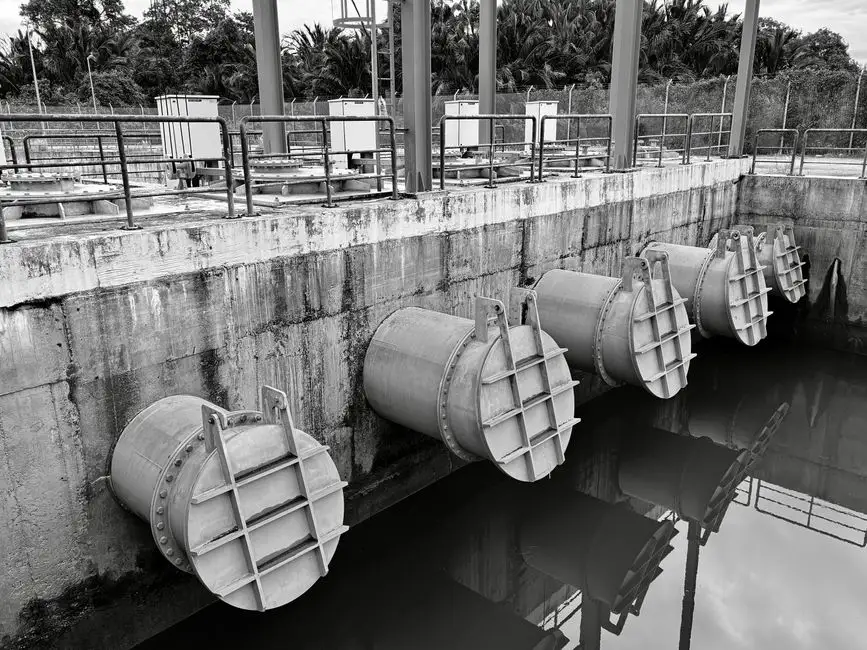
Japan's Water Pollution Control Act (水質汚濁防止法) sets the national effluent floor; the Kanagawa Prefectural Government layers stricter prefectural limits on top for pH, SS, COD, total nitrogen, total phosphorus, and a list of metals including zinc, copper, and hexavalent chromium. The Yokohama-shi Sewerage Bureau sets site-specific pretreatment limits on TDS, phosphorus, heavy metals, and biocide residuals before accepting concentrate. Cooling-tower chemicals — biocides, chromate substitutes, and phosphorus-based inhibitors — are captured under the Act's 'specified substances' (特定排出施設) list and trigger enhanced monitoring on a quarterly to semi-annual cadence, with self-reporting to the prefectural governor (S1).
For most Yokohama sites the practical discharge path is the Yokohama-shi Sewerage Bureau pretreatment permit. In the Keihin bay waterfront and tight-capacity inland districts, the bureau is increasingly directing applicants toward high-recovery reuse before accepting a permit, which pushes EPC teams toward Option B in the decision matrix below. A new CTBD discharge permit review typically runs 4–9 months, longer if ZLD is proposed; plan for a 12-month compliance baseline once the train is commissioned (S1). In 2026, multiple prefectures are discussing hyperscale water-disclosure mandates modelled on the September 2026 South Bend data center wastewater disclosure case, and Yokohama EPC teams should expect the same disclosure pressure to reach municipal stakeholders during the project's operating life (S3).
Four 2026 train options for a Yokohama data center — the decision matrix
Every option assumes side-stream filtration plus UF pretreatment in front of the membrane or thermal step; the variable is what happens to the concentrate. The selection logic is not "which is most efficient" but which combination of CAPEX, OPEX, sewer permit risk, and WUE reporting position is acceptable to the steering committee (S1).
Option A — side-stream filter (10–25 micron) + PVDF UF (0.01–0.1 micron) + BWRO at 70–85% recovery, concentrate to sewer under permit. The 2026 default for Yokohama: lowest CAPEX, fastest permit path. A PVDF ultrafiltration system delivers 90–95% recovery on its own with chemical-free backwash, and the industrial RO system for cooling-tower makeup reuse produces a 10–50 mg/L TDS permeate that blends directly into the cooling-tower basin (S1).
Option B — UF + BWRO + fluidized-bed precipitation + dynamic RO. The sweet spot for sites targeting METI WUE benchmark recognition or a corporate water-stewardship KPI. The fluidized-bed reactor drops silica and hardness out as a dense pellet before the second RO pass, so overall recovery reaches ~95% with ~1 mg/L silica in the permeate (IDE, 2026), and discharge volume is cut 80–90% (S1).
Option C — brine volume reduced 5–10× with 20–30% TDS off-site hauling. Enters the picture when the Yokohama-shi Sewerage Bureau declines or conditions the discharge permit (S1).
Option D — full ZLD, RO + MVC + crystallizer at 95–99% recovery, solid salt cake only, no sewer discharge. Reserved for board-level water-positive mandates; CAPEX is 5–8× a standard RO-reuse train (S1, S4).
The most common failure mode in CTBD reuse is not the RO stage itself but fouled or scaled membranes from inadequate upstream removal of suspended solids, organics, and treatment chemicals. A self-cleaning spiral side-stream filter at 10–25 micron cuts suspended solids to levels the downstream UF can handle without excessive backwash cycling (Genesis Water Technologies, 2026). Antiscalant selection is a discharge-permit decision as much as a membrane-protection decision: phosphorus-based inhibitors create a direct compliance conflict with Japan's total-phosphorus discharge limits and should be replaced with non-phosphate, low-fouling formulations (S1).
| Option | Train | Concentrate destination | Steering-committee fit |
|---|---|---|---|
| A | Side-stream filter + UF + BWRO (70–85% recovery) | Sewer under Yokohama-shi pretreatment permit | Default; lowest CAPEX, fastest permit |
| B | UF + BWRO + fluidized-bed precipitation + dynamic RO | Sewer or partial ZLD; brine reduced 5–10× | METI WUE benchmark recognition; cuts discharge 80–90% |
| C | Brine concentration + off-site hauling at 20–30% TDS | Off-site | When sewer permit is denied or denied conditionally |
| D | RO + MVC + crystallizer at 95–99% recovery | Solid salt cake; no sewer | Board-level water-positive mandate only; CAPEX 5–8× standard |
2026 yen cost bands and footprint for a 200 m³/day Yokohama CTBD train
For a 200 m³/day CTBD stream, Option A (side-stream filtration + UF + BWRO) installs in the order of ¥30–60M with OPEX of ¥180–360/m³ once energy, antiscalant, membrane replacement, and labor are summed (Genesis Water Technologies, 2026, converted to 2026 yen). The RO skid itself typically occupies 25–40 m² of floor area, with pretreatment and chemical dosing adding another 30–50 m²; a full Option A train including chemical rooms fits in a 100–140 m² equipment pad on a typical Yokohama site (S1).
Option B adds ¥20–40M to CAPEX for the fluidized-bed reactor and the second RO pass, but the discharge-volume saving typically pays back the upgrade in 3–5 years through avoided sewer fees, lower freshwater purchase, and a higher METI WUE benchmark rating. Option C roughly doubles the CAPEX of Option B; Option D triples it, putting hyperscale full ZLD into the ¥150–400M range with OPEX of ¥600–1,800/m³ (S1). The 2026 yen figures for Options C and D are derived from Genesis Water Technologies (2026) USD ranges at current FX; site-specific numbers depend on energy tariffs, sewer pretreatment surcharges, and the cost of off-site brine hauling. Direct discharge fees in water-stressed basins already reach $5–$15 per thousand gallons (Genesis Water Technologies, 2026); Yokohama's sewerage bureau tariffs are lower in absolute terms, but pretreatment surcharges on high-TDS concentrate and the tightening total-phosphorus limit replicate the same cost pressure on a per-m³ basis (S1).
| Option | CAPEX (¥M, 200 m³/day) | OPEX (¥/m³) | Footprint (m²) | Permit / discharge position |
|---|---|---|---|---|
| A | 30–60 | 180–360 | 100–140 | Standard Yokohama-shi pretreatment permit; fastest path |
| B | 50–100 | Higher; offset by 80–90% discharge reduction | Larger pad for FBR + 2nd RO | Strong WUE position; bureau increasingly directs bay-waterfront sites here |
| C | ~2× Option B | Driven by off-site hauling distance | Smaller than B; hauling replaces discharge | When permit is denied or conditioned |
| D | 150–400 | 600–1,800 | Largest; MVC + crystallizer hall | No sewer; reserved for water-positive board mandate |
Operational discipline that protects the CAPEX decision
Selecting the right train is only half the work; the upstream control moves below determine whether the selected train actually performs at the design recovery and permeate quality for the full 12-month compliance baseline. The UF stage at 0.01–0.1 micron PVDF achieves 90–95% recovery, tolerates high-turbidity spikes from basin upset, and backwashes with permeate on a fixed interval; chemical-enhanced cleaning is required only every 1–3 months (S1). A multi-media filter polishing step ahead of the RO high-pressure pump catches the turbidity excursions that follow a cooling-tower fan or fill change-out.
Biocide rotation between an oxidizing agent (chlorine dioxide or stabilized bromine) and a non-oxidizing agent (DBNPA or isothiazolone) prevents biofilm colonization of the RO feed. A PLC-controlled antiscalant and biocide dosing skid with closed-loop trim on RO concentrate pH and Langelier index keeps the inhibitor dose at the minimum effective rate. A documented biocide neutralization step is also a permit-review asset, because the Yokohama-shi Sewerage Bureau routinely asks how the program prevents residual biocide from passing sewer discharge limits. A pre-engineering bench test on site makeup water, run to the planned cycles of concentration, is the cheapest insurance against an equipment selection error that costs six months and ¥80–150M to correct (S1).
Frequently Asked Questions
What is the realistic 2026 CAPEX range for a 200 m³/day CTBD train in Yokohama?
For a 200 m³/day stream, the side-stream filtration + UF + BWRO default (Option A) installs in the order of ¥30–60M, with the fluidized-bed + dynamic RO option (Option B) adding ¥20–40M and the full ZLD option (Option D) reaching ¥150–400M (Genesis Water Technologies, 2026, converted to 2026 yen; S1). Site-specific CAPEX depends on energy tariff, sewer pretreatment surcharge structure, and the discharge TDS the Yokohama-shi Sewerage Bureau will accept — request a CAPEX letter that itemizes pretreatment, membrane skid, chemical dosing, building works, and contractor markups separately before committing.
How long does a Yokohama-shi Sewerage Bureau pretreatment permit review take in 2026, and what should we plan around it?
A new CTBD discharge permit review typically runs 4–9 months, longer if ZLD is proposed, and the Water Pollution Control Act requires semi-annual self-monitoring reports on specified substances once the train is commissioned (S1). Build a 12-month compliance baseline into the project schedule after commissioning, and request a pre-application meeting with the Yokohama-shi Sewerage Bureau before the front-end engineering design is frozen, because the bureau is increasingly directing bay-waterfront applicants toward high-recovery reuse before accepting a permit.
Why is silica, not calcium, the rate-limiting species for a Yokohama CTBD train?
Yokohama and the wider Keihin waterfront draw makeup from sources analogous to the Tone and Tama system: TDS 70–200 mg/L, calcium 8–18 mg/L, magnesium 3–8 mg/L, but with seasonal silica excursions of 8–25 mg/L (S1). Above 4 cycles, silica concentrates past the 150–180 mg/L scaling threshold and caps conventional BWRO at 75–80% recovery before silica scale forces a membrane shutdown (IDE, 2026); a fluidized-bed precipitation stage or a high-pH RO stage is required to push recovery to ~95%.
Does a pre-engineering bench test actually change the equipment selection for a Yokohama site?
Yes. A bench test on the actual site makeup water, run to the planned cycles of concentration, exposes silica scaling behavior, biocide interaction, and antiscalant compatibility before membrane specifications are frozen; S1 flags it as the cheapest insurance against an equipment selection error that costs six months and ¥80–150M to correct. Request that any vendor proposal be conditional on a documented bench-test report using the site's Q1 and Q3 makeup samples, so seasonal silica excursions are captured.
Related Equipment
- industrial RO system for cooling-tower makeup reuse — specifications, capacity range, and technical data