Why the DAF-vs-Clarifier Question Matters in Pacolet Mining
Pacolet sits in the historic textile-and-mining corridor of upstate South Carolina, where modern operators run aggregate washing, mineral processing, and metal-finishing lines that produce fines-laden, often reagent-bearing wastewater. The primary-clarification step chosen at a Pacolet plant in 2026 sets the floor for every downstream process: chemical consumption, footprint, recycled-water quality, and the plant's ability to stay ahead of discharge limits. Both dissolved air flotation (DAF) and gravity/lamella clarifiers are routinely offered as that primary step, and the wrong choice between them drives up either reagent cost or footprint before the next unit operation even sees the water.
Terminology is part of the confusion: in vendor literature a "clarifier" can mean a gravity settling tank, a lamella inclined-plate settler, or a DAF flotation unit. For this comparison, a gravity clarifier refers to a lamella or conventional settling tank, while a DAF clarifier is a flotation unit that deliberately bypasses gravity. Seven Seas explicitly names mining as a DAF application, listing removal of fine particles, flotation reagents, and suspended materials plus tailings water recovery (Seven Seas Water, 2025). That mining framing makes the choice a real engineering decision rather than a textbook comparison.
How Each Technology Actually Treats Mining and Metals Water
DAF systems saturate a recycle stream with air under pressure and release that stream at atmospheric pressure inside a flotation tank, generating millions of microbubbles in the 30–50 micron range (Clearwater Industries / SigmaDAF, 2026-04-27). Those bubbles attach to suspended solids, oils, and greases, lifting them to the surface where a paddle skimmer removes the float layer. DAF must be paired with proper chemical coagulation and flocculation conditioning; floc size and surface charge allow the bubbles to attach (Clearwater Industries / SigmaDAF, 2026-04-27). Without that conditioning step, the bubbles pass by the fines they are meant to capture.
A lamella clarifier uses gravity to separate chemically conditioned water as it passes between inclined plates at a controlled surface loading rate. HydropureWater's high-efficiency sedimentation tank documentation lists surface loading targets of 20–40 m/h and a design that combines sludge recirculation and flocculation in a single compact structure (lamella clarifier for heavy mineral slurry). Heavier settleable solids are the lamella's natural target; DAF floats material that would otherwise settle too slowly, which is why a DAF system for mining wastewater is specified for fines-, oil-, and reagent-laden streams where recycle water is the goal.
DAF vs Clarifier for Mining and Metals: Decision Matrix
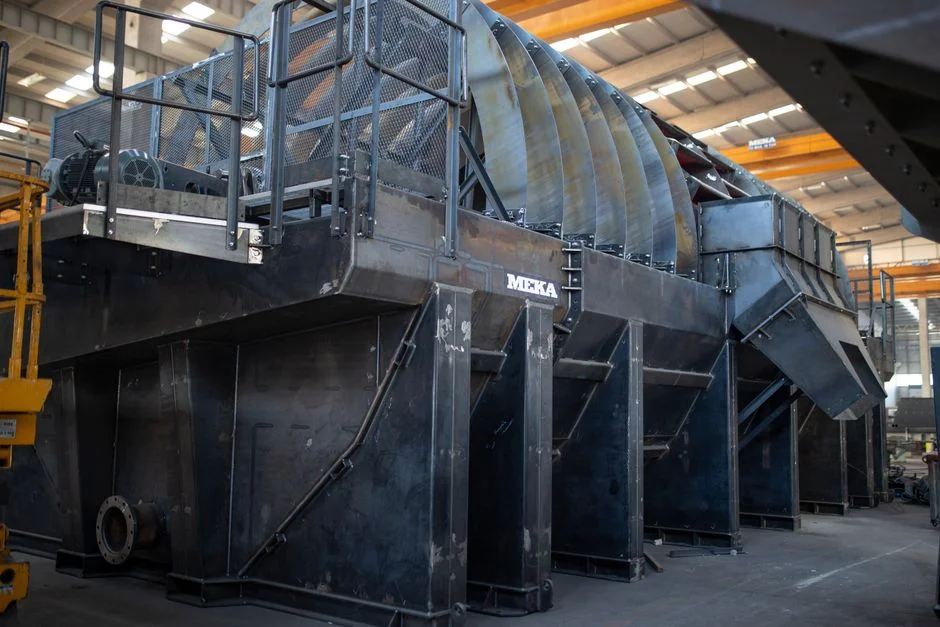
The choice between DAF and gravity clarifier depends on water composition, discharge permits, and recycle loop requirements. The matrix below lets a Pacolet engineer self-classify their stream against mining-specific criteria before contacting a vendor.
| Decision criterion | Favors DAF | Favors Lamella / Gravity Clarifier | Source |
|---|---|---|---|
| Target contaminant | Fine particles, emulsified oils, residual flotation reagents (Seven Seas Water, 2025) | Heavier settleable mineral solids, coarse grit | S3, HydropureWater catalog |
| Typical TSS profile | Low-to-medium TSS, high fines fraction, FOG-bearing | High TSS with settleable solids fraction | Clearwater Industries / SigmaDAF, 2026-04-27; HydropureWater catalog |
| Flotation reagents / oils present | Yes — explicitly named mining use case | No — reagents and oils disrupt gravity settling | S3 |
| Surface loading rate expectation | Microbubble-flotation hydraulics; not expressed as m/h | 20–40 m/h on inclined plates | HydropureWater catalog |
| Chemical budget pressure | Higher (coagulant + flocculant conditioning required) | Up to 30% lower chemical consumption per HydropureWater catalog | HydropureWater catalog |
| Water-reuse / tailings recycle target | Yes — tailings water recovery named application | Limited — typically a once-through settle | S3 |
| Footprint available | COMPACT DAF skid for ≤66 GPM single skid; two-skid modular above 66 GPM | Inherently compact due to inclined plates | Clearwater Industries / SigmaDAF, 2026-04-27; HydropureWater catalog |
| Material of construction / corrosion | 304SS standard, 316SS and polypropylene options for acidic/corrosive streams | Typically carbon or stainless; confirm with vendor per stream | Clearwater Industries / SigmaDAF, 2026-04-27 |
| Flow-rate range to size against | SigmaDAF Compact skid split at 66 GPM; HydropureWater DAF models span 4–300 m³/h across 13 standard sizes | Size to surface-loading rate; request vendor confirmation per stream | Clearwater Industries / SigmaDAF, 2026-04-27; HydropureWater catalog |
| When in doubt | Run matched jar tests, then a one-shift on-site pilot. No published source substitutes for site-specific bench work on a Pacolet-area stream. | Engineering judgment | |
Analyze this matrix as a weighted scorecard to determine the best equipment configuration for your specific process stream. A fines-rich aggregate wash with a recycle target will usually land in the DAF column, while a heavy mineral slurry with settleable solids and a tight reagent budget will usually land in the lamella column.
Materials, Footprint, and Configuration Trade-offs in 2026
Material of construction is a critical filter for Pacolet plants treating aggressive wastewater. Clearwater Industries / SigmaDAF ships standard DAF clarifiers in 304SS with 316SS and polypropylene available for corrosive or acidic mining streams (Clearwater Industries / SigmaDAF, 2026-04-27). If a plant is treating acid mine drainage or a metal-finishing rinse with residual acid, that material spec must be on the initial quote.
Footprint and packaging differ between the two technologies. The COMPACT DAF ships as a pre-assembled turnkey skid with chemical conditioning equipment, sensors, instruments, and a PLC control panel; flows of 66 GPM or less are managed with a single skid, while larger flows use a modular two-skid system (Clearwater Industries / SigmaDAF, 2026-04-27). Lamella units are inherently compact because the inclined plates multiply the effective settling area inside a small tank envelope (HydropureWater catalog). Both technologies integrate with PLC-controlled coagulant and flocculant dosing, making the chemistry side standard across both systems. For supplier due diligence, Sigmadaf Clarifiers reports 800+ projects in 25+ countries since 1994, with US manufacturing through Clearwater Industries since 1996 (Clearwater Industries / SigmaDAF, 2026-04-27).
A Selection Workflow a Pacolet Plant Can Run in 2026
A defensible 2026 workflow ensures primary-clarification success through data-driven selection.
- Characterize the stream. Measure TSS, FOG, total metals, residual flotation reagents, particle size distribution, pH, and target discharge or reuse quality. If you cannot measure residual reagent, you cannot pick between flotation and settling.
- Run bench-scale jar tests. Compare DAF and lamella settling on the same sample, with matched coagulant and flocculant doses. Record supernatant quality, settle or float rate, and chemical consumption.
- Shortlist 2–3 suppliers with documented mining references. Request hydraulic-loading, surface-loading, and chemical-consumption guarantees — not just tank dimensions. See automatic chemical dosing for DAF and clarifier pretreatment for how the chemistry side is typically scoped in 2026.
- Pilot the preferred technology on site for at least one shift cycle before committing to a full CAPEX line item. Pilots catch the swings that a 2 L beaker cannot.
For broader regulatory framing that pairs with this workflow, see US mining pretreatment compliance in 2026.
Frequently Asked Questions
What 2026 pricing range should a Pacolet plant budget for a DAF or lamella clarifier?
Specific 2026 unit prices for packaged DAF or lamella clarifiers in the Pacolet mining-and-metals context are not publicly published. Buyers should request a written quote that includes tank or skid dimensions, material of construction, surface-loading or hydraulic-loading guarantees, chemical-consumption guarantees, PLC scope, freight, and startup commissioning. Compare quotes on these line items, not on tank size alone.
How do I choose a DAF or clarifier supplier for a 2026 mining install?
Shortlist vendors based on documented mining references and written performance guarantees. Clearwater Industries / SigmaDAF reports 800+ projects in 25+ countries since 1994 and US manufacturing through Clearwater Industries since 1996 (Clearwater Industries / SigmaDAF, 2026-04-27). Ask each candidate for two recent mining or metal-finishing commissioning references, a site-specific hydraulic-loading or surface-loading guarantee, and a chemical-consumption target.
What flow rate can a single skid DAF handle, and when does it go modular?
Per the Clearwater Industries / SigmaDAF product page, flows of 66 GPM or less are managed with a single COMPACT skid design, and flows above 66 GPM use a modular two-skid system (Clearwater Industries / SigmaDAF, 2026-04-27). HydropureWater's DAF catalog lists 13 standard sizes spanning 4–300 m³/h, which is the flow range a Pacolet engineer should size against before asking vendors to engineer a custom tank.
When is a lamella clarifier the better fit over a DAF for a mining stream?
A lamella clarifier is the better fit when the stream is a heavy mineral slurry with settleable solids, the chemical budget is tight (the HydropureWater catalog cites up to 30% lower chemical consumption versus a DAF on suitable streams), and the plant is not trying to recover reagent or oil from the water. For fines-, oil-, and reagent-rich streams where water recycling is the goal, a DAF is the better fit (Seven Seas Water, 2025). When the stream sits between those two profiles, run the jar test in step 2 of the workflow above.