Why Containerized MBR Is the Default for Sydney Residential and Camp Projects
Containerized MBR combines activated-sludge biology with submerged ultrafiltration membranes in a single ISO high-cube (HC) frame, eliminating the secondary clarifier and shrinking the footprint enough to fit an inner-Sydney residential retrofit or a remote worker camp with limited lay-down area. The biological step runs an anoxic/aerobic sequence; the membrane step replaces gravity settling, so the same reactor can hold a higher mixed liquor suspended solids (MLSS) concentration and produce a more consistent effluent than a conventional activated-sludge plant of equal volume.
MAK Water positions its MBR as a corrosion-resistant, self-contained, modular FRP system designed for easy deployment to remote locations, with flat-sheet membranes and an integrated CIP system — directly relevant to camp projects in the Sydney basin and surrounds (MAK Water, 2026). At the upper commercial end, MENA-Water documents more than 1,200 m³/day capacity in a single 40-foot ISO container with stainless internal tanks, showing what "containerized" actually delivers when the flow is high (MENA-Water, 2026). The treatment train in both designs follows the same sequence: screening → balance tank → anoxic + aerobic → submerged PVDF membrane (0.04 µm Pure Aqua hollow-fibre, 0.1 µm flat sheet) with air scouring and CIP → disinfection. For a Sydney engineer comparing technologies, that train is the reason an MBR package is defensible against a conventional activated-sludge plant on space, reuse potential, and commissioning speed.
The Sydney Sizing Method: Five Sequential Calculations
Sizing a containerized MBR is a five-step calculation path, not a catalogue selection. The steps below are written so the engineer can replicate them on a Sydney residential or camp project without re-reading the vendor datasheet.
- Design population. Count residential dwellings at roughly 2.8 persons/dwelling (typical Australian household occupancy) or count camp beds at peak occupancy. Pure Aqua uses 50 gallons per capita per day (≈190 L/p/d) as the reference per-capita flow on its MBR-C sizing table; the Sydney-specific value is determined next, but the population count is the input the supplier will ask for first.
- Average dry weather flow (ADWF). Multiply population by the project's per-capita rate. Sydney residential work typically uses 150–180 L/p/d, but this number must be confirmed against the Sydney Water trade-waste consent for the receiving sewer rather than assumed, because the consent letter can set hydraulic and quality limits that override generic sizing assumptions.
- Peak flow. Apply a peak factor to the ADWF: 2.5–3.0 for residential diurnal peaks, and 3.0–4.0 for camp shift-change surges. The peak flow sizes the balance tank, the membrane train, and the hydraulic piping — not the bioreactor volume, which is set by the organic load.
- Organic load. Convert population to BOD load at roughly 40 g BOD/p/d, the figure implied by MAK Water's reference to Metcalf & Eddy (5th edition, 2014) typical composition of untreated domestic wastewater; higher or lower design values are available on request from suppliers and should be requested if the influent is trade-waste-influenced.
- Membrane area and reactor volume. Set MLSS and flux rate per the membrane module datasheet. The flat-sheet PVDF membrane module cassettes ship in 80–225 m² configurations, producing 32–135 m³/day per cassette, which lets the designer match capacity by cassette count rather than re-engineering the train.
| Step | Input | Reference value (research-backed) | Source |
|---|---|---|---|
| 1. Population | Dwellings × 2.8 p/dwelling or peak camp beds | 50 gpd per capita (≈190 L/p/d) sizing benchmark | Pure Aqua, 2026 |
| 2. ADWF | Population × per-capita rate | 150–180 L/p/d Sydney residential (confirm with Sydney Water) | Sydney Water trade-waste consent (project-specific) |
| 3. Peak flow | ADWF × peak factor | 2.5–3.0× residential; 3.0–4.0× camp | Standard Australian practice; confirm in consent |
| 4. BOD load | Population × per-capita BOD | ~40 g BOD/p/d (Metcalf & Eddy 5th ed., 2014 typical domestic) | MAK Water, 2026 |
| 5. Membrane area | Cassette count × module capacity | 80–225 m² per cassette; 32–135 m³/day per cassette | DF module datasheet, 2026 |
The point of running the five steps in order is that each one constrains the next. A peak factor of 4× on a 250-person camp with ADWF at 180 L/p/d produces a 180 m³/day peak that the membrane train must pass through without flux excursion, and a balance tank sized to roughly 25–50% of the daily ADWF (MAK Water recommends specific balance tank volumes sold separately). Skipping straight to "buy a 40' HC" leaves the membrane flux and the balance tank both undersized.
Container Selection: Matching 20' HC and 40' HC Packages to Population
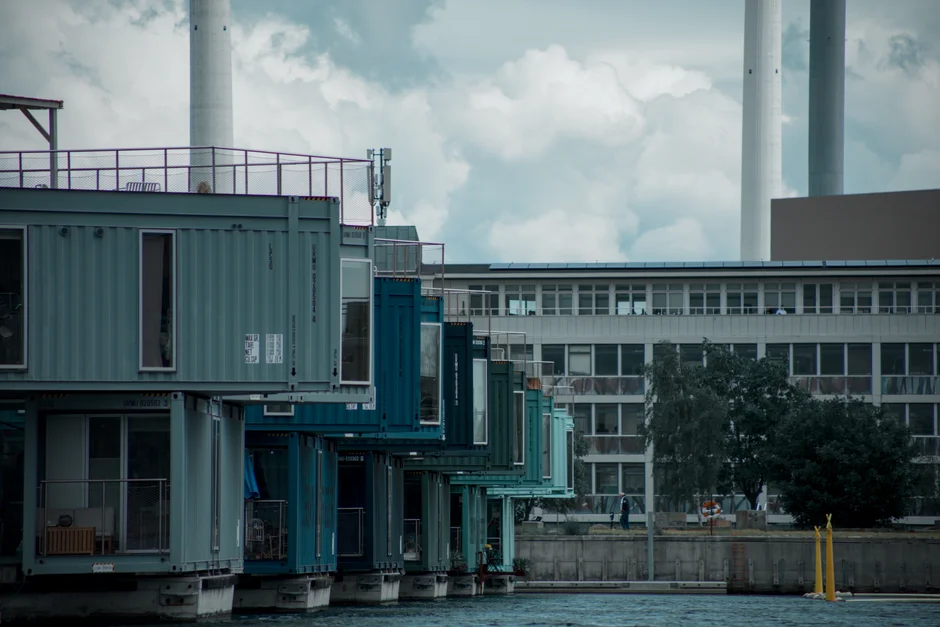
Container choice is driven by flow, site logistics, and the deployment mode (mobile skid vs. permanent in-ground buffer). Both Pure Aqua and MENA-Water standardise on 20' and 40' high-cube ISO containers; Pure Aqua's MBR-C ships in both sizes with insulated walls, zero water leakage, and a seaworthy frame, while MENA-Water's I-Version is fully integrated and mobile, and the U-Version uses underground buffer tanks for permanent residential or institutional sites where above-grade appearance matters (MENA-Water, 2026). Pure Aqua's MBR-C sizes population at 50 gpd per capita and links container size to approximate population served — the only published per-container population benchmark in the research set. MENA-Water documents more than 1,200 m³/day in a single 40-foot ISO container at the upper commercial scale, so the 40' HC is the workhorse for anything above roughly 100 m³/day. For camps on short timelines, the I-Version avoids civil works entirely; for permanent residential or institutional sites, the U-Version with underground buffering reduces the visible plant footprint to the container above grade only.
| Container | Typical flow envelope | Approx. population served (50 gpd per capita) | Best fit | Source |
|---|---|---|---|---|
| 20' HC | Up to ~50 m³/day at typical flux | Small residential clusters, sub-100-person camps | Tight sites, trailer-deployable | Pure Aqua, 2026 |
| 40' HC | ~100–250 m³/day typical; >1,200 m³/day at high-spec | 100–500 person camps, 50–100+ dwellings | Workhorse for medium flows; upper commercial scale | Pure Aqua, 2026; MENA-Water, 2026 |
| Split-train (two 40' HC) | Redundancy + higher peak | Sites where one train must stay online during membrane CIP | Reuse schemes, unattended camps | MAK Water, 2026 |
For a 100–500 person worker camp in the Sydney region, the 40' HC with a 1.5 mm drum screen upstream and air-scour on the submerged hollow-fibre modules — the Pure Aqua MBR-C reference build — covers the flow envelope and ships in a standard ISO frame that a standard drop-deck can carry to site. If the camp needs to move after two years (a common mining and LNG project pattern, per the MAK Water case studies in the research set), specifying the I-Version style of integration with quick-disconnect piping keeps the redeployment cost down. The containerized MBR system datasheet will confirm the exact flow at the Australian electrical supply (415 V / 3-phase / 50 Hz); see the next section for why that detail matters.
Effluent Quality Targets and How They Change the Design
Effluent quality is the single largest sizing lever after population, because a Class A+ reuse target tightens BOD, TSS, and turbidity limits and pushes MLSS up — which means more membrane area for the same flow. MAK Water's MBR is engineered for Class A+ effluent, suitable for "risk category high" reuse applications (toilet flushing, subsurface irrigation, wash-down) — the relevant target for Sydney camps that want to reuse treated water on-site and avoid the cost of potable substitution (MAK Water, 2026). MAK Water's ASBR and MBBR packages, by contrast, are specified to Class C, suitable only for "risk category low" reuse or environmental discharge — fine for discharge-consent sites but not for high-exposure reuse. Disinfection choice shifts with reuse class: hypochlorite is standard on MAK Water MBRs, with UV available for additional log credits on reuse schemes. A higher reuse class therefore is not a free option; it is a sizing decision that adds membrane area, adds MLSS, and adds the disinfection train. For a Sydney residential or camp project, the decision tree is short: if the water is being discharged to a Sydney Water sewer with a trade-waste consent, Class C is acceptable and the MBR is overspecified; if the water is being reused on-site for toilet flushing, irrigation, or wash-down, Class A+ is the defensible target and the MBR is the right technology. The MBR membrane module design criteria guide walks through how the MLSS target and flux rate move with each reuse class.
Pre-Treatment, Hydraulics, and Site Integration for Sydney Conditions
Pre-treatment and site integration determine whether the containerized plant actually works on a Sydney site, independently of how well the membranes are sized. MAK Water's standard MBR includes automatic 2 mm inlet screening, balance tank mixing, anoxic and aerobic treatment, flat-sheet membrane filtration with air scouring and CIP, and hypochlorite disinfection — the reference pre-treatment envelope (MAK Water, 2026). Pure Aqua's MBR-C adds a 1.5 mm drum screen upstream of the aeration tank, fine-bubble diffusers for biomass growth, and a built-in air-scour cleaning system for the submerged hollow-fibre modules. Power supply is a frequent specification trap: MAK Water's standard supply is 415 V, 3-phase, 50 Hz, which matches Australian mains; Pure Aqua's MBR-C is published at 460 V / 3-phase / 60 Hz, so Australian procurement must request a 415 V / 50 Hz variant or confirm compatibility before ordering, otherwise a transformer is required on site. Remote monitoring (e.g., MAK Water's ClearAccess) and an irrigation pump with mechanical flow totaliser are standard on premium packages and are valuable on unattended Sydney camp sites where operators visit only periodically. Upstream of the MBR, a rotary mechanical bar screen protects the membrane cassettes from ragging and grit, and the screening aperture should be matched to the membrane pore size — 2 mm on the MAK Water build, 1.5 mm on the Pure Aqua build.
Sydney Compliance Checklist Before You Finalise the Sizing
A defensible Sydney sizing must lock down the approvals and design inputs below before a purchase order is signed. The research does not contain the exact wording of current NSW Health or Sydney Water instruments; the checklist below lists what a Sydney engineer must request from the relevant authority and from the supplier, rather than paraphrasing those instruments.
| Item | Why it matters for sizing | What to request |
|---|---|---|
| Sydney Water trade-waste consent | Sets hydraulic and quality limits that override generic sizing assumptions | Consent letter with ADWF, peak flow, BOD/TSS limits, and any site-specific conditions |
| NSW Health reuse requirements (if on-site reuse) | Determines Class A+ vs Class C target and the disinfection train | Current NSW Health guidance applicable to the project category and risk classification |
| Influent alkalinity | Caustic dosing may be required if inadequate (MAK Water design note) | Influent alkalinity analysis and supplier's dosing skid spec |
| BOD:TKN ratio | Sucrose dosing may be required if ratio ≤5 (MAK Water design note) | Influent BOD and TKN analysis and supplier's carbon-supplementation spec |
| Peak vs average flow | Drives balance tank and membrane train sizing | Diurnal flow profile from the design brief or measured data |
| Desludging interval | Drives sludge tank volume and operator visit frequency | Supplier's recommended WAS withdrawal rate |
| Operator skill level | Drives the level of automation and remote monitoring required | Supplier's recommended control philosophy for the available operator |
The MBR sizing is correct only after these seven inputs are confirmed in writing. The MAK Water Karratha Airport case study in the research set is a useful precedent: the design, manufacture, commissioning, and WA Department of Health validation were all carried out before the reuse consent was finalised, and the same sequencing is defensible on a Sydney project against NSW Health. The full project-lifecycle sequence is set out in the phases of building a water treatment plant roadmap, and a parallel Sydney method is compared against overseas practice in the Algiers and Luanda sizing guides linked at the end of this article.
Frequently Asked Questions
What is the realistic price range for a containerized MBR STP for a 100–500 person camp in Sydney?
The supplied research does not contain a quoted price for a containerized MBR STP for the Sydney market. A buyer should request a written quotation from at least two suppliers with the same input set (population, peak factor, reuse class, influent alkalinity, BOD:TKN, and power supply), and specify whether the price includes the balance tank, treated effluent tank, civil works, and commissioning. A direct price comparison without that common input set is not meaningful, because Class A+ vs Class C, single-train vs split-train, and I-Version vs U-Version each move the price independently of the flow number.
How do I choose between suppliers for a Sydney containerized MBR?
Check three things before shortlisting. First, confirm the supplier can deliver at 415 V / 3-phase / 50 Hz to Australian mains without an external transformer — Pure Aqua's published 460 V / 60 Hz specification must be re-quoted for Australia. Second, confirm the supplier can provide a Sydney Water trade-waste-compliant control philosophy and a NSW Health reuse validation pathway if on-site reuse is intended; the MAK Water Karratha case shows the validation pathway but is a WA Department of Health precedent, not an NSW Health one. Third, confirm the membrane replacement interval, CIP chemical consumption, and remote-monitoring subscription in writing, because those recurring costs often exceed the capital cost difference between two suppliers over a 10-year camp lease.
How long does delivery and commissioning take for a 40' HC containerized MBR?
The supplied research does not contain a Sydney-specific delivery lead time. Pure Aqua states that its turn-key systems are pre-engineered using the latest CAD technology and that custom systems are built around similar core systems to improve turnaround time, but does not publish a lead time in days or weeks (Pure Aqua, 2026). A buyer should request a written lead time from each shortlisted supplier, broken into fabrication, factory acceptance test (FAT), shipping, site installation, commissioning, and the reuse-validation step if applicable. Add at least 8–12 weeks of buffer for the consent and validation steps on a Sydney project, because those are the activities that typically drive the program rather than the fabrication itself.
Can a 20' HC container handle a 200-person worker camp?
Based on Pure Aqua's 50 gpd per capita benchmark, a 20' HC is typically sized for sub-100-person populations, while a 40' HC is the workhorse above roughly 100 m³/day and is documented at more than 1,200 m³/day at the upper commercial scale (Pure Aqua, 2026; MENA-Water, 2026). For a 200-person camp, the defensible answer is to specify a 40' HC rather than a 20' HC, and to confirm the exact flow envelope against the supplier's model-by-model table. A 20' HC will not deliver the same hydraulic margin on the membrane train at the 3.0–4.0× camp peak factor, even if the average flow is within its nominal capacity.