Kyushu Semiconductor Wastewater: What You're Actually Treating
Front-end and back-end semiconductor streams behave like two different wastewaters on the same site, and that split is the single biggest driver of technology choice. Front-end operations (CMP polishing, wet etch, photoresist strip, and lithography developer rinses) produce low-TSS water dominated by colloidal silica in the 10–100 nm range, fluorinated surfactants, TMAH developer carryover, trace hydrofluoric acid, and resist-derived FOG. Back-end operations (backgrinding, dicing, electroless plating) generate the opposite profile: high TSS in the hundreds to low thousands of mg/L, copper/nickel/gold-bearing sludge, and moderate fluoride with much higher settleability.
Combined Kyushu fab flows typically sit in the 500–3000 m³/day range with sharp diurnal swings tied to batch tool cycles. Engineers planning 2026 budgets need to separate these streams at the lateral before sizing any primary treatment, because a single combined train underperforms on both ends. The Japan Water Pollution Control Law sets the national BOD, COD, TSS, and nitrogen/phosphorus baselines, but Fukuoka, Kumamoto, and Kagoshima prefectures each add their own ceilings on fluoride, boron, and total nitrogen. Select a primary technology that meets the most restrictive prefecture first, or the equipment retrofit gets repeated in three years.
DAF Mechanics: Why Microbubbles Change the Game for Colloids
Dissolved air flotation works because saturating a side stream at 3–6 bar and then releasing it through needle valves produces a cloud of 30–50 µm microbubbles that adhere to hydrophobic and colloidal particles via van der Waals and electrostatic attachment, lifting them to the surface far faster than gravity can pull them down (Clearwater Industries, 2026-04-27). That physics is why DAF handles colloidal silica, fluorinated surfactants, and emulsified FOG, contaminants that pass straight through a gravity settler.
Chemical conditioning is not optional. A working DAF train pairs coagulant dosing (PAC or FeCl₃ typically 10–50 mg/L) with a low-dose polymer flocculant (0.5–2 mg/L) through either a serpentine flocculator tube or a mix tank before the contact zone (Clearwater Industries, 2026-04-27). The model lineup matters for Kyushu fabs because flow variability is high: the FPBC uses a lamella pack to slow velocity and capture low-buoyancy particles; the FPAC handles very high TSS and FOG with a large free surface for float accumulation; the FPHF combines cross-flow and countercurrent flow for higher flow rates; and the COMPACT ships as a turnkey skid with chemical dosing, sensors, and PLC control, managing ≤66 GPM (≈15 m³/h) on a single skid and stepping to a modular two-skid layout above that threshold (Clearwater Industries, 2026-04-27). A paddle skimmer strips floated solids, and an auger pulls heavier settleables from the bottom collection zone.
For a fab choosing DAF, the DAF system models FPAC, FPBC, FPHF, COMPACT for 4–300 m³/h give the right model-to-stream mapping. The same skid family covers a 500 m³/day back-end grinder as easily as a 3000 m³/day front-end concentrate stream.
Lamella Clarifier Mechanics: Gravity Enhanced by Geometry
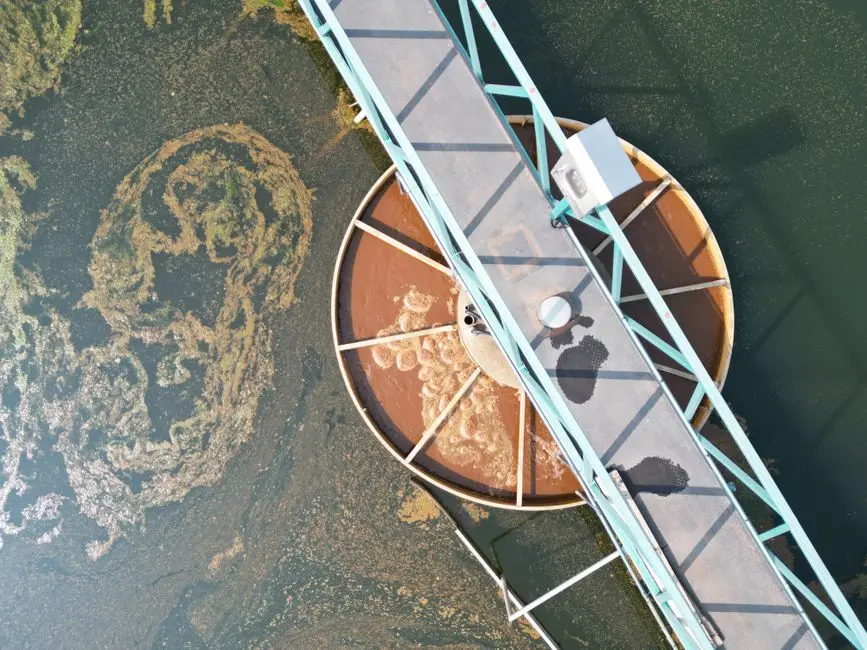
A lamella clarifier is a conventional gravity settler packed with inclined plates at 55–60°, multiplying the effective settling area inside a small footprint. Surface loading rates reach 20–40 m/h, an order of magnitude higher than a traditional clarifier, because each particle only needs to fall a few centimeters between plates before sliding down to the sludge hopper. Coagulant and flocculant doses drop up to 30% versus conventional clarifiers because the laminar flow between plates lets flocs grow and settle without turbulent resuspension.
Energy use is low: only flocculator mixers and sludge pumps, no air compressors or saturators. For a Kyushu fab paying ¥18–¥22/kWh, that electricity delta matters over a 10-year horizon. The trade-off is physics. A lamella only removes particles denser than water and roughly above 20 µm; colloidal silica, emulsified FOG, and buoyant flocs escape. The right application is back-end grinding and plating rinse water, streams with high settleable TSS and low colloidal load. The lamella clarifier with 20–40 m/h loading and 30% chemical savings covers 10–200 m³/h in a single tank and pairs naturally with a PLC-controlled coagulant and polymer dosing for DAF or clarifier skid to keep dose proportional to flow.
Head-to-Head: Contaminant Removal Performance for Semiconductor Streams
The table below maps the dominant Kyushu fab contaminants to which technology actually removes them, and where downstream polishing becomes mandatory.
| Contaminant | DAF (with coagulation) | Lamella clarifier | Winner / Required follow-up |
|---|---|---|---|
| Colloidal silica (10–100 nm) | High removal with proper coagulant; bubbles attach to destabilized colloids | Poor — particles stay suspended in laminar flow | DAF; downstream RO polish for UPW |
| Fluoride (F⁻) dissolved | No direct removal | No direct removal | Neither; requires CaF₂ precipitation or adsorption downstream |
| CaF₂ flocs from precipitation | DAF floats the floc well | Lamella settles flocs if size >50 µm | Either, with lime dosing |
| Fluorinated surfactants / TMAH | Microbubbles strip via foam fractionation | Ineffective — stays in solution | DAF; biological oxidation for TMAH |
| Heavy metals as hydroxide precipitates | Good post-precipitation | Good; ~30% less coagulant lowers sludge volume | Lamella on OPEX; DAF if FOG co-present |
| FOG / resist strip oils | 95%+ removal — designed for FOG (Clearwater Industries, 2026-04-27) | <50% — emulsified oils float past plates | DAF |
| TSS >200 mg/L grinding sludge | FPAC handles it with large float zone | Lamella designed for this loading | Context dependent; lamella wins on footprint |
Two patterns dominate this table. DAF wins every category where the target contaminant is colloidal, buoyant, or surface-active, which describes most front-end CMP and etch streams. Lamella wins where the contaminant is dense, settleable, and high in mass load, which describes back-end grinding and plating. Most Kyushu fabs are not one or the other; they are both, and the engineering decision is which stream goes to which unit.
Kyushu Regulatory Reality Check: Prefecture by Prefecture
National baselines under the Water Pollution Control Law set the floor (Greenolap, 2025), but every Kyushu prefecture layers additional ceilings that directly constrain technology choice. The table summarizes the limits that matter for primary treatment selection.
| Parameter | National baseline (JWPCL) | Fukuoka | Kumamoto | Kagoshima |
|---|---|---|---|---|
| Fluoride | Set by prefecture | <8 mg/L | <5 mg/L (groundwater zones) | Per JWPCL plus local ordinance |
| Boron | Set by prefecture | <10 mg/L | <10 mg/L | <5 mg/L (agricultural protection) |
| Total nitrogen | <120 mg/L | <120 mg/L | <120 mg/L | <120 mg/L |
| BOD / COD / TSS | Rigorous limits, BOD/COD <160 mg/L, TSS <200 mg/L | Per JWPCL | Per JWPCL | Per JWPCL |
| Effluent temperature | Per ordinance | Per ordinance | Per ordinance | <30°C stricter |
| Continuous monitoring | Required for >一定規模 | Flow + pH standard | TOC continuous at TSMC-scale sites | Flow + pH standard |
JIS K 0102 governs wastewater testing methods and JIS B 8222 governs DAF equipment standards; both are required for permitting in most Kyushu jurisdictions (Greenolap, 2025). METI guidelines push ZLD for new fabs, and existing fabs face 5-year reuse roadmaps driven by corporate ESG reporting rather than direct regulation (Greenolap, 2025). Confirm the exact fluoride ceiling with the prefecture environmental bureau before locking the technology, because Kumamoto's 5 mg/L groundwater limit and Kagoshima's 5 mg/L boron limit both force downstream polishing regardless of whether the primary unit is DAF or lamella.
Footprint, Energy, and 10-Year TCO in Kyushu Context
A fab manager defending CAPEX in 2026 needs numbers the finance team can model, not just spec sheet language. The table below frames the comparison a procurement committee will recognize.
| Cost driver | DAF system (COMPACT + auxiliaries) | Lamella clarifier | Notes for Kyushu |
|---|---|---|---|
| Footprint at 200 m³/h | Modular two-skid layout; larger than lamella for equal flow | Compact inclined-plate tank, smaller footprint | Land at ¥300,000–¥800,000/tsubo tilts CAPEX toward lamella for brownfield |
| Energy per m³ treated | Air compressor + recirculation pump, several × lamella draw | Flocculator mixers + sludge pump only | Industrial power at ¥18–¥22/kWh amplifies DAF OPEX |
| Chemical consumption | Standard PAC + polymer dose | Up to 30% lower dose at equivalent settling | Lamella saves on sludge-handling downstream |
| Sludge volume | Float + settled solids, higher water content | Thickened sludge, lower volume | Affects dewatering OPEX and disposal cost |
| RO membrane protection (ZLD path) | Strong — removes colloidal load that fouls RO | Weaker — colloids pass through to RO | DAF extends RO life where UPW reuse is the goal |
| JIS / prefectural compliance | JIS B 8222 design standard applies | JIS K 0102 testing applies; equipment standard varies | Both can be permitted; DAF has clearer equipment standard |
For a 500 m³/day greenfield front-end stream targeting ZLD, the DAF protects downstream RO from colloidal fouling; the OPEX premium over ten years is recovered in avoided membrane replacement. For a brownfield back-end grinder on a sewer discharge permit, the lamella clarifier wins on both footprint and chemical cost. The PLC-controlled coagulant and polymer dosing for DAF or clarifier is a shared line item either way.
Decision Framework: Three Kyushu Fab Scenarios
Use the table to self-locate, then follow the recommended path. Each row maps a real Kyushu fab archetype to a primary technology and a reuse or discharge target.
| Scenario | Stream profile | Recommended primary | Downstream | Reasoning |
|---|---|---|---|---|
| A — New front-end fab, ~1000 m³/day, ZLD target, greenfield | Colloidal silica, FOG, surfactants from CMP/etch | DAF (FPBC or COMPACT) | RO → ED → evaporator for ZLD | DAF removes colloids that foul RO; modular skids fit phased build-out |
| B — Back-end expansion, ~800 m³/day, discharge to sewer, brownfield | High settleable TSS, metals, moderate fluoride | Lamella clarifier | Sand filter → discharge | Lamella handles settleable load at lower chemical and energy cost; tight footprint |
| C — Existing fab upgrade, ~1500 m³/day, UPW reuse 60%, phased budget | Mixed front/back-end combined | Hybrid: DAF on front-end (≈300 m³/h), lamella on back-end (≈500 m³/h) | Shared RO polish → UPW loop | Matches each technology to its best-fit stream; phases CAPEX per stream |
All three scenarios need JIS-compliant equipment and a prefectural permit amendment; for Scenario A and C, the RO polish is the same family of reverse osmosis units sized for semiconductor UPW reuse. AI/IoT monitoring of effluent quality against prefectural limits is becoming a permit expectation rather than a value-add (Greenolap, 2025).
90-Day Procurement Checklist for Kyushu Fab Managers
Weeks 1–2: Split the wastewater streams at the lateral and pull representative samples from each — front-end, back-end, and combined. Test for colloidal silica (0.45 µm filtration followed by ICP), fluoride, surfactants, TSS, FOG, and TMAH. Without these numbers, vendor proposals are guesses.
Week 3: Issue jar-testing requests to two DAF vendors and two clarifier vendors. Insist on tests run against the actual Kyushu water matrix, not synthetic. Compare coagulant dose, floc size, float or sludge volume, and settleability at the planned surface loading.
Week 4: Verify JIS B 8222 certification on DAF equipment, METI registration, and a Kyushu service base (Fukuoka, Kumamoto, or Kagoshima) capable of 4-hour emergency response with Japanese-language support (Greenolap, 2025).
Weeks 5–6: Run an on-site pilot at 1–2 m³/h for a minimum of two weeks. Measure actual removal, chemical use, sludge characteristics, and energy draw on real fab wastewater.
Week 7: Build the 10-year TCO model with Kyushu electricity tariffs, land cost, chemical prices, and a credit for DAF-driven RO membrane life extension if ZLD or UPW reuse is in scope.
Week 8: Hold a pre-consultation with the Fukuoka, Kumamoto, or Kagoshima environmental bureau using the pilot data. Confirm the discharge permit path and any prefecture-specific monitoring requirements before final spec.
Weeks 9–12: Finalize the specification, negotiate a performance guarantee with penalty clauses for effluent exceedance, and sign. For ongoing DAF reliability issues that surface after startup, the DAF troubleshooting guide for rising sludge, foam, and poor float covers the common failure modes. For a parallel read on metals-stream selection, see the mining/metals DAF vs clarifier selection framework, and for fab-specific design outside Kyushu, the semiconductor wastewater treatment engineering guide for Pune fabs covers a comparable regulatory environment.
Frequently Asked Questions
What is the typical CAPEX difference between DAF and lamella clarifier for a 500 m³/day Kyushu semiconductor fab in 2026?
The research data does not provide a specific CAPEX figure for 2026 Kyushu fabs. A buyer should request itemized quotes from at least two vendors for each technology, with separate line items for the primary unit, chemical dosing skid, civil works, and installation, then model land cost at the actual site's ¥/tsubo and apply the Kyushu electricity tariff to convert pump and compressor draw into annual OPEX.
Can a lamella clarifier meet Kumamoto's 5 mg/L fluoride limit without downstream treatment?
No. Neither lamella nor DAF removes dissolved fluoride; the lamella only handles settleable solids after fluoride has been precipitated as CaF₂ with lime. For Kumamoto groundwater zones, the primary unit must be paired with a calcium precipitation step and a polishing stage (ion exchange or adsorption) to reliably hit 5 mg/L; budget and permit both need to reflect that downstream train.
How much floor space does a 200 m³/h DAF COMPACT system need vs equivalent lamella clarifier?
The research confirms the COMPACT DAF handles ≤66 GPM (≈15 m³/h) on a single skid and scales to a modular two-skid layout above that threshold (Clearwater Industries, 2026-04-27), but does not provide a published footprint for the 200 m³/h configuration. Request a general arrangement drawing from each shortlisted vendor and overlay it on the available site footprint before committing.
Which Kyushu-based vendors offer JIS-certified DAF with 4-hour emergency response in Kumamoto?
The research confirms that Japanese-market equipment must meet JIS standards and that regional service partners with Japanese-language support are a normal expectation (Greenolap, 2025), and that performance guarantees with defined timelines are standard in the DAF supply market (Sigmadaf Clarifiers), but it does not name Kumamoto-specific vendors. Shortlist by requesting JIS B 8222 documentation, a Kumamoto or Fukuoka service address, and a written 4-hour response commitment tied to a contractual penalty.