Why Textile Mills Are Moving to Prefabricated Wastewater Plants
Textile manufacturing is one of the largest industrial water users on the planet, and the discharge gap is the first thing any mill engineer should see before discussing equipment. In 2015, China's textile industry discharged 1.84 billion tons of wastewater and 206,000 tons of COD, ranking 3rd and 4th respectively among 41 key industries for five consecutive years (PeerJ).
The reuse rate tells the harder story: textile water reuse sat below 70% versus an 80% national industrial average, and the printing and dyeing sub-sector — the effluent stream a packaged plant actually has to treat — reused only 30% (PeerJ). The China Textile Industry Plan 2016–2020 targeted a 23% cut in water intake per unit of industrial added value and a 10% cut in major pollutant discharge (PeerJ), a policy direction that is consistent with the 2026 frameworks mills now have to plan against. The practical consequence is that a mill aiming for anything close to a 70% reuse loop has to push effluent to near-reuse quality, which historically meant large concrete biological basins and polishing reactors built on site. That civil bottleneck is exactly what a prefabricated wastewater plant for textile industry buyers removes: the biological and polishing units arrive as factory-built, pre-piped modules, so the civil scope drops to interconnecting pipework and a concrete base slab.
What 'Prefabricated' Actually Means in a Textile ETP
A prefabricated wastewater plant is factory-built, pre-piped, pre-wired, and factory-tested before shipment. On-site work is limited to inter-skid pipework, power and control cabling, and commissioning — the reactors themselves never get cast in place. Three package formats are in real use and a buyer should know them before requesting a quote. A skid-mounted plant is an open-frame module on a steel base, lifted by crane into an existing shed or canopy, and suited to retrofits. A containerized plant puts the entire process train inside ISO shipping containers for plug-and-play installation, the fastest option for greenfield or export projects. A buried modular plant — the WSZ type — sits below grade with landscaping above, fully automated and typically used where above-grade space is constrained. These configurations share the same engineering approach: discrete factory-built units that scale by adding modules. The boundary that does not move: civil concrete tanks, large biological basins cast in situ, and any reactor requiring more than roughly 40 m³/day in a single vessel are usually built on site even inside a "packaged" project, because the crane and transport limits kick in well before the engineering does.
Process Flow Inside a Prefabricated Textile Wastewater Plant
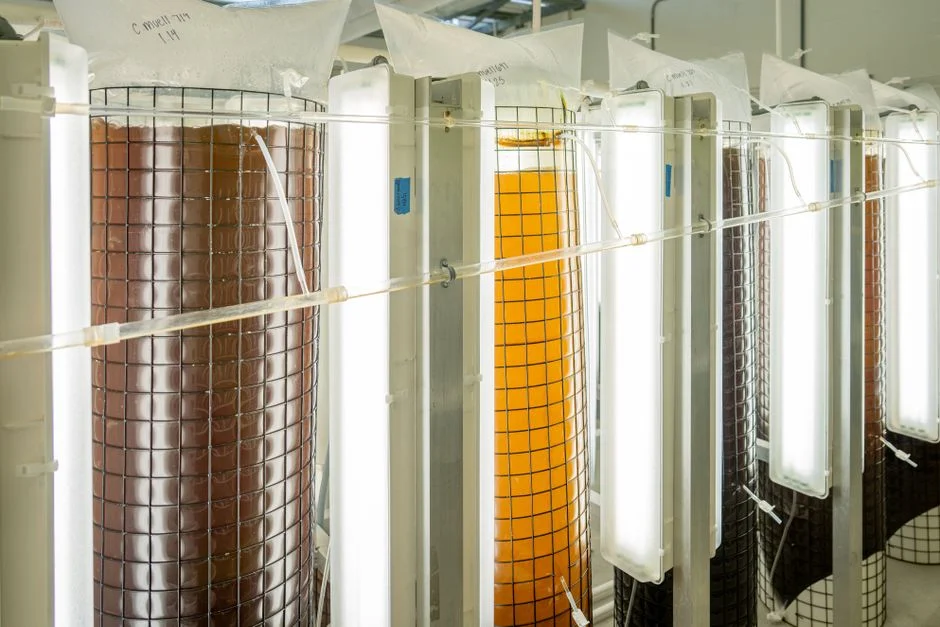
A packaged textile ETP delivers the same five-stage process train a civil plant uses, just in factory-built vessels. The buyer should be able to point to each stage on a P&ID and verify the influent match.
| Stage | Unit Operation | Function in Textile Duty |
|---|---|---|
| 1. Equalization | EQ tank with mixers and pH correction | Buffers batch swings in pH, temperature, and flow; typical detention 8–24 h. |
| 2. Primary clarification | DAF or lamella clarifier | Removes suspended solids, oils, and a portion of colour; proven in textile, pulp & paper, and food processing (Genesis Water Technologies). |
| 3. Biological treatment | MBBR or submerged MBR | Bulk COD and partial decolorization (MBBR); submerged MBR adds <1 µm filtration and a smaller footprint and is preferred for dye-bearing effluent. |
| 4. Tertiary polishing | AOP (ozone, Fenton, UV/H₂O₂), UF, or RO | Targets residual colour, salinity, and organics; the 2026 ScienceDirect review flags ozone-catalyst, nanomembranes, and advanced bioremediation as the direction of travel. |
| 5. Sludge handling | Plate-and-frame filter press | Dewaters wasted biological and chemical sludge for off-site disposal. |
Stage 1 evens out the pH and temperature swings that are characteristic of batch dyehouse discharge. Stage 2 uses a DAF for textile primary clarification to lift suspended solids, oils, and a useful fraction of the colour load before the biological step. Stage 3 is where the bulk COD and most of the decolorization happens; a prefabricated MBR system for textile effluent is the usual choice for dye-bearing streams because the membrane retains biomass and produces a clarified effluent that is much easier to polish. Stage 4 is sized to the discharge or reuse target; AOP process selection for textile polishing covers the ozone, Fenton, and UV/H₂O₂ trade-offs, while nano and ultrafiltration for textile reuse is the reference for closed-loop polishing. Stage 5 is a filter press for textile ETP sludge that drops the wasted biosolids to a handleable cake. The clarified, treated stream either meets the local discharge limit (India CPCB textile norms, China GB 4287, Bangladesh DoE, or the ZDHC MRSL where buyers commit to it) or is polished further for boiler feed, cooling-tower make-up, or process rinsing.
Skid vs Containerized vs Buried Modular: Choosing the Right Package
The choice of format is usually the primary factor that determines whether the project ships on time. The three configurations share the same hydraulic and biological design basis — the difference is civil, structural, and logistic.
| Format | Best Fit | Civil Work | Install Time | Notes |
|---|---|---|---|---|
| Skid-mounted | Retrofits, indoor installs, largest single-train capacity | Concrete base slab and a shed or canopy | Weeks | Lifted by crane; needs overhead clearance. |
| Containerized (ISO) | Greenfield, remote sites, export projects | Pad foundation only | Days | Weather-protected, transportable by standard logistics. |
| Buried modular (WSZ-type) | Space-constrained urban or industrial-park sites | Excavation and backfill | Days to weeks | Sits below grade, landscaping above, fully automated. |
The decision rule most engineers apply: a buyer with an existing shed, a tight schedule, and a hot climate usually picks skid; a buyer building a new dyehouse in a remote export zone picks containerized; a buyer in a space-constrained urban site or a hospitality/industrial park picks a buried modular textile wastewater package plant. All three formats arrive with the same control philosophy — PLC with remote-monitoring options — so operator skill level is rarely a discriminator.
Sizing and Influent Parameters to Send Your Supplier
A reputable packaged-plant vendor will refuse to quote without a written influent sheet. The following table is the minimum the buyer should hand over before asking for a budget number, because every line below drives a different equipment selection downstream.
| Parameter | What the Vendor Needs | Why It Matters |
|---|---|---|
| Flow | Average m³/day, peak hourly m³/h, batch vs continuous | Sets equalization volume and biological tank size. |
| Pollutants | COD, BOD, TSS, colour (Pt-Co or ADMI), pH, temperature, total nitrogen, conductivity | Drives biological loading and the choice of tertiary step. |
| Dye chemistry | Reactive, disperse, vat, acid; heavy metals (Cr, Cu, Zn) from mordants; sizing agents (PVA, starch) | Determines whether AOP, UF, or RO is needed. |
| Reuse target | Discharge to sewer/surface water, or reuse (boiler, cooling tower, rinsing) | Sets the polishing train and the operating cost baseline. |
| Compliance | India CPCB, China GB 4287, Bangladesh DoE, EU BAT, ZDHC MRSL, or any local pretreatment ordinance | Hard design constraint, not a wish list. |
| Site constraints | Footprint available, max skid height, ambient temperature, power (V/Hz/phase), operator skill level | Picks the package format and the automation level. |
Without these inputs, any budgetary number a vendor gives is a guess. With them, the same vendor can size the EQ volume, the biological loading rate, the membrane area, and the polishing reactor in a single pass — and the resulting CAPEX band is the one the buyer can actually plan against.
CAPEX and OPEX Drivers for a Prefabricated Textile ETP
The honest way to talk about cost in a packaged textile ETP is to list the drivers, not invent a price per cubic metre. Textile influent varies too widely for a single number to mean anything, and the suppliers who quote one are usually the ones a buyer should screen out.
CAPEX drivers. Plant capacity (m³/day) is the dominant lever, followed by effluent complexity — dye chemistry, salinity, and the presence of heavy metals each add unit operations. The tertiary step is the next swing factor: UF is materially cheaper than RO, and RO is cheaper than a full AOP train. Level of automation (local PLC vs SCADA with remote telemetry) and the chosen package format (skid, containerized, or buried) account for the rest. One structural saving is invisible in a vendor's line items: prefabrication removes most civil concrete work, which is the single largest CAPEX block in a conventional ETP. A buyer comparing like-for-like should ask each bidder to break civil out separately so the saving is visible.
OPEX drivers. Power for membrane aeration and blowers is the largest line in a biological textile plant. Chemical consumption — coagulants, flocculants, pH adjusters, and any oxidant — is the second. Membrane replacement is the third, with MBR modules typically on a 5–8 year cycle and UF/RO elements on a 3–5 year cycle, so an automatic dosing system for textile pH and coagulant control pays back through chemical savings as much as through consistency. Sludge disposal rounds out the OPEX stack. A packaging plant that closes 70–80% of the loop changes the OPEX math dramatically versus a discharge-only design, because every cubic metre reused displaces both fresh-water purchase and discharge fees — a topic the broader manufacturing water-reuse and reduction strategies guide covers in detail. The cleanest way to get a real number is to give a vendor the influent sheet from the previous section and ask for a sized budgetary quote, not a catalogue price.
Compliance, Reuse, and a Buyer's Checklist
The packaged plant has to be designed to the specific discharge or reuse standard that applies at the site — India CPCB textile norms, China GB 4287, Bangladesh DoE, EU BAT, or the ZDHC MRSL where the brand commits to it. If the project goal is a closed-loop mill, the tertiary step (UF plus RO, or AOP plus filtration) must be sized to the actual reuse demand, not just to discharge compliance, because the two trains look very different on a P&ID. Vendor due-diligence should include reference plants of similar capacity, a written process guarantee on the treated-effluent parameters, a spare-parts schedule, and a PLC/SCADA option for remote monitoring. On timeline, a prefabricated plant typically ships 8–16 weeks after design freeze, with on-site work limited to piping, cabling, and commissioning, versus 6–12 months for a civil ETP. Two reference packaged configurations cover most textile site types: the MBR integrated treatment system for an above-grade or containerized install, and the WSZ underground package plant for a buried modular install.
Frequently Asked Questions
What CAPEX should a textile mill budget for a prefabricated wastewater plant?
There is no defensible per-cubic-metre number for textile duty because influent varies so widely. The CAPEX is driven by plant capacity, effluent complexity, the tertiary step, the level of automation, and the package format. A
Frequently Asked Questions
What is the typical process flow inside a prefabricated wastewater plant for a textile dyeing mill?
The process flow typically begins with physical-chemical pretreatment, involving screening and coagulation-flocculation to remove suspended solids and color. This is followed by a biological stage, usually a Membrane Bioreactor (MBR) or Moving Bed Biofilm Reactor (MBBR), which achieves high removal rates for Chemical Oxygen Demand (COD) and Biological Oxygen Demand (BOD).
For facilities aiming for water reuse, the final stage integrates tertiary treatment, such as Nanofiltration (NF) or Reverse Osmosis (RO), to reduce Total Dissolved Solids (TDS) and eliminate residual micropollutants. This multi-stage setup ensures compliance with stringent discharge standards while producing permeate suitable for process recycling.
How do I choose between a skid-mounted, containerized, and buried modular textile ETP?
Skid-mounted systems are ideal for indoor installations where space is constrained and the plant can be integrated into existing infrastructure. Containerized units (standard 20ft or 40ft ISO containers) provide the highest portability and are recommended for rapid deployment or temporary sites where external weather protection is required.
Buried modular systems are selected when surface footprint is at a premium and the facility requires a low-profile aesthetic. These require reinforced civil works and specialized corrosion-resistant coatings to withstand soil pressure and groundwater exposure, making them more expensive to install but more space-efficient in the long term.
What influent parameters should I send to a packaged textile wastewater plant supplier to get an accurate quote?
To receive an accurate engineering proposal, you must provide the average and peak hydraulic flow rates (m³/day). Critical water quality parameters include pH range, COD (mg/L), BOD₅ (mg/L), Total Suspended Solids (TSS), TDS, and heavy metal concentrations (e.g., Cr, Cu, Zn).
Additionally, disclose the specific dyeing processes used, such as the type of fibers (cotton, polyester, or blends) and the chemical classes of dyes (reactive, disperse, or acid). Specifying the target water quality for discharge or reuse is essential for the supplier to size the membrane surface area and chemical dosing systems correctly.
How much does a prefabricated textile ETP cost per m³/day, and what drives the price up or down?
Capital expenditure for a prefabricated textile ETP generally ranges from $400 to $1,200 per m³/day of capacity. The price variance is driven primarily by the required effluent quality; plants designed for high-rate water reuse (RO/NF-based) sit at the higher end of this spectrum compared to systems designed for simple discharge compliance.
Other cost drivers include the degree of automation (PLC/SCADA integration), the quality of materials (e.g., SS316 vs. coated carbon steel), and the complexity of the sludge management system. Pre-assembled modular units reduce on-site labor costs, but logistical expenses for transport and crane requirements can significantly impact the final investment cost.
Can a packaged textile wastewater plant meet ZDHC and local discharge limits while reusing water in the dyehouse?
Yes, modern packaged textile ETPs utilizing MBR followed by two-stage RO can achieve discharge quality that meets or exceeds Zero Discharge of Hazardous Chemicals (ZDHC) guidelines. These systems effectively remove high-molecular-weight organic compounds and colorants that are otherwise resistant to conventional treatment.
To facilitate water reuse, the system must be engineered to achieve TDS levels below 500 mg/L, which is the typical upper limit for most dyeing processes. Success depends on maintaining strict chemical inventory control at the dyehouse source and implementing real-time monitoring of permeate conductivity to ensure the recycled water does not negatively impact fabric quality.