
Why Berlin Operators Are Re-Engineering Process-Water Strategy in 2026
Berlin's Spree basin is mid-stress on global water-risk maps, but cumulative withdrawal from new fabs and hyperscale data halls is now a permit-review issue rather than a background concern. The TNFD February 2026 technology-sector case study reports that 45% of data centres globally sit in basins at high risk of water-availability disruption, and that a single microchip fab consumes on the order of 14 billion litres of ultrapure water (UPW) per year (TNFD 2026). For every unit of UPW produced, 1.4–1.6 units of municipal water are drawn in, so reject streams can equal 30–40% of intake if they are not reused.
On top of the basin pressure, the regulatory ceiling moved. The 2024 revision of the EU Industrial Emissions Directive (IED) and the 2024 update to the German Abwasserverordnung tightened limits on PFAS, total organic carbon (TOC), and metals from electronics manufacturing. In Berlin, any flow to the public sewer is governed by the Indirekteinleiterverordnung of Berliner Wasserbetriebe (BWB), which classifies sites discharging more than 10 m³/d of industrial process wastewater as indirect dischargers (Indirekteinleiter) and mandates on-site pre-treatment, 24-hour composite sampling, online pH/conductivity monitoring, and a designated Betriebsbeauftragter Gewässerschutz (water-protection officer). The EU Chips Act is funding new European fab capacity, with several projects in the Berlin/Brandenburg hinterland, so the operator designing a 2026 facility has to assume permit reviewers will weigh water reuse as heavily as discharge quality.
The 2026 Regulatory Stack: WHG, AbwAG, IED, and BWB
Four legal layers control a Berlin fab or data-hall discharge in 2026, and the compliance manager should be able to map any parameter in the design basis to one of them. The Wasserhaushaltsgesetz (WHG) sets the overarching duty of care for any water-handling activity, including process wastewater at semiconductor plants, and is the basis for the Stand der Technik (state of the art) test that permit reviewers apply. Below WHG, the Abwasserverordnung (AbwV) Annex 22 governs effluents from metal-processing and electronics manufacturing, with numeric limits on fluoride, copper, nickel, lead, zinc, AOX, and total nitrogen. The 2024 IED revision and the 2024/2025 BAT conclusions for semiconductor manufacturing define Best Available Technique-Associated Emission Levels (BAT-AELs) for etching, chemical-mechanical planarisation (CMP), and photolithography streams, and these are the benchmarks a permit reviewer will quote back. At the local level, the BWB Indirekteinleiterverordnung (Berlin, consolidated 2023) is the document that decides whether your site can discharge to the Spree-trunk sewer at all.
| Layer | Instrument | What it controls | 2026 anchor |
|---|---|---|---|
| EU | Industrial Emissions Directive (IED) 2024 revision | BAT-AELs for etching, CMP, photolithography; PFAS, TOC, metals | BAT conclusions 2024/2025 for semiconductor manufacturing |
| Federal | Wasserhaushaltsgesetz (WHG) | Duty of care, Stand der Technik test, permit issuance | WHG §§ 48–60 for discharge permits |
| Federal | Abwasserverordnung, Annex 22 | Numeric limits for electronics/metal-processing effluents | Fluoride, Cu, Ni, Pb, Zn, AOX, total N per Annex 22 |
| State/Local | BWB Indirekteinleiterverordnung (Berlin, 2023 consolidated) | On-site pre-treatment, monitoring, officer appointment for >10 m³/d industrial discharge to BWB sewer | 24-h composite sampling, online pH/conductivity, Betriebsbeauftragter Gewässerschutz |
In practice, the toughest single number to hit in Berlin is fluoride at the indirect-discharge point, because BWB applies a tight local cap on top of the AbwV Annex 22 ceiling. The permit memo should state the BAT-AEL range, the AbwV Annex 22 number, and the BWB local limit side by side, so the reviewer can see the design is conservative against all three.
Stream-by-Stream Chemistry: What Each Source Demands
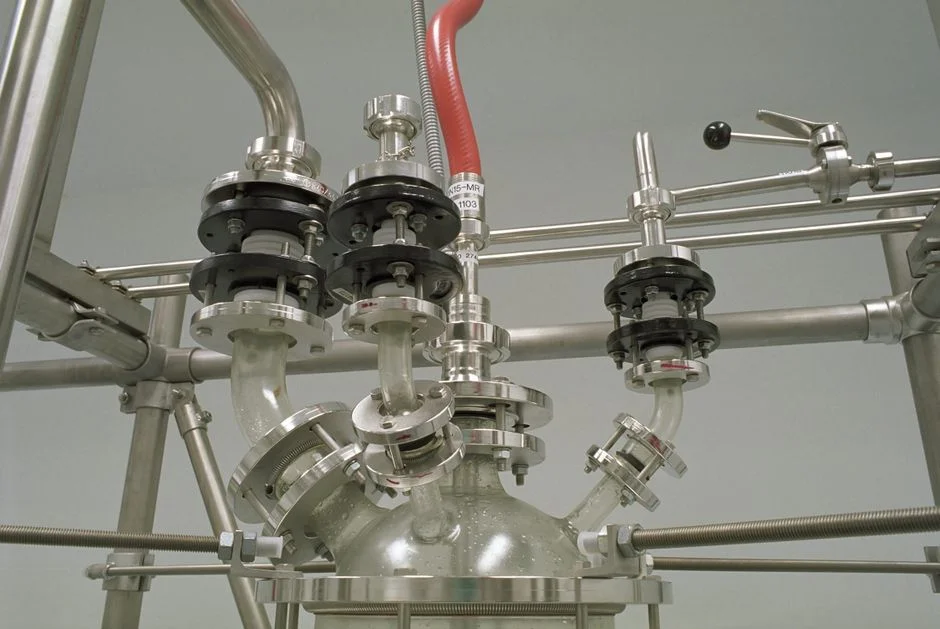
End-of-pipe treatment of mixed fab effluent is a 1990s design choice. Modern fabs segregate at source so each stream can be sent to the unit operation that handles its chemistry, and so that high-purity reject can be polished back toward UPW make-up rather than discharged. The TNFD 2026 case study notes that reject streams can equal 30–40% of intake when the 1.4–1.6× municipal-water ratio is not actively managed, which is exactly what segregation is meant to control.
Six stream archetypes cover the bulk of flows at a Berlin fab or hyperscale data hall. UPW reject and rinsewater are low-TDS, high-volume, and the prime candidates for direct reverse-osmosis (RO) reuse back to UPW make-up after polishing. CMP slurry wastewater carries high suspended solids, colloidal silica, and copper; a DAF unit for CMP and scrubber pre-treatment or a lamella clarifier takes out the bulk before the stream rejoins the metal-bearing line. Etch and clean streams contain HF, NH₄F, IPA, and NMP, and have to be hit to ≤50 mg/L fluoride and aggressive BOD/COD targets; calcium chloride precipitation followed by biological polishing is the standard train. Scrubber blowdown is acidic and may contain oxidisers, so pH adjustment and chemical precipitation (CaF₂, CaSO₄) come first. Cooling-tower bleed and data-hall humidification reject are high-TDS, scaling-ion streams that respond well to softener plus RO sidestream treatment. Process-tool chiller water and humidification condensate are usually clean enough to recycle with minimal intervention.
| Stream | Key contaminants | Indicative influent | Primary treatment | Reuse / discharge target |
|---|---|---|---|---|
| UPW reject / rinsewater | Low TDS, trace silica, boron | TDS 1–10 mg/L; resistivity 10–15 MΩ·cm after partial pass | Polishing cartridge → RO | Recycle to UPW make-up |
| CMP slurry wastewater | Colloidal silica, Cu, suspended solids | TSS 200–2,000 mg/L; Cu 5–50 mg/L | Lamella / DAF → metal precipitation | Cu recovery; clarified water to RO |
| Etch & clean (HF, NH₄F, IPA, NMP) | Fluoride, ammonia, COD | F⁻ 100–1,000 mg/L; COD 500–5,000 mg/L | CaCl₂ precipitation → biological (MBR/MBBR) | F⁻ ≤50 mg/L to BWB; reuse of polished water |
| Scrubber blowdown | Acids, oxidisers, metals | pH 1–4; trace HF, HNO₃, H₂SO₄ | Neutralisation + precipitation | Metals to AbwV Annex 22; water to RO |
| Cooling-tower bleed / data-hall humidification reject | High TDS, Ca, silica, biocides | TDS 500–2,000 mg/L; Ca 200–800 mg/L | Softener → RO sidestream | 90% reuse in cooling loop |
| Process chiller / condensate | Low contamination | TDS <50 mg/L | Filtration, optional UV | Direct reuse for non-UPW make-up |
Designing from this stream map is what unlocks the 60–90% reuse band operators now expect in permit negotiations. A single end-of-pipe biological plant cannot deliver that, because the mixing of fluoride, solvents, and copper at high pH creates stable complexes that are expensive to break downstream.
Building the 2026 Treatment Train: Segregate, Reuse, Polish
A defensible 2026 treatment train for a Berlin fab has five ordered steps, each with its own parameter envelope, and ends in an optional zero-liquid-discharge (ZLD) polish where the Spree-basin permit demands it. The logic is to remove the easy stuff first, polish the water to a quality the reuse point can absorb, and concentrate the brines for recovery rather than discharge.
Step 1 — Segregate at source. Dedicated drain manifolds separate fluoride-bearing, ammonia-bearing, solvent-bearing, and metal-bearing streams. This mirrors the targeted-not-end-of-pipe approach recommended for semiconductor facilities, where mixed chemistry is the main reason end-of-pipe trains under-perform. Step 2 — Primary removal. A lamella clarifier for fluoride precipitation or a DAF cell takes out TSS, FOG, and the bulk of the suspended silica from CMP waste. Fluoride is precipitated with calcium chloride to remove 90–98% of influent fluoride, yielding a CaF₂ sludge that can be sold to a cement producer. Step 3 — Biological polishing. An MBR polishing train for fab wastewater strips COD, BOD, and ammonia from the IPA- and amine-bearing streams; this is the step that lets the train hit the BWB COD ≤150 mg/L envelope without high chemical dosing. Step 4 — Membrane polish. UF (PVDF, nominal 0.03 µm) protects the RO, which runs at up to 95% recovery; EDI then pushes the permeate back toward UPW make-up via an industrial RO system for fab UPW make-up. Step 5 — Brine handling. Counter-flow reverse osmosis (CFRO) or a carrier-gas extraction (CGE) brine concentrator reduces liquid waste to a solids-handling stream, with an optional crystalliser for true ZLD where the BWB permit sets a zero-liquid-discharge condition.
| Stage | Unit operation | Key parameter in | Target out | Notes |
|---|---|---|---|---|
| Pre-treatment | Equalisation + pH adjustment | pH 1–11 swings; flow >10 m³/d | pH 6.5–8.5; flow damped | Triggers BWB Indirekteinleiter classification at >10 m³/d |
| Primary | Lamella / DAF + CaCl₂ precipitation | F⁻ 100–1,000 mg/L; TSS 200–2,000 mg/L | F⁻ ≤50 mg/L; TSS ≤30 mg/L | CaF₂ sludge to cement off-taker |
| Biological | MBR (PVDF 0.03 µm) | COD 500–5,000 mg/L; NH₃-N 50–500 mg/L | COD ≤150 mg/L; NH₃-N ≤10 mg/L | Handles IPA, NMP, amines |
| Membrane polish | UF → RO → EDI | RO feed: free Cl₂ <0.2 mg/L; SDI <3 | Permeate TDS <10 mg/L; resistivity >15 MΩ·cm | RO recovery up to 95% |
| Brine / ZLD | CFRO / CGE ± crystalliser | RO reject TDS 5,000–50,000 mg/L | Distillate to reuse; solids to landfill or off-taker | Used where permit sets zero-liquid-discharge |
The non-negotiable parameter envelope for any 2026 Berlin design basis is: effluent fluoride ≤50 mg/L at the BWB indirect-discharge point, COD ≤150 mg/L, TOC ≤30 mg/L, TSS ≤10 mg/L, and free chlorine <0.2 mg/L on the RO feed. Hit these in writing and the permit reviewer has a defensible reference document; miss any one of them and the train needs a redesign before the public consultation.
Reuse, By-Products, and the 2026 Cost Equation
Reuse is no longer only an environmental ask in Berlin. With AbwV Annex 22 and BWB local caps tightening, the cost of fresh water plus the cost of treating for discharge is converging on the cost of treating for reuse, and the by-product revenues push reuse over the line for several streams. Three reuse bands dominate the 2026 design conversation: 50% reuse, achievable with the lowest capex and largely stream-rerouting; 70% reuse, a balanced RO + MBR train that handles the bulk of the fab effluent; and 90%+ reuse, where RO + EDI plus a ZLD polish is needed and energy and chemical intensity rise sharply past 85% reuse. The cheapest stream to push to 90% is data-hall humidification reject, because the influent chemistry is already low-contamination and the RO recovery is high.
| Reuse band | Indicative 2026 Berlin cost (€ / m³ treated, CapEx + OpEx annualised) | Typical train | By-product revenue | Permit posture |
|---|---|---|---|---|
| ~50% | €1.5–2.5 / m³ | Segregation + lamella/DAF + biological | CaF₂ to cement (modest) | Comfortable fit with BWB indirect-discharge rules |
| ~70% | €2.5–4.0 / m³ | Above + RO sidestream + MBR polish | CaF₂, Cu, IPA recovery | Standard for new Berlin fabs; meets 2024 AbwV |
| ~90%+ | €4.0–7.0 / m³ | Above + EDI + CFRO/CGE ± crystalliser | Ammonium sulfate fertiliser; near-closed loop | Used where BWB sets ZLD condition or Spree stress is high |
By-product credits are not negligible. Calcium fluoride sells into cement, ammonium sulfate (from the ammonia stripper off the MBR) sells into fertiliser, and recovered copper and IPA can be looped back into the process. The procurement lead should expect a 5–15% offset to OpEx from by-product sales at the 70% band, rising as the band moves toward 90%. The compliance manager should also note that site-level water stewardship is now a TNFD disclosure topic for EU-listed operators (TNFD 2026), so the design basis needs to support reporting on withdrawal, consumption, discharge quality, and reuse rate, not just on compliance with the BWB indirect-discharge permit. A PLC-controlled chemical dosing system for BWB compliance and a UV steriliser at the reuse polish are the kind of unit operations that make the data set auditable, not just the water clean. For broader 2026 context, engineers building the design basis can also reference the UPW contamination budget for 2026 fabs, the fluoride precipitation engineering specs, and our smart monitoring guide for 2026 wastewater reliability.
Frequently Asked Questions
What is the BWB threshold for becoming an Indirekteinleiter in Berlin?
Under the BWB Indirekteinleiterverordnung (Berlin, 2023 consolidated), industrial sites discharging more than 10 m³/d of process wastewater to the public sewer are classified as indirect dischargers and must provide on-site pre-treatment, 24-hour composite sampling, online pH/conductivity monitoring, and appoint a Betriebsbeauftragter Gewässerschutz.
Which Abwasserverordnung annex governs semiconductor and data-hall effluent in Germany?
Annex 22 of the Abwasserverordnung (AbwV) covers metal-processing and electronics effluents, setting numeric limits on fluoride, copper, nickel, lead, zinc, AOX, and total nitrogen that apply to fab and backend discharge alongside the 2024 IED BAT conclusions.
What fluoride limit must a Berlin fab hit at the indirect-discharge point in 2026?
The BWB local cap is ≤50 mg/L fluoride at the indirect-discharge point, layered on top of the AbwV Annex 22 ceiling; calcium chloride precipitation to CaF₂ is the standard 90–98% removal step upstream of biological polishing.
What reuse rate can a Berlin 2026 fab realistically target?
A segregated, RO + MBR train with an EDI polish routinely hits 70% reuse on fab effluent; adding CFRO/CGE brine concentration and an optional crystalliser pushes the site to 90%+ reuse where the Spree-basin permit requires near-zero liquid discharge.
Related Equipment
- MBR polishing train for fab wastewater — specifications, capacity range, and technical data