Why Semiconductor Fabs Are a Categorical Pretreatment Source in 2026
Semiconductor plants near Littleton meet 2026 sewer-discharge pretreatment limits by operating as a federally regulated categorical source under 40 CFR Part 469 while complying with site-specific local limits issued by the receiving POTW — typically the South Platte interceptor system feeding Metro Wastewater Reclamation District. The federal framework starts at 40 CFR 403.3(j), which defines an Industrial User (IU) as a non-domestic source discharging process wastewater to a POTW. A fab becomes a Significant Industrial User (SIU) when it discharges more than 25,000 gpd of process wastewater, falls under a federal categorical standard, or is designated as significant by the POTW control authority (per 40 CFR 403.3(v)).
40 CFR Part 469 is the categorical standard that applies to semiconductor manufacturing, and it sets numeric effluent limits for pollutants including total metals (copper, lead, nickel, zinc, arsenic, antimony), fluoride, total suspended solids, ammonia, and pH (per EPA categorical effluent guidelines, 2024 revision). On top of the federal category, 40 CFR 403.5 prohibits discharges that cause pass-through — defined at 40 CFR 403.3(p) as a discharge that exits the POTW in concentrations that cause a violation of the POTW's NPDES permit — or interference as defined at 40 CFR 403.3(k), which includes inhibition or disruption of the POTW's sludge processes, use, or disposal. Because most 40 CFR Part 403.5 prohibited-discharge standards are narrative rather than numeric, POTWs are required under 40 CFR 403.5(c) to develop local limits that translate those prohibitions into enforceable end-of-pipe numbers. The EPA's Toxic Pollutants list (65 entries) and Priority Pollutants list (126 substances) define the universe of parameters a fab drain may carry, including acids, copper, lead, arsenic, antimony, fluoride, ammonia, and solvents. Compliance failure triggers escalating enforcement — warning letter, administrative penalty, and ultimately an order to stop discharging — and any operator designing a new fab drain in 2026 should structure the submittal around the local-limits letter before any process equipment is ordered.
Characterizing Fab Wastewater: What Must Be Removed Before Sewer Discharge
Semiconductor wastewater is heterogeneous by design because the upstream processes are heterogeneous. Etching contributes HF, HCl, and H₂SO₄; CVD and photoresist stripping contribute NH₃; plating and CMP contribute copper, nickel, and tungsten; CMP slurries add silica and ceramic particulates; photoresist residuals and solvents add organic load; and specialty chemistries contribute emerging PFAS (per IDE Tech, 2026). The most widely adopted 2026 working architecture for US fabs is Samsung Austin's three-stream segregation model — pH neutralization, fluoride treatment, and copper treatment — with each stream segregated at the source and treated independently before a final polish (per GWI Magazine, January 2020; the same architecture is still the cited US reference in 2026).
The single largest stream by volume is often CMP wastewater, which can represent 30–40% of a fab's total wastewater flow (per IDE Tech, 2026). Because a modern fab can use up to 10 million gallons of water per day (per IDE Tech, 2026), a 5 ppm excursion in any one drain line translates to multi-pound-per-day mass loadings at the POTW monitoring manhole. Local limits typically regulate total metals (Cu, Pb, Ni, Zn, As, Sb), fluoride, TSS, COD, ammonia, pH, oil and grease, and — increasingly in 2026 — PFAS compounds as state and federal MCLs tighten. The table below maps each fab drain to the pollutants that the local POTW will test for and the 40 CFR 469 subcategory those pollutants fall under.
| Fab Drain / Source | Dominant Pollutants | Typical 2026 POTW Local-Limit Range | 40 CFR 469 Subcategory Trigger |
|---|---|---|---|
| Wet etch (HF, HCl, H₂SO₄) | Fluoride, total acidity, pH | F⁻ 10–45 mg/L; pH 6–9 | 469.30 (etching) |
| CMP (copper, tungsten, dielectric) | Cu, Ni, W, TSS, silica slurry | Cu 1–3 mg/L; TSS 250–500 mg/L | 469.32 (CMP) |
| Plating / ECD | Cu, Ni, sulfate, chelators | Cu 1–3 mg/L; Ni 0.5–2 mg/L | 469.34 (plating) |
| Photoresist strip / solvent | COD, BOD, TMAH, NMP | COD 300–600 mg/L; NH₃-N 30–100 mg/L | 469.36 (photoresist) |
| CVD scrubber / NH₃ | NH₃-N, NO₃ | NH₃-N 30–100 mg/L | 469.38 (CVD) |
| Specialty chemistries (PFAS) | PFOA, PFOS, HFPO-DA, GenX | PPT-level (state-driven, 2026) | Not yet categorical; local-limits driven |
The Three-Stream Treatment Train Used by US Fabs in 2026
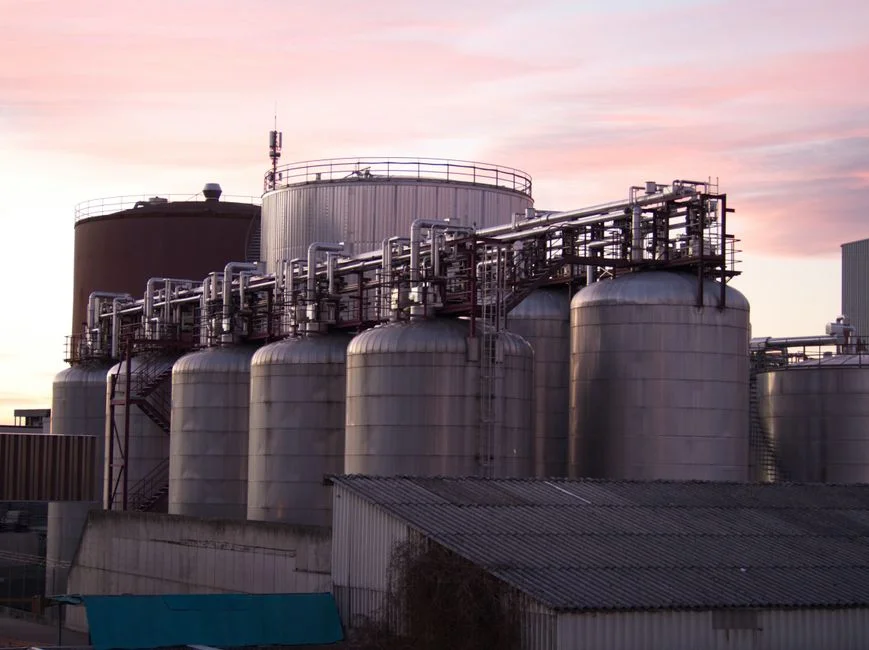
The unit-operation sequence that delivers compliant effluent in 2026 mirrors the Samsung Austin reference: three segregated streams, each with its own chemistry, monitored continuously, with automatic diversion back to equalization when any parameter drifts.
Stream 1 — pH neutralization. Acid and alkaline drains are routed to an in-line equalization basin with PLC-controlled acid/caustic dosing. Target discharge pH is typically 6–9, and the dosing logic is driven by in-tank pH probes with redundant fail-safe valves. A skid-mounted PLC chemical injection package handling pH adjusters and coagulants is the standard duty for this stage, and a properly designed skid will log every dose event for the discharge monitoring report (DMR).
Stream 2 — fluoride treatment. Fluoride-bearing wastewater is dosed with calcium chloride or lime to precipitate CaF₂, then sent to a high-rate lamella clarifier for solids separation. The CaF₂ cake is dewatered on a plate-and-frame filter press, producing a stackable filter cake that Samsung Austin ships to a local end-user for reuse in another wastewater plant (per GWI Magazine, January 2020). Fluoride breakthrough is one of the most common POTW excursion causes, so the post-clarifier fluoride probe is typically set to divert back to equalization at >30 mg/L to give the precipitation stage retention time to recover.
Stream 3 — copper and CMP treatment. The 2026 industry trend is ion exchange replacing chemical co-precipitation for copper. Samsung Austin's pilot projected a reduction of 2 million lb/year in chemical use, 1.5 million lb/year in solids generation, and a 65% reduction in system footprint versus the prior co-precipitation system (per GWI Magazine, January 2020). CMP solids are settled in a high-rate lamella clarifier and dewatered on a plate-and-frame filter press before the clarified water moves to the polishing train.
Polishing and reuse. The combined effluent passes through multimedia filtration, then a 0.03 micron PVDF ultrafiltration system, then ion exchange, and — for water reuse — reverse osmosis. UF is the membrane that protects RO from sub-micron CMP particle carryover, which is the most common RO fouling mode in fab service. PFAS treatment is increasingly a 2026 compliance trigger; the current option set is high-pressure membrane (NF/RO), granular activated carbon, ion exchange resins, and advanced oxidation (per IDE Tech, 2026).
| Stage | Chemistry / Mechanism | Target Parameter | Expected Removal / Outcome | Sludge or Side-Stream Handling |
|---|---|---|---|---|
| Stream 1 — pH neutralization | H₂SO₄ / NaOH dosing, PLC-controlled | pH 6–9 | Neutralization to sewer limit | Neutralized effluent → Stream 2/3 mix |
| Stream 2 — fluoride precipitation | CaCl₂ or Ca(OH)₂ → CaF₂ | F⁻ 10–45 mg/L | 95–99% F⁻ removal | CaF₂ cake → off-site reuse (Samsung model) |
| Stream 2 — lamella clarifier | High-rate settling | TSS reduction | 80–95% TSS capture | Underflow → filter press |
| Stream 3 — CMP / Cu ion exchange | Selective resin, no chemical precipitation | Cu 1–3 mg/L | >95% Cu removal to <0.5 mg/L | Spent resin → metal recovery |
| Stream 3 — plate-and-frame filter press | Bentonite-aided floc, mechanical dewatering | Cake dryness 25–35% | TCLP-passing solids | Non-hazardous landfill disposal |
| Polishing — UF | 0.03 µm PVDF membrane | Turbidity, particles, sub-micron CMP carryover | >99% particle removal | Backwash → Stream 3 |
| Polishing — ion exchange | Selective resin for trace metals | Residual Cu, Ni, Zn | Sub-ppb on key metals | Spent resin → metal recovery |
| Polishing — RO (reuse mode) | Reverse osmosis | TDS, organics, most ions | 95–99% rejection; 60–75% recovery | Brine → brine recovery RO or evaporator |
Sludge, Solids, and the TCLP Question
The cost of solids disposal is often the line item that determines whether a treatment-train investment pays back. The risk to manage is EPA's Toxicity Characteristic Leaching Procedure (TCLP, 40 CFR 261, Method 1311), which determines whether a sludge is classified as hazardous waste. The catch is that chemically precipitated flocs — the workhorse of conventional wastewater treatment — are fragile, and the heavy metals they capture can leach back out under the pressure of filter-press dewatering, causing the cake to fail TCLP. When that happens, the cake has to be hauled to a liquid hazardous-waste disposal site, which is typically 5–10× the per-ton cost of municipal-landfill disposal of a non-hazardous cake.
The technical lever is the separating agent. Bentonite-based or structured separating agents produce durable flocs that retain the captured metals through TCLP extraction, so the resulting cake can be landfilled as non-hazardous waste (per Silicon Semiconductor, 2024). This is the design principle the dewatering stage should be built around, and a plate-and-frame filter press is the standard unit operation for producing a 25–35% dry-solids cake that passes TCLP at a municipal landfill. The CaF₂ cake from the fluoride stream sits in a different category: it has an established off-site reuse pathway, and Samsung Austin's reported model is to ship the cake to a local end-user that reuses it in another wastewater treatment process (per GWI Magazine, January 2020).
2026 Compliance Checklist for Fabs Near Littleton
The sequence below maps each step to the controlling 40 CFR citation and is ordered the way a new or expanding fab should actually run it in 2026.
- Confirm the receiving POTW. Most Littleton-area fabs discharge to the South Platte interceptor feeding Metro Wastewater Reclamation District. Request the current local-limits letter and the rate/fee schedule before any design freeze.
- Submit a Nondomestic Waste Discharge Survey (or local equivalent), then a full permit application at least 90 days before any planned discharge (per CWS process flow, US industry template).
- Submit a Baseline Monitoring Report (BMR) within 180 days of becoming a categorical SIU under 40 CFR Part 469, sampling all categorical priority pollutants (per 40 CFR 403.12(b)).
- File self-monitoring reports on the cadence set in the discharge permit (typically monthly or quarterly), retaining records on-site per 40 CFR 403.12(o).
- Participate in the annual local-limits review by the POTW, including any 40 CFR 403.5(c) re-evaluation of pollutants of concern.
- Prepare for 2026 PFAS scrutiny — pre-screen incoming chemistries, map PFAS use to drain lines, and design a polishing stage (GAC or IX) into any new train before it is needed, not after.
| Step | Deliverable | Controlling Citation | Typical 2026 Timing |
|---|---|---|---|
| 1. Confirm POTW / obtain local-limits letter | Local-limits letter; rate/fee schedule | 40 CFR 403.5(c) | Pre-design (–180 days) |
| 2. Nondomestic Waste Discharge Survey + application | Survey → full permit application | 40 CFR 403.3(j); 40 CFR 403.12(b) | ≥90 days before discharge |
| 3. Baseline Monitoring Report (BMR) | 8–12 sampling events across categorical priority pollutants | 40 CFR 403.12(b); 40 CFR Part 469 | Within 180 days of CIU status |
| 4. Self-monitoring reports (DMRs) | Permit-defined parameter list, certified | 40 CFR 403.12(l), 403.12(o) | Monthly or quarterly |
| 5. Annual local-limits review | Letter response / re-sampling | 40 CFR 403.5(c)(3) | Annually |
| 6. 2026 PFAS pre-screen | PFAS drain map, polishing-stage design basis | EPA PFAS Roadmap (2024–2026) | Pre-discharge baseline |
Designing for Water Reuse Without Losing Compliance
Most 2026 fab projects combine sewer-discharge compliance with on-site reuse, and the two are designed in series rather than in parallel. The same segregated streams that protect the POTW from pass-through also protect the reuse train from contamination events: a copper excursion that would shut the POTW down also destroys an RO membrane, so segregation and continuous monitoring pay back twice. State-of-the-art fabs in 2026 can recover 85–90% of their wastewater using high-recovery RO, advanced filtration, and thermal polishing, with some facilities pursuing zero liquid discharge (ZLD) for even higher recovery (per IDE Tech, 2026). The reuse-side architecture that pairs with the treatment train above is a high-recovery reverse osmosis polishing stage sized to handle the combined polishing effluent, with continuous conductivity and TOC probes at the permeate and reject streams. For operators weighing reuse against discharge, the decision is rarely technical — it is volumetric: above roughly 1 MGD of combined process flow, reuse crosses the threshold where RO capex is recoverable inside five years on water and sewer surcharge savings alone.
Frequently Asked Questions
What triggers SIU status for a semiconductor fab?
A fab becomes a Significant Industrial User when it discharges more than 25,000 gpd of process wastewater, falls under a federal categorical standard (40 CFR Part 469 for semiconductors), or is designated as significant by the POTW control authority per 40 CFR 403.3(v). Categorical status alone is sufficient — flow volume does not have to exceed 25,000 gpd for SIU status to apply.
Why does chemically precipitated sludge fail TCLP, and how do bentonite flocs pass it?
Conventional polymer or inorganic flocculants produce fragile flocs that release captured metals under the pressure of dewatering, so the cake fails EPA's Toxicity Characteristic Leaching Procedure (40 CFR 261, Method 1311) and is classified as hazardous. Bentonite-based separating agents form durable flocs with a large specific surface area and net negative charge that retain metals through TCLP extraction, allowing disposal in a municipal landfill at a fraction of the cost (per Silicon Semiconductor, 2024).
How is the CaF₂ cake from the fluoride stream disposed of?
Calcium fluoride cake produced by calcium chloride or lime precipitation is dewatered on a plate-and-frame filter press and shipped off-site to an industrial end-user that reuses it in another wastewater treatment process, per the Samsung Austin reference case (per GWI Magazine, January 2020). When no reuse market is available locally, the cake is disposed of as non-hazardous industrial waste subject to a TCLP check.
What is the fastest indicator of copper breakthrough in the treatment train?
Continuous online copper ion-selective electrode (ISE) probes on the ion-exchange effluent, paired with conductivity spikes on the resin vessel, give the earliest warning. A properly designed train diverts automatically back to equalization when the polishing-stage copper reading exceeds the local limit, typically 1–3 mg/L for sewer discharge.
Is PFAS a 2026 compliance trigger for fab drains?
Yes. The EPA's PFAS Roadmap and CERCLA designation of PFOA and PFOS as hazardous substances (per EPA, 2024) put fabs on notice that PFAS reporting and treatment are coming, and the current treatment option set is high-pressure membrane (NF/RO), granular activated carbon, ion exchange resins, and advanced oxidation (per IDE Tech, 2026). The minimum due diligence in 2026 is a PFAS drain map and a designed polishing stage before any new train is built.
Related Equipment
- PLC-controlled chemical dosing skid — specifications, capacity range, and technical data
- high-rate lamella clarifier — specifications, capacity range, and technical data
- plate-and-frame filter press — specifications, capacity range, and technical data
- 0.03 micron PVDF ultrafiltration system — specifications, capacity range, and technical data