What counts as a small community wastewater system in Ireland in 2026
A small community wastewater system in Ireland is a treatment plant serving fewer than 1,000 population equivalent (PE), roughly 350 homes, under Uisce Éireann's Small Wastewater Treatment Plants National Plan: Supporting Communities while Protecting our Natural Environment, which is open for public submissions until 20 October 2026 (Uisce Éireann, 2026). Of the more than 1,000 wastewater treatment plants (WWTPs) operated by Uisce Éireann, approximately 800 are small plants that together treat only around 4% of the national load but drive most local water-quality complaints (Uisce Éireann, 2026). The Uisce Éireann PE threshold for the new plan sits one tier above the EPA Wastewater Treatment Manual scope of P.E. 10–500, which remains the design reference of record for the equipment itself (EPA, Treatment Systems for Small Communities, Business, Leisure Centres and Hotels).
Three bodies govern these schemes. Uisce Éireann (Irish Water) is the asset owner and is responsible for capital investment. The Environmental Protection Agency is the environmental regulator and the publisher of the design manual and the Water Framework Directive characterisation work. The 31 local authorities handle planning, Building Regulations and the legacy sewer networks that feed small plants. The compliance frame is set by the EU Urban Wastewater Treatment Directive (91/271/EEC), transposed in Ireland by S.I. 597/2024 (Urban Wastewater Treatment Regulations 2024), which lowered the agglomeration threshold to <2,000 PE and tightened reporting on small discharges (Uisce Éireann, 2026).
Regulatory and design framework for small Irish WWTPs
Every defensible small-plant submission to a local authority or Uisce Éireann must cite the EPA Act 1992, the Waste Management Act 1996 and the Water Pollution Acts 1970–1990 as the statutory basis for discharge consent and design criteria (EPA, 2024, Section 1.1). The 1878 Public Health (Ireland) Act is still the instrument of choice for nuisance abatement against poorly operated small plants, and engineers should expect it to be cited in any planning objection (EPA, 2024, Section 1.3). Building Regulations 1991 — specifically Part A (Structure), Part C (Site preparation and resistance to moisture), Part D (Materials and Workmanship) and Part H (Drainage and waste disposal) — govern buried package plants and their surrounds (EPA, 2024, Section 1.2.4).
For Uisce Éireann-funded upgrades, capital delivery follows the Public Spending Code (December 2019) and the Department of Housing, Local Government and Heritage's Water Services Sector Specific Guidelines on the Public Spending Code: Management of Public Investment in Irish Water, issued 19 July 2022 (Uisce Éireann, 2026). The project lifecycle moves through five stages — rationale, detailed optioneering, design and statutory approvals, tender, then construction and commissioning — and an engineer pitching a 350 PE package plant should expect to be assessed against the "detailed optioneering" gate before any equipment is selected. Citing this chain together signals that small-plant specification is as much a regulatory and procurement exercise as a hydraulic one, which is why many specifiers benchmark their shortlist against a structured framework such as the one in this 2026 guide to comparing reliable wastewater treatment solutions.
EPA influent characterisation and design loadings

Domestic wastewater from an Irish small community can be assumed at SS 163 mg/L, BOD₅ 168 mg/L, COD 389 mg/L, O-PO₄ 7.1 mg/L, Total-N 40.6 mg/L, NH₃-N 31.5 mg/L and pH 7.5 (mean values from the EPA's study of twelve small-scale plants, reproduced in Table 1 below) (EPA, 2024). For mixed community schemes with hotel or restaurant trade, the loading rises materially to SS 293 mg/L, BOD₅ 470 mg/L, COD 888 mg/L and Total-N 55.0 mg/L, and the higher NH₃-N of 45.6 mg/L must be carried into the aeration tank design (EPA, 2024, Table 2). Dry weather flow (DWF) is defined as the daily average over 7 dry days following 7 days with rainfall ≤0.25 mm on any one day (EPA, 2024, Section 2.2), and the EPA's Figure 2 diurnal curve drives a peak-to-mean ratio that typically lands between 2.5 and 3.0 for a separate sewer catchment. BOD₅ loading rate in kg/d is the primary design parameter for biological units in small schemes, not hydraulic residence time alone (EPA, 2024, Section 2.4).
| Parameter | Domestic mean (mg/L) | Domestic SD | Hotel/Restaurant mean (mg/L) | Hotel/Restaurant SD |
|---|---|---|---|---|
| Suspended solids (SS) | 163 | 136 | 293 | 238 |
| BOD₅ | 168 | 127 | 470 | 455 |
| COD | 389 | 310 | 888 | 860 |
| O-PO₄ | 7.1 | 4.2 | 8.21 | 4.95 |
| Total-N | 40.6 | 19.0 | 55.0 | 40.7 |
| NH₃-N | 31.5 | 15.6 | 45.6 | 36.5 |
| pH | 7.5 | 0.5 | 7.37 | 0.64 |
Source: EPA Treatment Systems for Small Communities, Tables 1 and 2. Bacterial counts (Total-coli ~1×10⁸ CFU/100 mL, E-coli ~4×10⁶ CFU/100 mL domestic) are reproduced in the original; they drive disinfection sizing rather than biological design.
Site and layout constraints from the EPA manual
Setback distance is the single most common reason a planning submission for a package plant is refused or reduced in scope. The EPA recommends minimum distances of 28 m for 10–40 PE schemes, 31 m for 41–60 PE, 34 m for 61–80 PE, 37 m for 81–100 PE, 40 m for 101–120 PE, 43 m for 121–140 PE, 46 m for 141–160 PE, and 50 m for any system above 161 PE (EPA, 2024, Table 4). On a constrained Irish village site, that gradient can dictate whether a packaged or constructed-wetland solution is even permissible before process selection begins.
| System size (PE) | Approx. houses served | Min. setback from existing development (m) |
|---|---|---|
| 10–40 | 2–10 | 28 |
| 41–60 | 11–15 | 31 |
| 61–80 | 16–20 | 34 |
| 81–100 | 21–25 | 37 |
| 101–120 | 26–30 | 40 |
| 121–140 | 31–35 | 43 |
| 141–160 | 36–40 | 46 |
| >161 | >41 | 50 |
Source: EPA Treatment Systems for Small Communities, Table 4. Sludge handling is the second binding constraint: the EPA notes it can account for up to 50% of operating cost (EPA, 2024, Section 3.8), and septic-tank capacity must be sized from C = 180·P + 2000 L (minimum 2.72 m³), with an additional 70 L/person where household garbage grinders are installed (EPA, 2024, Equation 4). All installation work should be supervised and certified by indemnified professionals — a clause local authorities increasingly require as a condition of planning.
Process options for small community WWTPs in Ireland
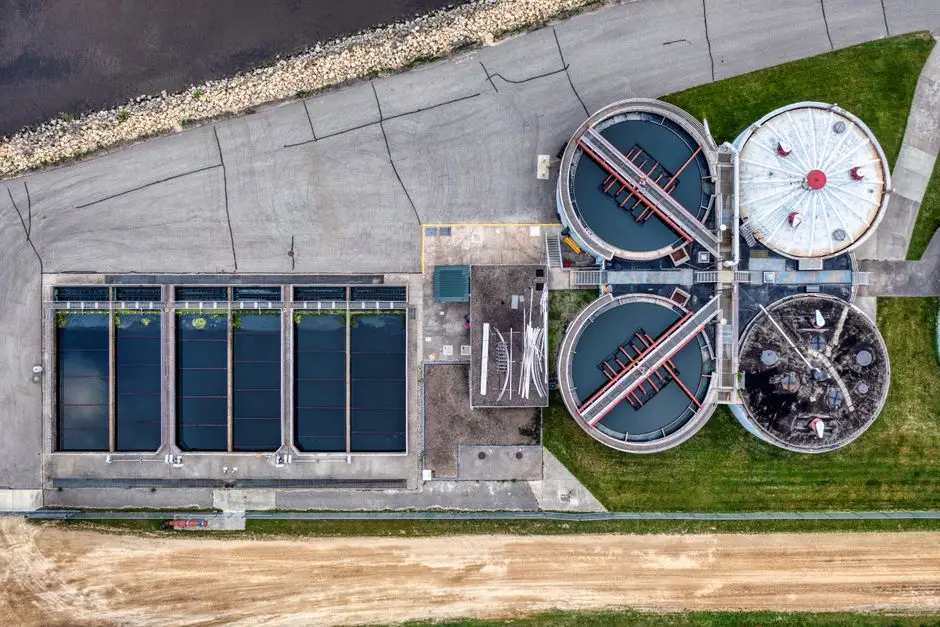
The EPA manual sets out the canonical process list, and a modern specifier should still walk it before reaching for a packaged unit. The Imhoff tank (EPA Table 5) combines primary and biological action in one unit and is suited to <200 PE schemes with land-based effluent disposal. The intermittent sand filter (Table 6) is robust, low-energy and a strong polish stage after a septic or Imhoff unit, but its footprint rules it out on tight village sites. The percolating filter (Tables 7–8) and rotating biological contactor have a long Irish track record in the 200–1,000 PE range and remain defensible choices where operator skill is limited. Submerged aerated filters and extended-aeration activated sludge (Tables 8–9, Figure 12) are the workhorses for packaged small schemes; an oxidation ditch (Figure 13) or sequencing batch reactor (SBR, Table 10, Figure 14) gives better ammonia control where the discharge consent requires BOD ≤20 mg/L and NH₃-N ≤5 mg/L (EPA, 2024). Constructed wetlands (Figures 4–6) are relevant for rural villages with land available and near-zero operator input. Comparable European context is useful when benchmarking — the small community wastewater system in Germany 2026 guide shows a similar SBR/MBR mix trending upward, and the equivalent small community wastewater system in France 2026 guide shows reed-bed retention dominating rural village sites.
Side-by-side process selection for 50–500 PE Irish communities
For most Irish small communities in the 50–500 PE band, the shortlist collapses to four practical options: packaged extended-aeration activated sludge, SBR, membrane bioreactor (MBR) and constructed wetland. The table below compares them on the parameters a consulting engineer will actually be asked about in a planning response or a Uisce Éireann optioneering report.
| Process | Effluent BOD₅ (mg/L) | Effluent NH₃-N (mg/L) | Footprint (m²/PE) | Energy (kWh/PE·yr) | Sludge yield | Operator skill | Indicative CAPEX band (€/PE) |
|---|---|---|---|---|---|---|---|
| Extended aeration (packaged) | ≤20 | 5–10 | 0.20–0.30 | 25–35 | Low | Basic | €350–€550 |
| SBR | ≤20 | ≤5 | 0.12–0.20 | 30–40 | Low | Moderate (controls) | €500–€750 |
| MBR | ≤5 | ≤2 | 0.05–0.10 | 45–60 | Low–moderate | Higher (membranes) | €800–€1,200 |
| Constructed wetland | ≤20 | 5–15 (variable) | 1.5–3.0 | ~0 | Very low (accumulated) | Minimal | €250–€450 |
Extended aeration remains the typical Irish default because it is robust, has a long parts-and-service history, and its footprint fits most village sites. SBR is the right step up where ammonia consent is tight but capital is constrained. MBR is the choice for sites adjacent to sensitive receiving waters or where the consent is approaching reusable-effluent quality, and a packaged underground integrated sewage treatment plant is the right call where the site is constrained but a conventional activated-sludge envelope is acceptable. For the tightest consents or smallest footprints, a skid-mounted MBR membrane bioreactor reduces plant area by roughly 60% versus conventional activated sludge, at the cost of higher energy and membrane replacement. Constructed wetland is unbeatable on rural land availability and operator budget, but variable NH₃-N performance must be acceptable to the regulator.
Sizing a packaged plant against Irish domestic loadings

Worked example: a 350 PE scheme in a separate sewer catchment. DWF at 180 L/PE·d = 63 m³/d, and applying the EPA diurnal curve (Figure 2) gives a peak factor of 2.5–3.0, so peak hydraulic flow lands at 6.5–8.0 L/s (EPA, 2024, Section 2.2). At the EPA domestic BOD₅ of 168 mg/L, the daily organic load is 63 × 0.168 = 10.6 kg BOD₅/d. A packaged extended-aeration tank sized at 0.25–0.35 m³/PE (87.5–122.5 m³ total) with a food-to-microorganism ratio (F/M) of about 0.08 kg BOD₅/kg MLVSS·d sits inside the EPA Table 8 envelope for nitrification (EPA, 2024).
The same load maps cleanly onto commercial equipment: a HydropureWater underground package sewage treatment plant covers the 1–80 m³/h flow range and is buried for low visual impact on a residential site, while a skid HydropureWater MBR membrane bioreactor suits tighter consents or brownfield sites. Downstream, a UV steriliser for treated effluent polishing is the default for bathing-water or shellfish-water receiving waters, with a chlorine dioxide generator as a higher-residual alternative where contact-tank retention is short.
Costs, delivery and the 2026 Uisce Éireann investment pipeline
The Uisce Éireann 2026 plan is moving the small-plant estate from a reactive, site-by-site investment model to a coordinated, evidence-led national framework that uses plant performance, available capacity, local water quality and future development needs as decision inputs (Uisce Éireann, 2026). For a consulting engineer, this means optioneering will be tested against a published national framework, not just a local authority planner. Capital projects funded through Uisce Éireann follow the five-stage Public Spending Code lifecycle — rationale, detailed optioneering, design and statutory approvals, tender, and construction/commissioning — under the Water Services Sector Specific Guidelines issued 19 July 2022 (Uisce Éireann, 2026).
Sludge handling remains the operating-cost driver. Because it can absorb up to 50% of OPEX (EPA, 2024, Section 3.8), processes with low sludge yield — extended aeration, SBR and MBR — generally beat intermittently desludged septic/Imhoff trains on 20-year whole-life cost. Where sludge is generated, a plate and frame filter press for sludge dewatering typically reduces cake volume by 75–80% versus lagoon storage and cuts haulage cost per tonne. The Small Towns and Villages Growth Programme list (Uisce Éireann, 2026) shows which schemes are actively progressing through the Public Spending Code gates in 2026, which is the right reference for any engineer asking whether their site will be picked up in the next capital cycle. Whole-life cost benchmarks per MGD for water treatment infrastructure in 2026 give the dollar-per-volume envelope to test any vendor's offer against.
Frequently Asked Questions
What population equivalent counts as a small community WWTP in Ireland?
Fewer than 1,000 PE under Uisce Éireann's 2026 Small Wastewater Treatment Plants National Plan, approximately 350 homes (Uisce Éireann, 2026). The EPA design manual itself covers P.E. 10–500, so plants in the 500–1,000 PE bracket need the manual's principles extended with full municipal-scale design references.
Which process is most common for small Irish communities?
Packaged extended-aeration activated sludge remains the default for the 100–500 PE band because it is robust, has a long Irish spares-and-service history and meets BOD₅ ≤20 mg/L and NH₃-N 5–10 mg/L (EPA, 2024). SBR and packaged MBR are growing for tighter ammonia or nutrient consents, while constructed wetlands dominate where land is available.
What effluent standard must a small Irish WWTP meet?
The discharge licence sets the numbers. Plants covered by the UWWTD typically target BOD₅ ≤25 mg/L and SS ≤35 mg/L, with tighter BOD₅ ≤10–15 mg/L and NH₃-N ≤5 mg/L for discharges to sensitive catchments. The Urban Wastewater Treatment Regulations 2024 (S.I. 597/2024) tightened monitoring and reporting for agglomerations down to <2,000 PE.
How close to housing can a small package plant be?
Per EPA Table 4: 28 m at 10–40 PE, rising to 50 m at >161 PE. On constrained sites the engineer must either reduce the design PE below the threshold or demonstrate to the local authority that equivalent protection is provided by enclosure, venting and odour control.
When does the Uisce Éireann 2026 consultation close?
Submissions to [email protected] close at 5 pm on Tuesday 20 October 2026, with the draft national framework to follow for further consultation before the plan is finalised (Uisce Éireann, 2026). Engineers with schemes in the pipeline should consider this the window to feed site-specific data into the national evidence base.